REVIEW: Westwood | Kawakubo: In Dialogue
Westwood | Kawakubo brings together the work of two of fashion’s most innovative designers who changed the way we think about clothing and its relationship to the body, gender construction, and notions of beauty.
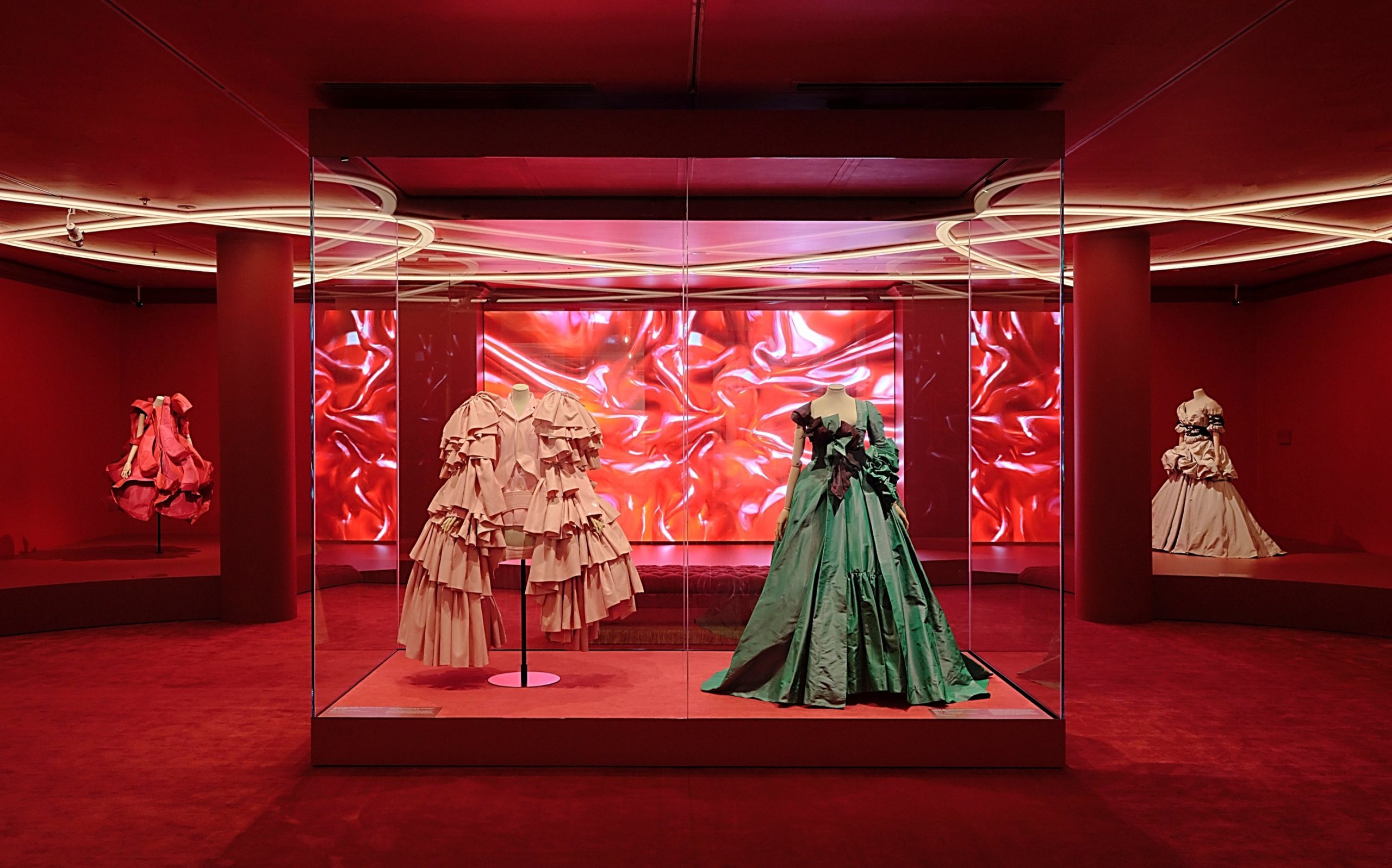
As the title Westwood | Kawakubo suggests, the National Gallery of Victoria’s (NGV) latest fashion exhibition plays to the idea that these two titans of contemporary design need no qualification. Their names are synonymous with the redefining of fashion over the past fifty years. Born a year apart, Vivienne Westwood (1941–2022) and Rei Kawakubo’s (1942–) fashion practices have constantly challenged accepted notions of fashion-making and meaning. Their striving for the new and reimagined has served to reframe fashion as a site for creative experimentation and expression. As such, both have commanded solo exhibitions at major institutions—Vivienne Westwood in 2004 at the Victoria and Albert Museum, London, and Rei Kawakubo/Comme des Garçons: Art of the In-Between at the Metropolitan Museum of Art, New York, in 2017, followed in 2019 by the National Gallery of Victoria’s extensive survey of Kawakubo’s work in Collecting Comme.
What is intriguing about this current exhibition is the choice to pair the two, something which has not previously been done. Through a series of seven theme-based sections, the exhibition curators, Katie Sommerville and Danielle Whitfield, have placed the works of Westwood and Kawakubo into dialogue. In the spirit of both designers’ approach to fashion, the figurative conversations are open-ended. Arranged in discrete sections, these conversations range across themes which the curators have identified as being common to the designers’ practice: Punk and Provocation, Rupture, Reinvention–History, Reinvention–Tailoring, Reinvention–Design Methods, the Body, and the Power of Clothes.
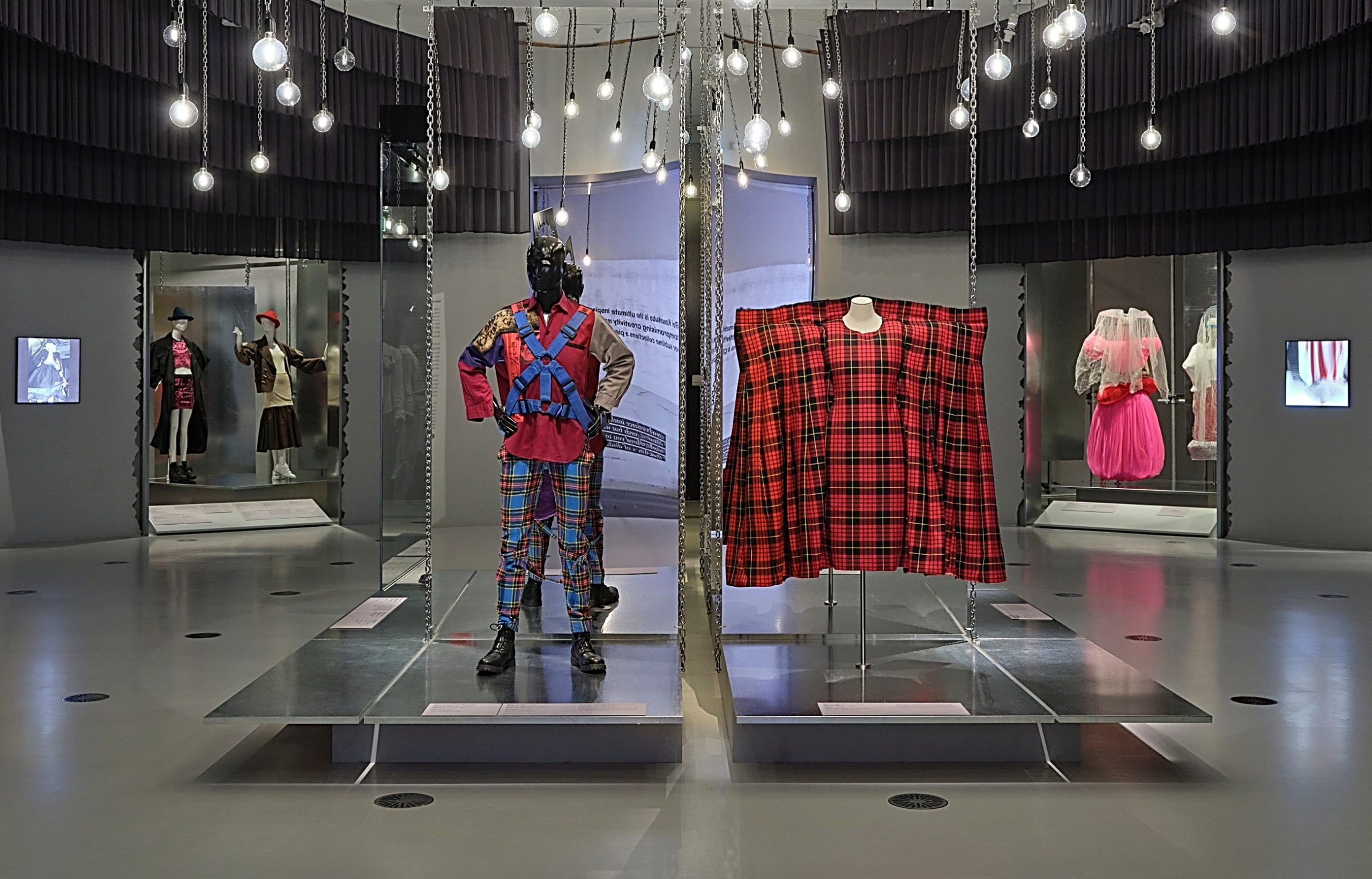
Installation view: Punk and Provocation, Westwood / Kawakubo, 2026, NGV International, Melbourne. Foreground view: (L) Vivienne Westwood, Parachute shirt, c. 1977, cotton, silk, plastic (fastenings). (R) Rei Kawakubo, Look 7 Dress, 2016, wool polyester, cupro. Photographed by Sean Fennessy.
Visitors are first led through a narrow corridor plastered with large quotes that encapsulate Westwood and Kawakubo’s ideas and approaches to their work. These are augmented by broadcast soundbites and a long row of screens with looped visuals that set the scene, including footage of punks on London streets. Together, these textual, visual, and audio elements communicate ideas of disruption and revolt that have provided impetus for Westwood and Kawakubo’s work. As self-taught designers who saw the possibilities for fashion as an expression of artistic and personal freedom, and a vehicle for change, they essentially threw out the rule book in terms of what constituted fashion and how it should look.
The first room, which addresses the theme of Rupture, features some of Westwood’s earliest works from the 1970s which relate to her crucial role in creating a punk aesthetic—ripped and torn clothing, profane and irreverent slogans and imagery emblazoned across T-shirts, and bondage-inspired outfits. It also covers her influential collections of the 1980s, including her turn to the New Romantic look in the Pirate collection of 1981. In contrast, the selection of Kawakubo’s work in this room dates from 2008 to 2024 and concentrates on her exploration of the sculptural and conceptual possibilities of clothing, as evidenced in the collections Not Making Clothing, spring–summer 2014, and Neo-Future, autumn–winter 2020–21. These feature abstracted forms that move beyond the limits of clothing as we know it. The surprising absence in the exhibition of Kawakubo’s early ground-breaking designs of the 1980s (a number of which are in the NGV’s collection), featuring black, shapeless, deconstructed, and hole-ridden garments, may reflect the designer’s steadfast philosophy to not look back, but always firmly to the future. While the exhibition does not act as a retrospective for either designer’s practice, the absence of this period of Kawakubo’s work detracts from an understanding of just how radical these designs, which have now been absorbed into mainstream visual culture, were at the time.
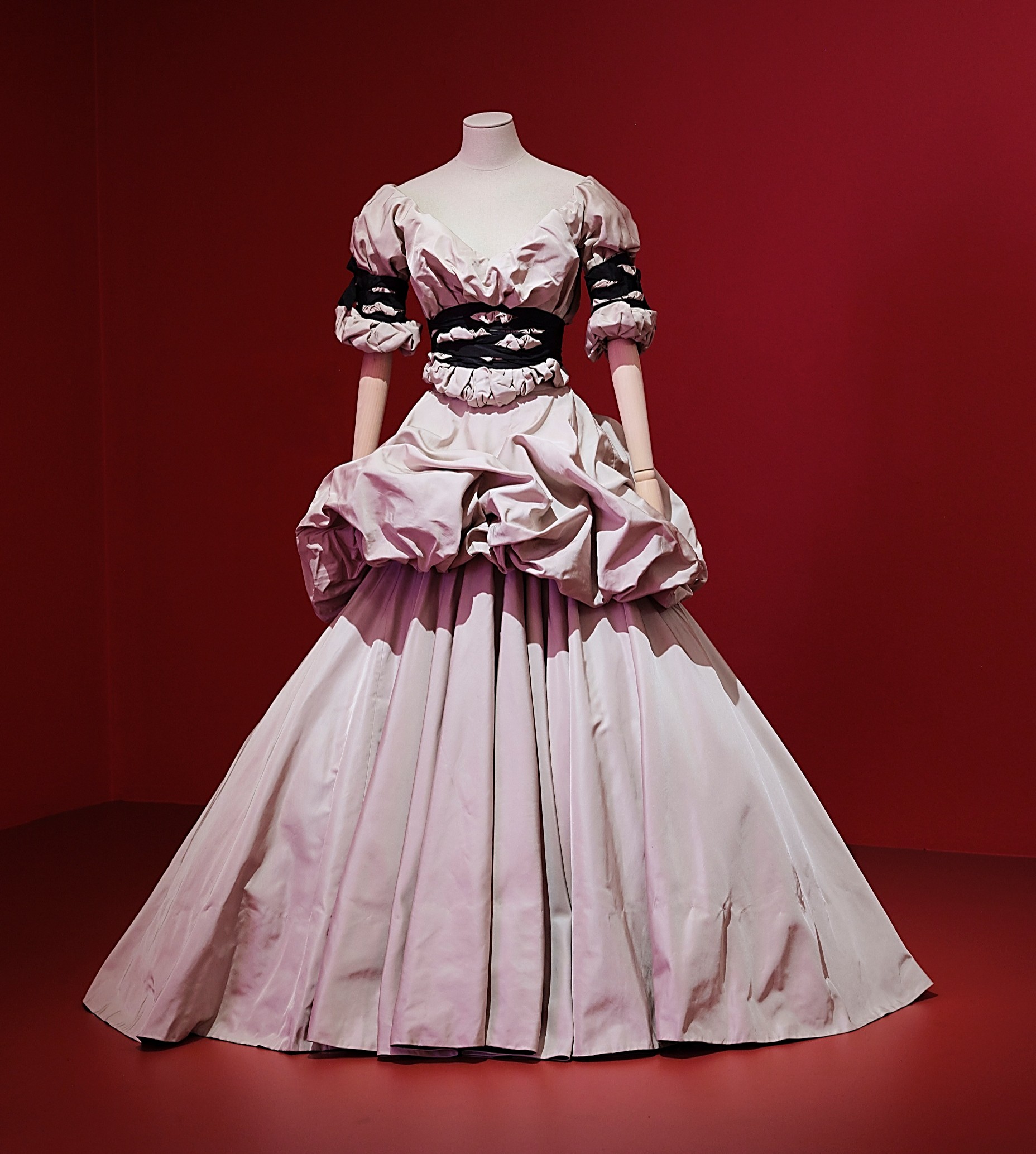
Installation view: Reinvention – History, Westwood / Kawakubo, 2026, NGV International, Melbourne. Vivienne Westwood, Corset gown, 1998, silk (plain, organza, taffeta), nylon (tulle), metal (fastening). Photographed by Sean Fennessy.
As a major summer show catering for large volumes of visitors, the exhibition is designed to lead visitors along a strongly defined pathway from entry to exit. It begins with Punk and Provocation in the 1970s and ends with the Power of Clothes and the designers’ deployment of fashion to express their concerns for a better world and the need for change. An important part of the exhibition is the archival timeline situated in a narrow corridor linking the early sections of Rupture and Reinvention–History. Key events and significant collections from each decade clearly map the corresponding and diverging creative pathways taken by Westwood and Kawakubo. In addition, screens showing catwalk footage are strategically placed throughout the exhibition, highlighting how design concepts and form relate to the body in motion and belie common criticisms that some of the clothes are so abstracted and convoluted that they are unwearable.
The open-ended nature of the exhibition’s dialogue setup between the two designers is emphasised by the grouping of each designer’s works together, rather than setting individual works side-by-side in a literal compare and contrast juxtaposition. This allows visitors to familiarise themselves with each designer’s aesthetic concerns and creative vocabulary. This approach was particularly effective in the large, dramatic space at the centre of the exhibition, titled Reinvention–Design Methods, where numerous Westwood designs are arranged on vast plinths either side of the room, providing a direct sightline through to a series of Kawakubo’s more recent experimental works, all of which are positioned across the far wall in a theatrical double-tiering from floor to ceiling.
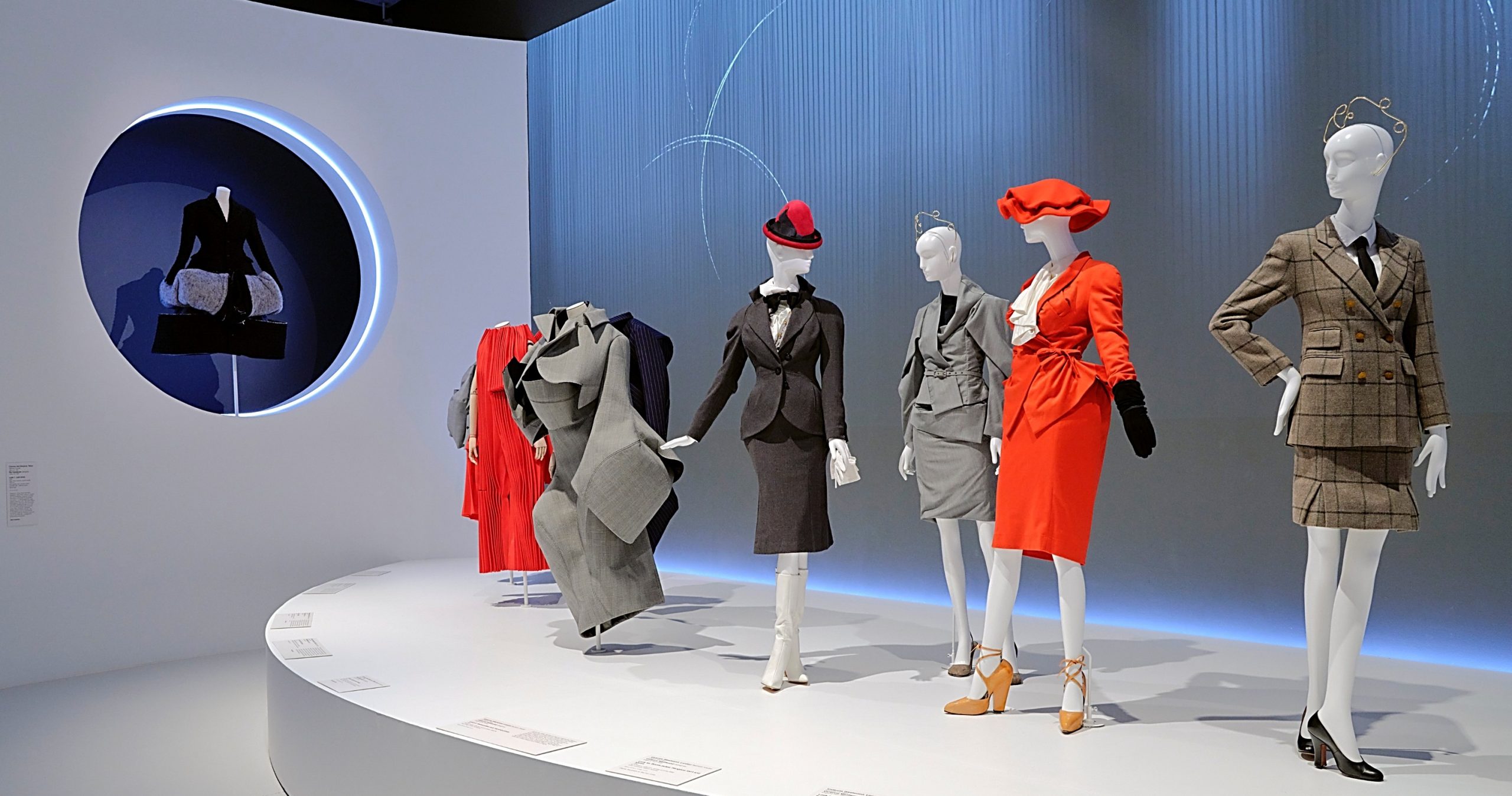
Installation view: Reinvention – Tailoring, Westwood / Kawakubo, 2026, NGV International, Melbourne. Left to right: Rei Kawakubo, Look 1, coat dress, 2022; Look 18, jumpsuit, 2025; Look 2, jacket and dress, 2025. Vivienne Westwood, Look 2, Metropolitan suit, hat and gloves, 1995; Look 45, Booze jacket, Hangover skirt and shoes, 1999; Look 51, Cocotte jacket, blouse, Bag skirt, bum pad, hat, shoes and gloves, 1995. Photographed by Sean Fennessy.
Such groupings work well within the larger context of an exhibition which invites broader contemplation on how these two designers strove to rethink fashion, eschewing traditional rule-based training of cut and construction, and shunning conformity in order to create something innovative and original. Westwood famously stated that the only reason why she was in fashion was to destroy the word “conformity,” while Kawakubo explained that in her search to create something that had never been done before, she had to “start at zero.” The works in this exhibition, often with twisted, exaggerated, asymmetric, and protruding forms, exemplify Westwood and Kawakubo’s commitment to push the limits of fashion, particularly in their interrogation of its relationship to the body and its role in constructions of gender and notions of beauty. Boundaries between body and clothing are blurred, dichotomies of male and female are collapsed, and beauty is found in the ugly and vulgar. A major strength of Westwood | Kawakubo is not only the opportunity to view a large number of these key creations in relation to one another, but for the way in which the exhibition provides a catalyst for ongoing conversations. I expect we will see further discussions in academia and beyond that spring from this conceptually and visually stimulating exhibition.
Exhibition
Westwood | Kawakubo
7 December 2025 – 19 April 2026
National Gallery of Victoria, Melbourne
Images courtesy of the National Gallery of Victoria, Melbourne; Westwood Heritage; Rei Kawakubo; Comme des Garçons, Tokyo.
Laura Jocic is a curator and historian specialising in fashion and textiles, based in Melbourne.
This article was first publishing Artist Profile Issue 74, 2026.
Edwards was born on Kaurna Yarta in 1998 and raised on Nauo Country in the small seaside community of Tulka, on the Lower Eyre Peninsula....

Under the auspices of Geelong Gallery’s director, Humphrey Clegg, and co-curated by Marianne Mathieu, former scientific director of the Musée Marmottan Monet, and Claire Durand-Ruel...
Nike Savvas: Purple Haze presents intimate screen prints and immersive large-scale installation and video work by Savvas from 2005–2026, each evocative of different places and...
Although physically he is of modest stature, Zofrea has devoted much of his life to grand projects that have been conceived and executed on a...
Through a multidisciplinary collaboration between Rotterdam-based curators, architect Paul Cournet of CLOUD and artist-designer Sabine Marcelis of Studio Sabine Marcelis, the exhibition explores the interplay...
Artificial intelligence will be used by young artists who started using it as kids on their phones. They will see it as a natural extension...

This year’s Biennale arrives under more complex circumstances than most. It is shaped by the profound loss of its curator, Koyo Kouoh (1967–2025), whose exhibition...
No artist creates in isolation. Every painting carries traces of the conversations, places and histories that shaped it, preserving within its surface a particular moment...
The weekend markets at Fairfield Showground have been one of Western Sydney’s great institutions for more than fifty years. Fresh fruit and vegetables, children’s clothes,...