ESSAY | In Defence of Not Knowing: Être and the Art of Reflection
In a culture that demands constant justification, productivity and visibility, art that encourages quiet reflection can feel disconcerting. We are surrounded by invitations to reflect, particularly on ourselves. Our phones track our sleep, our moods, our productivity. Social media urges us to narrate our lives in real time, to refine our public identities and to choose a side.
But this form of reflection is a busy, instrumental process. It is meant to optimise us and make us more efficient or presentable. We are encouraged to reflect so that we can move on quickly, fix something, or perform a better version of ourselves. What we are rarely offered is space to sit with ambiguity, contradiction, or not knowing.
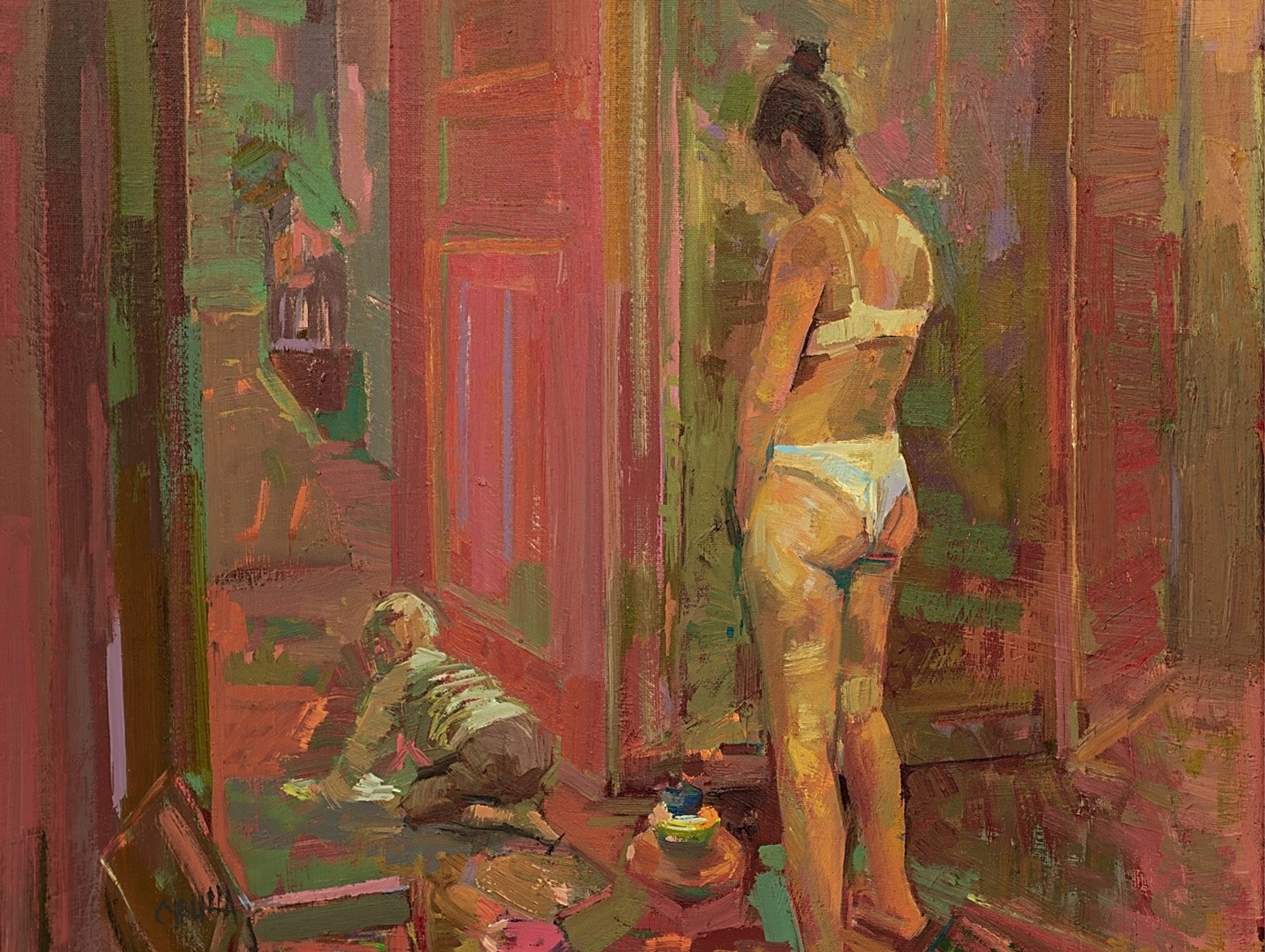
Genuine reflection, the quiet, unresolved, sometimes uncomfortable kind, feels increasingly rare. We are seldom invited to sit with what we do not yet understand. This is where art can still matter; not as decoration, not as therapy, and not as moral instruction; but as a rare site of inwardness. And yet, without inwardness, social / public life becomes brittle. If we are never asked to sit with uncertainty, how do we tolerate complexity in others? If everything must be articulated instantly, how do we make room for grief, doubt, or change?
In making my recent body of work, Être—a French word for “to be”—I became aware of how uncomfortable many people became when confronted with works that didn’t immediately offer an explanation or ask anything explicit of the viewer. Viewers often seem to want guidance: what does this represent? What am I meant to feel? What is the takeaway?
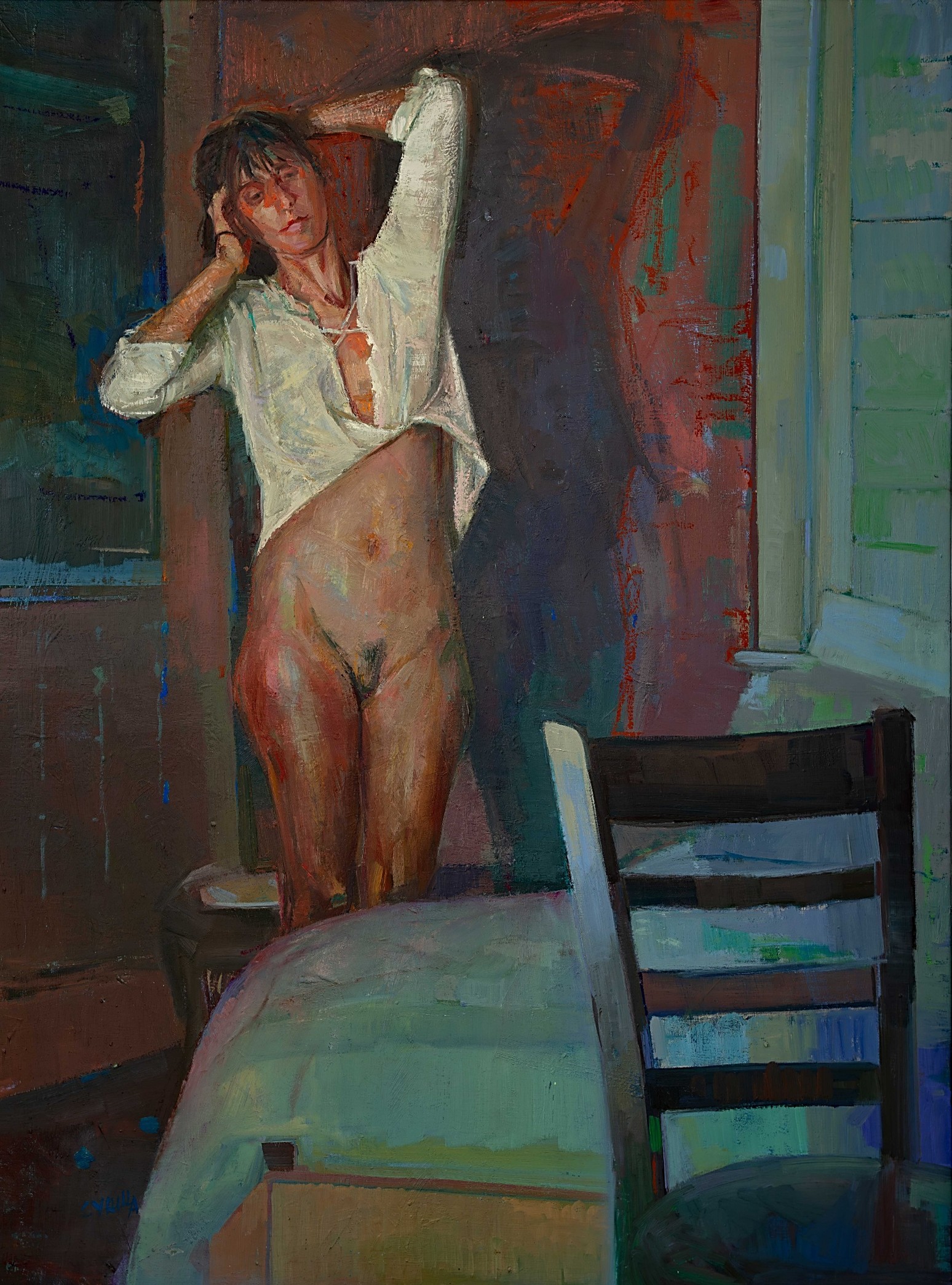
Dagmar Cyrulla, Reminiscing, 2025-26, oil, oil stick, linen, 122 x 91 cm. Photographed by Dieter Canje.
One painting in particular, Reminiscing, 2025-26, became a quiet test of this reaction. In the work a female figure stands alone in an interior, neither posed nor performing, caught in a moment that feels private rather than declarative. There is no narrative to follow, no symbolic key to unlock, no instruction on how long to look. The work offers only duration. Its stillness does not resolve itself but asks the viewer to remain, with the body, the space and whatever discomfort or recognition arises.
These responses were telling. It suggested to me that we are increasingly unpracticed in simply being with ourselves; without narrative, without productivity, without validation.
What struck me while working on Être was not a sense of resolution, but of resistance, both my own and that of the audience. There was a temptation to clarify, to soften, to provide reassurance. To make the work more legible, more digestible, more comfortable. Resisting that impulse felt important, even if it meant alienating some viewers.
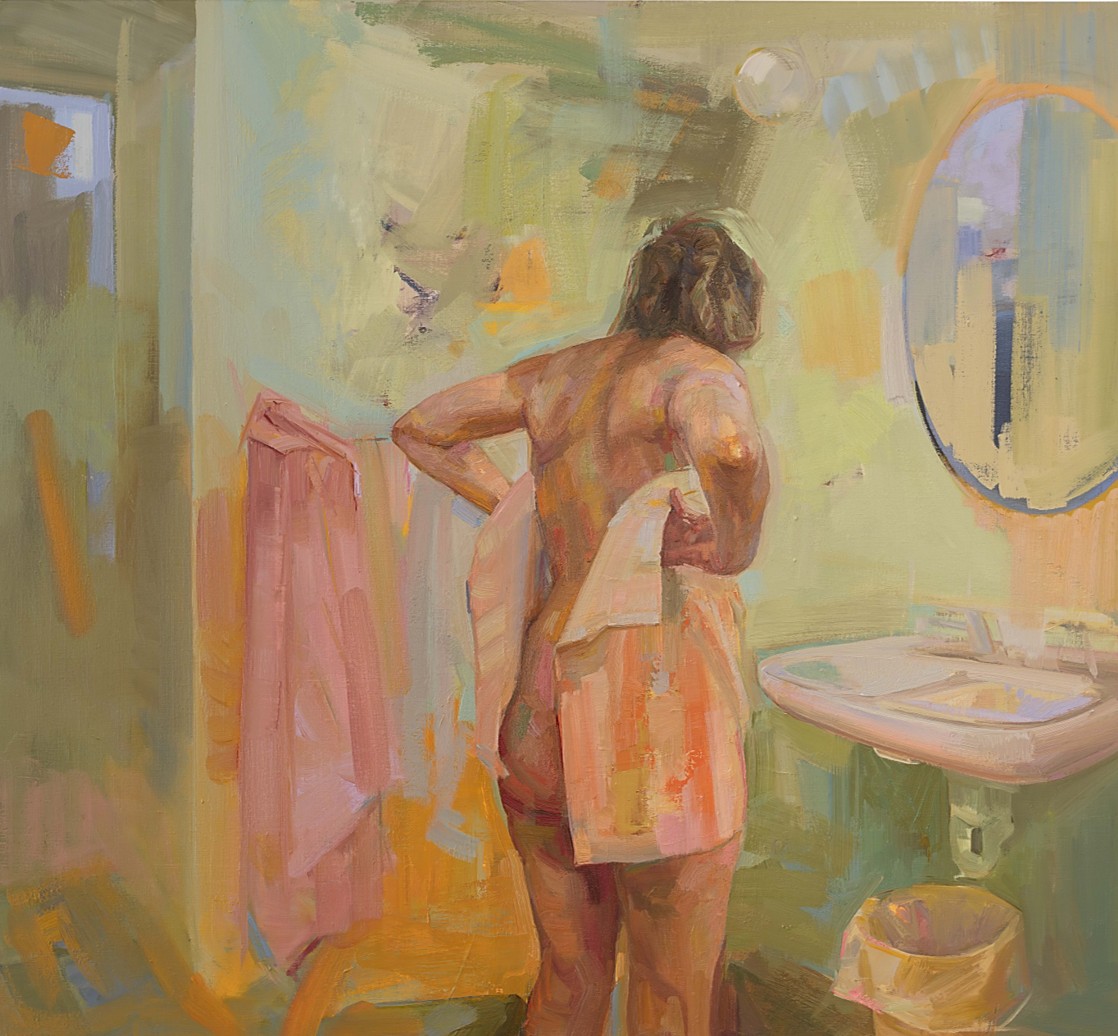
Dagmar Cyrulla, The bather III, 2025, oil, linen, 100 x 93 cm. Photographed by Dieter Canje.
Reflection is not always pleasant. It can be boring, disorienting, or unsettling. It does not always lead to insight, and it rarely produces a neat conclusion. But it is precisely this lack of outcome that distinguishes reflection from performance.
Perhaps the value of art that encourages reflection lies precisely in what it withholds. It does not reassure us, optimise us, or promise resolution. It offers no script for how to feel or who to become. Instead, it asks something quieter and more demanding: whether we are willing to remain with ourselves a little longer, without explanation. Art that encourages reflection is not asking us to become better people. It is asking us to notice where we are, before improvement, before explanation. It invites a kind of attention that is not goal-oriented, nor extractive. It does not offer answers but creates conditions in which answers can arise.
In a culture that rewards certainty, speed and visibility, not knowing can feel like failure. Art that makes space for it reminds us that it is not. It is a beginning. Whilst preparing my exhibition, Être, I was thinking about what it means to ask viewers not for interpretation, but for presence and reflection.
Exhibition
Être
1 – 25 April, 2026
Lennox Street Gallery, Melbourne
Images courtesy of the artist and Lennox Street Gallery, Melbourne
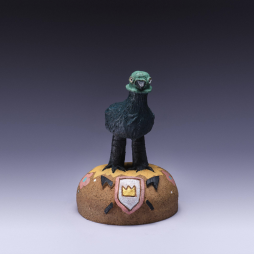
Edwards was born on Kaurna Yarta in 1998 and raised on Nauo Country in the small seaside community of Tulka, on the Lower Eyre Peninsula....

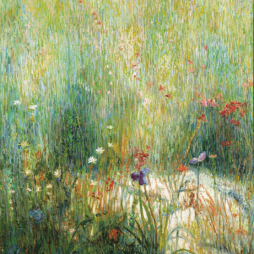
Under the auspices of Geelong Gallery’s director, Humphrey Clegg, and co-curated by Marianne Mathieu, former scientific director of the Musée Marmottan Monet, and Claire Durand-Ruel...
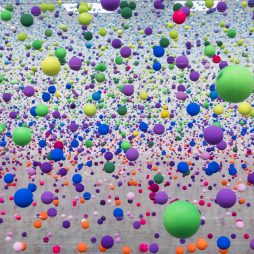
Nike Savvas: Purple Haze presents intimate screen prints and immersive large-scale installation and video work by Savvas from 2005–2026, each evocative of different places and...
Although physically he is of modest stature, Zofrea has devoted much of his life to grand projects that have been conceived and executed on a...
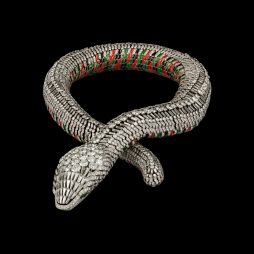
Through a multidisciplinary collaboration between Rotterdam-based curators, architect Paul Cournet of CLOUD and artist-designer Sabine Marcelis of Studio Sabine Marcelis, the exhibition explores the interplay...
Artificial intelligence will be used by young artists who started using it as kids on their phones. They will see it as a natural extension...

This year’s Biennale arrives under more complex circumstances than most. It is shaped by the profound loss of its curator, Koyo Kouoh (1967–2025), whose exhibition...
No artist creates in isolation. Every painting carries traces of the conversations, places and histories that shaped it, preserving within its surface a particular moment...
The weekend markets at Fairfield Showground have been one of Western Sydney’s great institutions for more than fifty years. Fresh fruit and vegetables, children’s clothes,...