Olafur Eliasson | Spectacle and Substance
Olafur Eliasson's exhibition at Brisbane’s Gallery of Modern Art (GOMA) demonstrates how sensory spectacle and environmental urgency converge, transforming perception into a collective act of engagement and accountability.
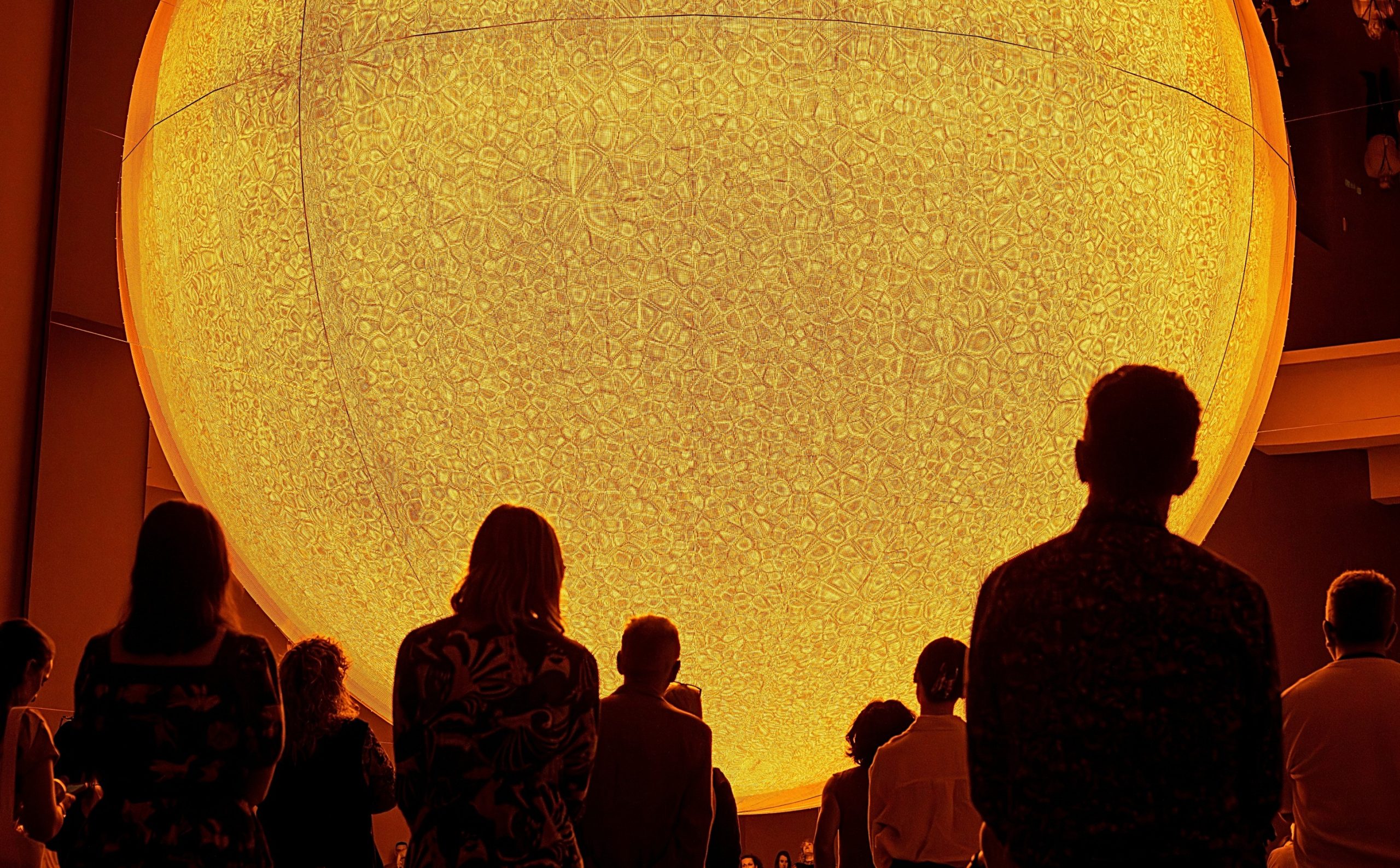
Standing before a luminous artificial sun or walking through rainfall inside a gallery, audiences might mistake spectacle for Olafur Eliasson’s primary concern. Yet, beneath the immediate visual drama lies a profound inquiry into the fundamental processes by which we perceive, interpret, and ultimately co-create the world around us. Olafur Eliasson: Presence, occupying GOMA’s ground floor spaces, is precisely this kind of experience—a comprehensive survey spanning three decades of work by an artist whose practice has consistently interrogated the boundaries between nature and culture, private experience and public space, artistic intervention and environmental activism.
Icelandic-Danish artist Olafur Eliasson (b.1967) has built an international reputation for recontextualising natural elements to alter perceptions of place and self, often in the public domain. From The Weather Project, 2003, at Tate Modern’s Turbine Hall to The New York City Waterfalls, 2008, and more recently Sydney’s Roof for stray thoughts, 2021, where an eighty eight tonne sculptural canopy of fluorescent green and mirror-polished stainless-steel spans the base of Quay Quarter Tower, Eliasson’s occupation of public space prompts an intensive engagement with the world. The artist posits, “Public space is interesting as we own it together, it is ours. How do we create this experience of belonging and sharing, what we own together, how can public space reflect our values of our society and of the time? Believing in the public is believing in public spaces.”
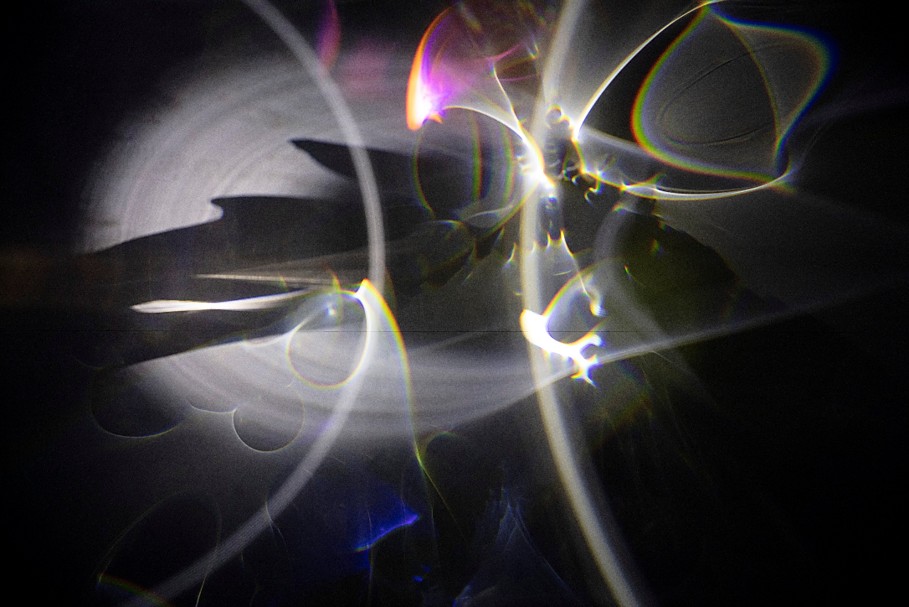
Installation view: Olafur Eliasson, ‘Pluriverse’, 2021 / 2025 Gallery of Modern Art, Brisbane. Projection screen, LED projectors, motors, electrical ballasts, control units, aluminium, brass, steel, stainless steel, plastics, lenses, optical components, glass, wood, dichroic filters, wire, fabric, paraffin oil, plants, 360 x 1000 x 383 cm.
This tension between individual perception and collective experience anchors Presence. Developed through QAGOMA’s head of international art Geraldine Kirrihi Barlow’s extended residency at Studio Olafur Eliasson in Berlin in 2024, the exhibition has evolved from a decade-long professional relationship. Such sustained curatorial engagement and a shared interest in climate change have clearly benefited both institution and artist. “Olafur’s work reminds us that we each perceive the world differently, even when standing side by side,” Barlow observes. Further, “This exhibition rewards curiosity, slowing down, taking our time.” Barlow’s curation is refined; the exhibition presents photographic series, sculptures and installations, and three new commissions in a considered, spacious pacing.
Audiences familiar with Eliasson’s exhibition Take Your Time, 2009, at the MCA Australia—curated by Madeleine Grynsztejn and organised by SFMOMA—will recognise several works including Beauty, 1993, The cubic structural evolution project, 2004, and the studio’s model showcase. Revisiting works in different institutional contexts often proves valuable, as different curatorial frameworks reshape meaning.
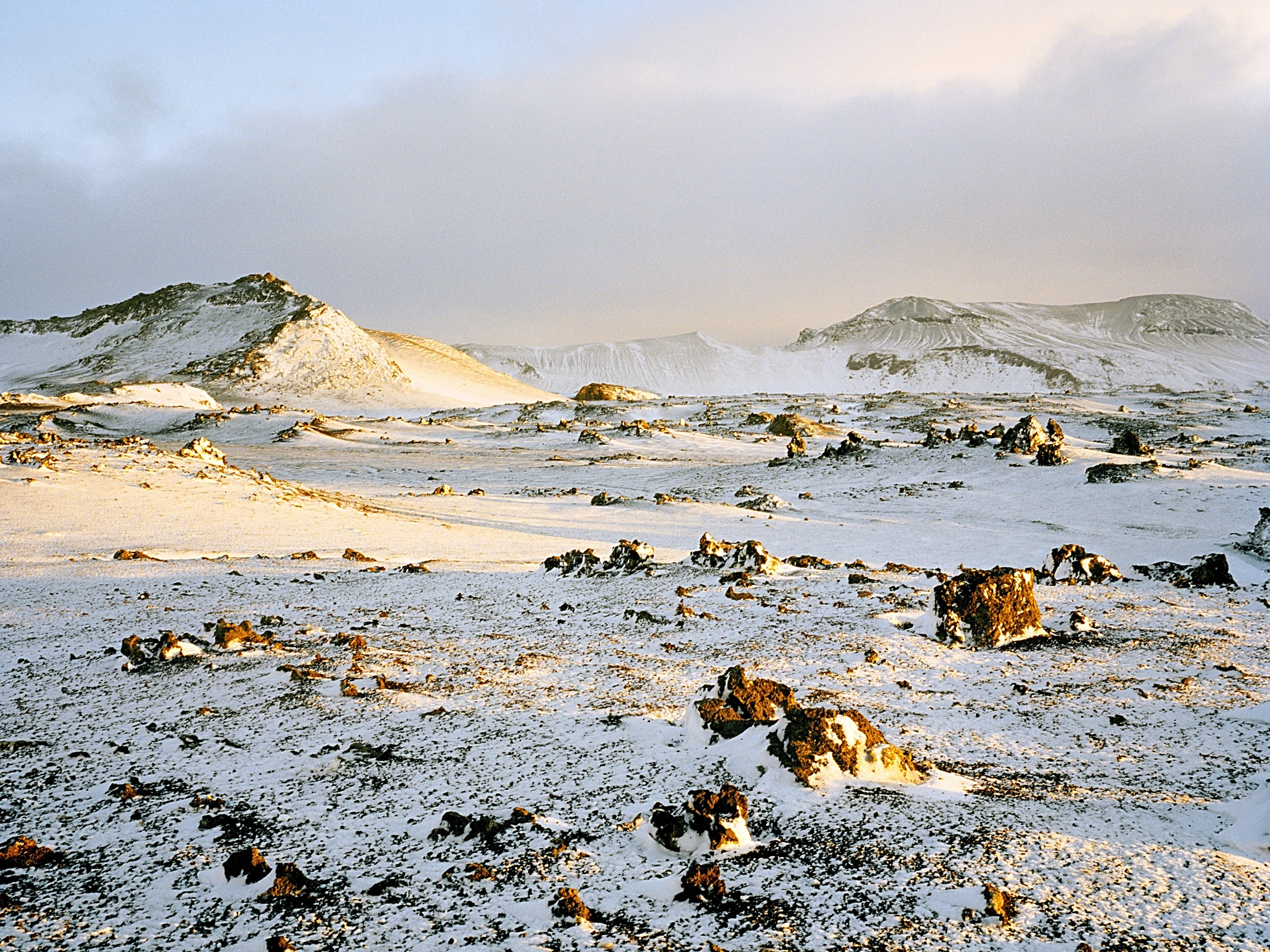
Olafur Eliasson: ‘Presence – Hekla twilight’ series 2006 / 2025 Gallery of Modern Art, Brisbane , cropped. Photograph: N Umek © QAGOMA .
The exhibition opens by establishing Eliasson’s deep connection to Iceland’s extremes and his ancestral homeland. Photographic series including The Hekla Twilight Series, 2006, and The Morning Small Cloud Series, 2006, document glaciers, volcanic peaks, and atmospheric phenomena with forensic precision, yet are reproduced at an intimate scale, demanding close attention. A deep green hue suffuses the space, and the distant sound of rainfall creates an unexpectedly calming threshold into what follows.
Beyond lies Pluriverse assembly, 2021, where in near-darkness, projected light transforms suspended everyday objects—plants in paraffin oil, dichroic filters, rotating lenses, kitchenware—into cosmic phenomena that gleam and intersect like galaxies faraway. True to Eliasson’s commitment to transparency and demystification, viewers can walk behind the screen to observe the humble apparatus producing these sublime effects, revealing that wonder requires neither complexity nor concealment. Similarly, Beauty, 1993, delivers actual rainfall through fine mist falling gently downward, producing rainbow effects as viewers walk through the phenomenon. Created using only spotlight, water, nozzles, and pump, the installation makes seemingly intangible forces real. The audience’s experience differs based on height, angle, and the mist’s drift; we become, in Eliasson’s terms, vital “co-producers” of the work.
Two new commissions explore polarisation with remarkable effects. In Your negotiable vulnerability seen from two perspectives, 2025, circular polarising lenses transform the perception of a central kaleidoscopic form as viewers move around—what appears black becomes white, coloured forms vanish and reappear. Adjacent, Your truths, 2025, comprises five circular filters suspended in front of a billowing transparent curtain activated by five ground-level fans generating different tonal spectrums within each disc. Further, the sound of rainfall from the first gallery space is in fact revealed as the rustle of the plastic curtain. These works insist on physical engagement, and the results are mesmerising.
Not all artworks achieve equal impact. Works such as Firefly City, 2025, employing kaleidoscopic devices to create optical effects in a nod to childhood nostalgia, feel somewhat gimmicky compared to more conceptual installations. By contrast, the titular and sublime work, Presence, 2025, floods a double-height gallery with yellow mono-frequency light restricting perception to monochromatic tones. Layered patterns created through printed fabric beneath perforated aluminium sheets generate dynamic moiré effects activated by movement. Mirrors create the impression of a complete of its actual volume, and the experience is visceral. While Presence employs similar mono-frequency light techniques to Eliasson’s celebrated The Weather Project at Tate Modern, whereby a half-spherical sun enhanced by ceiling mirrors glowed across the Turbine Hall shrouded in mist, GOMA’s more intimate gallery space produces a more concentrated intensity, trading atmospheric diffusion for immediate impact.
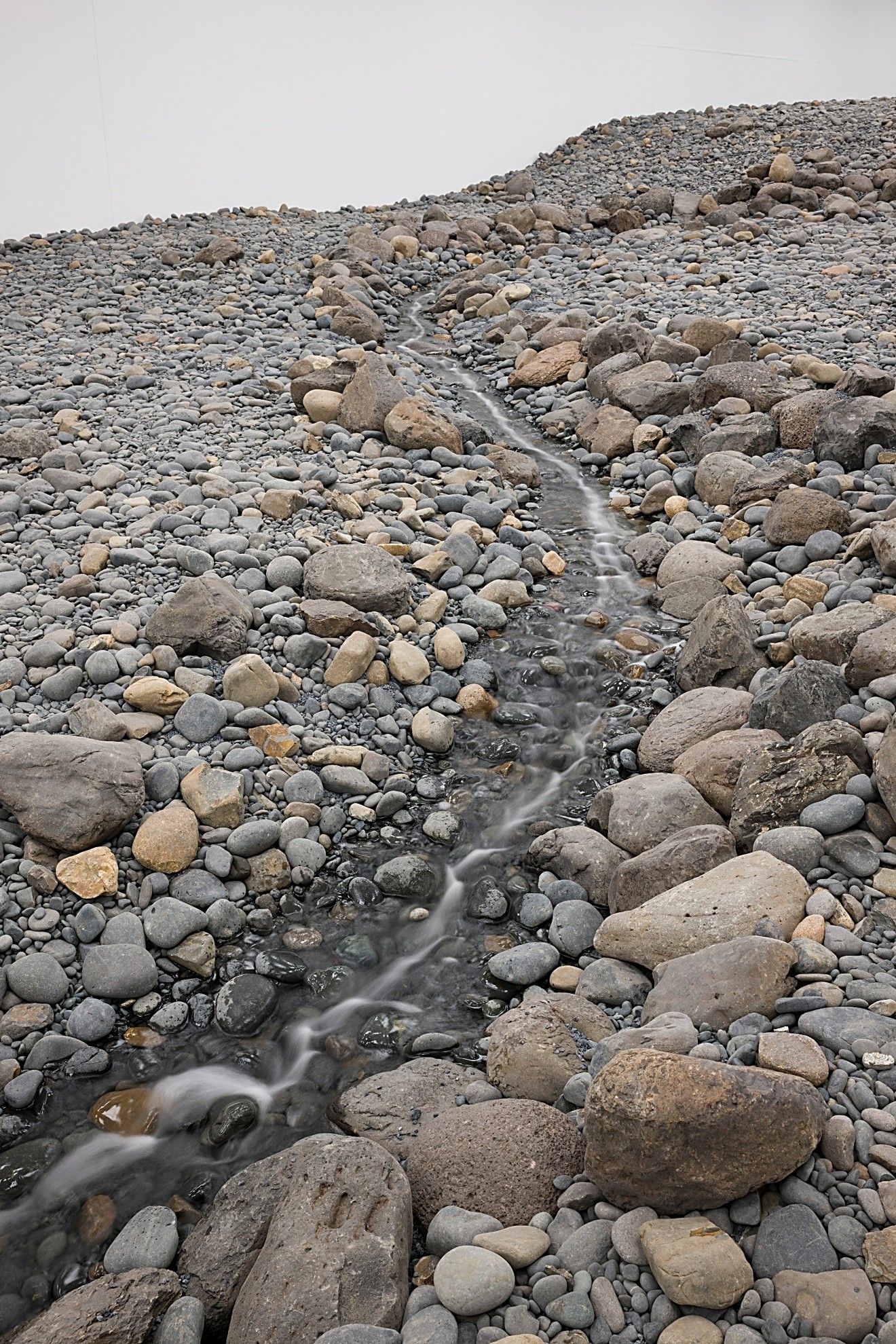
Installation detail: Olafur Eliasson, Riverbed, 2014 / 2025 Queensland Art Gallery | Gallery of Modern Art, Brisbane), water rock (volcanic stones [blue basalt, basalt, laval, other stone, gravel, sand), wood, steel, plastic sheeting, hose, pumps, variable dimensions.
“Museums are spaces where we can slow down,” Eliasson reflects. “When we slow down, we speed up because we sensitise ourselves.” Presence succeeds most fully in these terms, offering carefully calibrated environments for heightened perception rather than mere spectacle. In an era of climate crisis and social polarisation, Eliasson’s practice demonstrates art’s capacity to address urgent concerns through unity and how perception itself shapes, for better or worse, our understanding of the world and each other.
Exhibition
Olafur Eliasson: Presence
6 December 2025 – 12 July 2026
Gallery of Modern Art, Brisbane
Images courtesy of the artist; neugerriemschneider, Berlin; Tanya Bonakdar Gallery, New York; Queensland Art Gallery | Gallery of Modern Art, Brisbane.
Sarah Hetherington is a Sydney based art, architecture and design writer. She is a member of the International Art Critics Association.
The article was first published in Artist Profile Issue 74, 2026.
Edwards was born on Kaurna Yarta in 1998 and raised on Nauo Country in the small seaside community of Tulka, on the Lower Eyre Peninsula....

Under the auspices of Geelong Gallery’s director, Humphrey Clegg, and co-curated by Marianne Mathieu, former scientific director of the Musée Marmottan Monet, and Claire Durand-Ruel...
Nike Savvas: Purple Haze presents intimate screen prints and immersive large-scale installation and video work by Savvas from 2005–2026, each evocative of different places and...
Although physically he is of modest stature, Zofrea has devoted much of his life to grand projects that have been conceived and executed on a...
Through a multidisciplinary collaboration between Rotterdam-based curators, architect Paul Cournet of CLOUD and artist-designer Sabine Marcelis of Studio Sabine Marcelis, the exhibition explores the interplay...
Artificial intelligence will be used by young artists who started using it as kids on their phones. They will see it as a natural extension...

This year’s Biennale arrives under more complex circumstances than most. It is shaped by the profound loss of its curator, Koyo Kouoh (1967–2025), whose exhibition...
No artist creates in isolation. Every painting carries traces of the conversations, places and histories that shaped it, preserving within its surface a particular moment...
The weekend markets at Fairfield Showground have been one of Western Sydney’s great institutions for more than fifty years. Fresh fruit and vegetables, children’s clothes,...