Enrico Taglietti: Architect for the People
Taglietti: Life in Design at Canberra Museum and Gallery (CMAG) commemorates the centenary of Enrico Taglietti’s (1926–2019) birth in Milan, Italy. The exhibition offers a glimpse into the life, family, philosophy and legacy of this visionary architect whose profound influence on Canberra and its development was equaled by the effect of the city and its surrounds on him.
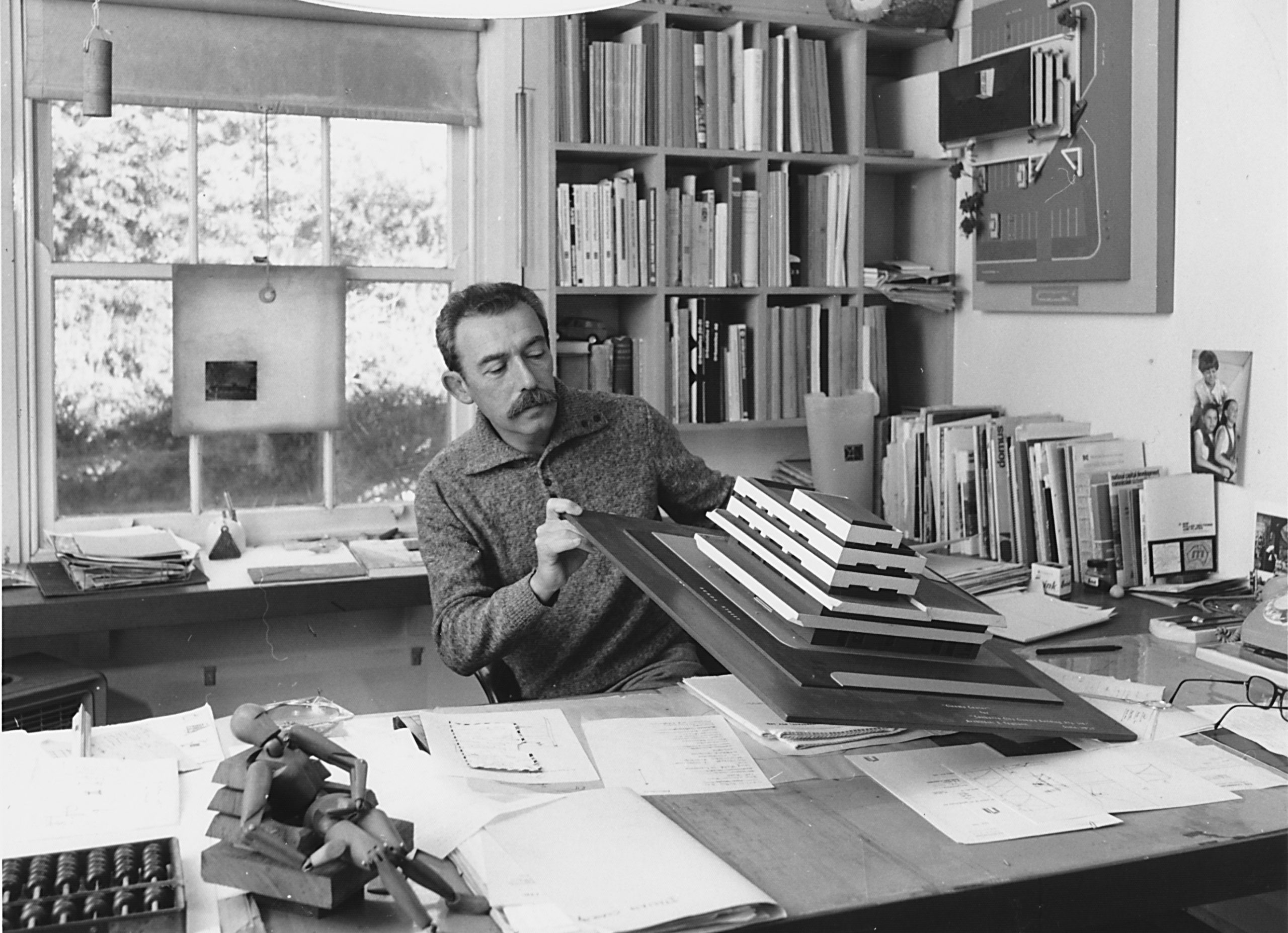
Enrico Taglietti AO met his future wife Francesca (Franca) while they were both studying at the Politecnico di Milano (Milan Polytechnic), with Taglietti completing his degree in 1954. The couple shared the view that architecture and design were ultimately about people, and this was evident in their life and work. The salotto (parlour), for instance, was central to their belief in generating dialogue and connections.
The curatorium, comprising Dr. Silvia Micheli from the University of Queensland; Taglietti’s daughter, Tanja Taglietti of Taglietti Studio and Archive; and Virginia Rigney, senior curator visual art at CMAG, has created an exhibition that gives the viewer insights into Taglietti’s vision. Viewers are invited to sit at a long exhibition table and immerse themselves in the Tagliettis’ lives via various personal and work objects, including the original models of the Town House Motel, 1961, and the Cinema Center, Civic, 1965. Without wanting to be revisionist, it’s apparent that Enrico and Franca were a team, similar to that other famous architectural couple, Walter Burley Griffin and his wife Marion Mahony Griffin.
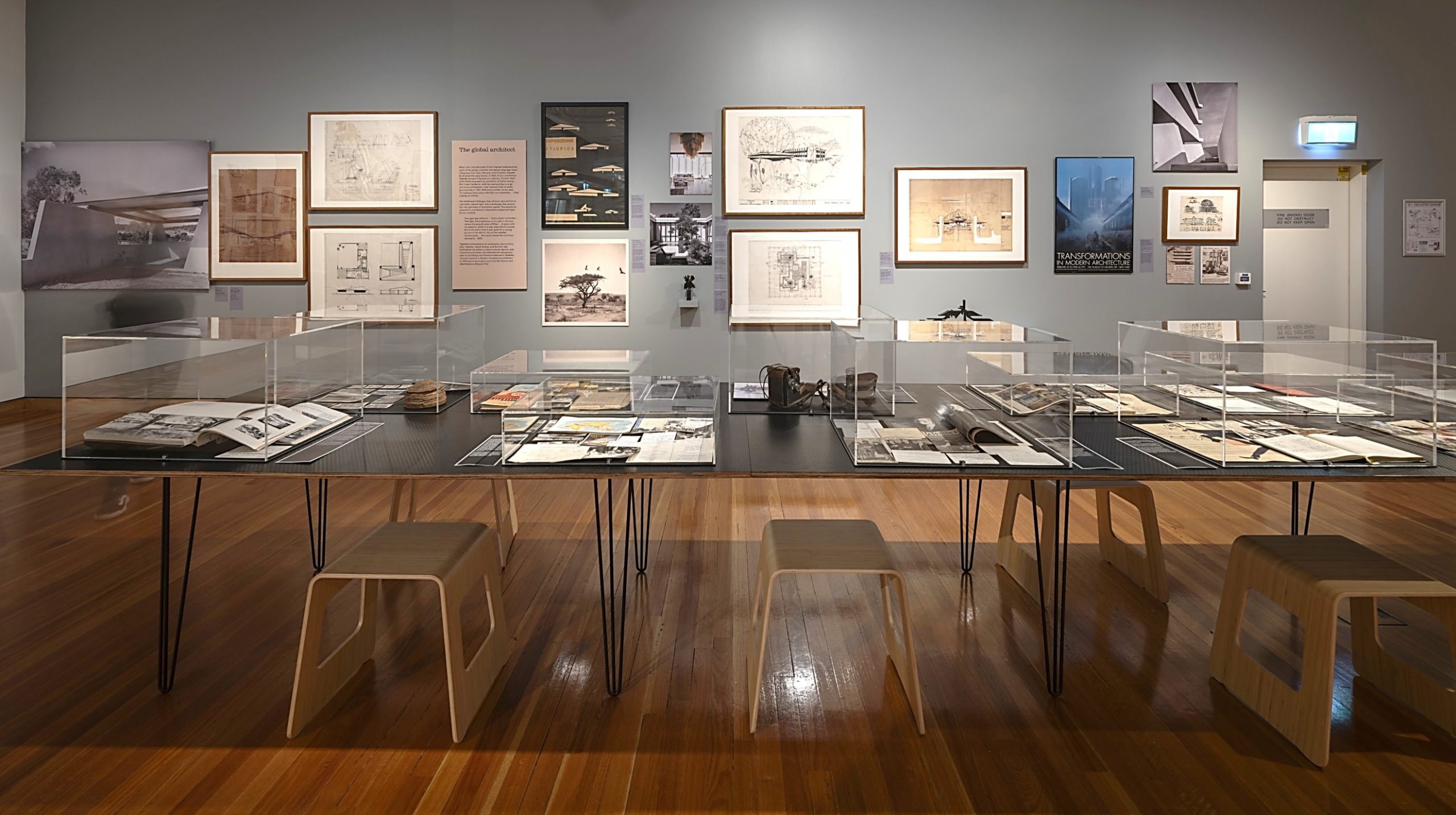
Installation view: Taglietti Life in Design, 2025, Canberra Museum and Gallery. Canberra. Photographed by Dominic Northcott.
The Tagliettis, unlike other expatriates that left Europe in the post-war period, had a promising future in their homeland. He had successfully completed works for the X Milan Triennale in 1954, and had collaborated with Carlo de Carli on the “theatre in the round” design for the Sant’Erasmo theatre, 1951–53. There would have been plenty of opportunities for them in Italy if they had chosen to return. Their initial destination in Australia was Sydney, having been invited by Sir Charles Lloyd Jones, then chair of department store David Jones, to design and supervise Italy at the flagship David Jones in the city centre. This exhibition of Italian art, design, and architecture opened in July 1955 and included Taglietti’s creation of a model Milanese apartment. But it was Canberra that would for them promise so much as “a city without a past” and Taglietti set up his architectural practice there in the following year.
As a young architect who had felt the suffocating burden of history in Italy, he found Canberra was “a proper void”. The Italian government commissioned him to work on its new ambassador’s residence, with Taglietti suggesting a Roman atrium house. Years later, in a discussion in 2017 with Gianmatteo Romegialli— who also designed the clever spatial intervention in this exhibition—Taglietti would reiterate his initial reaction to Australia: “For me after forty years, the light, the challenge of the emptiness and the relationship with the fragility of this ancient land, are still reasons for my profound attraction to this country. To be a modern architect, one has to sever oneself from the past and ask questions as though nothing existed before.”
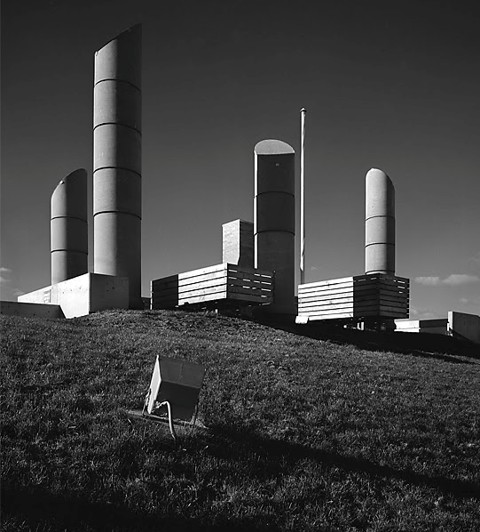
Nitrate Film Vaults in Mitchell, Canberra, 1977. Enrico Taglietti Architect. Photographed by Max Dupain. Taglietti Archive.
The exhibition illustrates the seven core architectural concepts that were key to Taglietti’s practice: Dissolving the Facade, Threshold, Framing the Landscape, Compression and Expansion, Growing from the Ground, Breaking the Edge, and Deceiving Gravity. These are all apparent in his models and sketches. For instance, the brief Taglietti had in the late nineties for the Nitrate Film Vaults in Mitchell, Canberra, was to create a storage vault for highly volatile films. Film stock is notoriously prone to spontaneous combustion. His solution was an underground building with exposed cylindrical ventilation stacks of varying heights, creating an aesthetically pleasing sculptural arrangement above ground.
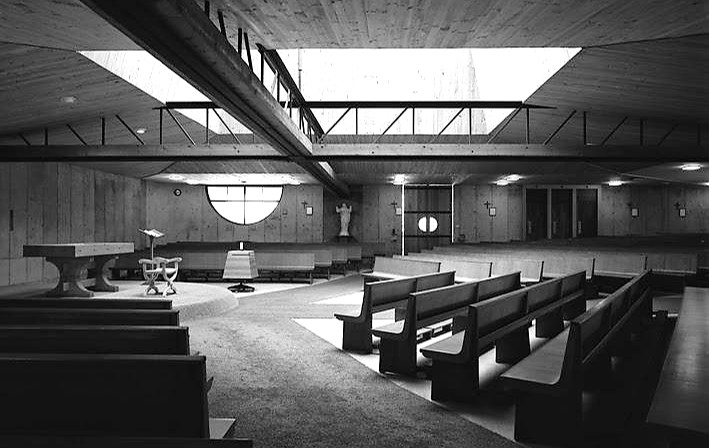
1968 Saint Anthony Church, Marsfield. Enrico Taglietti Architect. Photographed by Harry Sowden. Taglietti Archive.
Taglietti also believed that the interior space did not have to dictate the exterior or in turn be compromised by the external architecture. This can be seen with the 1968 St Anthony’s Parish Church in Marsfield, Sydney. Its internal height and cavernous central atrium are completely unexpected. The outside looks like a low-lying structure that follows the line of the earth, which was achieved by partially sinking the construction into the site so that it appeared lower. Like the majority of his projects in Canberra, it had a strong emphasis on horizontal lines. In a conversation with Gevork Hartoonian and Patrick Stein in 2014, Taglietti said “I have always been bewitched by the poet Giacomo Leopardi and his notion of the infinite. . . that he was happy because where he lived he could not see the total horizon—he had something blocking it, allowing him to imagine. . . . It was the infinite that was existing in wonder. I think I follow that quite often.”
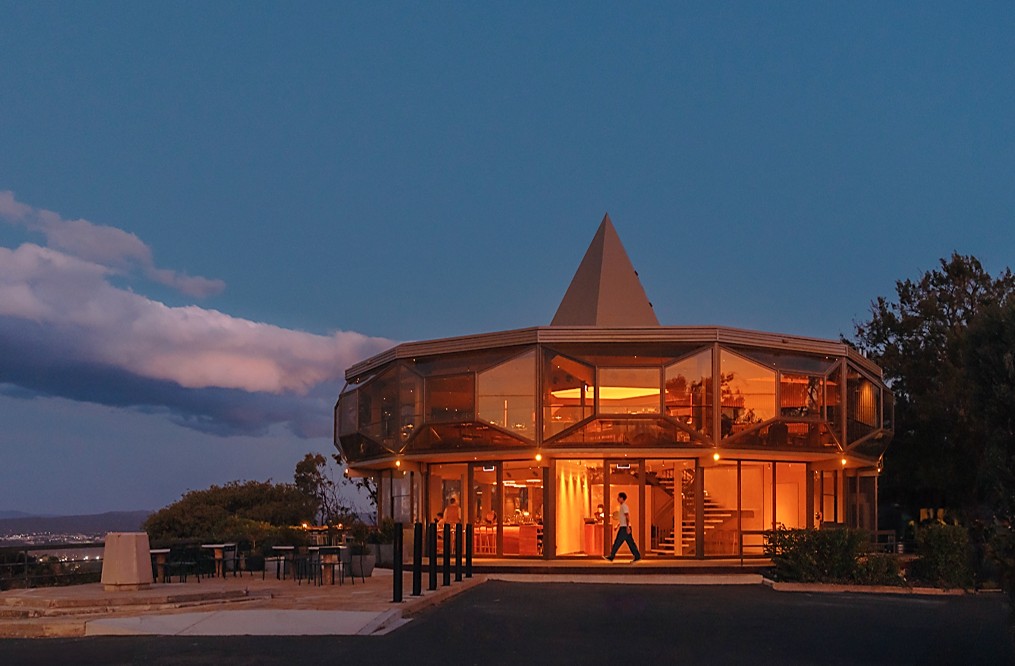
Lunetta Restaurant, Canberra, 2025. Photographed by @days.of.being
In November 2024, the twelve-sided polygon restaurant atop Red Hill reopened as Lunetta. It was originally known as Carousel and was designed by the Czech architect Miles Jakl in 1963 but was modified by Taglietti almost two decades later when it was closed for renovations before reopening in 1981. He added the convex bay windows and various fittings enjoyed today, which enhanced the futuristic aesthetic of the optimistic space-aged themes of Googie architecture that Jakl had employed.
Even though many of Taglietti’s commercial buildings have been demolished, for short-sighted and dollar-driven reasons no doubt, it seems all the houses he designed, such as the 1965 Dingle House in the Canberra suburb of Hughes, have remained intact. I think that says something about the awareness of meaning and purpose in space that Taglietti brought to his houses, which those who are lucky enough to dwell in them appreciate. Architecture is about people and as Taglietti said, “architecture is a theatre in search of actors.” For Taglietti, if the people are not happy then it’s dead. The people should be happy—that is what is most important.
Exhibition
Taglietti: Life in Design
7 June 2025 – 3 May 2026
Canberra Museum and Gallery, Australian Capital Territory.
Images courtesy of the Taglietti Studio and Archive, and Canberra Museum and Gallery, ACT.
H.R. Hyatt-Johnston is an artist and writer, based in Sydney.

Under the auspices of Geelong Gallery’s director, Humphrey Clegg, and co-curated by Marianne Mathieu, former scientific director of the Musée Marmottan Monet, and Claire Durand-Ruel...
Nike Savvas: Purple Haze presents intimate screen prints and immersive large-scale installation and video work by Savvas from 2005–2026, each evocative of different places and...
Although physically he is of modest stature, Zofrea has devoted much of his life to grand projects that have been conceived and executed on a...
Through a multidisciplinary collaboration between Rotterdam-based curators, architect Paul Cournet of CLOUD and artist-designer Sabine Marcelis of Studio Sabine Marcelis, the exhibition explores the interplay...
Artificial intelligence will be used by young artists who started using it as kids on their phones. They will see it as a natural extension...

This year’s Biennale arrives under more complex circumstances than most. It is shaped by the profound loss of its curator, Koyo Kouoh (1967–2025), whose exhibition...
No artist creates in isolation. Every painting carries traces of the conversations, places and histories that shaped it, preserving within its surface a particular moment...
The weekend markets at Fairfield Showground have been one of Western Sydney’s great institutions for more than fifty years. Fresh fruit and vegetables, children’s clothes,...
In recent times, Yorgos Lanthimos has shifted toward photography, noting in a Guardian interview, 2026, that he needs respite, saying, “it might be a couple...