REVIEW | Mia Khin Boe: Walking About
Hidden in the heart of Fitzroy, just off Brunswick Street, Sutton Gallery sits quietly behind large, closed doors. When I arrive, a small sign reading “open” offers a hint of irony. In the first room, facing the entrance, is "Australia’s Proclamation to the Aborigines 2026," 2026. Modest in scale (69.5 x 42.5 cm), the oil and acrylic painting on board draws me in at close range. The room contains only this single work, acting as a preface, establishing the tone, themes, and urgency of Mia Khin Boe’s solo exhibition, "Walking About."
Visually, the work unfolds like a page from a storybook. Figures appear to stand together, perhaps even holding hands. Boe’s work references the proclamation boards issued by George Arthur, Lieutenant Governor of Van Diemen’s Land, now Tasmania, between 1824 and 1836. His Proclamation to the Aborigines, 1828–30, used pictograms to communicate the idea of equality under British law. These boards proclaimed equal punishment for violent crimes committed by both Aboriginal people and European settlers. They were intended to regulate relations during the extreme violence of the Black War. Lieutenant Governor Arthur enacted violent dispossession, leading to the deaths of many Aboriginal people and more than 250 executions. Within this context, Boe exposes the superficiality of the equality claim. What appears as a declaration of cooperation conceals systems of surveillance, policing, and control. Gestures of friendship become strategies of governance, translating violence and dispossession into a form of “justice” authored by colonial power.
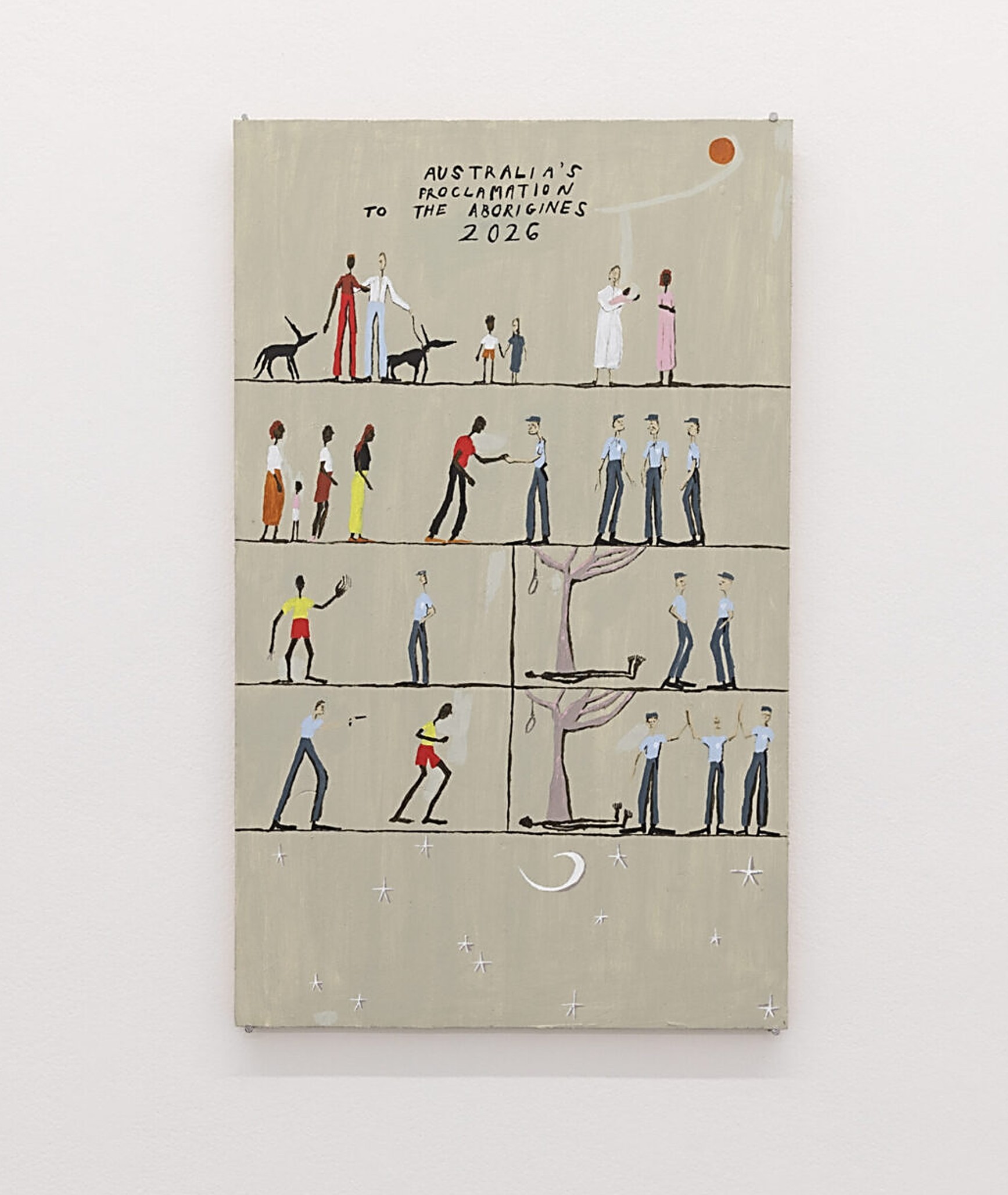
Mia Khin Boe, Australia’s Proclamation to the Aborigines 2026, 2026, oil on board, 69.5 x 42.5 cm. Photographed by Andrew Curtis.
In Boe’s reworking, these tensions are made plain. Figures that seem united are also constrained, their proximity suggesting both enforced order and quiet resistance. As I stand with the work, it reaches beyond its historical reference, pointing toward contemporary police violence and the systemic injustices faced by First Nations people, and in doing so sets the tone for the exhibition.
A sequence of paintings unfolds in the second room along the walls at eye level, forming a continuous line that guides my movement through the space. Following the sequence, I observed shifts in composition, colour, and scenario, revealing the artist’s evolving exploration of human experience. These changes do not read as rupture but as modulation, different inflections of the same enquiry into the world and existence.
Boe’s paintings use thinly laid grounds, upon which subjects and details are built, gradually accumulating into thick, tactile surfaces that foreground the materiality of paint. Exposed linen and dense pigment create a sharp contrast between figure and ground. Stylistically, the works draw from conceptualism, colour field painting, hard-edged abstraction, and figuration, yet they do not feel derivative. Instead, they read as a riff on Australian modernism. Distorted figures, abrasive colour, and unsettled atmospheres heighten a sense of psychological unease. While the scenes suggest individual experiences of alienation, isolation, and belonging, they extend beyond the personal. There are echoes of Albert Tucker’s Images of Modern Evil, 1943–48, where warped figures probe the moral and psychological complexities of human behaviour. Similarly, Boe’s environments situate her subjects within states of instability, and emotional unrest.
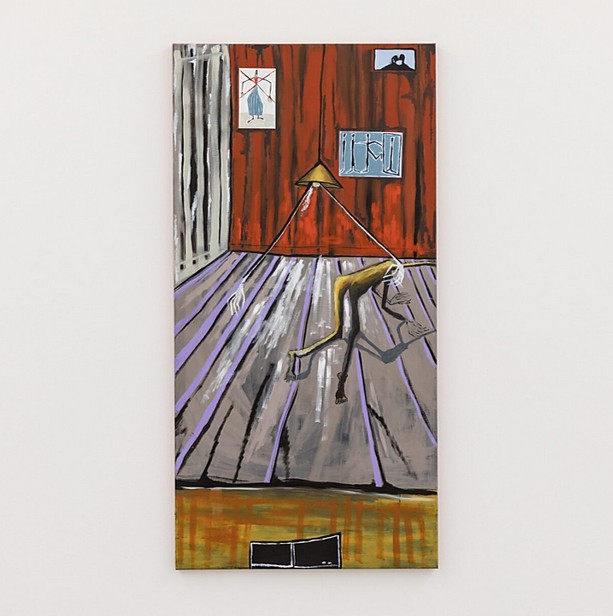
Mia Khin Boe, In fright, 2026, acrylic on linen, 152.5 x 76 cm. Photographed by Andrew Curtis.
As the exhibition progresses and culminates, this tension deepens. In Boe’s painting In Fright, 2026, beams of light from a lamp extend like arms toward a collapsing, elongated figure. The body appears constrained, caught between forces. This instability articulates a fractured relationship to lineage and belonging. The interior shows scattered images on the wall suggesting inherited narratives, yet their disjointed placement suggests rupture rather than continuity. One image in the background shows a figure crossed out with a red X, reinforcing a sense of erasure or refusal. Within this compact, psychologically charged space, Boe’s distorted figure reminded me of Russell Drysdale’s elongated forms, with environment amplifying the subject’s existential and emotional restlessness. In In Fright, 2026, the interplay of cultural references, personal memory, and the figure’s suspension evokes disinheritance, a condition of being denied full access to cultural, historical, or spatial grounding.
The exhibition’s title, Walking About, offers a key to its structure. While it suggests casual observation, Boe’s work resists detachment. These paintings feel closer to testimony than passive viewing, grounded in lived experience and disrupting the neutrality often associated with modernist observation. Through this lens, Walking About becomes an exploration of marginalisation and endurance, tracing Boe’s inheritances and disinheritances as a woman of Butchulla and Burmese descent, and the ongoing exclusions that shape contemporary Australia.
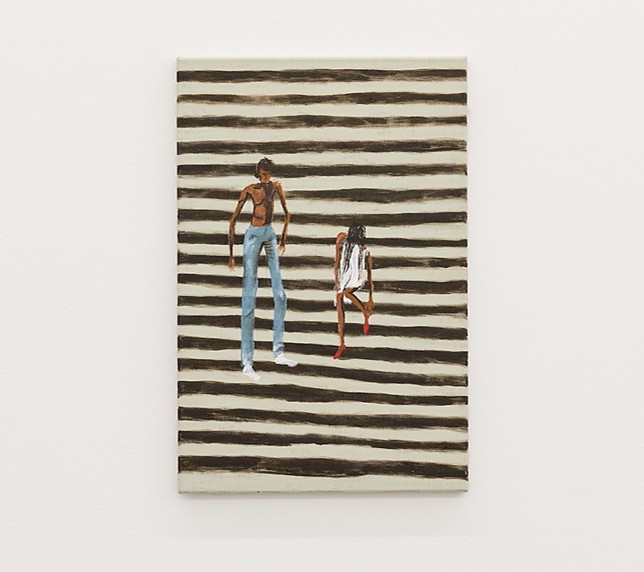
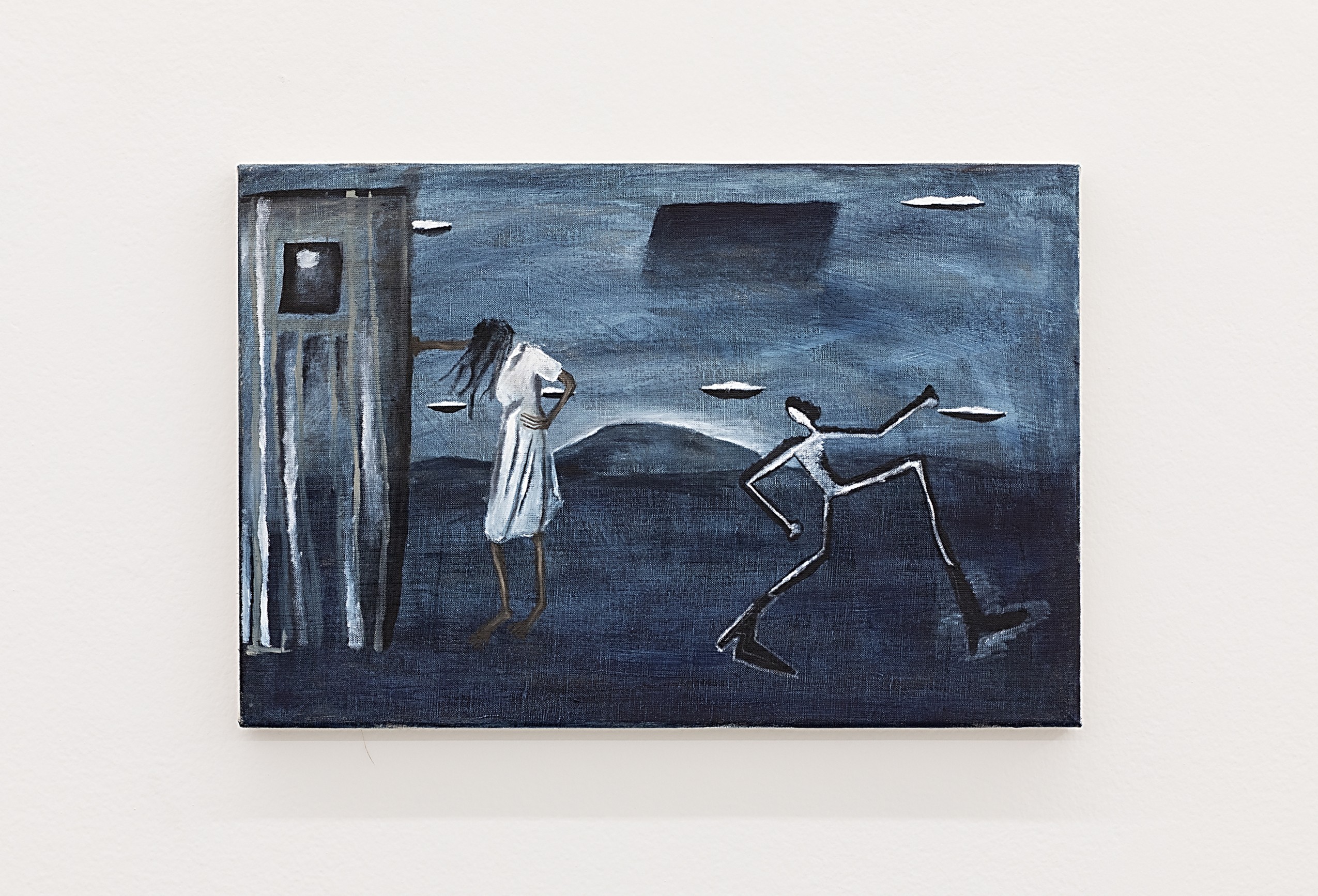
Mia Khin Boe, And you said something that I’ve never forgotten, 2026, oil on linen, 61 x 41 cm. Photographed by Andrew Curtis.
The title gestures toward the notion of walkabouts, a traditional rite of passage for young First Nation males involving living on and learning from Country, following ancestral songlines. Rather than offering definition, Boe mobilises it as a shifting framework, guiding the viewer through layered histories of displacement, survival, and cultural continuity.
I left the exhibition without a sense of resolution, but with a heightened awareness of my own position in relation to the work. Walking About does not offer easy access or closure; instead, it demands sustained, attentive engagement. While the exhibition’s limited interpretive framing creates distance, it also reinforces the difficulty of fully grasping experiences that are not my own. In this tension, Boe’s work remains potent, insisting on the complexities of history, identity, and looking. As a woman of European descent, I was prompted to reflect on my assumptions and the limits of my understanding, questioning what it means to encounter these works on their own terms rather than through the frameworks I have inherited.
Exhibition:
Walking About
7 March –11 April 2026
Sutton Gallery, Naarm Melbourne
Images courtesy artists, Sutton Gallery and Andrew Curtis.
Amélie Blanc is an art writer based in Naarm Melbourne.
Edwards was born on Kaurna Yarta in 1998 and raised on Nauo Country in the small seaside community of Tulka, on the Lower Eyre Peninsula....

Under the auspices of Geelong Gallery’s director, Humphrey Clegg, and co-curated by Marianne Mathieu, former scientific director of the Musée Marmottan Monet, and Claire Durand-Ruel...
Nike Savvas: Purple Haze presents intimate screen prints and immersive large-scale installation and video work by Savvas from 2005–2026, each evocative of different places and...
Although physically he is of modest stature, Zofrea has devoted much of his life to grand projects that have been conceived and executed on a...
Through a multidisciplinary collaboration between Rotterdam-based curators, architect Paul Cournet of CLOUD and artist-designer Sabine Marcelis of Studio Sabine Marcelis, the exhibition explores the interplay...
Artificial intelligence will be used by young artists who started using it as kids on their phones. They will see it as a natural extension...

This year’s Biennale arrives under more complex circumstances than most. It is shaped by the profound loss of its curator, Koyo Kouoh (1967–2025), whose exhibition...
No artist creates in isolation. Every painting carries traces of the conversations, places and histories that shaped it, preserving within its surface a particular moment...
The weekend markets at Fairfield Showground have been one of Western Sydney’s great institutions for more than fifty years. Fresh fruit and vegetables, children’s clothes,...