ESSAY | Clean Edges and a Messy Studio: The Abstraction of Evie Adasal
Evie Adasal makes hard-edged abstract paintings which trade representational subject matter for bold colour, crisp geometry and charged surfaces. This article traces the events that propelled her first into paint and then into abstraction, revealing the idiosyncrasies of her process.
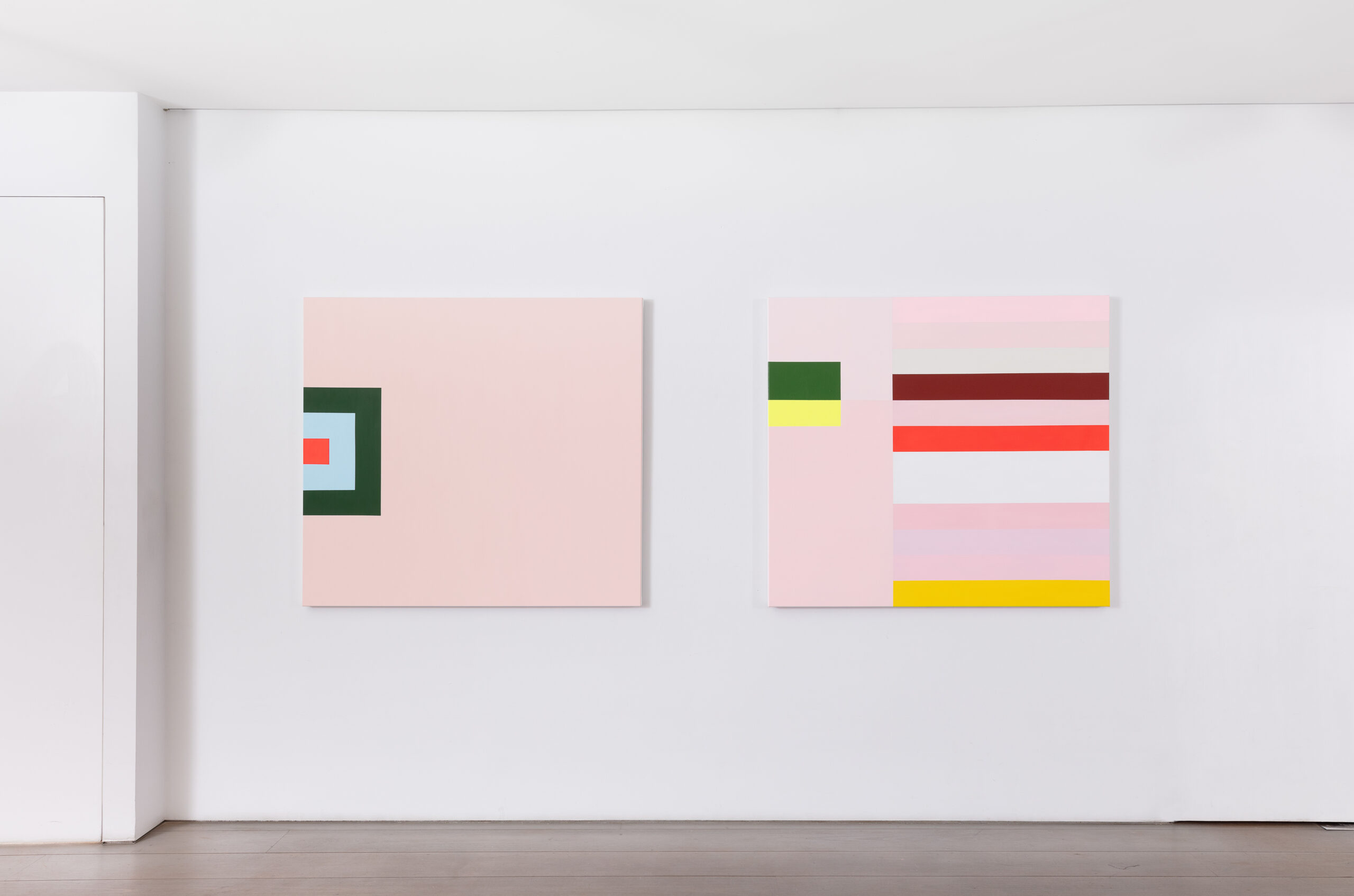
Evie Adasal always wanted to paint, but she hesitated. “I graduated from art school in the ‘90s in photography and film,” she recalls. “When I was at TAFE, we had a really rough painting teacher, and she scared the shit out of me, so I thought I might stick to photography.” Years later, however, these hesitations were brushed aside by the brutal clarity of a near-death experience, when she suffered two cardiac arrests. “In the second one, I actually flatlined, and they struggled to bring me back and resuscitate me,” she confides. “When you recover from something like that, you kind of go, ‘holy shit, I haven’t really been serving myself for the last ten years.’” So began Adasal’s venture into painting.
The Sydney-based artist produces a form of hard-edged abstraction that bypasses legible subject matter and instead reaches directly for bold colour and feeling. Her practice has not always looked like this. When Adasal first started painting in her garage fifteen years ago, she looked to the human figure. Yet these forms only held her attention for a short time.
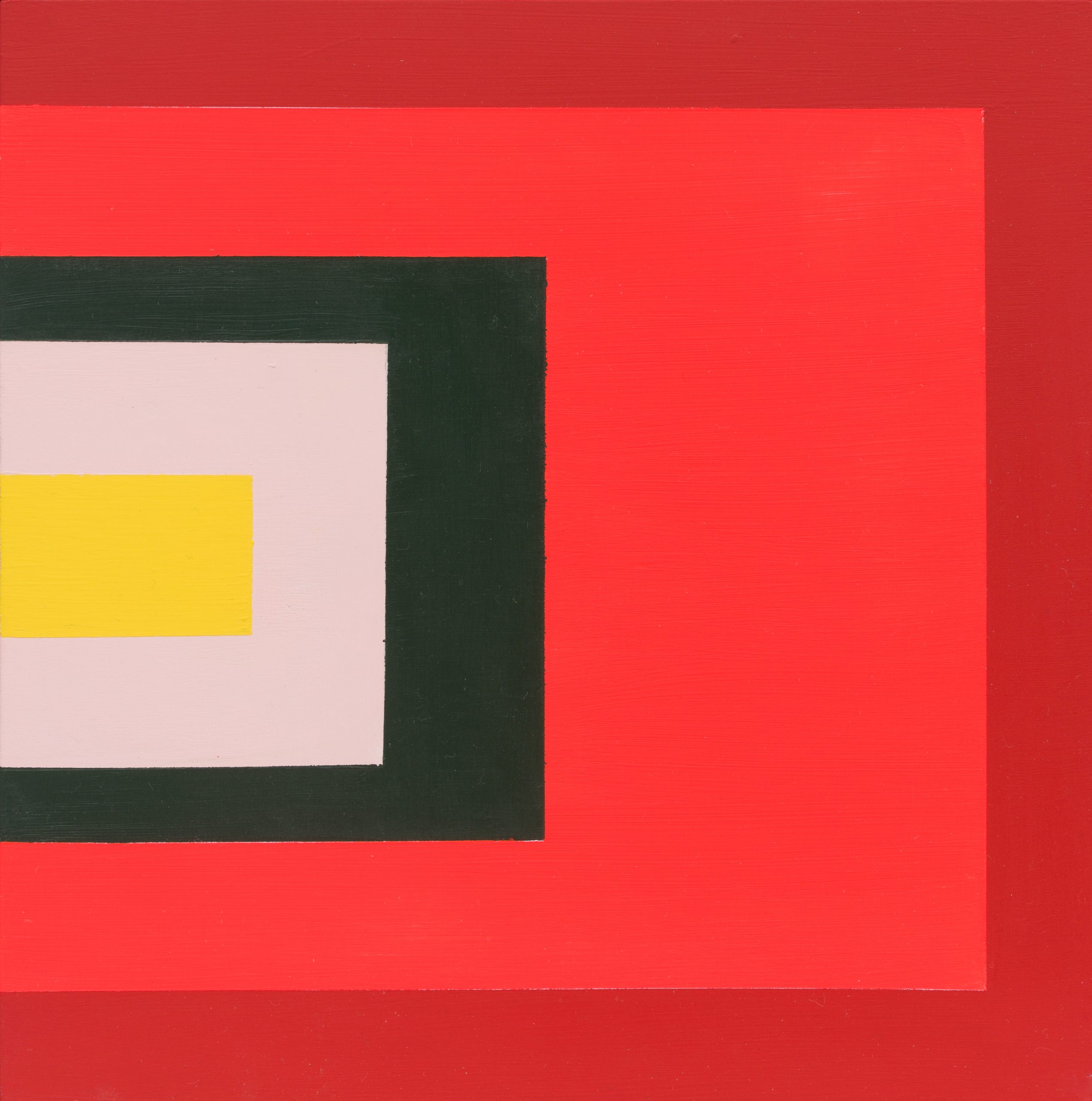
Evie Adasal, Drips Like Velvet, 2025, synthetic polymer paint, wood, 20 x 20 cm. Photographed by Brett East.
A director of a small gallery on the coast advised Adasal to look to her own experiences for inspiration—to try and capture the very thing that had set her on this path, the cardiac arrests. “He said, ‘why don’t you paint about that?’ and I thought, ‘how the hell do I paint about that?,’” she explains to me. Even hearing the bare facts of the conversation, I can’t imagine anything worse. It’s the kind of horribly oblique yet explosive prompt that an art schoolteacher casually tosses to a bachelor of fine arts student—blowing up their world—before walking away (I’m being unfair, of course.).
Nonetheless, the prompt pushed Adasal to explore new directions. In attempting to recapture the past, her immediate frustration led to a new method of working: destruction. “I was going nowhere, so I decided I was just going to wreck a painting,” she says. “I’ll just let it be whatever it’s meant to be. It’s not for an audience; it’s not for anyone.” Liberated from her previous figurative strictures, Adasal rubbed back the paint with her hands in a kind of tactile experience that inspired a subsequent series of hand-painted works.
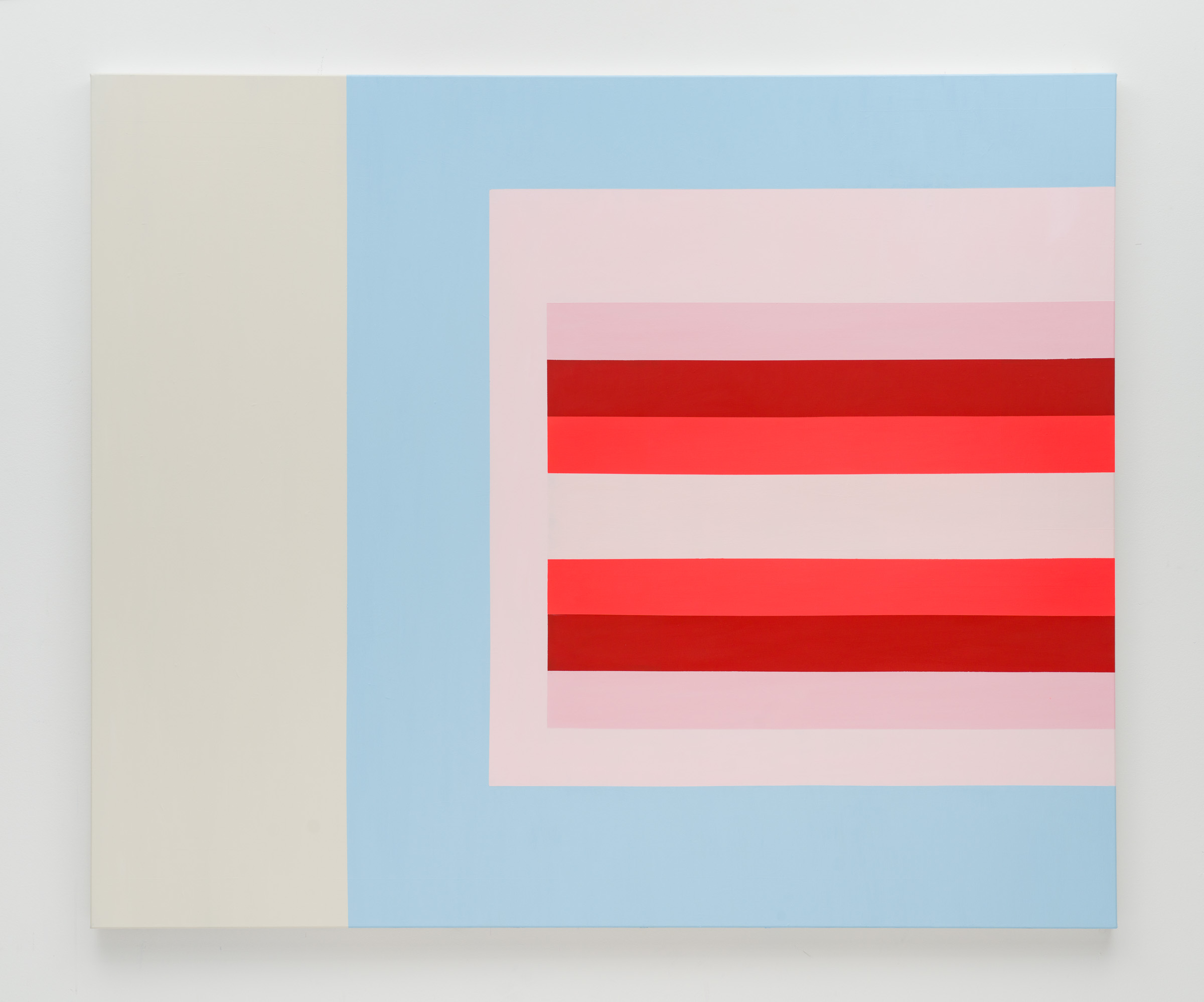
Evie Adasal, I never promised you a Rose Garden, 2025, acrylic paint, poly cotton, 180 x 150 cm. Photographed by Brett East.
When Adasal moved to Sydney four years ago, it was during COVID-19 and she found herself living in the middle of the city. The Botanical Gardens became a haven and a ritual, as she walked through it every morning. She began to obsess over the light filtering through the trees and the colour of the foliage, and to experience the garden not just as a garden, but almost as a space where she could harvest the visual elements of her work. The artificial geometry, topography and world building of the garden began to filter into her aesthetic decisions.
Even then, Adasal’s work lingered at the edges of abstraction and representation, stopping short of the unapologetic geometry that characterises her practice today. “It was almost like I wanted to prove to myself that I could paint . . . rather than just doing pure abstract,” she explains. “But then I thought, ‘why am I playing safe? Nobody knows who I am, nobody knows my work.’ I literally thought, fuck it, I’m just going to do it. Why do I have to prove this transition?”
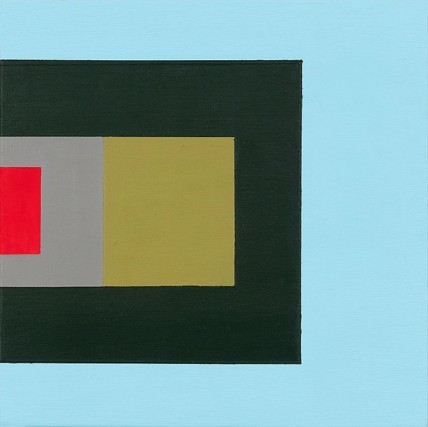
Evie Adasal, Brown not Black, 2025, acrylic paint, wood, 20 x 20 cm. Photographed by Brett East.
Adasal began to embrace the areas of her paintings that she found most compelling, taking, for instance, a flat passage of colour from the corner of a composition and reframing the entire work around it. From marginalia to the main event. In paintings like I Never Promised You A Rose Garden, 2025, we see this kind of expansion in a series of fully abstract horizontal passages of reds and pinks, which are set against a field of pale blue and a ground of cream. With Brown not Black, 2025, Adasal moves from canvas to a wood-panel base; yet, for me, both works still call to mind the modernist artist Josef Albers (1888 – 1976), who famously explored how different planes of overlapping and adjacent colour interact in his work and writing.
Adasal is not interested in the predetermined chromatic relationships, however. “I like going into it almost naïvely, without knowing too much. Sometimes when I put a dark brown next to a pastel pink, all of a sudden the dark brown looks black,” she observes. “I want to discover it. I don’t want to learn it first and then put it into practice. I want to just play and see what appears.”
It’s clear that Adasal has her own way of doing things. Her works appear unbelievably crisp and clean, but she confesses that her studio is often a whirlwind of mess. Likewise, where I assume that each composition is painstakingly planned, she insists that intuition is the key driver of her process. If a painting is completed quickly or with ease, she regards it with suspicion and insists on reworking it until some struggle has entered her process. There is something undoubtedly productive in all of this contradiction, which propels her work forward and keeps it alive to revision, surprise, and the possibility that a painting might still misbehave.
Exhibition
Dopamine
29 April – 23 May 2026
OLSEN Gallery, Sydney
Images courtesy of the artist; OLSEN Gallery, Sydney and Michael Reid, Sydney.
Tai Mitsuji is an art historian and curator based in Sydney.
The article was first published in Artist Profile Issue 74, 2026.

Under the auspices of Geelong Gallery’s director, Humphrey Clegg, and co-curated by Marianne Mathieu, former scientific director of the Musée Marmottan Monet, and Claire Durand-Ruel...
Nike Savvas: Purple Haze presents intimate screen prints and immersive large-scale installation and video work by Savvas from 2005–2026, each evocative of different places and...
Although physically he is of modest stature, Zofrea has devoted much of his life to grand projects that have been conceived and executed on a...
Through a multidisciplinary collaboration between Rotterdam-based curators, architect Paul Cournet of CLOUD and artist-designer Sabine Marcelis of Studio Sabine Marcelis, the exhibition explores the interplay...
Artificial intelligence will be used by young artists who started using it as kids on their phones. They will see it as a natural extension...

This year’s Biennale arrives under more complex circumstances than most. It is shaped by the profound loss of its curator, Koyo Kouoh (1967–2025), whose exhibition...
No artist creates in isolation. Every painting carries traces of the conversations, places and histories that shaped it, preserving within its surface a particular moment...
The weekend markets at Fairfield Showground have been one of Western Sydney’s great institutions for more than fifty years. Fresh fruit and vegetables, children’s clothes,...
In recent times, Yorgos Lanthimos has shifted toward photography, noting in a Guardian interview, 2026, that he needs respite, saying, “it might be a couple...