Dale Frank | Food for the Soul
Chicken Soup, Dale Frank's latest solo exhibition at Roslyn Oxley9 Gallery, arrives with all the force and irreverence that has defined one of Australian contemporary art's most singular artists. Occupying the gallery’s two spaces, the exhibition comprises a new suite of twenty large-scale paintings and three sculptures, together forming a body of work that is visceral, ethereal, at times unsettling and in its own deliberately excessive way, decadently glorious.
Frank was born in Singleton, New South Wales in 1959, and has been represented by Roslyn Oxley9 since 1982—a relationship that spans more than four decades and speaks to a sustained, uncompromising commitment. His work has been shown internationally since the 1980s, appearing at PS1 in New York, the 4th Biennale of Sydney, and the 55th Venice Biennale, where Frank featured in Personal Structures at the Palazzo Bembo. His work is held in major collections worldwide, from the Solomon R. Guggenheim Museum in New York to the Zurich Kunsthaus, and across all major Australian national and state galleries.
A major solo retrospective was held at the Museum of Contemporary Art Australia in 2000, and in 2024, a feature-length documentary on his life and work, Dale Frank – Nobody’s Sweetie, premiered at the Sydney Film Festival to widespread acclaim. More recently, in April 2024, the National Art School in Sydney staged Dale Frank: Growers and Showers, a survey of more than forty works spanning the early 1980s to the present. Presenting Frank at his experimental best, a multitude of mediums and surfaces, from poured epoxy-glass on metallic Perspex, to CDs, human hair wigs, shattered glass and air vent ducts, as well as an interactive treadmill, were exhibited. Whilst significant in terms of institutional recognition, a full-scale national retrospective remains overdue. Chicken Soup and the continued strength of his new work make the case compellingly.
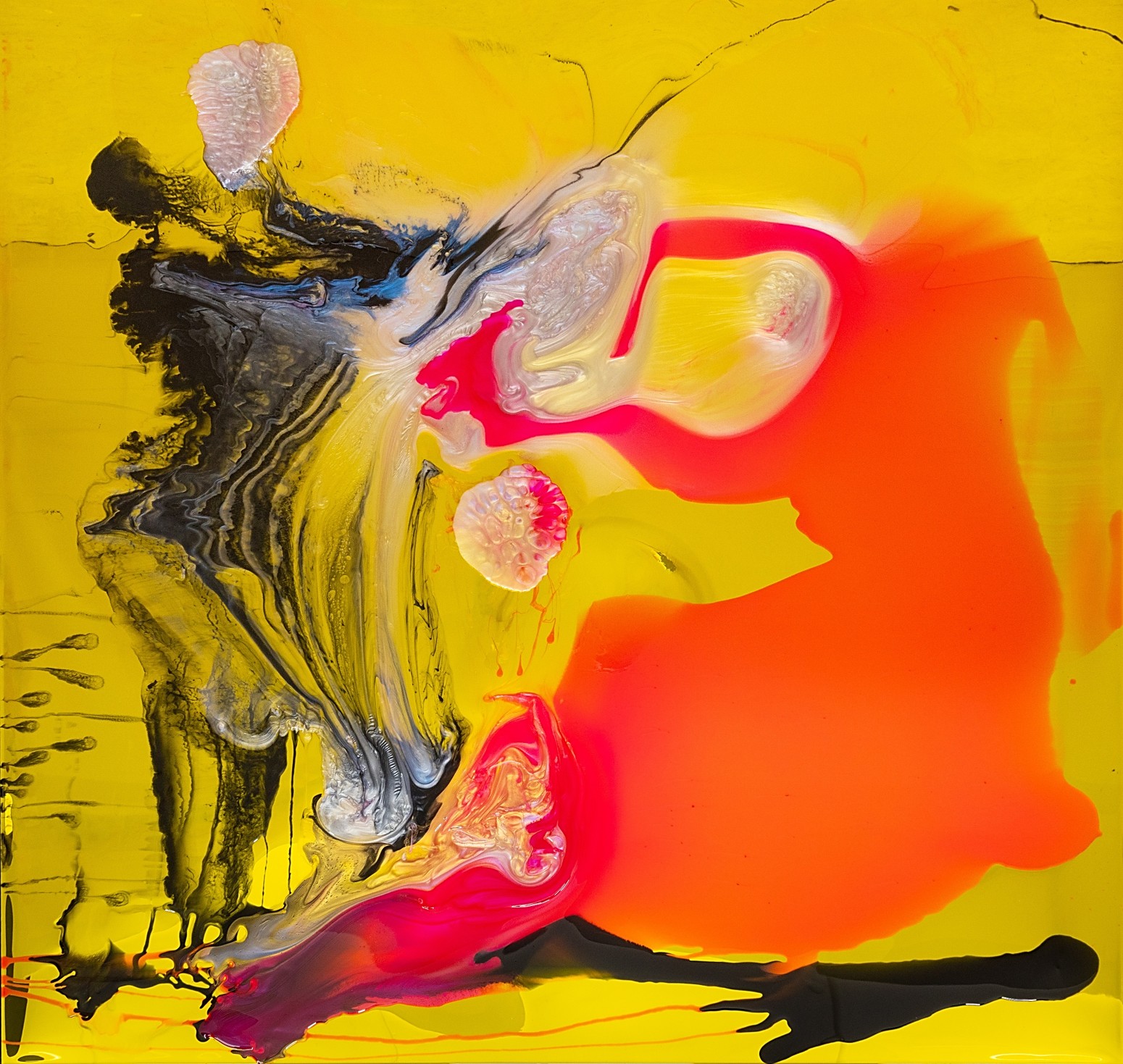
Dale Frank, Lighter the sun slowly rose really blinding, blackening their mood, 2026, colour powder pigments in Epoxyglass, Epoxyglass, on perspex, 200 x 200 cm.
From the moment you ascend the gallery’s stairway, the installation announces itself. There is decadence to the density of the presentation, yet it never tips into overwhelm. To place these paintings in a more minimalist proposition would deny their intensity and impressive presence. Singularly, they float. Combined, they are magnificent, almost mural-like and enveloping a la Italian frescos.
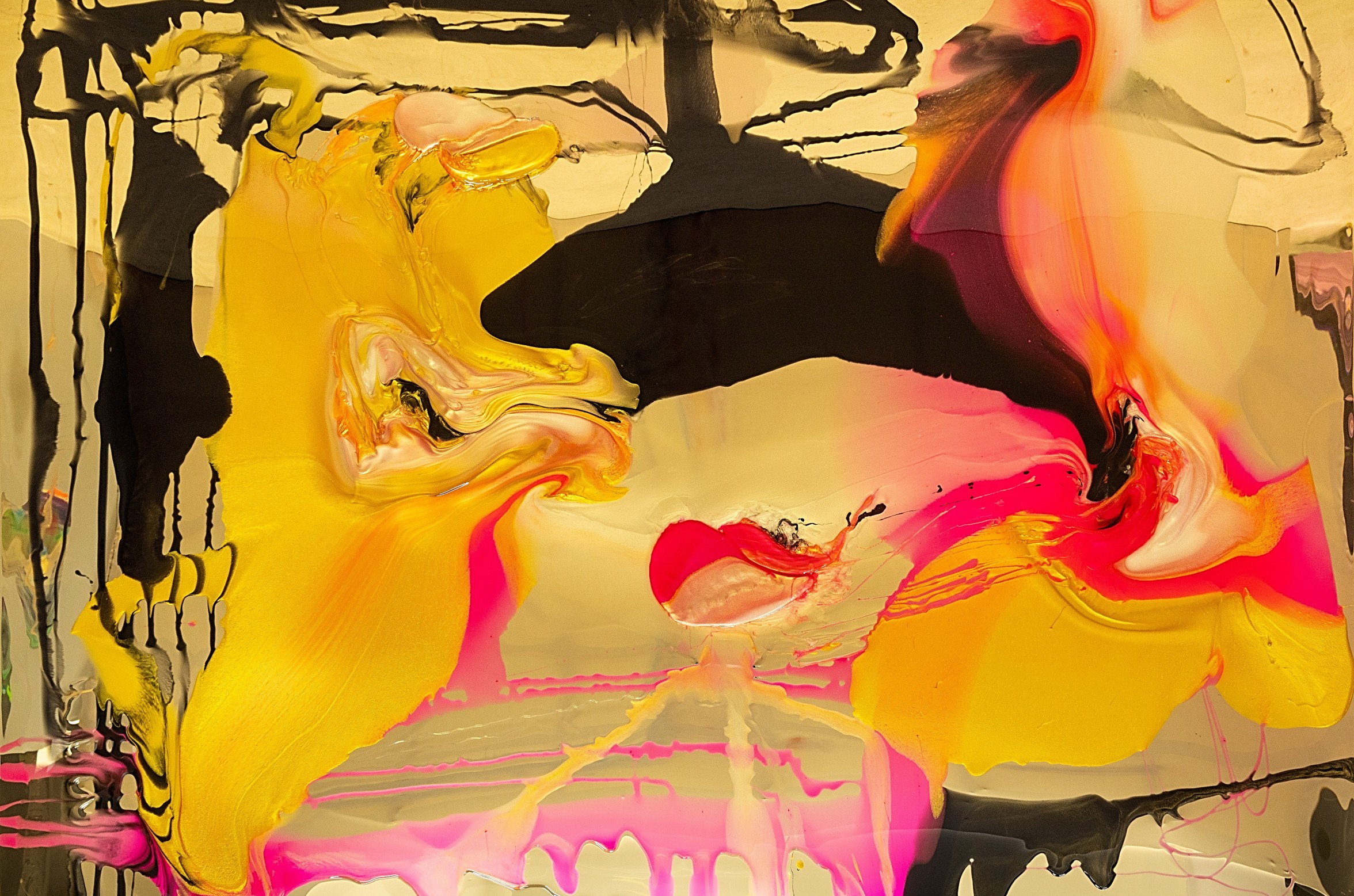
All but one of the paintings stand two metres tall; commanding, expansive, varying in width from square to rectangular but sharing a sense of verticality. The works are made using two modes of application: easycast, producing softer, thinner passages, and Epoxy glass, which generates the protruding, almost geological elements that push out from the picture plane. Frank’s surface fetishism is paramount. These are paintings that are as much about material as about image, as much about process as about meaning. And yet they are rich with both.
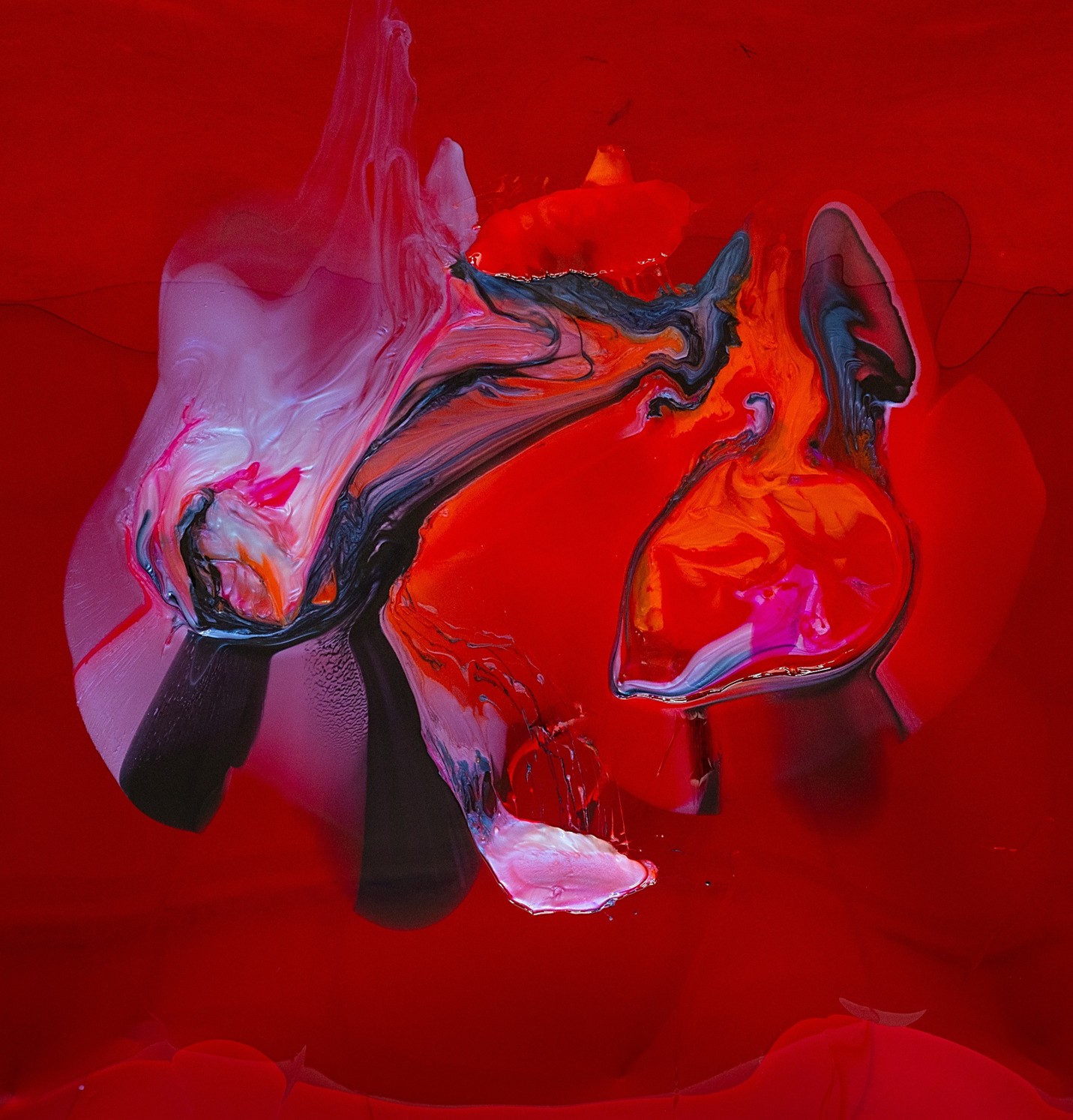
Dale Frank, His eyes collided side to side in a dance floor disco embrace, his receding dick shuddered up and down, his exhausted breast strained, his sinuous muscles sagging balloons like an old ladies underarm flab, the vanilla cream filling of his life licked off, 2026, colour powder pigments in Epoxyglass, Epoxyglass, on perspex, 200 x 180 cm
Frank produces surfaces of extraordinary luminosity and depth. Liquid and geological at once, his marks pool, billow, and calcify into forms that hover between the biological and the cosmic. There is something of the deep ocean in them, something of the microscopic slide, something of weather systems seen from altitude. The works read simultaneously as macro and microcosm: intergalactic worlds, galaxies far away, the subconscious, Rorschach fields, the mind’s eye, Frank himself. And yet they resist all such analogies. Frank has always been clear that his paintings are about painting, that form is content, surface is substance, and standing before them, the argument becomes self-evident. Moreover, Frank’s titles do considerable work. Long, syntactically peculiar, cut from the vernacular of inner lives and private comedies, they operate as a kind of verbal analogue to the paintings: digressive, vivid, and at times devastating.
Lighter the sun slowly rose really blinding, blackening their mood, 2026, burns in saturated cadmium yellow, its surface worked into tides of black, pink and red, both meteorological event and emotional weather at once. In the deep crimson field of She needed to declutter her life and her bedroom, 2026, hot magenta and orange forms erupt through pink grounds with barely contained energy. Elsewhere, we enter into something almost Botticelli-esque in its richness: He often said he was too busy to be lonely imagining that he was running the country’s largest porn film production company, 2026, where soft blues emerge from creamy celestial voids, and the wit of the title sharpens rather than deflates the visual pleasure. The largest work, Lionel and Jake have an enormous collection of Christmas albums and singles, 2025, unfurls in acid yellow, magenta and black—a painting that demands full bodily attention.
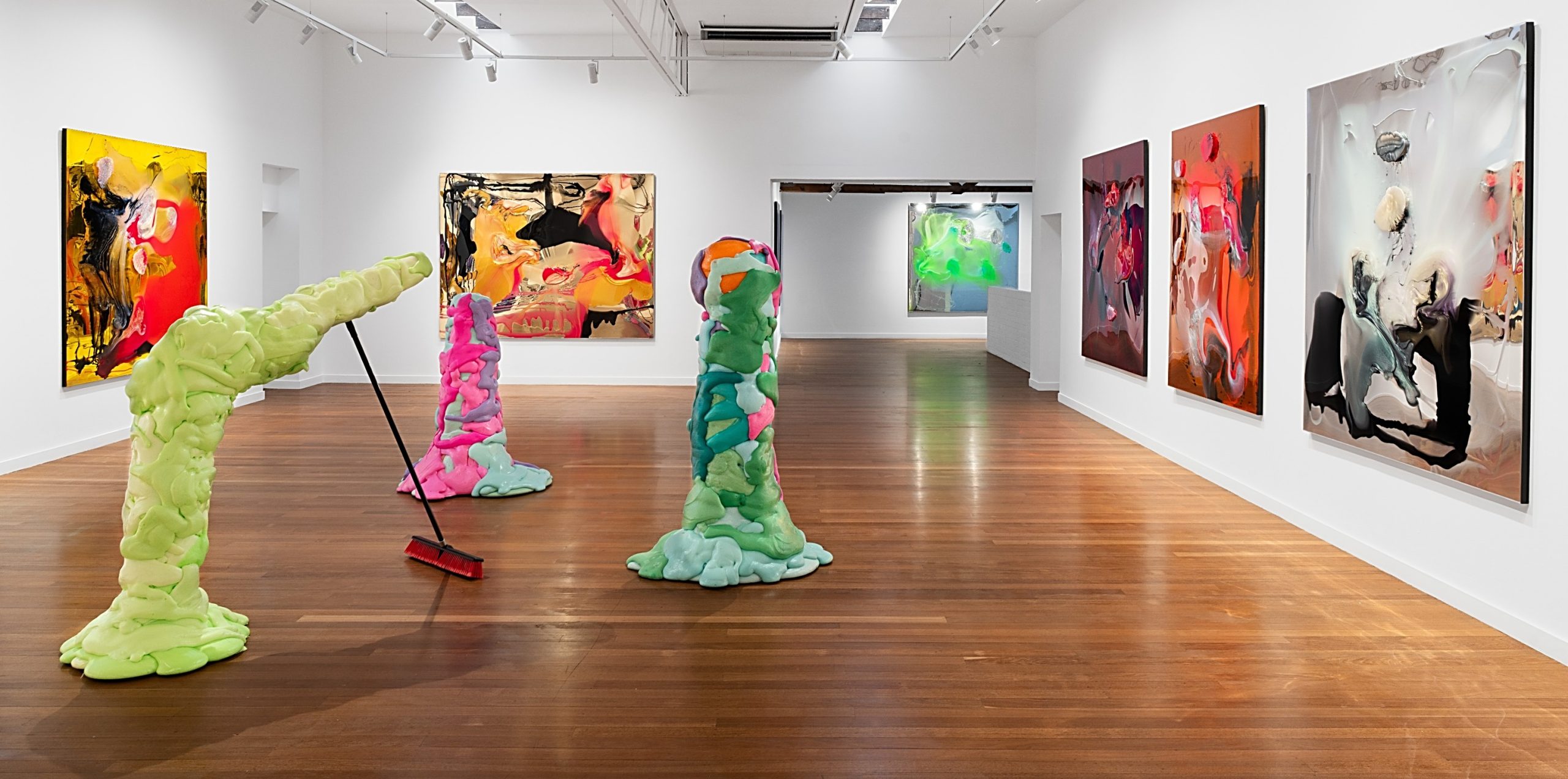
Installation view: Dale Frank: Chicken Soup, Roslyn Oxley9 Gallery, Sydney.
Three totemic sculptures in flexible polyurethane foam, wire and cloth titled: He was scared of his own shadow; Wired, he never got to sleep in; and A dead homeless man simulating bending to reach perfection, all 2026, occupy the main gallery with an almost aggressive cheerfulness. Lumpen, frankly phallic, oozing in visceral lime green, fuchsia and aqua, they recall playground equipment filtered through an art historical consciousness stretching from Lynda Benglis to Martin Kippenberger. Wholly experimental in register, yet entirely aligned with Frank’s sensibility.
Colm Guo-lin Peare, writing about Frank in Vitamin P4: New Perspectives in Painting (Phaidon, 2026), posits that his formalist paintings reflect our own narcissistic fantasies: “when form becomes content, when painting is about painting…,” the surfaces offer only our own reflection. It is an astute interpretation. However, Chicken Soup is too warm, too alive with wit and feeling, to be read as purely cold formalism. These paintings, as metaphor for food for the soul, demand attention, and desire something of you. One posits that most visitors will find themselves glad to have succumbed.
Exhibition
Chicken Soup
17 April – 16 May 2026
Roslyn Oxley9 Gallery, Sydney
Sarah Hetherington is an art, architecture and design writer based in Sydney.

Under the auspices of Geelong Gallery’s director, Humphrey Clegg, and co-curated by Marianne Mathieu, former scientific director of the Musée Marmottan Monet, and Claire Durand-Ruel...
Nike Savvas: Purple Haze presents intimate screen prints and immersive large-scale installation and video work by Savvas from 2005–2026, each evocative of different places and...
Although physically he is of modest stature, Zofrea has devoted much of his life to grand projects that have been conceived and executed on a...
Through a multidisciplinary collaboration between Rotterdam-based curators, architect Paul Cournet of CLOUD and artist-designer Sabine Marcelis of Studio Sabine Marcelis, the exhibition explores the interplay...
Artificial intelligence will be used by young artists who started using it as kids on their phones. They will see it as a natural extension...

This year’s Biennale arrives under more complex circumstances than most. It is shaped by the profound loss of its curator, Koyo Kouoh (1967–2025), whose exhibition...
No artist creates in isolation. Every painting carries traces of the conversations, places and histories that shaped it, preserving within its surface a particular moment...
The weekend markets at Fairfield Showground have been one of Western Sydney’s great institutions for more than fifty years. Fresh fruit and vegetables, children’s clothes,...
In recent times, Yorgos Lanthimos has shifted toward photography, noting in a Guardian interview, 2026, that he needs respite, saying, “it might be a couple...