REVIEW | Jen Valender: (It is Necessary to) Learn to Swim and Chaohui Xie: 18 Generations
In two exhibitions that merge into one, Project8 Gallery unveils a meditation on what persists and what slips away. Across "(It is Necessary to) Learn to Swim," featuring the work of Jen Valender, and "18 Generations," showcasing Chaohui Xie, a shared sensibility emerges, one that treats decay and inheritance as ongoing processes rather than fixed histories. Materials fade, surfaces wear, images dissolve, yet traces remain, carrying memory forward in unstable forms. Whether through the aftermath of environmental catastrophe or the quiet erosion of ancestral connection, each work circles the same condition: that what shapes us is often already disappearing.

Operating within a commercial framework yet not representing artists, Project8 allows for a greater sense of curatorial freedom, privileging thematic and carefully considered exhibitions over fixed affiliation. The expansive gallery, connected to Art @ Collins and the University of Melbourne, is curated by Kim Donaldson with Jiayang Zhang.
Carrying the same title as the exhibition, (It is Necessary to) Learn to Swim, 2025, a moving-image installation opens the space: a screen reclines on a chaise longue, surrounded by books recovered from Lismore after the 2022 floods. As I enter, the work positions me within a reconstructed counselling setting. While grounded in questions of human impact and climate change, Valender draws on memory and childhood. A miniature replica of the installation sits within the work, rendered in resin and paper, restaging the scene at a childlike scale. Looking back at this earlier self, Valender seems to ask, “how did I get here?” and, in turn, asks us, “how did we get to this point?” What feels like self-reflective questions create an introspective, almost therapeutic atmosphere.
Across her body of work at Project8 Gallery, Valender repeatedly incorporates remnants of extreme events such as fires and floods. In Out-of-Place Talismans (tails), 2026, and Out-of-Place Talismans (teeth), 2026, timber drawers salvaged from a fire-damaged printing press bear the impressions of missing objects; letters are gone, yet their outlines remain.
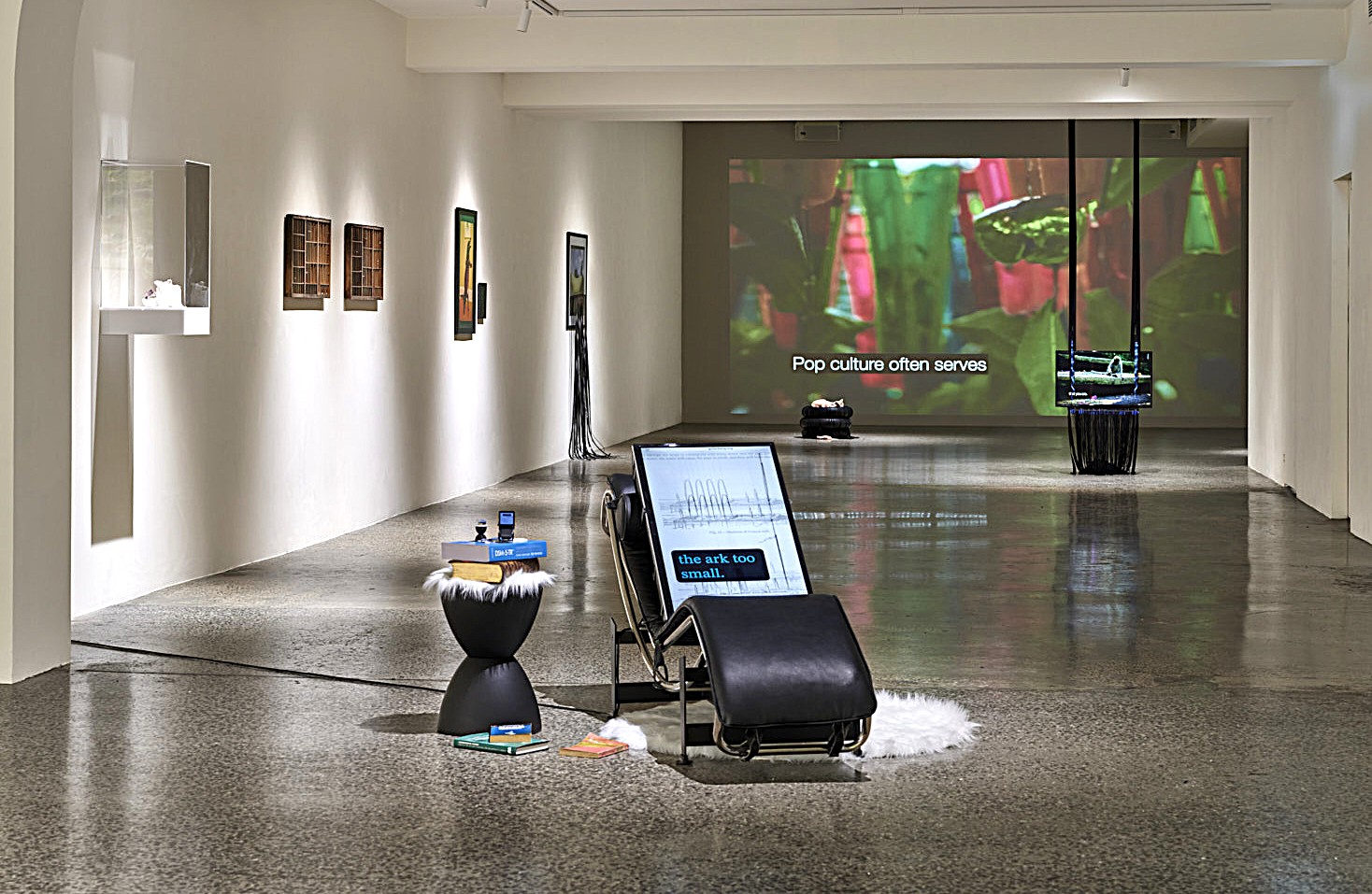
Exhibition view (from front to back): Jen Valender, (It is Necessary to) Learn to Swim, 2025; Humanity’s Wickedness I, 2026; Humanity’s Wickedness II, 2026; Out-of-Place Talismans (teeth), 2026; Out-of-Place Talismans (tails), 2026; Inventory of Collectables After the Flood (Lismore): Please No Alligators I, 2026; Inventory of Collectables After the Flood (Lismore): Please No Alligators II, 2026; Inventory of Collectables After the Flood (Lismore): Big Banana Righteousness, 2026; Recounting Lore for Monarchs, 2024; No Cats (God Regrets Creating), 2026; Recounting Lore Reading Circle, 2024; Announces Decision to Destroy, 2026.
In the video projection Recounting Lore Reading Circle, 2024, Valender examines a cultural fixation on imminent danger. In media, art, and politics, crisis is continually invoked yet rarely considered beyond mention. She speaks of “climate fantasy” and “climate fiction,” insisting that these are not speculative constructs, but realities produced by human impact. Positioned at the back of the gallery, the video clarifies the urgency of her stance. Where other works gesture toward disappearance, this piece speaks directly and insistently. Together, Valender’s works suggest that human extinction is self-inflicted, presented both abruptly and cumulatively. The video demands recognition; it asks not to be watched, but to be seen. The exhibition’s title echoes this insistence. It is Necessary to Learn to Swim is not an invitation or suggestion, but a condition. Learning to swim is urgent, immediate. Valender exposes the gap between awareness and action, emphasising the immediacy of the unfolding climate crisis.
Moving to the other side of the room, I encounter 18 Generations, where five works by Chaohui Xie hang together, exploring themes of family, heritage, immigration, and memory. A thread runs through them: the binding force of lineage, and the responsibilities that come with it. There is a quiet questioning of accountability to those who came before and those who follow. Do they shape us, and are they, in some way, accountable for who we become?
A recurring typography of numbers grounds ideas of generations and heritage in something measurable. These concepts are revealed as quantitative, giving them a sense of tangibility, as if they can be counted, ordered, and contained, pointing to time, age, and lineage.
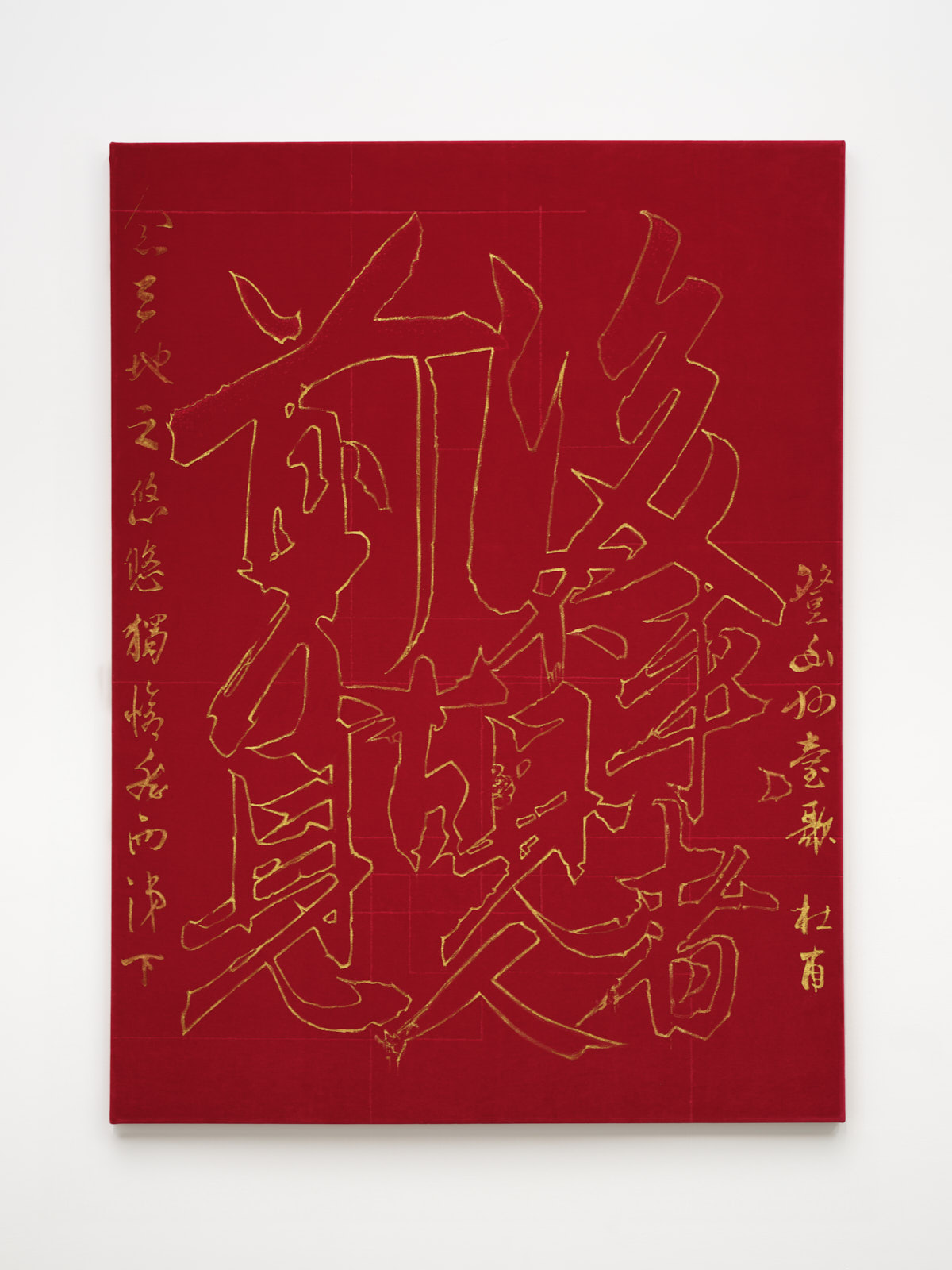
Chaohui Xie, Destined to Never Meet (Shāng商), 2026, Gold metallic paint on red velvet, 140 x 105 cm.Photographed by Lucy Foster.
Set against velvet, red, yellow, and gold take on a particular resonance in Destined to Never Meet (Shāng 商), 2026, and Destined to Never Meet (Shēn 参), 2026. The fabric’s softness suggests intimacy, even reverence, recalling drapery or adornment, while its weight lends the works a sense of gravity. Together, they produce a sensorial richness that feels both opulent and distant, as if inherited through time rather than directly experienced. The surface shows signs of decay, the paint thinning, the fabric wearing. This slow deterioration introduces a temporal dimension: heritage not as something fixed, but as something that fades, shifts, and is re-encountered imperfectly. It carries a sense of nostalgia, but also of loss, as memory persists unevenly in the present.
Having immigrated to Australia, what remains of Xie’s heritage appears in these works as something spectral. An ancestral presence hovers at the edge of what I can make out, unable to be directly represented, only felt or traced through absence. The paintings hold a quiet energy, something still yet charged, which reads as almost spiritual.
Disappearing (1), 2026, and Disappearing (2), 2026, feel gestural. Broad, rapid strokes move across the surface with a sense of immediacy, as if driven by intuition and compulsion. The numbers reappear but now seem to dissolve into the act of painting itself. To search for the past, for ancestors, is to pursue something already undone. What remains instead are residual forces that Xie invokes in her brushstrokes.
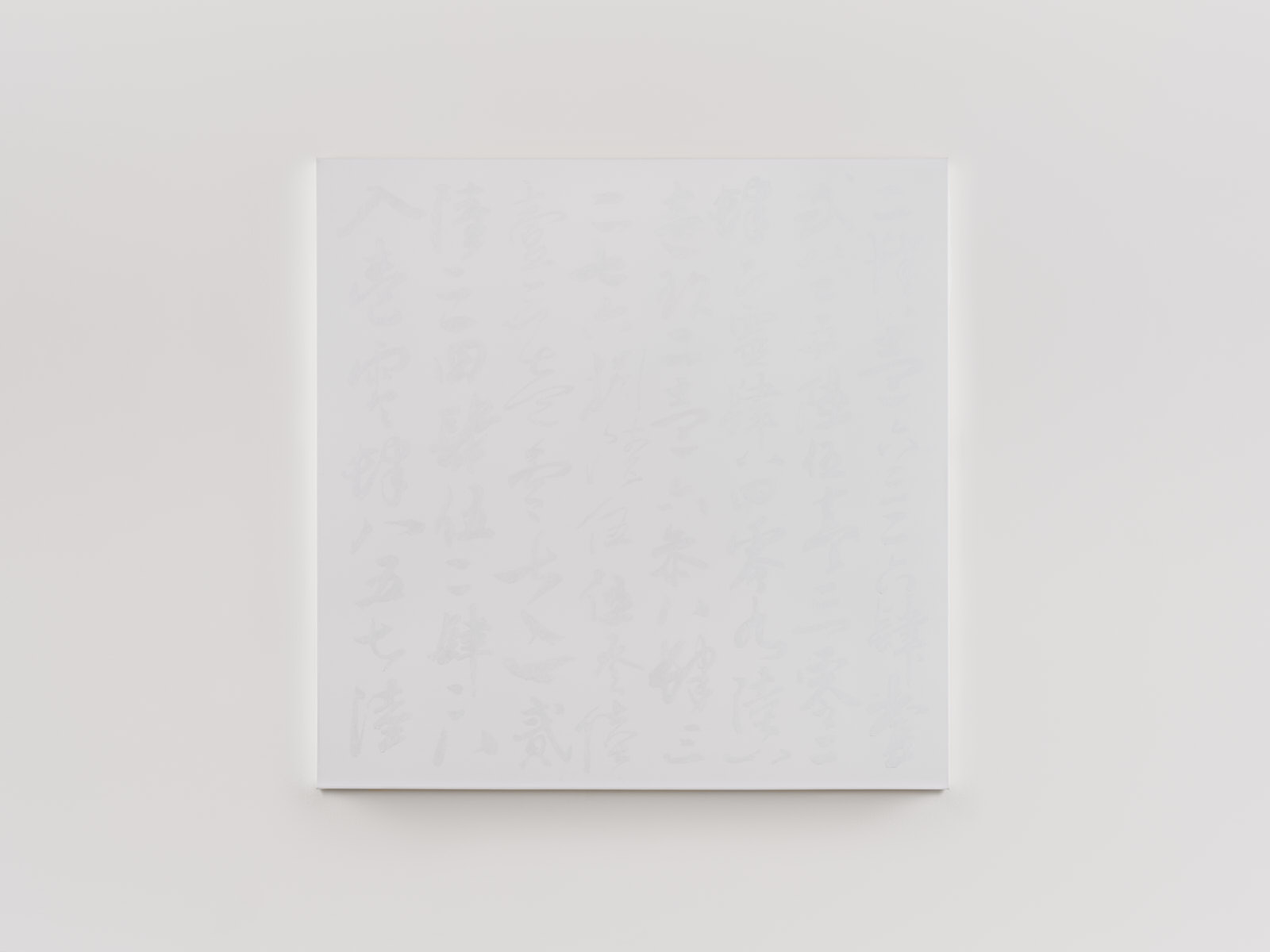
Chaohui Xie, Nearly Apparent (1), 2026 (detail). Oil and acrylic on canvas, 122 x 122cm. Photographed by Lucy Foster.
Across these works, the act of engaging with ancestry and heritage feels complex, even painful. It is not something that can be seen clearly. When memory falters, history becomes diffuse. In Nearly Apparent (I), 2026, this tension comes to the fore. Forms hover on the edge of visibility, never fully resolving.
Together, these exhibitions refuse resolution, keeping me suspended in the precarious space between memory and loss. In this tension, both artists insist that to look closely is not to recover the past, but to recognise how its traces continue to shape and unsettle the present.
Exhibition
Jen Valender, (It is Necessary to) Learn to Swim | Chaohui Xie, 18 Generations
28 February 2026 – 11 April 2026
Project8 Gallery, Naarm Melbourne
Images courtesy of Project8 Gallery and Lucy Foster
Amélie Blanc is a curator and writer based in Naarm Melbourne
Edwards was born on Kaurna Yarta in 1998 and raised on Nauo Country in the small seaside community of Tulka, on the Lower Eyre Peninsula....

Under the auspices of Geelong Gallery’s director, Humphrey Clegg, and co-curated by Marianne Mathieu, former scientific director of the Musée Marmottan Monet, and Claire Durand-Ruel...
Nike Savvas: Purple Haze presents intimate screen prints and immersive large-scale installation and video work by Savvas from 2005–2026, each evocative of different places and...
Although physically he is of modest stature, Zofrea has devoted much of his life to grand projects that have been conceived and executed on a...
Through a multidisciplinary collaboration between Rotterdam-based curators, architect Paul Cournet of CLOUD and artist-designer Sabine Marcelis of Studio Sabine Marcelis, the exhibition explores the interplay...
Artificial intelligence will be used by young artists who started using it as kids on their phones. They will see it as a natural extension...

This year’s Biennale arrives under more complex circumstances than most. It is shaped by the profound loss of its curator, Koyo Kouoh (1967–2025), whose exhibition...
No artist creates in isolation. Every painting carries traces of the conversations, places and histories that shaped it, preserving within its surface a particular moment...
The weekend markets at Fairfield Showground have been one of Western Sydney’s great institutions for more than fifty years. Fresh fruit and vegetables, children’s clothes,...