REVIEW | Women Photographers 1900–1975: A Legacy of Light
A century of female photographers distilled: revelatory, rigorous, and yet sharply bounded by the 1900–1975 frame.
Women Photographers 1900–1975: A Legacy of Light draws on more than 300 photographs and photomedia from the National Gallery of Victoria’s (NGV) collection and the affiliated Shaw Research Library. The Gallery’s curator Maggie Finch shapes material that is disparate in subject, technique, and intention into a coherent passage through photographic modernity. Viewers are reasonably asked to read women’s image-making not as a marginal supplement, but as vital practices embedded in the century’s visual languages.
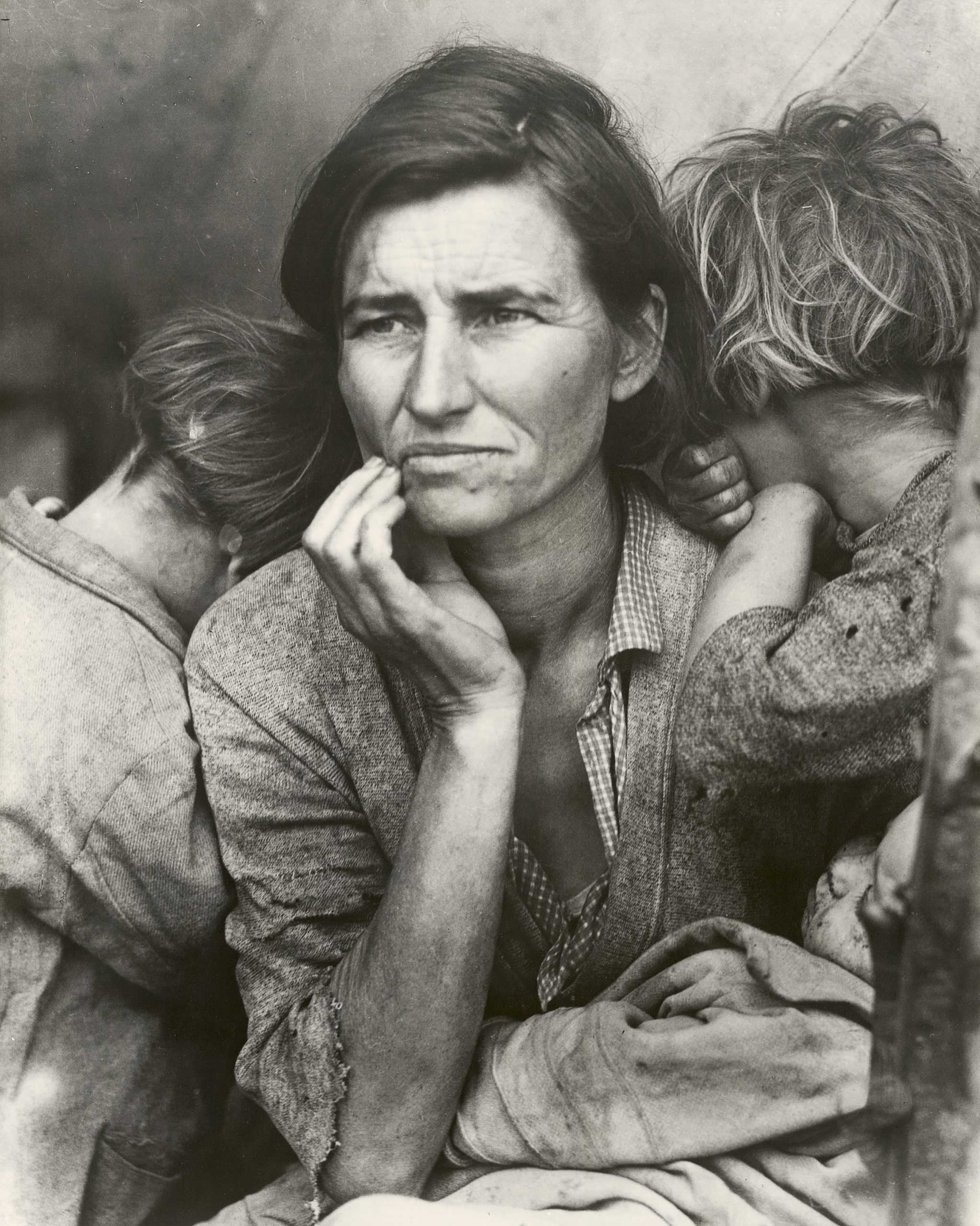
Dorothea Lange, Migrant mother, Nipomo, California, 1936, gelatin silver print (printed c. 1975), 49.4 × 39.6 cm. National Gallery of Victoria, Melbourne.
The exhibition is also a demonstration of long-term institutional strategy. With more than 170 works acquired in recent years—supported largely by Krystyna Campbell-Pretty AM and the Bowness family—A Legacy of Light reads less like a one-off survey than the public articulation of sustained collection-building, leaving a permanent resource rather than a temporary, resource-intensive gathering of loans. Yet the pragmatics are not neutral. Like other recent NGV collection exhibitions, this one is ticketed. The decision is understandable in an era of rising costs, but it introduces a grating note: while the show is framed as a corrective to histories of exclusion, the entry fee becomes an access barrier and inevitably reduces the audience.
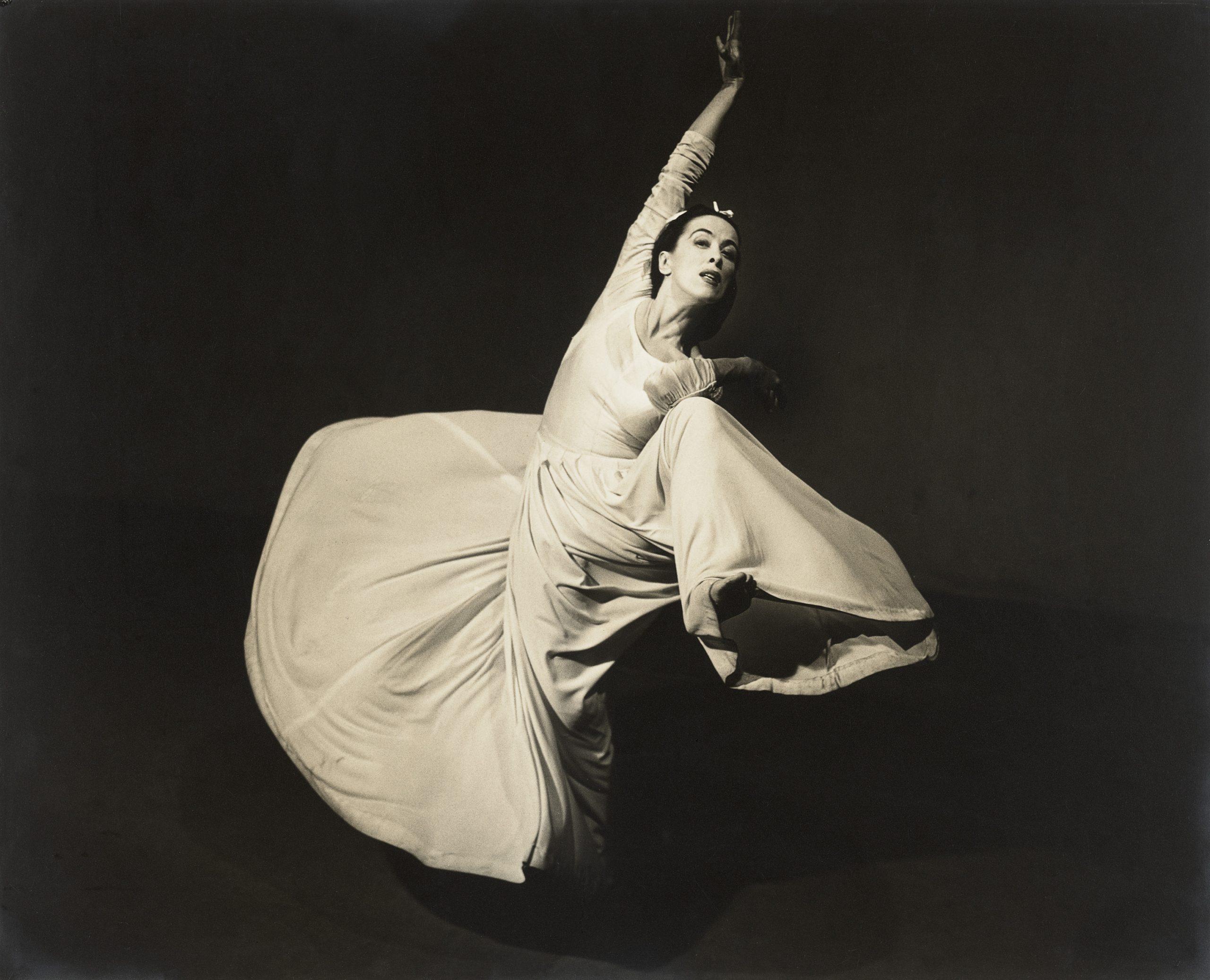
Barbara Morgan, Martha Graham – Letter to the world, 1940, gelatin silver print, 38.9 x 48.2 cm, National Gallery of Victoria, Melbourne. Bowness Family Fund for Photography, 2024. The Barbara Morgan Estate.
The chosen time frame, 1900 to 1975, is defended through clear markers: suffrage on one side, the United Nation’s International Women’s Year on the other. Still, the cut-off can feel slightly arbitrary, especially given how much energy women photographers gather throughout the 1970s and thereafter. The bracket sharpens awareness of what sits just outside it: not only key works held elsewhere, but the chance to show how conditions of recognition changed—including the rise of Aboriginal and Torres Strait Islander photographers such as Brenda L. Croft, Destiny Deacon and many others. Sydney’s Australian Centre for Photography opened to students in 1973 [incidentally, it was also recently acquired and rebranded by Sydney’s, Powerhouse Museum of Applied Arts & Sciences in 2022]; students emerging from places such as Prahran College, including Carol Jerrems and Jacqueline Mitelman, quickly shaped a new vernacular. Both artists feature here, but the strict stop at 1975 heightens the sense of what cannot be shown: the absence of key loans—Jerrems’s Vale Street, 1975, for instance—and bodies of work that consolidate soon after, such as the Macquarie University 1977 series. At the same time, a much wider sweep would be a different, likely unwieldy, exhibition, and perhaps a poor trade for the clarity Finch achieves within the chosen dates.
Early rooms set a quiet, attentive tone through portraiture: Ruth Hollick’s Thought,1921, has an inward charge, while Madame d’Ora’s decadently costumed The Dolly Sisters, c. 1928, opens onto glamour and artifice. Trude Fleischmann’s portrait The actress Sibylle Binder, Vienna, c. 1926, captures the “New Woman” as sleek, self-possessed, and androgynous, while Gertrude Käsebier’s The gargoyle, c. 1900, reads in retrospect as a foreshadowing of later performance work.
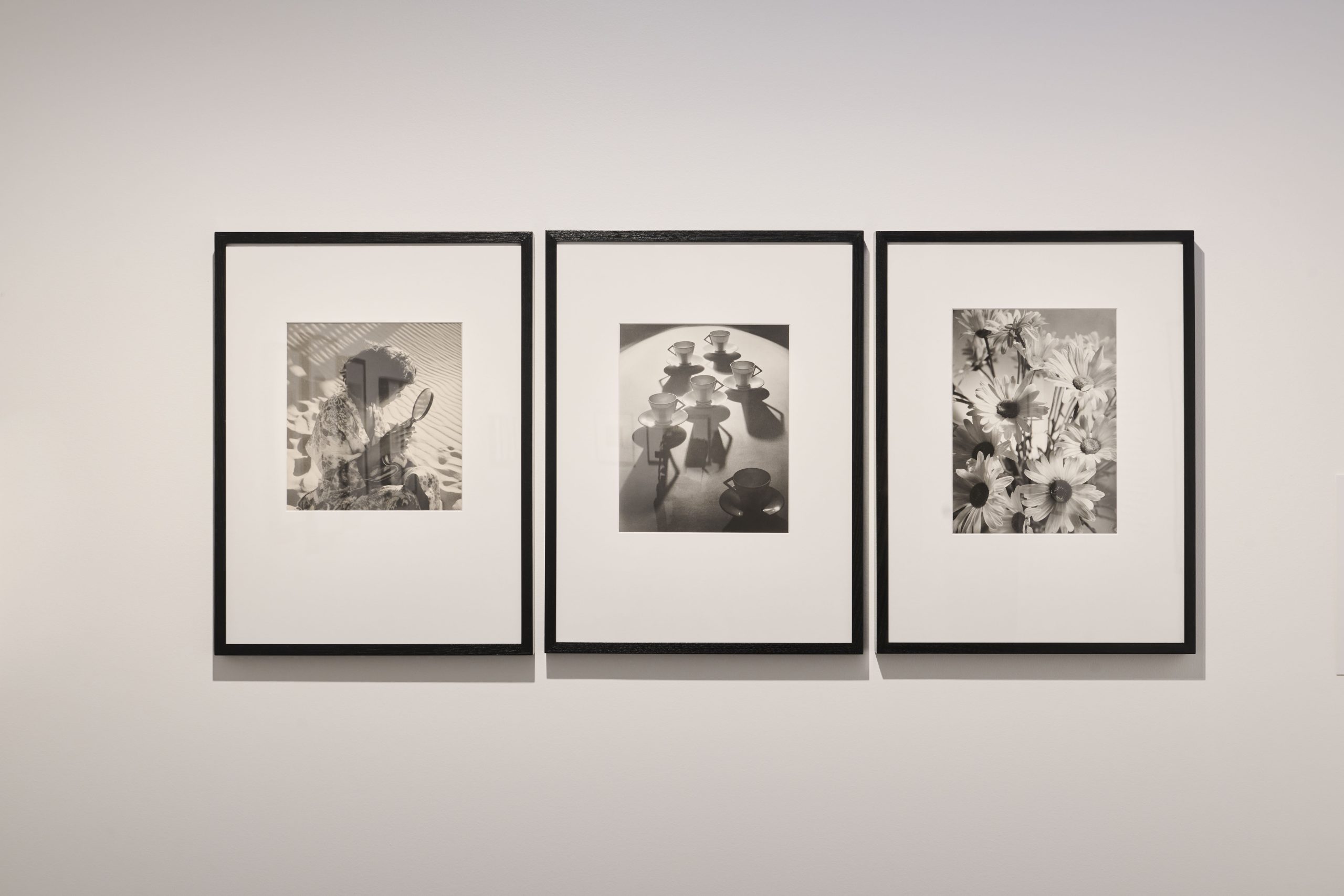
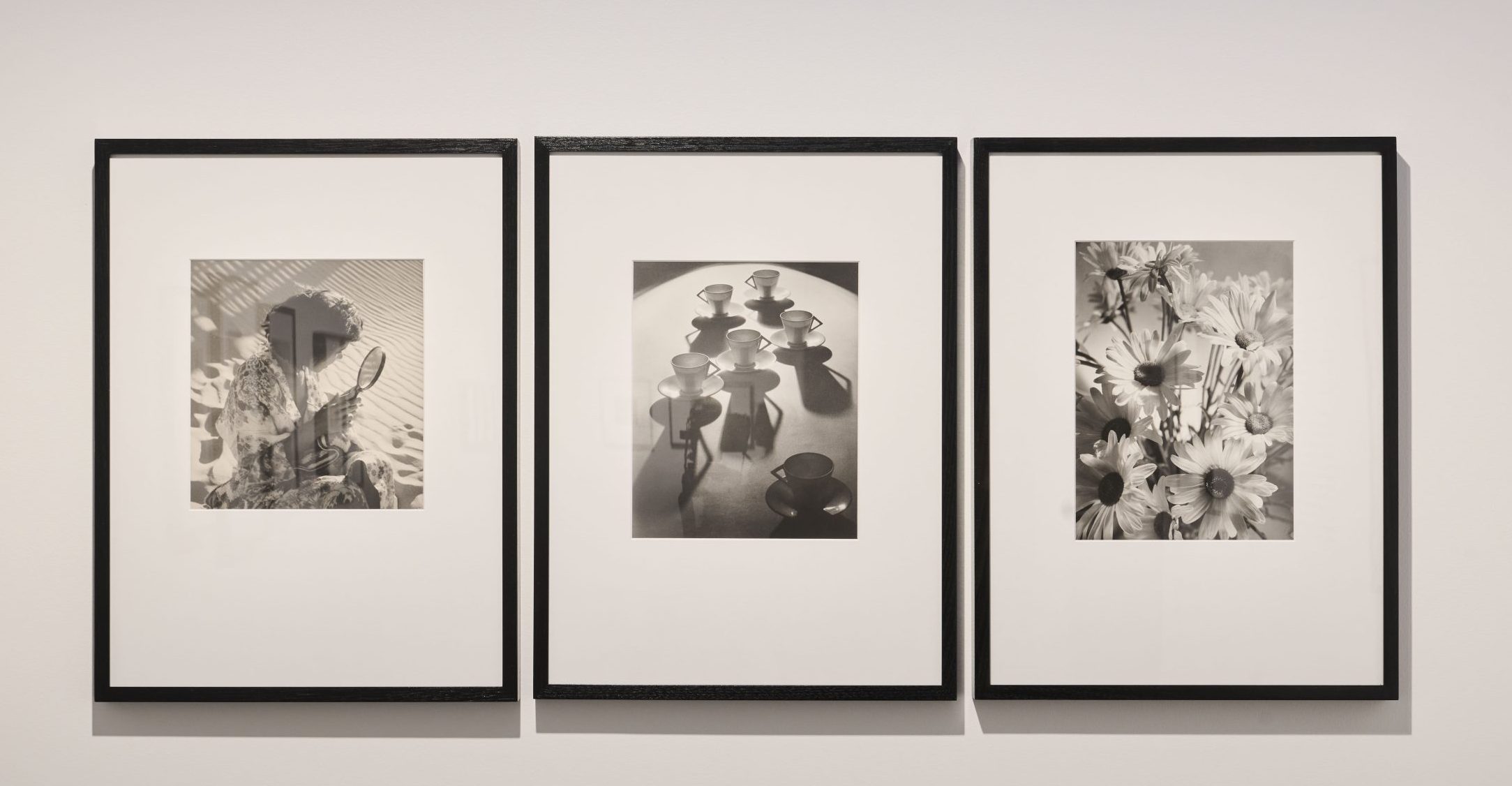
Installation view: Women Photographers 1900–1975: A Legacy of Light, 2025-26, National Gallery of Victoria International. Photographed by Eve Wilson.
The early consolidation around Germany’s Bauhaus (1919–1933) influence is equally persuasive. Yamawaki Michiko’s miniature street photographs from 1933 introduce a crisp vision of the everyday, followed by concise experimental invocations of still life and the natural world: Elsa Thiemann’s dazzling opticality in Design for Wallpaper, 1930–31, Florence Henri’s dynamic, almost cinematic Nature morte (Still life), 1931, and Olive Cotton’s graphic whimsy in Teacup ballet, 1935.
Grace Lock’s The Fly, c. 1960s, shifts the register again. A dragonfly rests on a slightly withered shoot against a finely toned sky—cloud in one corner, jewel-like wings in the other—and the resulting stillness is both captivating and faintly unnerving. Lock achieves something rare: an image that holds the vibrancy, delicacy and fragility of life at once. It sits beautifully alongside Ruth Bernhard’s Two leaves,1952, and Imogen Cunningham’s iconic Agave Design I, 1920s, which reshape the natural world with geometry: precise lines, bold forms, and light and shadow elevating composition to subject.
A sustained exploration of the city and the built environment follow, and Berenice Abbott’s New York at night, 1932, hums: bold diagonals of the city grid emerge from inky blackness, overlaid with lattices of windows lit like pinpricks. Margaret Bourke-White’s Beach accident, Coney Island, 1952, sharpens the macro–micro tension. The aerial view first reads as pattern and density, then tightens into a psychological image as beachgoers crowd around the injured subject: a vortex of attention that could, at a distance, be mistaken for an insect swarm. Germain Krull’s portfolio Métal,1928, and adjacent, Eve Sonneman’s Real Time, 1968–74, and Hilla and Bernd Becher’s Coal tipple, Goodspring, Pennsylvania, 1975, exemplify seriality, accumulating meaning with each image and eschewing the decisive moment. A handful of surrealist and Dada photomontage experiments enliven the corners, but Lotte Jacobi’s Dancer #16, Pauline Koner, New York, c.1937, and other “Photogenics” are a restrained, standout counterpoint.
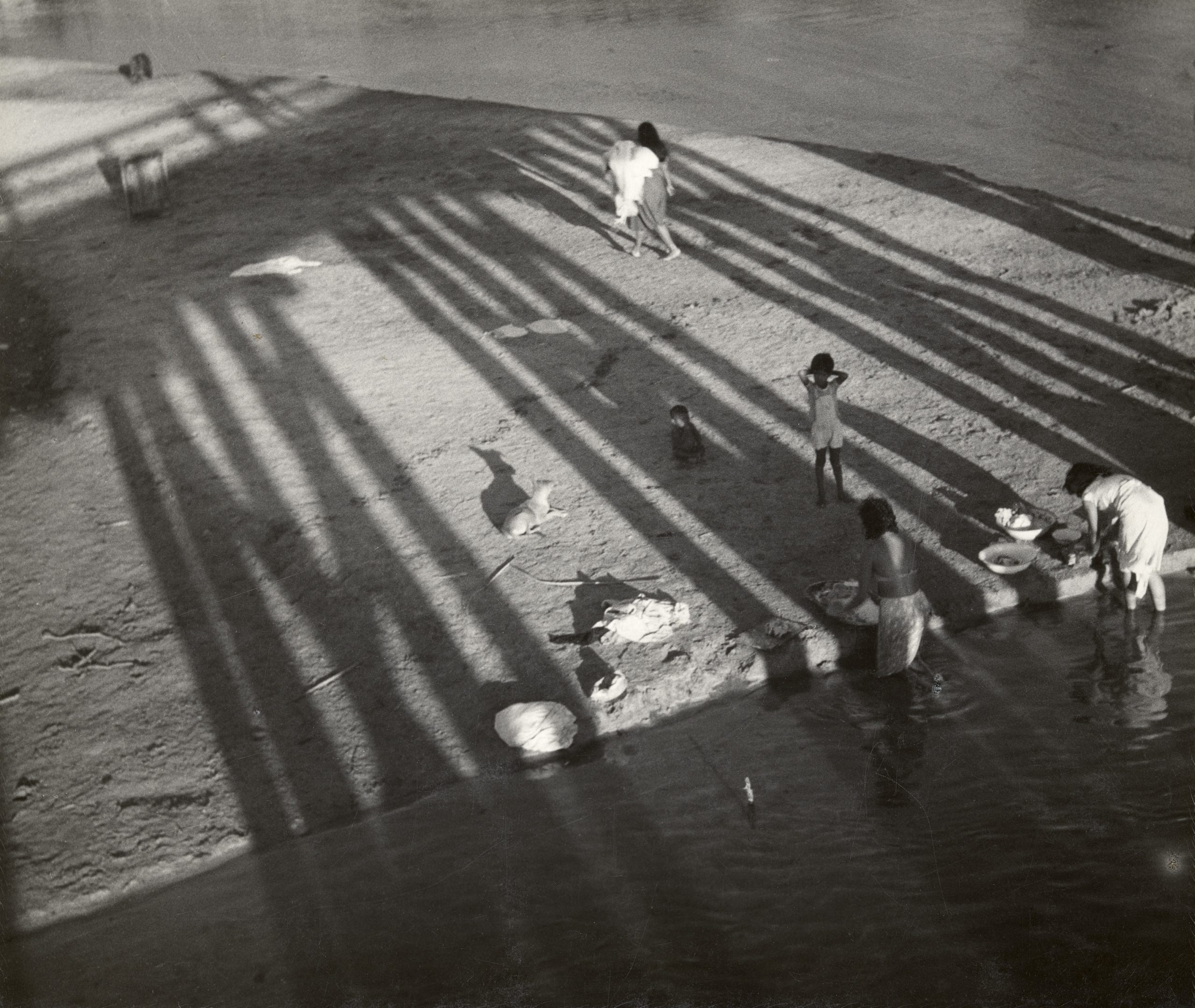
Lola Álvarez Bravo, The washerwomen (Las Lavanderas), c. 1950, gelatin silver print on cardboard, 18.9 × 22.3 cm (image and sheet). National Gallery of Victoria, Melbourne. Bowness Family Fund for Photography, 2024. Center for Creative Photography, The University of Arizona Foundation.
More quotidian rooms addressing social clubs and movements, the photography business and travel are worthwhile, though not quite as aesthetically gripping. That said, the exhibition’s American documentary lineage—Dorothea Lange, Diane Arbus, Marion Post Wolcott, and Consuelo Kanaga among its anchors—remains resonant and increasingly pertinent in the present. The relative social ease of Christine Godden and Sue Ford builds to Ponch Hawkes’s more pointed work, closing the exhibition with playful, politically articulate documentation of the 1970s gay liberation movement.
If the 1900–1975 frame occasionally feels restrictive, what happens inside it rarely is: the works keep insisting on the bristling intelligence of the medium. American art critic and curator Abigail Solomon-Godeau’s catalogue essay is a thoughtful highlight among many solid entries to the accompanying exhibition catalogue.
Exhibition
Women Photographers 1900–1975: A Legacy of Light
28 November 2025 – 3 May 2026
National Gallery of Victoria International, Melbourne.
Images courtesy of the National Gallery of Victoria, Melbourne.
Peter McKay is a curator and writer based in Melbourne.
This article was first published in Artist Profile Issue 74, 2026.
Edwards was born on Kaurna Yarta in 1998 and raised on Nauo Country in the small seaside community of Tulka, on the Lower Eyre Peninsula....

Under the auspices of Geelong Gallery’s director, Humphrey Clegg, and co-curated by Marianne Mathieu, former scientific director of the Musée Marmottan Monet, and Claire Durand-Ruel...
Nike Savvas: Purple Haze presents intimate screen prints and immersive large-scale installation and video work by Savvas from 2005–2026, each evocative of different places and...
Although physically he is of modest stature, Zofrea has devoted much of his life to grand projects that have been conceived and executed on a...
Through a multidisciplinary collaboration between Rotterdam-based curators, architect Paul Cournet of CLOUD and artist-designer Sabine Marcelis of Studio Sabine Marcelis, the exhibition explores the interplay...
Artificial intelligence will be used by young artists who started using it as kids on their phones. They will see it as a natural extension...

This year’s Biennale arrives under more complex circumstances than most. It is shaped by the profound loss of its curator, Koyo Kouoh (1967–2025), whose exhibition...
No artist creates in isolation. Every painting carries traces of the conversations, places and histories that shaped it, preserving within its surface a particular moment...
The weekend markets at Fairfield Showground have been one of Western Sydney’s great institutions for more than fifty years. Fresh fruit and vegetables, children’s clothes,...