REVIEW: Tina Stefanou | Motet Fail
Can sound exist without being heard? Transforming West Space into an immersive backgammon board, Tina Stefanou’s "Motet Fail" approaches this question with quiet insistence.
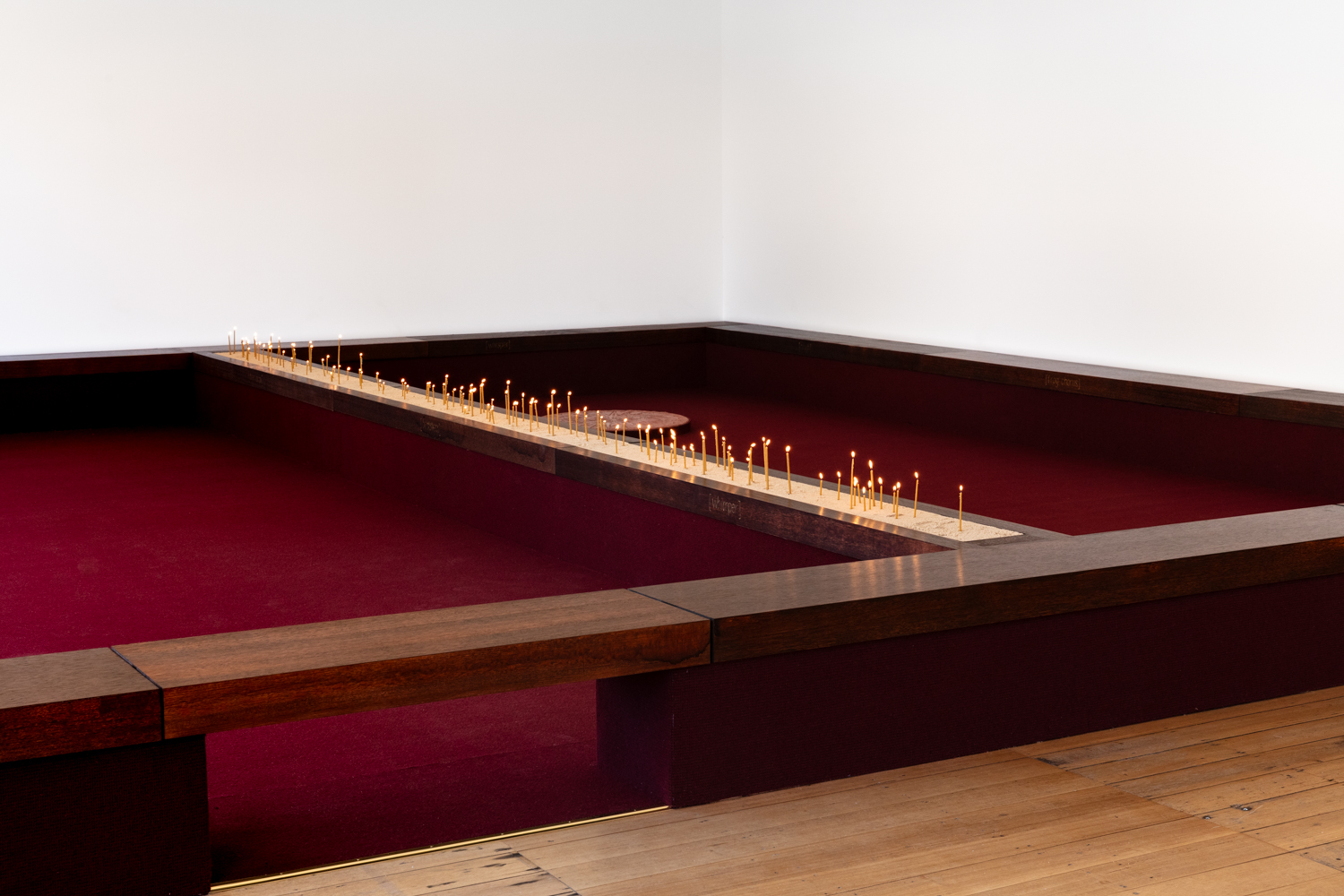
Motet Fail, 2026, reshapes Artist Run Initiative, West Space into an immersive backgammon board that operates as a site of reflection, encounter, and quiet concert. Tina Stefanou collaborated with Romanie Harper and Aldo Bilotta on the design and construction of the set and objects for Motet Fail, and with West Space director and curator Joanna Kitto on the exhibition. The exhibition follows Stefanou’s You Can’t See Speed, 2025, presented at the Australian Centre for Contemporary Art, and functions as its contemplative counterpart. Where the earlier project examined cinema at its perceptual and sonic limits, Motet Fail unfolds as a quieter and more intimate extension.
Based in Wattle Glen, Victoria, Stefanou draws on her upbringing and the cultural and religious practices of her immigrant family, shaped by working-class histories. Informed by her background in vocal training, her interdisciplinary practice centres on embodied connection and multispecies encounters within communities and environments. Horses play an important role in both her life and work, shaped by a decade-long collaboration with young riders. In works such as Wake for Horses, 2021, and Hym(e)nals, 2022, Stefanou explores care, labour and women’s presence within equestrian settings.
In the Motet Fail room sheet, Stefanou writes “The Singing Lesson: Actions for Phono-Chronophobia,” while her brother and collaborator Kosta Stefanou contributes “The Cosmotechnics of Tavli: The First Couple of Rolls.” Written in response to the work, Kosta Stefanou proposes a conceptual framework that reflects on the rules of Tavli and the meanings assigned to different dice rolls, interweaving them with personal stories. While accompanying the installation, the text appears as a work of its own. West Space also commissioned an accompanying online essay by Berlin-based theorist and artist Patricia Reed titled “Choral Stories and Independent Vocality (Thinking with Tina Stefanou’s Motet Fail),” extending the exhibition’s inquiry beyond the gallery space.
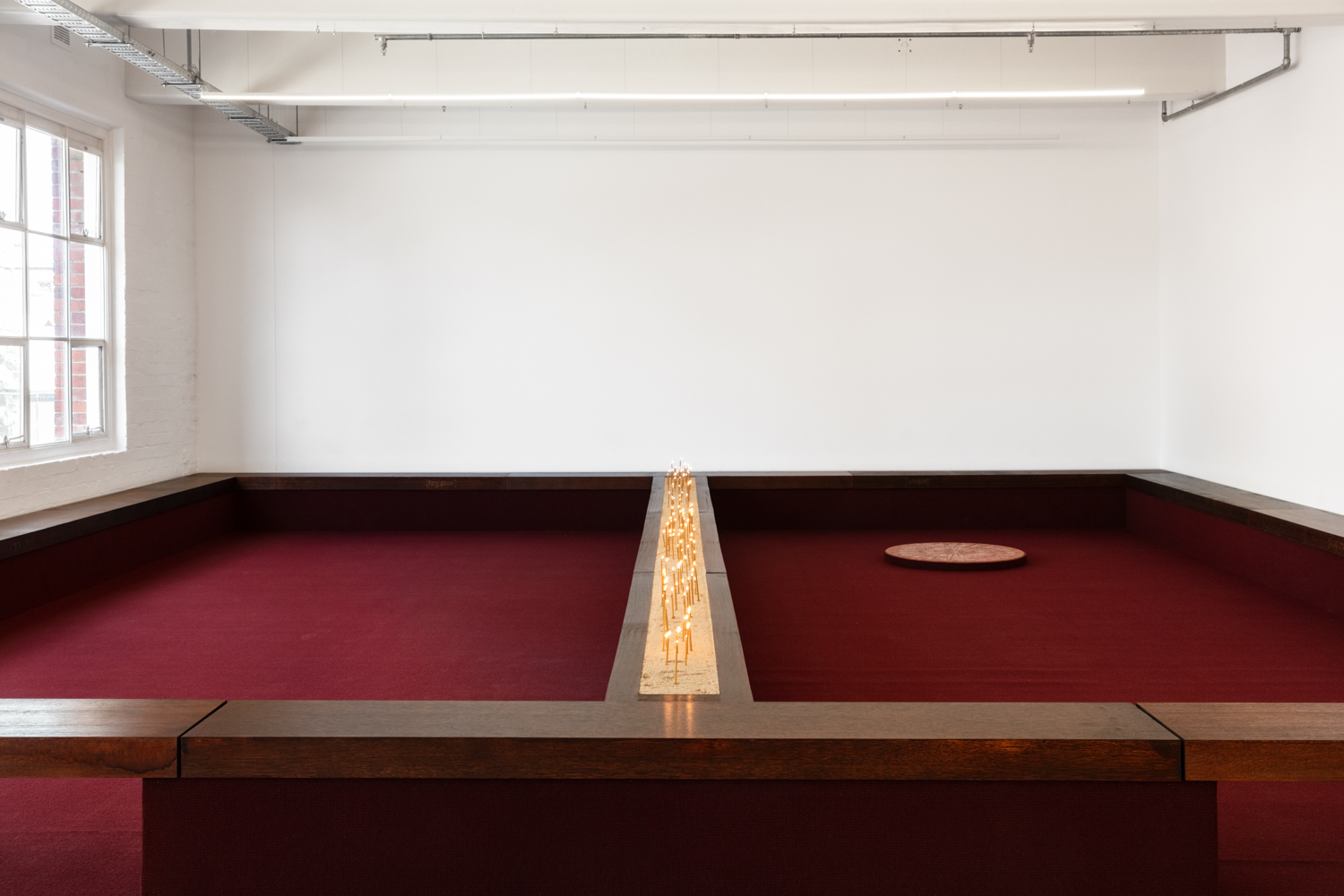
Installation view: Tina Stefanou, Motet Fail, 2026, concrete, carpet, wood, stone, granite, sand, beeswax, fire. Photographed by Janelle Low.
At the centre of Motet Fail lies the structure of a backgammon board, a game integral to Stefanou’s childhood. The backgammon board, also known as Tavli, literally means “board” in Greek and refers to a popular traditional Greek game played with checkers and dice. The board is framed by continuous wooden benches, creating a clear perimeter that both encloses and invites.
Underfoot, a deep burgundy carpet softens the space, filling it with warmth and intensity while muffling sound. Sculptural chip forms rest directly on the ground, enlarging the visual language of the game. The chips are engraved with triangular motifs that recall the points of a traditional Backgammon board. One chip sits within the confines of the board, while others move beyond its edges, resting nearby and even extending into the courtyard at the front of the gallery. In this way, the logic of the game seemed to extend beyond the gallery, moving with me rather than remaining confined to a momentary experience. I became part of the game or perhaps realised I had always been within it.
The displacement of the chips and the removal of the triangular motif from the board feel like another act of silence, as if the game’s original function has been suspended. The carpet, replacing the expected wooden surface, absorbs and disguises sound. A wooden barrier filled with sand divides the board into two halves, with candles planted along its length. Drawing on the sensibilities of artisan craftsmanship and the languages of interior and industrial design, Tina Stefanou reimagines the environment as something to be inhabited.
The human scale of the backgammon board becomes fully immersive. I felt both held and unsettled, positioned inside a structure that preceded me. Like the artworks of Robert Therrien, Motet Fail reverses scales; something that was small and intimate becomes architectural and immersive. Therrien’s famous sculpture No Title (Folding Table and Chairs, Green), 2008, similarly enlarges familiar domestic furniture, giving it an unexpected, monumental presence. When scaled up, these everyday objects become architectural. The shift in scale destabilises perception and repositions the body in relation to the object. Similarly, Stefanou’s inhabitable backgammon board, normally experienced at hand scale, becomes environmental. The intimate becomes spatial. Within Motet Fail, I found myself as both an observer and a playing piece. Submerged within the board, we are rendered minuscule, absorbed into its logic, pattern, and play.
Upon entering, the space drew me into something akin to a guided meditation. Engraved words such as “thunder,” “whisper,” and “long pause” evoke auditory textures without producing sound. These cues function like a dispersed score, conjuring environments through language alone. They feel both universal and intimate, echoing sonic memories embedded in the artist’s history. Additionally, throughout the space, the recurring charm of the Greek evil eye, or Matiasma, signals protection and care. In this way, Motet Fail succeeds through restraint. It cultivates an atmosphere of attentiveness where memory, ritual, and participation quietly converge.
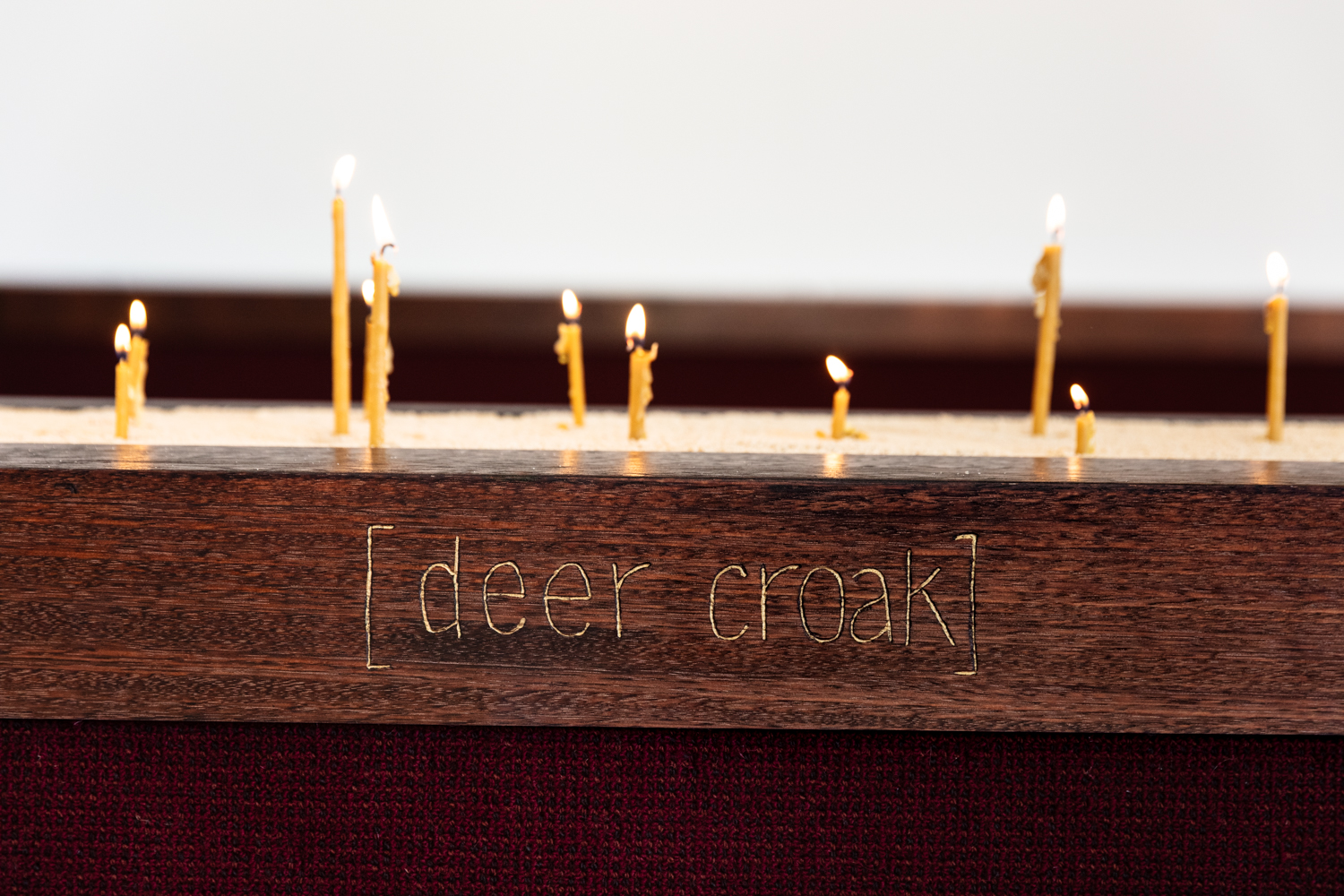
Installation view: Tina Stefanou, Motet Fail, 2026, concrete, carpet, wood, stone, granite, sand, beeswax, fire. Photographed by Janelle Low.
The installation invites a dual mode of participation: stillness and action. The room sheet shares performance prompts, paired with the opportunity to light a candle along a linear bed of sand dividing the room, shifting the audience from passive viewer to active participant.
The act of lighting a candle is simple yet symbolically layered. It carries religious, communal, and meditative associations, evoking gestures of care and ritual. For Stefanou, the gesture recalls childhood singing lessons where a flickering flame measured breath and fragility. The slightest movement of wind, breath, or presence causes the flame to waver.
A monitor near the entrance shows Stefanou performing the prompts from the room sheet. Yet, positioned in a corner of the reception, the footage feels peripheral; at first, I wasn’t even sure it belonged to the exhibition. Similarly, physical objects such as dice made of stone, granite and evil eyes placed on the front desk were neither highly visible nor easily accessible, limiting their impact. While these elements attempt to extend the conceptual framework, their placement makes them easy to miss, diluting their potential resonance within the installation.
By the time I left West Space, I realised that sound does not need to be audible to exist. The exhibition’s title, Motet Fail, reflects this central idea, suggesting a “failed harmony.” Sound is present everywhere, though not in a conventional, harmonious way. A motet, from the French, refers to a vocal composition, a polyphonic piece in which multiple independent melodic lines come together. Here, Stefanou creates a polyphonic piece without sound. Stillness and silence are themselves charged, resonating in memory, the mind, and across culture. They flicker in candlelight, linger in engraved words, and settle into the burgundy carpet and surrounding wooden benches.
Exhibition
Motet Fail
18 February – 18 April 2026
West Space, Naarm Melbourne
Images courtesy of the artist, West Space and Janelle Low.
Amélie Blanc is an arts writer based in Naarm Melbourne.
Edwards was born on Kaurna Yarta in 1998 and raised on Nauo Country in the small seaside community of Tulka, on the Lower Eyre Peninsula....

Under the auspices of Geelong Gallery’s director, Humphrey Clegg, and co-curated by Marianne Mathieu, former scientific director of the Musée Marmottan Monet, and Claire Durand-Ruel...
Nike Savvas: Purple Haze presents intimate screen prints and immersive large-scale installation and video work by Savvas from 2005–2026, each evocative of different places and...
Although physically he is of modest stature, Zofrea has devoted much of his life to grand projects that have been conceived and executed on a...
Through a multidisciplinary collaboration between Rotterdam-based curators, architect Paul Cournet of CLOUD and artist-designer Sabine Marcelis of Studio Sabine Marcelis, the exhibition explores the interplay...
Artificial intelligence will be used by young artists who started using it as kids on their phones. They will see it as a natural extension...

This year’s Biennale arrives under more complex circumstances than most. It is shaped by the profound loss of its curator, Koyo Kouoh (1967–2025), whose exhibition...

No artist creates in isolation. Every painting carries traces of the conversations, places and histories that shaped it, preserving within its surface a particular moment...
The weekend markets at Fairfield Showground have been one of Western Sydney’s great institutions for more than fifty years. Fresh fruit and vegetables, children’s clothes,...