William Mackinnon
William Mackinnon is a painter who divides his time, and his exhibitions, between Europe and Australia. His canvases have a cinematic quality which evoke road trips at night. He says that “the road for me is kind of like the gum tree for Fred Williams, or Ned Kelly for Nolan.”

William Mackinnon has just flown into Melbourne from Spain, where he spends half his life. He is en route to Lorne on the Great Ocean Road where he has a large beachside house that allows him to indulge his twin passions for surfing and painting. He currently has one major exhibition in Madrid at Bowman Hal, and another at Philip Bacon Galleries, Brisbane, in August this year.
We settle down on his hotel’s rooftop entertainment area, quiet enough at midday to record our conversation. He passes me a copy of a recently published monograph on his work, complete with exquisitely overprinted slip case, published by Hugo Michell Gallery. It contains three insightful, written contributions from curator Kirsty Grant; Dr. Lisa Slade, then assistant director at the Art Gallery of South Australia; and Chloe Hooper, a writer of fiction and non-fiction.
Many of the artworks detailed, on later looking and reading, are universal in terms of subject matter: gas stations; hillside properties; surf beaches; night signage on dark, moonlit highways. But others are personal, and memoiresque: The Second Marriage, 2020; The New Family, 2020; Modern Family, 2021 and perhaps most telling Blended Family, 2023.
Mackinnon is a big man, dressed in a light jacket, camel-coloured trousers, and grey t-shirt. When we look closely at any of the reproductions in his book, he takes off his sunglasses and squints against the late summer light, pointing at details with a thick index finger. Oil or acrylic, I ask. He replies, “I use both. Oil on top of acrylic, but only in certain areas. And auto-enamel. In other more textured passages, I’ll use liquid nails to create a third area.”
I began by asking him to describe the current exhibition in Madrid and how he felt about it. He says, “When I saw the work hanging on the walls—and it’s a beautiful space—it became obvious that I was searching for some idea of ‘home’. But what is that? There’s the place where you were born, which was Melbourne, and your nationality. But I’m constantly travelling between Ibiza in Spain, and Lorne. Two surf beaches and two painting studios. And I’m immediately missing my children. Living in another country definitely intensifies things. And these compositions are like a stage set that I’ve created.”
I mention that some of the scenes he creates remind me of Los Angeles, with steep hillsides, deep canyons, and luxury houses emerging from the undergrowth. Perhaps mirroring a night drive in one of Michael Connelly’s Harry Bosch novels, moving like a sidewinder from the Topanga Canyon down through the San Fernando Valley. By contrast, the clear waters of Ibiza with the dark figures on the beach remind me of the Caribbean.
“Those winding roads are really a stand-in for me. The protagonist is a metaphor for all the encounters one has. Some people say I don’t paint figures, that my canvases are all depopulated. But everything you see is shaped by humans and populated with roads and rubbish bins, and cars and electric lights.” As he speaks, I think of his painting Silent Scream, 2025, the lone figure on the rocks…possibly in more ways than one. Its dark psychology lying somewhere between David Lynch and Alfred Hitchcock.
Many of his broad vistas are populated with road signs and kerbside markings, taking on an almost human presence. “The large painting King Lear, 2016-21” he tells me, “is a pun on ‘Keep Clear,’ which is painted on the asphalt.” This painting was recently purchased by Art Gallery of South Australia. In the book in front of us, Dr. Lisa Slade makes some insightful observations about Mackinnon’s work practice and methodology: “On the back of this painting is another painting—a copy of a painting by renowned Scottish painter Peter Doig whom Mackinnon admires. Mackinnon copied the painting to understand why it is so successful. He takes this approach annually. Each year he selects a painting that he finds beguiling and makes a copy of it.” How did this idiosyncratic journey begin? “You went to art school later in life,” I say, digging down into his back story. “I think I read somewhere that you were in your late twenties when you started at Chelsea College of Arts in London. What did you do before that?”
“I went to university first. I was discouraged from going into art by my mother who is a painter, and my father who is a farmer. And I think it was good advice. I did a bachelor of arts degree, but I was always painting and working in my sketchbooks. I had my first exhibition at the George Paton Gallery on the Melbourne University campus. I then created a self-styled apprenticeship working at Christie’s as a storeman. I helped Michelle Kemp catalogue her father Roger’s estate. I worked as a printmaking apprentice to Kim Westcott, then as an artist-assistant to Tim Maguire which took me to London for a few years. So, I cobbled together my own education, and then went to Chelsea and did a postgraduate diploma. Then a masters at the Victoria College of the Arts with Jon Cattapan as one of my tutors. Before that, a scholarship took me to the Kimberley, then Papunya Tula to work as a field officer. That totally changed my way of thinking and working. I turned my back on ideas of postmodernism and the emptying out of meaning and significance.”
The Philip Bacon exhibition will contain smaller paintings than those in Madrid. They were all made on the island of Ibiza. It’s called The Divine Thread and he tells me that refers to the way one painting leads to the next, and the next.
The Madrid exhibition, in the beautiful space of the Bowman Hal gallery, is called Snakes and Ladders. His large paintings are often 200 x 300 cm, sometimes larger. What’s he referring to with this title? “I guess it’s a reflection on life. Sometimes you are climbing up ladders, and then slithering down snakes. It refers to a period in my life when I was very much going down the snakes. My marriage had come to an end. My London gallery had gone into receivership. I’d just painted a large show for them, and it never happened. Then I had some kind of breakdown…”
But that was some time ago. He now has the air of a man, of an artist, who is confidently climbing up the ladders. And his website is well worth a visit, with several films of him working in his studios, and driving through the night.
EXHIBITION
The Divine Thread
19 August – 13 September 2025
Philip Bacon Galleries, Brisbane
This profile was first published in Artist Profile Issue 71, 2025.
Image courtesy of the artist, Philip Bacon Galleries, Brisbane

Under the auspices of Geelong Gallery’s director, Humphrey Clegg, and co-curated by Marianne Mathieu, former scientific director of the Musée Marmottan Monet, and Claire Durand-Ruel...
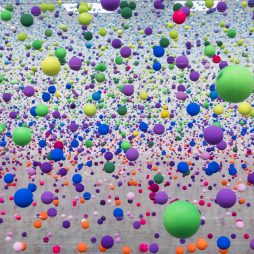
Nike Savvas: Purple Haze presents intimate screen prints and immersive large-scale installation and video work by Savvas from 2005–2026, each evocative of different places and...
Although physically he is of modest stature, Zofrea has devoted much of his life to grand projects that have been conceived and executed on a...
Through a multidisciplinary collaboration between Rotterdam-based curators, architect Paul Cournet of CLOUD and artist-designer Sabine Marcelis of Studio Sabine Marcelis, the exhibition explores the interplay...
Artificial intelligence will be used by young artists who started using it as kids on their phones. They will see it as a natural extension...

This year’s Biennale arrives under more complex circumstances than most. It is shaped by the profound loss of its curator, Koyo Kouoh (1967–2025), whose exhibition...
No artist creates in isolation. Every painting carries traces of the conversations, places and histories that shaped it, preserving within its surface a particular moment...
The weekend markets at Fairfield Showground have been one of Western Sydney’s great institutions for more than fifty years. Fresh fruit and vegetables, children’s clothes,...
In recent times, Yorgos Lanthimos has shifted toward photography, noting in a Guardian interview, 2026, that he needs respite, saying, “it might be a couple...