REVIEW: Classics from the Golden Age of Utopia
Classics from the Golden Age of Utopia exhibition showcases the explosion of talent that emerged from Utopia at the end of the twentieth century.
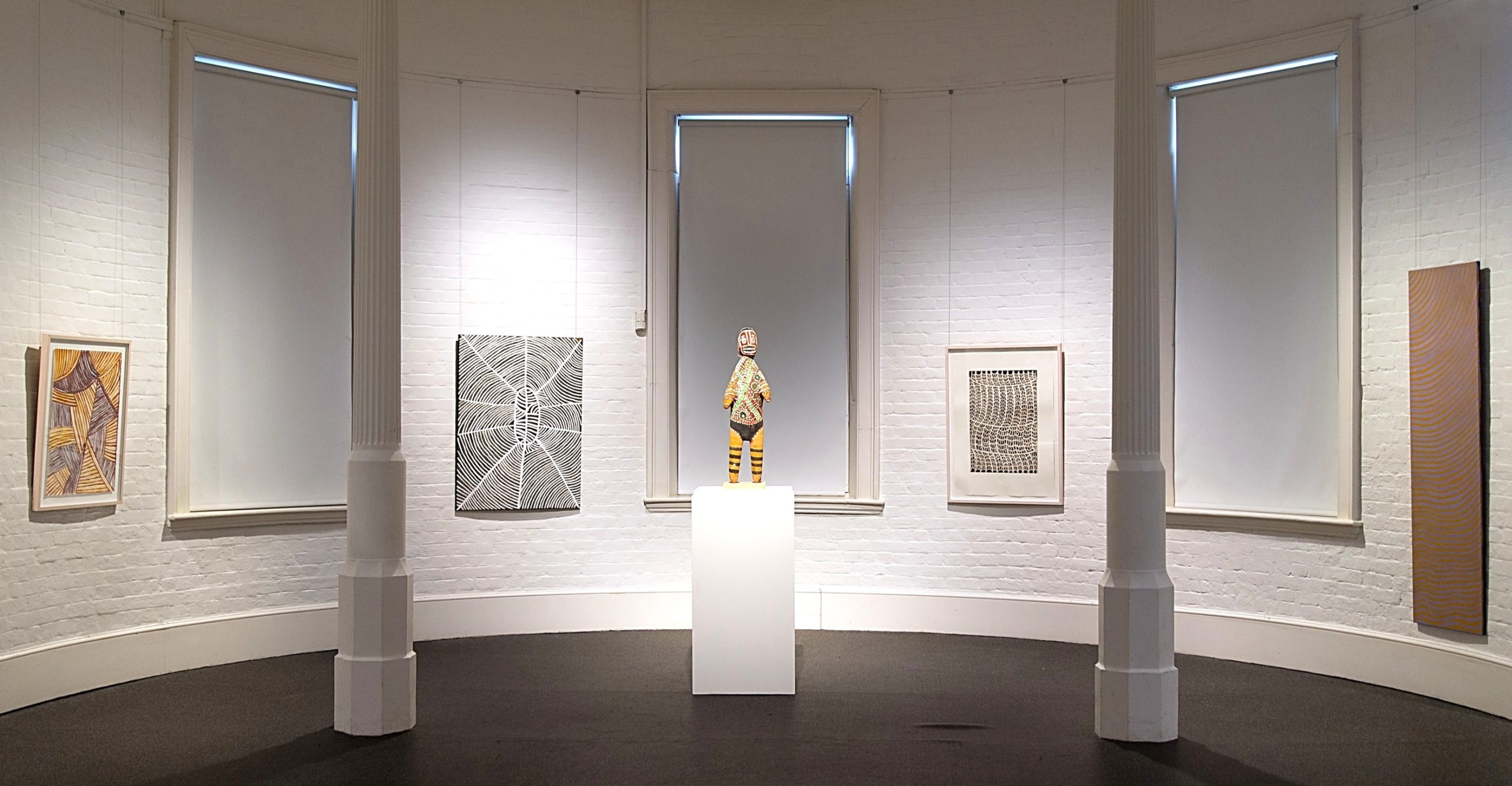
Emily Kame Kngwarreye, Gloria Tamerre Petyarre and Ada Bird Petyarre lead with major paintings that were revolutionary at the time. They are supported by many of their friends and peers who add to the richness and diversity of the wider Utopia community. There are major works in this exhibition including those drawn from private collections that have not been publicly exhibited before. This exhibition contributes to the celebration of Emily Kame Kngwarreye currently showing at TATE Modern in London.
On first entering the Classics from the Golden Age of Utopia I was struck by a beautiful vertical painting by Emily Kame Kngwarreye in subtle purple hues–she really knew how to work colour–and then turned to be met by one of her large grids in red and white. I was hooked! What an impact. Classics from the Golden Age of Utopia is full of surprises and its genesis story is equally serendipitous.
As Christopher Hodges recalled, thirty-six years ago he had landed in Alice Spring in response to a call from Rodney Gooch, then art advisor at Central Australian Aboriginal Media (CAAMA) Shop in Alice. Anne Brody, curator at the Holmes à Court collection had also arrived at the CAAMA Shop. Gooch had summonsed them to see eighty-nine paintings– acrylic on canvas ̶ leaning against the walls and on the floor, all done by the women at Utopia over the summer of 1988-89. They had made the transition from the batik technique to painting on canvas in one brief sweltering summer.
The shop was abuzz! The paintings were the first works in this medium by the women and were revelatory. A phone call interrupted; not for Rodney or the CAAMA Shop, but for Anne Brody from Dinah Dysart, then director at the S.H. Ervin Gallery in Sydney. A hole had appeared in her exhibition timetable; she’d tracked down Anne to Alice Springs. Her urgent question: did Anne have a suggestion for an exhibition to fill this spot? Brody looked across to Hodges as they gazed at these works and said, “Chris, do we have an exhibition?” A Summer Project: Utopia Women’s Painting was born. It opened at the S.H. Ervin Gallery, in April 1989 garnering acclaim and brought three of these artists ̶ Emily Kame Kngwarreye (c. 1910-1996), Ada Bird Petyarre (c. 1930-2009) and Gloria Tamerre Petyarre (1945-2021), into the Australian artworld limelight as painters in their own right. All three artists had been members of the Utopia women’s batik group from its inception in 1977.
Classics from the Golden Age of Utopia came about in response to a call to Christopher Hodges at Utopia Art Sydney from current S.H. Ervin Gallery director, Jane Watters, who again had an unexpected gap in the gallery’s exhibition schedule. It provided a great opportunity to celebrate that first exhibition which launched the individual careers of many of the artists, especially for Kngwarreye, Gloria Tamerre Petyarre and Ada Bird Petyarre. In fact, this trio’s works were included in the internationally acclaimed 1st Asia Pacific Triennial at the Queensland Art Gallery, Brisbane in 1993.
The exhibition includes many major works from private collections that have not been publicly exhibited as well as a wide range of media; acrylic on canvas and paper, a variety of printmaking styles and wooden sculptures. Apart from the three significant women painters mentioned, other Utopia artists include Lucky Kngwarreye, Glady and Ally Kemarre, May Baily Petyarre, Louis Pwerle and Lindsay Bird Mpteyane. Much of the work on show is concentrated within the 1990s, a stellar period of expansion and experimentation.
The exhibition is grouped into a series of conversation courts with works in dynamic dialogue. Ada Bird and Gloria Tamerre Petyarre each have an early work from 1989, done shortly after their first foray with the Summer Project. Both these works hang next to an Emily Kame Kngwarreye painted in 1990, revealing one of her early stylistic shifts to layered dots. Ada Bird Petyarre’s neighbouring 1989 work bears the striped border reminiscent of many of the Utopia batiks, indicative of the transition underway to the new medium of paint on canvas. All three works are modestly sized.
With these three women painters, scale and the confidence required to undertake it, is one of the key markers of their development during the 1990s along with the explosion of colour evident in their unfolding work. Ada Bird Petyarre’s transition from the modest-sized, mainly ochre and white palette of 1989 to the monumental almost five-metre long 1997 painting, Awelye ̶ a controlled, riot of complementary colour, masterfully handled, pulsing with life ̶ is a celebration both of women’s ritual and of an artist at her apex.
Gloria Tamerre Petyarre was the first Indigenous artist and first Indigenous women to win the Art Gallery of New South Wales’ Wynne Prize for landscape painting in 1999 with her multi-panelled work, Leaves. In this exhibition, a similar work, Untitled 2000 (twelve panels) is paired next to a sixteen panelled grid work by Emily Kame Kngwarreye, Untitled 1994. These powerful, restrained works on the central main wall of the Art Gallery anchor the space, allowing the central court to pulse with sensuous colour and dynamic paint handling.
Many of the very large works by Emily Kame Kngwarreye are in the TATE Modern exhibition, however this exhibition presents a number of outstanding, privately owned works that celebrate her various styles. For those who can’t see the Emily Kame Kngwarreye exhibition in London, never fear, there are fifteen major works by the artist in this show: Awelye, 1991 was in the first Emily exhibition at the Queensland Art Gallery in 1998 and Untitled 1993 was included in the National Gallery of Australia’s Emily Kame Kngwarreye exhibition in 2023.
This exhibition has captured the explosive, expansive and exciting energy of that first decade in the 1990s and into the early 2000s.To see works rarely available publicly by these three major women artists, surrounded by their peers, is also a testament to those early supporters–private collectors–who made it possible for these artists to continue making work, and to the commitment of art advisors such as Rodney Gooch.
You’ve got until Sunday, 14 September to see and experience Classics from the Golden Age of Utopia.
EXHIBITION
Classics from the Golden Age of Utopia
2 August ̶ 14 September 2025
S.H. Ervin Gallery, Sydney
Image courtesy of S.H. Ervin Gallery, Sydney and Utopia Art Sydney
This article was first published in Artist Profile, Monthly Newsletter, September 2025

Under the auspices of Geelong Gallery’s director, Humphrey Clegg, and co-curated by Marianne Mathieu, former scientific director of the Musée Marmottan Monet, and Claire Durand-Ruel...
Nike Savvas: Purple Haze presents intimate screen prints and immersive large-scale installation and video work by Savvas from 2005–2026, each evocative of different places and...
Although physically he is of modest stature, Zofrea has devoted much of his life to grand projects that have been conceived and executed on a...
Through a multidisciplinary collaboration between Rotterdam-based curators, architect Paul Cournet of CLOUD and artist-designer Sabine Marcelis of Studio Sabine Marcelis, the exhibition explores the interplay...
Artificial intelligence will be used by young artists who started using it as kids on their phones. They will see it as a natural extension...

This year’s Biennale arrives under more complex circumstances than most. It is shaped by the profound loss of its curator, Koyo Kouoh (1967–2025), whose exhibition...
No artist creates in isolation. Every painting carries traces of the conversations, places and histories that shaped it, preserving within its surface a particular moment...
The weekend markets at Fairfield Showground have been one of Western Sydney’s great institutions for more than fifty years. Fresh fruit and vegetables, children’s clothes,...
In recent times, Yorgos Lanthimos has shifted toward photography, noting in a Guardian interview, 2026, that he needs respite, saying, “it might be a couple...