Hossein Valamanesh: Poetic Objects
Hossein Valamanesh made art with a poetic sensibility, a simplicity of language and a fearlessness that accompanies spiritual understanding grounded in ancient knowledge.
A stone I died and rose again;
A plant I died and rose an animal;
I died an animal and was born a man.
Why should I fear? What have I lost by death?
Rumi (1207-1273)
For Hossein Valamanesh, the writings of Rumi and other Persian poets from the tenth to the fourteenth centuries were a cornerstone of his upbringing and education in his native Iran; he cited Rumi often and his poetry imbued the artist’s creative practice with a gentle spirituality and poetic grace.
In her introduction to the exhibition Hossein Valamanesh: Poetic Objects at Annette Larkin Fine Art in Paddington, Janet Laurence spoke of the artist’s sense of the sacred, ritual and reverence inspired by Sufi mysticism, and how arriving into a seemingly bland and culturally impoverished Australia in 1973, Valamanesh embodied a spiritual otherness, respectful of ancient peoples and wisdom.
An openness for mysticism and connection to nature drew the twenty-five-year-old Valamanesh to experience Australia’s traditional peoples, and in 1974 he travelled to remote Aboriginal communities including Papunya. Here he met and painted alongside Elders who welcomed him and shared knowledge and ceremony. Valamanesh felt deeply honoured and always acknowledged the experience as pivotal for his art: “The effects on my practice were both physical, through the use of natural materials, and metaphysical by recognition of such a connection.”
The exhibition Hossein Valamanesh: Poetic Objects presents an intimate collection of fifteen exquisite works spanning two decades of the artist’s creative practice: the earliest from 2001, and the most recent made in 2021, just a few months before the artist’s unexpected passing on 15 January 2022. This compelling selection is elegantly proportionate to Larkin’s gallery spaces; the considered hang flows easily and individual pieces warmly invite closer viewing. Each piece appears as a verse in a poem, or as Janet Laurence observed in her opening remarks– “the works are like little prayers.”
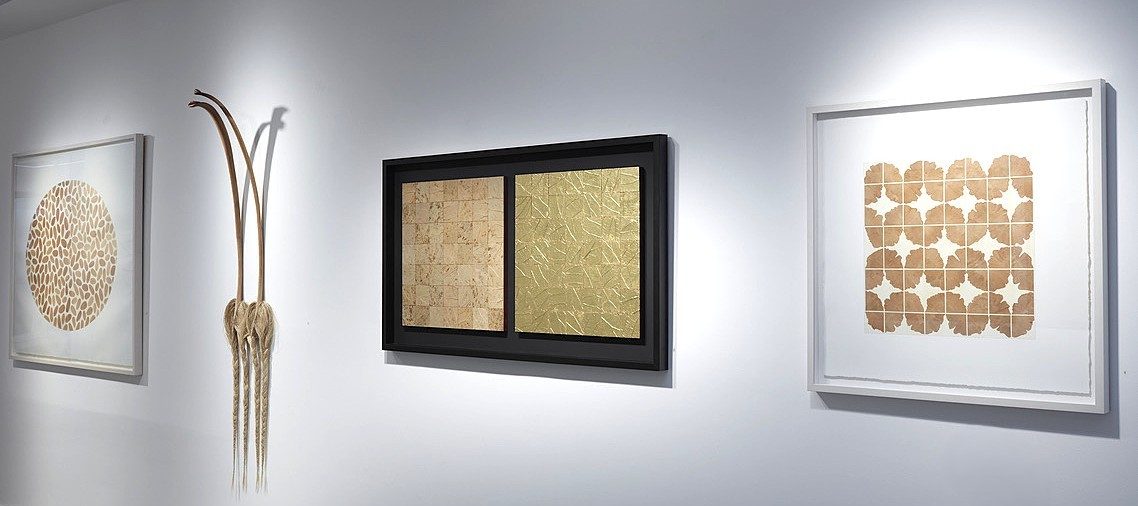
Central to the exhibition is Fallen Branch, 2005, a wall-mounted sculpture of bronze-cast twigs composed in a broadly circular form. Each twig is uniquely dynamic, rearranged by the artist in many directions. Their composition is further complicated by the shadow they cast on the wall, creating a kind of double image. The work’s circular form and harmony speak of the cyclical progression of life, inspired by the seasons and the interconnectedness of nature.
Branches, twigs and natural elements are recurring materials in Valamanesh’s works –the exhibition includes Twins, 2007, made from a fan palm whose blonde fibres have been braided, like a pair of little girls with plaits. In a surreal touch, each curvaceous palm-stalk finishes with a pair of carved, red-coloured lips – the artist had a playful sense of humour. Mourning, 2008, similarly anthropomorphises nature in the form of a fan palm whose fibres have been combed and dyed, falling forward like the long hair of a mourning woman.
Together 1, 2021, is the most recent work in the exhibition, and arguably among the most compelling. A wall-mounted eucalyptus branch hangs vertically, its cut section sealed with goldleaf and its spindly limbs have been coerced together into a blackened point at the base. With a rigorous simplicity of means, the form evokes a calligrapher’s brush dipped in ink, or an inverted flame. As with Fallen Branch adjacent, the knobbly in-between spaces are as important as the limbs themselves; their cavities and emptinesses are evocative of meaning and are as firm as belief.
Together 1 suggests elements of Zoroastrian mysticism whose tenets include veneration of natural elements like fire, air, water and earth; all are regular occurrences in Valmanesh’s work. His simplicity of language conveys a profound message about the interconnectedness of all life and the fearlessness that accompanies spiritual understanding.
Earth Samples #1 and Earth Samples #2, both 2017, are examples of the artist’s use of earth materials and ochres as a painterly medium, a practice he initiated decades ago following his experiences in Papunya and with other desert artists. The chequerboard grid is marked at each corner by a pebble, evoking much larger topographical sand works and land art.
Grid formats with tonal gradation similarly feature in other works, notably Garden & Cosmos #1 and #2, both 2016, and Valamanesh’s collaborations with his artist-soulmate Angela Valamanesh. It’s easy to sense the closeness of their creative life together in a series of exquisite miniature compositions with tonally gradated petals and leaves, such as Miniature with Rhus, 2001, Miniature with Alstroemeria Petals, 2003, and Grid of Rose Petals, 2005. The works’ compact rigour serves to liberate the delicate beauty of abstracted nature.
Hossein Valamanesh AM was a truly accomplished and valued artist. He leaves a great legacy in public and private collections in Australia and around the world. Annette Larkin’s exhibition of works selected from the Valamanesh family collection is both rare and enriching.
EXHIBITION
Hossein Valamanesh: Poetic Objects
23 July ̶ 13 September 2025
Annette Larkin Fine Art, Paddington, New South Wales
Image courtesy of Geoff Boccalatte / Annette Larkin Fine Art, Paddington New South Wales
This article was first published in Artist Profile, Monthly Newsletter, 6 September 2025

Under the auspices of Geelong Gallery’s director, Humphrey Clegg, and co-curated by Marianne Mathieu, former scientific director of the Musée Marmottan Monet, and Claire Durand-Ruel...
Nike Savvas: Purple Haze presents intimate screen prints and immersive large-scale installation and video work by Savvas from 2005–2026, each evocative of different places and...
Although physically he is of modest stature, Zofrea has devoted much of his life to grand projects that have been conceived and executed on a...
Through a multidisciplinary collaboration between Rotterdam-based curators, architect Paul Cournet of CLOUD and artist-designer Sabine Marcelis of Studio Sabine Marcelis, the exhibition explores the interplay...
Artificial intelligence will be used by young artists who started using it as kids on their phones. They will see it as a natural extension...

This year’s Biennale arrives under more complex circumstances than most. It is shaped by the profound loss of its curator, Koyo Kouoh (1967–2025), whose exhibition...
No artist creates in isolation. Every painting carries traces of the conversations, places and histories that shaped it, preserving within its surface a particular moment...
The weekend markets at Fairfield Showground have been one of Western Sydney’s great institutions for more than fifty years. Fresh fruit and vegetables, children’s clothes,...
In recent times, Yorgos Lanthimos has shifted toward photography, noting in a Guardian interview, 2026, that he needs respite, saying, “it might be a couple...