Mindscapes and Feminist Utopias
Two simultaneous exhibitions at Shoalhaven Regional Gallery this April–May present audiences with explorations of mental landscapes and alternative realities, contested histories and feminist resistance.


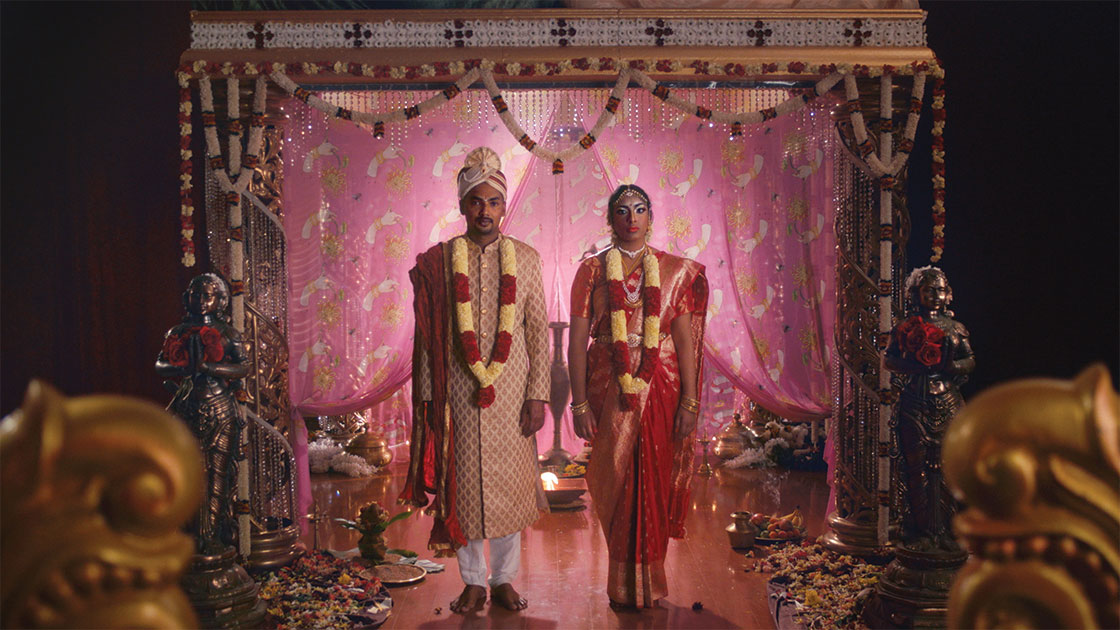
A mindscape, by definition, is a panorama created within a person’s imagination. A mental landscape. But also importantly, it’s one that is capable of being viewed by someone else. This begins a convergence of two perspectives: the creator whose mind it represents and the person whose mind is making meaning of it, which makes the concept of a mindscape unusually difficult to pin down. It exists somewhere between being created and being viewed, as memories, feelings, ideas merge within it. What better time, given our present circumstances, to consider these deeper imaginative recesses of our own individual minds and the mindscapes of others?
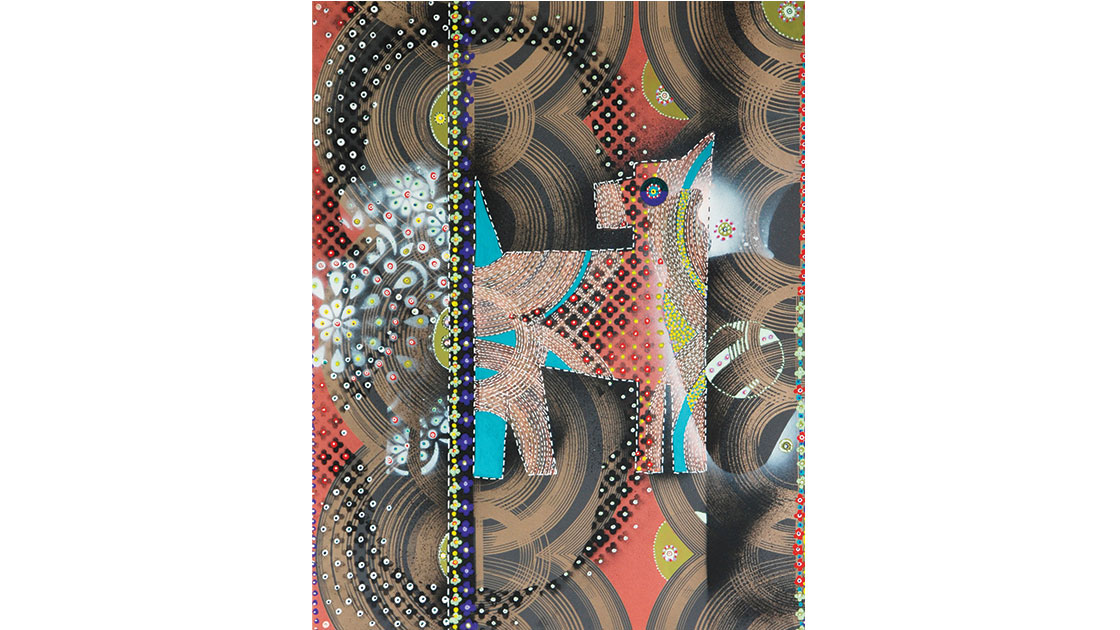
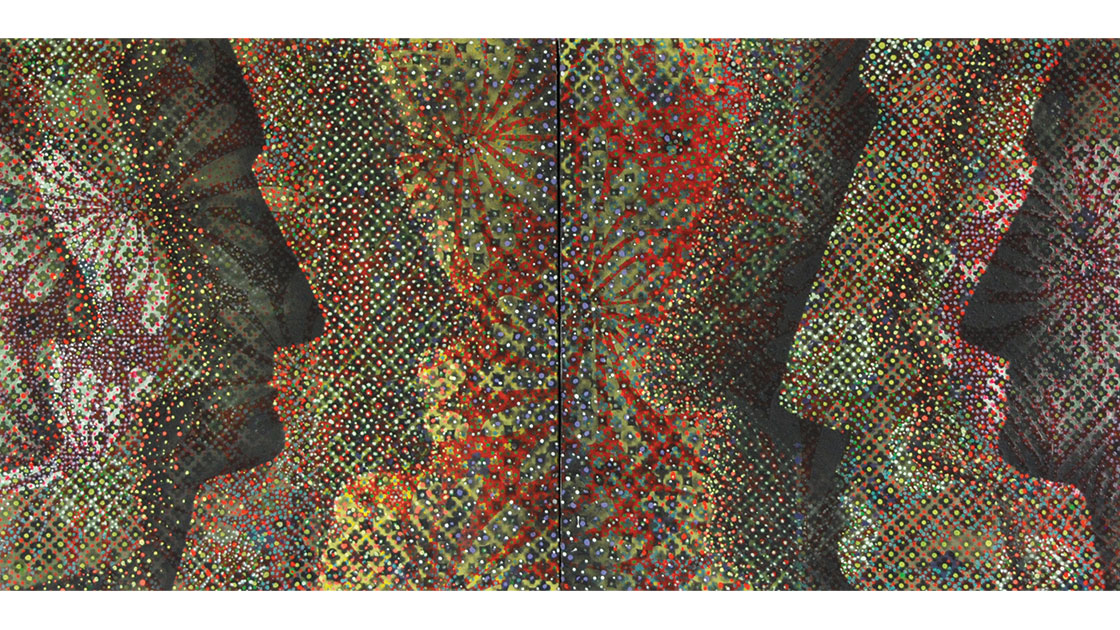
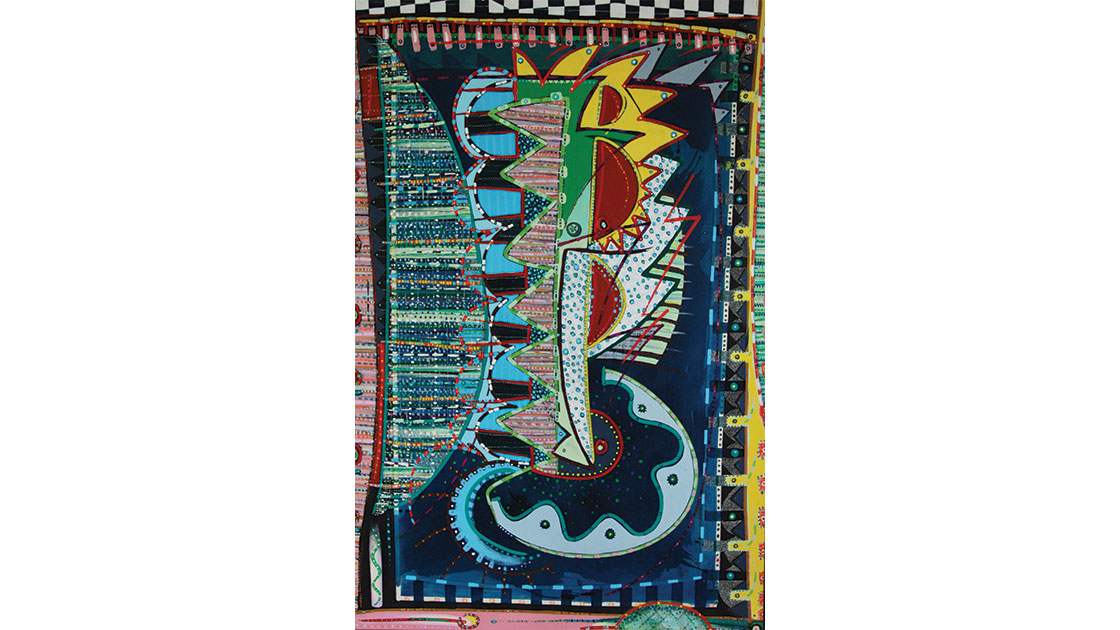
MindScapes is the name chosen for Graham Blondel’s upcoming exhibition at Shoalhaven Regional Gallery, located in Nowra on the South Coast of New South Wales. The exhibition comes together as a survey of Blondel’s work since the 1970s and demonstrates collectively his beginnings in non-objective abstract painting that has since developed towards more figurative and graphic work. The exhibition also marks a return to Nowra for the artist, who grew up in the area before attending art school in Sydney.
The title MindScapes fits perfectly. Abstracted pattern vies with more figurative gestures; here a pair of eyes, there a silhouette. Blondel explains that these works aren’t planned, they are created instinctively on the spot. Imaginative compositions that he adds to again and again until the layers work together. In his more recent artworks, the artist started with old, patterned wallpapers, which he then worked over in this layered way. “I make it [the wallpaper pattern] disappear to a degree or integrate it into the layering of images,” he explains. “They’re quite graphic, quite densely populated.”
Blondel’s recent artworks feature alongside selected earlier works in this exhibition, including Apparition of The Mythmaker, 1983. In this work, you can see Blondel’s early interest in colour and complex pattern, influenced by artists like Janet Dawson and Picasso, as well as street art and tribal art forms and compositions. However, in his more recent work, such as Pandemic Heads Suite, 2020, pattern is heightened along with his vivid use of colour, which accentuates the graphic impact of Blondel’s work as he moves towards more figurative compositions. Conceptually, the exhibition explores this interiority of abstraction in Blondel’s work, and gives form to unanticipated connections within the mind.
While Blondel’s artworks will be exhibited in the Main and Foyer Galleries, a second exhibition in the Access and East Galleries brings together video installations by Australian artist and filmmaker, Zanny Begg. This is where mindscapes meet feminist utopias, as These Stories Will Be Different demonstrates Begg’s feminist engagement in female-centred and non-binary stories of love, resistance, and power.
Begg has become renowned in recent years for creating socially and politically engaged film installations that respond to contemporary issues, often creating works in collaboration with other artists and filmmakers. These Stories Will Be Different is a UNSW Galleries and Museums & Galleries of NSW touring exhibition and includes three of the artist’s most significant installations to date: The City of Ladies (with Elise McLeod), 2017, The Beehive, 2018, and Stories of Kannagi, 2019. “Each of the works in this exhibition were made as individual pieces, but when they come together for this tour, I can see the threads that connect them. An obvious thread that links the works is an emphasis on feminism and female storytelling,” says Begg.
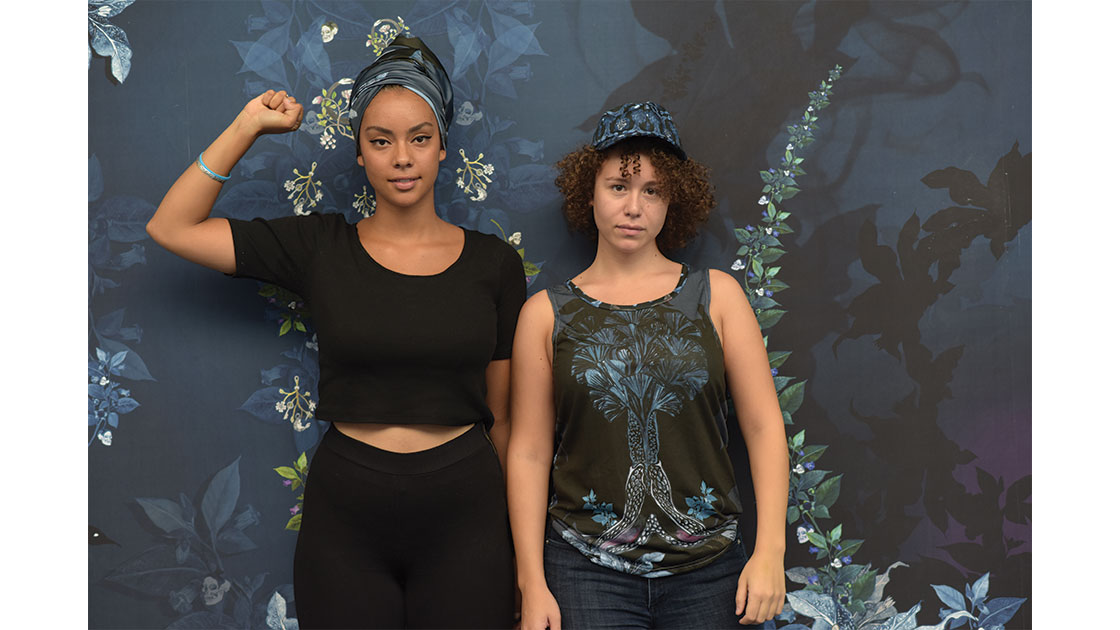
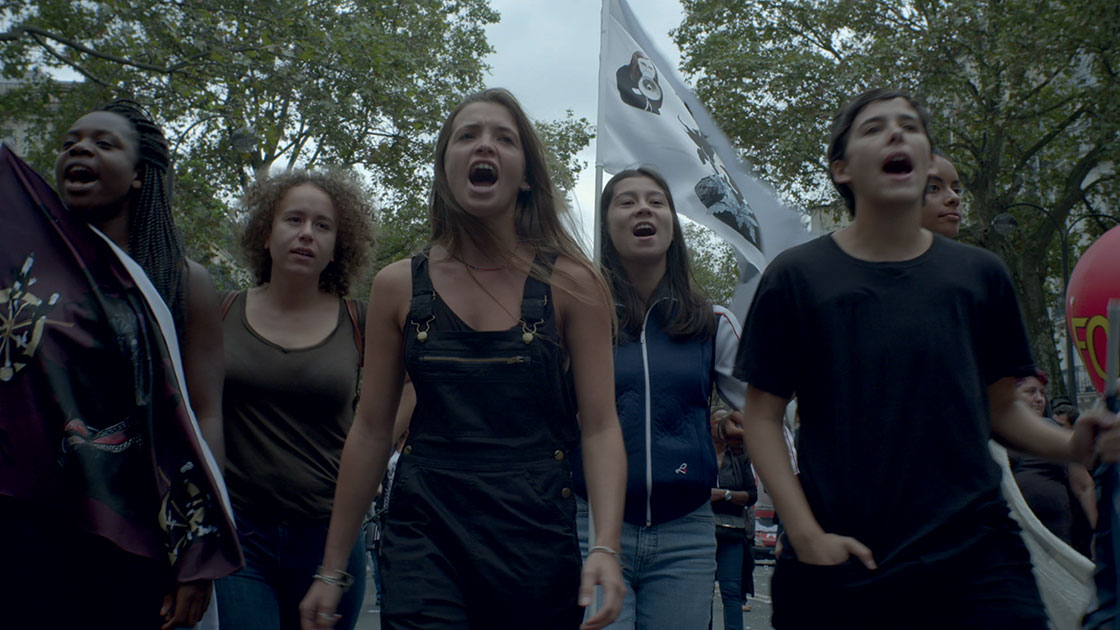
The City of Ladies is inspired by Christine de Pizan’s fifteenth-century novel The Book of the City of Ladies, c.1405, which imagines a utopian feminist society made entirely of women. Working with a group of young Parisian feminist and activist women, Begg and McLeod take cues from both twenty-first century feminist politics, resistance, and experience and early feminist thought from de Pizan’s era.
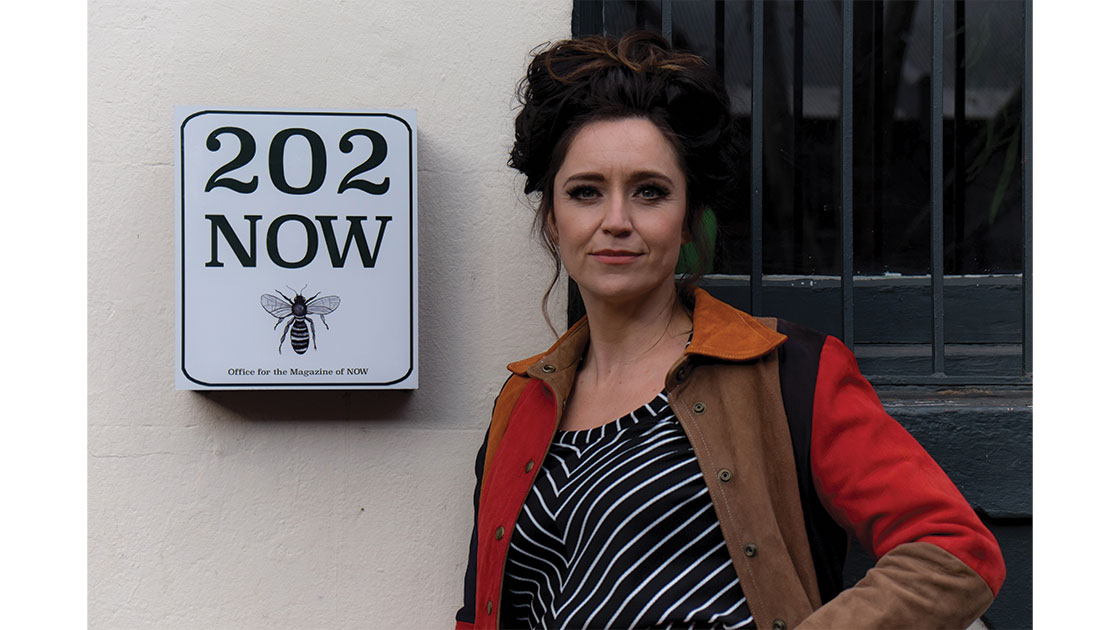
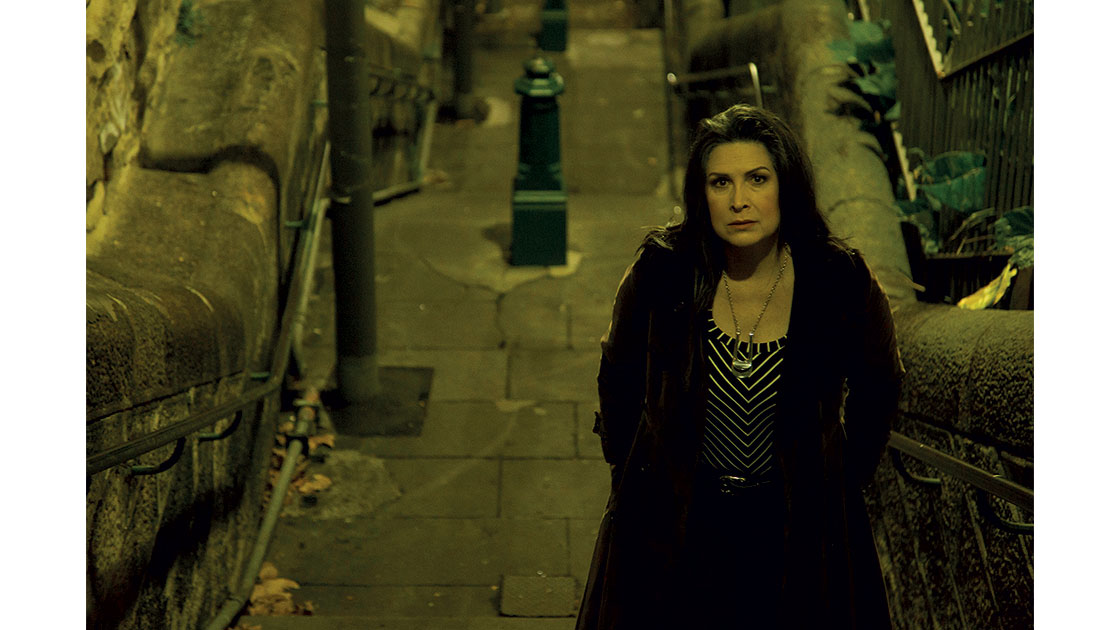
As others have pointed out, Begg’s work often engages with contested histories and uses multiplicity to demonstrate unresolved issues. The Beehive is one prominent example of the artist’s interest in multiple storylines colliding within a work, grappling as it does with the disappearance and unsolved murder of Juanita Nielsen in Sydney in 1975. Nielsen was a low-income housing activist and journalist, known for her involvement in the Green Bans movement as someone who fought gentrification and supported the low-income communities who were being pushed out of the inner city. That is, until she vanished one night.
Many of Begg’s films are non-linear and result in different combinations of footage that is randomly selected for each viewing. As a non-linear experimental documentary, The Beehive, for example, has 1344 possible variations, while The City of Ladies similarly uses an algorithm to generate over 300,000 possible narratives. “In this work I was interested in multiple approaches to feminism that layered in intersecting ideas of class, race, religion, sexuality,” says Begg. These intersecting and diverse narratives will offer a return for audiences who may find new surprises and intentions in each viewing.
This article was originally published in Artist Profile, Issue 58, 2022.
EXHIBITION
MindScapes; These Stories Will Be Different
2 April – 28 May 2022
Shoalhaven Regional Gallery, New South Wales
Edwards was born on Kaurna Yarta in 1998 and raised on Nauo Country in the small seaside community of Tulka, on the Lower Eyre Peninsula....

Under the auspices of Geelong Gallery’s director, Humphrey Clegg, and co-curated by Marianne Mathieu, former scientific director of the Musée Marmottan Monet, and Claire Durand-Ruel...
Nike Savvas: Purple Haze presents intimate screen prints and immersive large-scale installation and video work by Savvas from 2005–2026, each evocative of different places and...
Although physically he is of modest stature, Zofrea has devoted much of his life to grand projects that have been conceived and executed on a...
Through a multidisciplinary collaboration between Rotterdam-based curators, architect Paul Cournet of CLOUD and artist-designer Sabine Marcelis of Studio Sabine Marcelis, the exhibition explores the interplay...
Artificial intelligence will be used by young artists who started using it as kids on their phones. They will see it as a natural extension...

This year’s Biennale arrives under more complex circumstances than most. It is shaped by the profound loss of its curator, Koyo Kouoh (1967–2025), whose exhibition...
No artist creates in isolation. Every painting carries traces of the conversations, places and histories that shaped it, preserving within its surface a particular moment...
The weekend markets at Fairfield Showground have been one of Western Sydney’s great institutions for more than fifty years. Fresh fruit and vegetables, children’s clothes,...