
Stephen Bird | Rogue Heroes
Stephen Bird's 'Industrial Sabotage' at Gould Galleries, Melbourne.
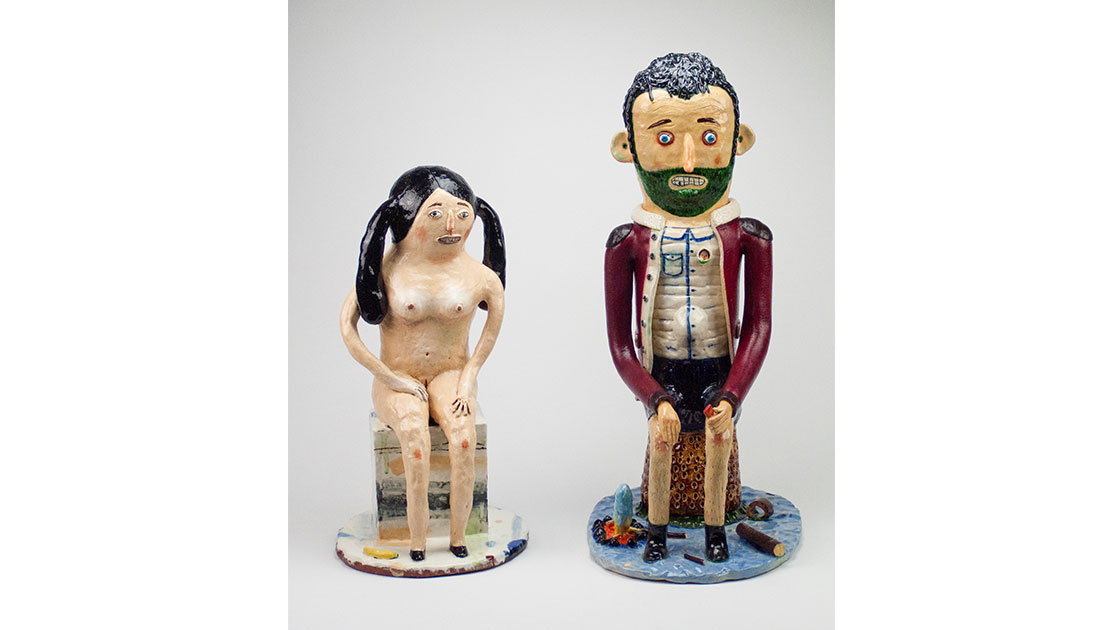
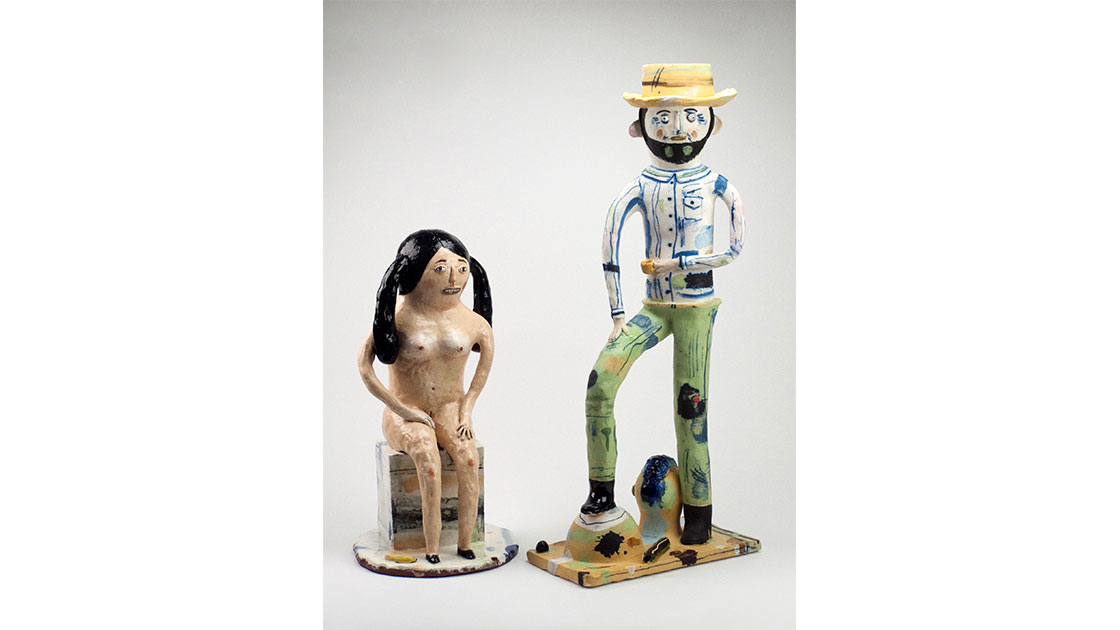
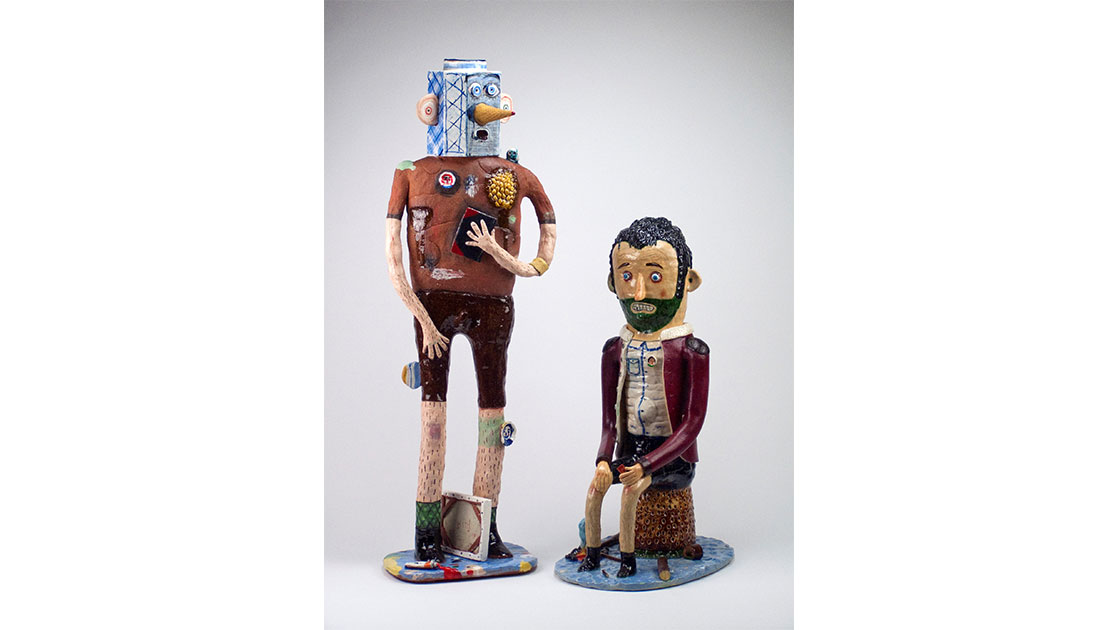
Even within the (welcome) large number of artists using ceramics locally and internationally these days Stephen Bird’s work is distinctive. They are easy to spot for their style, their clarity of message, an underlying seriousness and, often, humour.
For, like a handful of other Australian artists (think Reg Mombassa), Stephen Bird uses humour (and clay) to talk about some pretty serious things. Violence, sexual relations, religion, colonialism are some that come to mind.
As a case in point, Bird’s self-driven research, which he calls ‘Industrial Sabotage,’ looks at the implicit narratives of Victorian English figure groups. As beautiful as Bow or Staffordshire work of can be, there’s plenty there in terms of that era’s sexual relations and norms for the astute observer: the way these Victorian figures are seated, dressed, the way they seem to be comporting themselves in relation to each other, all speak to expectations and the contemporary social contract between the sexes.
Stephen Bird’s newest series of work, ‘Rogue Heroes’, at Gould Galleries looks at some of these implicit narratives and disrupts them completely – disrobing the woman, seating the man like an obedient school child with this hands on his knees, or giving him a carrot nose and a robot head.
Kind of ‘random’, as my children might say, but actually a targeted randomness aimed at puncturing the air out of our expectations. There’s a lot going on in this work that requires investigation. Does that nude woman really have a banana at her feet? Has the seated officer-looking man been whittling wood, or painting? Why does the robot guy have a small canvas frame between his feet and shapes poking out from his knee and thigh? These rogue heroes pose a lot of questions though don’t seem to offer many clear answers – thank goodness.
EXHIBITION
Stephen Bird | Rogue Heroes
16 November – 9 December 2017
Gould Galleries, Melbourne
Courtesy the artist and Gould Galleries, Melbourne.
Edwards was born on Kaurna Yarta in 1998 and raised on Nauo Country in the small seaside community of Tulka, on the Lower Eyre Peninsula....
Under the auspices of Geelong Gallery’s director, Humphrey Clegg, and co-curated by Marianne Mathieu, former scientific director of the Musée Marmottan Monet, and Claire Durand-Ruel...
Nike Savvas: Purple Haze presents intimate screen prints and immersive large-scale installation and video work by Savvas from 2005–2026, each evocative of different places and...
Although physically he is of modest stature, Zofrea has devoted much of his life to grand projects that have been conceived and executed on a...
Through a multidisciplinary collaboration between Rotterdam-based curators, architect Paul Cournet of CLOUD and artist-designer Sabine Marcelis of Studio Sabine Marcelis, the exhibition explores the interplay...
Artificial intelligence will be used by young artists who started using it as kids on their phones. They will see it as a natural extension...
This year’s Biennale arrives under more complex circumstances than most. It is shaped by the profound loss of its curator, Koyo Kouoh (1967–2025), whose exhibition...
No artist creates in isolation. Every painting carries traces of the conversations, places and histories that shaped it, preserving within its surface a particular moment...
The weekend markets at Fairfield Showground have been one of Western Sydney’s great institutions for more than fifty years. Fresh fruit and vegetables, children’s clothes,...