Maggie Jeffries
In her debut solo exhibition at Hobart's Despard Gallery, Maggie Jeffries plumbs the pools of emotion that are expressed in the more-than-human world.
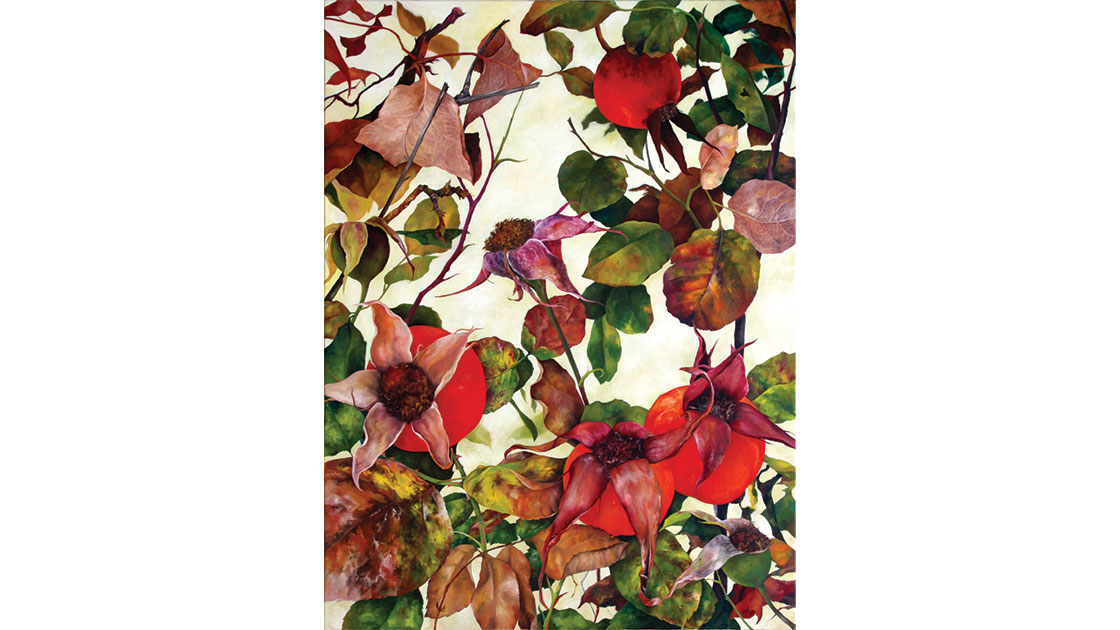
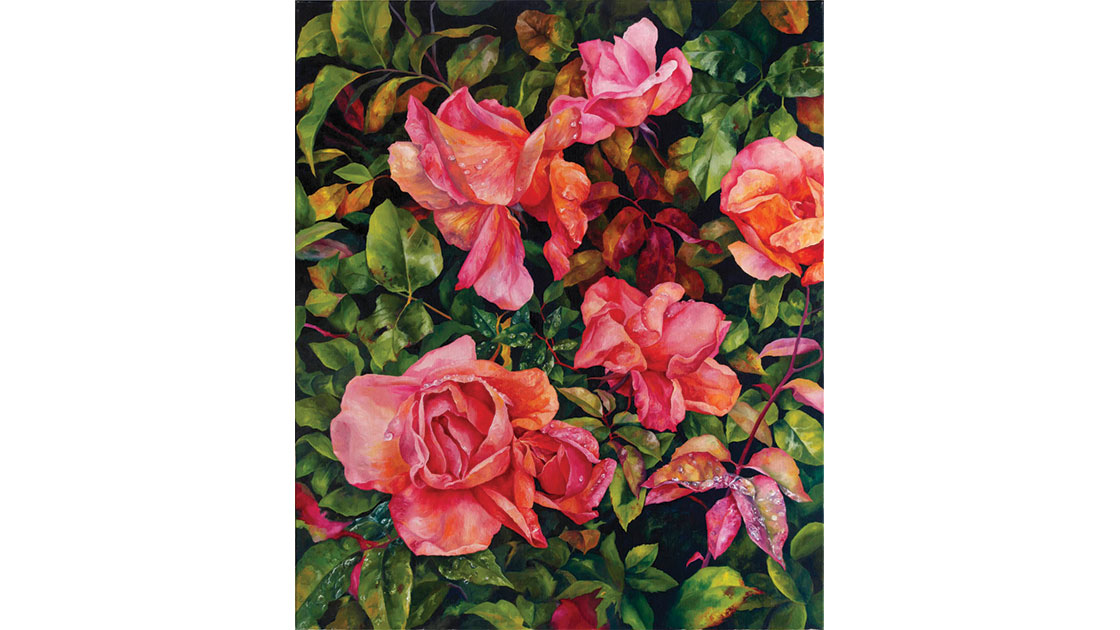


In Maggie Jeffries’s True Blue, 2020, a pair of eucalyptus branches reach toward each other. Across the canvas, these impossibly emotive plants seem to gesture with high feeling; they are so close to touching one another. The field they reach across is dappled blue – dense and saturated in its colour. Jeffries’s plants are not still life studies in deathliness and liveliness, and nor are they straightforward botanical illustrations. They are high-artifice, and affectively amped-up. They ooze all the self-knowing feeling of melodrama, and the punches and turns of kitsch. Text for the exhibition does indeed confirm that Jeffries is interested in the connection between plants and affective life, especially nostalgia, and that she works from sites of personal significance, collaging multiple images together in her paintings in order to depict memories, as much as botanical specimens.
Many paintings in this show are named after, for, or with women. There is Vanessa, Barbie’s Garden, and For Lily – Dancing Bears. In their saturation, and their alignment with the realm of emotion and gesture – their demonstrativeness – these paintings ask us to engage with ideas of (hyper)femininity with both criticality and fondness. What makes these paintings look like it’s right that they’re named for women? Should looking at flowers through this gendered lens feel comfortable, or not? Does this have something to do with the exhibition’s titular pearls?
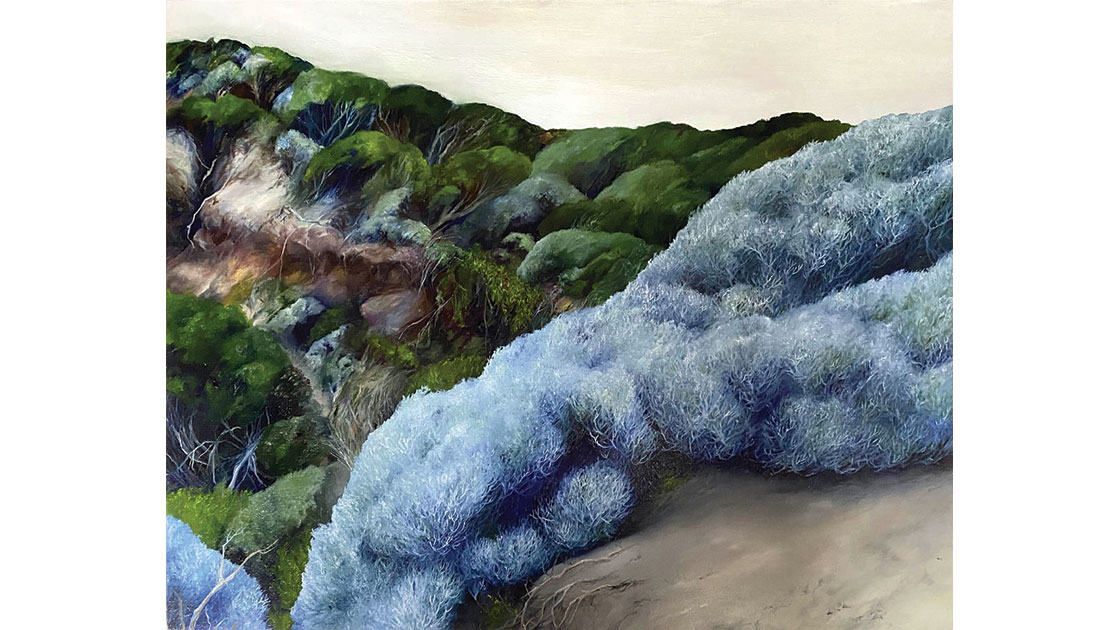
A series of darker botanical images, as well as landscapes, comprise the “King Island” sequence of works. Undertaken on forty-three consecutive days during a six-week artist residency on King Island, the works track Jeffries’s shifting relationship with the island. They often make use of sea water, sand, and soil, alongside the more conventional media of oil, acrylic, and charcoal. Here, too, is an investigation of what it is to be attached to the more-than-human world, and what it is to find or make oneself a place there.
Taken together, these bodies of work create an exhibition which is at once nostalgic and clear-eyed, revelling in innocence from the vantage point of knowledge.
EXHIBITION
Maggie Jeffries: All the Pearls
20 October – 13 November 2021
Despard Gallery, Hobart
Two years ago, Macleod returned to his hometown of Christchurch, New Zealand, to be with his mother during the final phase of her life. At...
Edwards was born on Kaurna Yarta in 1998 and raised on Nauo Country in the small seaside community of Tulka, on the Lower Eyre Peninsula....

Under the auspices of Geelong Gallery’s director, Humphrey Clegg, and co-curated by Marianne Mathieu, former scientific director of the Musée Marmottan Monet, and Claire Durand-Ruel...
Nike Savvas: Purple Haze presents intimate screen prints and immersive large-scale installation and video work by Savvas from 2005–2026, each evocative of different places and...
Although physically he is of modest stature, Zofrea has devoted much of his life to grand projects that have been conceived and executed on a...
Through a multidisciplinary collaboration between Rotterdam-based curators, architect Paul Cournet of CLOUD and artist-designer Sabine Marcelis of Studio Sabine Marcelis, the exhibition explores the interplay...
Artificial intelligence will be used by young artists who started using it as kids on their phones. They will see it as a natural extension...

This year’s Biennale arrives under more complex circumstances than most. It is shaped by the profound loss of its curator, Koyo Kouoh (1967–2025), whose exhibition...
No artist creates in isolation. Every painting carries traces of the conversations, places and histories that shaped it, preserving within its surface a particular moment...