Eva Rothschild | Limits and Liberation
Eva Rothschild waves to me on the street in front of her studio. This close to the centre of London, civic infrastructure is a main character in every scene. The afternoon’s unseasonal warmth feels like it’s blown straight out of the Northern Line station a few blocks away. Cars behind us are slowed by a sequence of speed bumps and pedestrian crossings, and the occasional Lime cyclist on the footpath weaves around the surrounding flats’ bins. Rothschild raises the studio’s roller door, and we move into a built landscape of instructive objects something like the one outside—but more troubling, and more delightful.

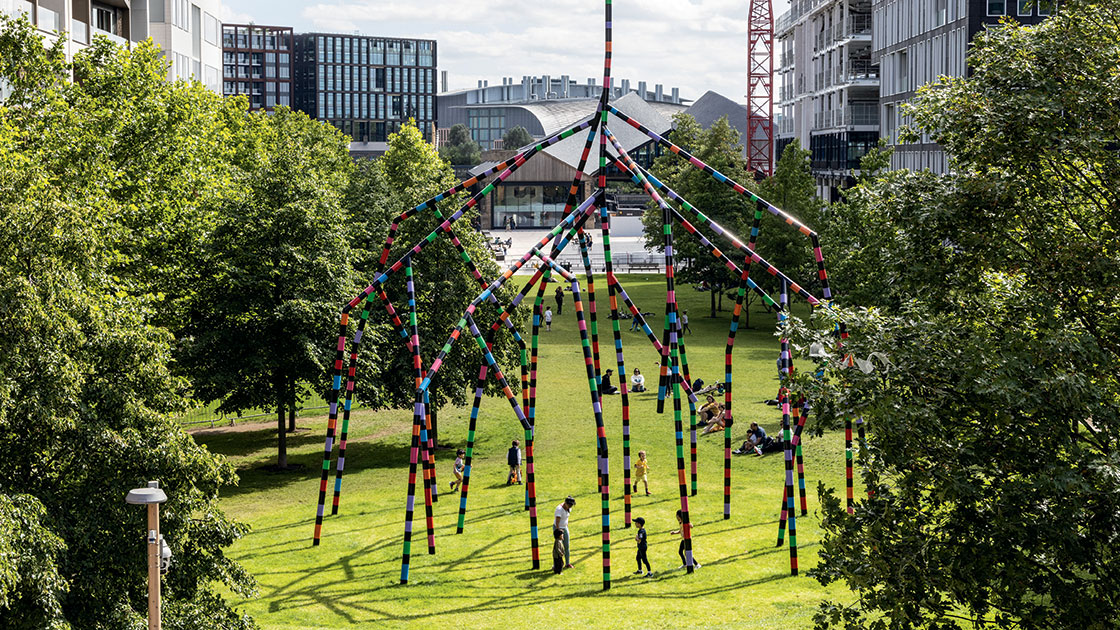

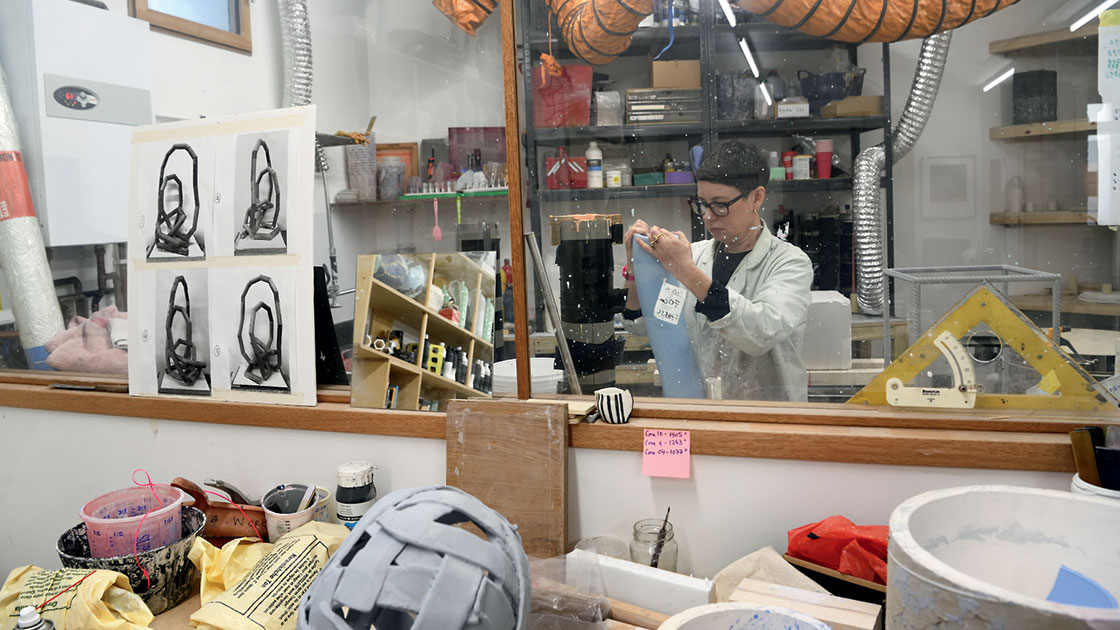
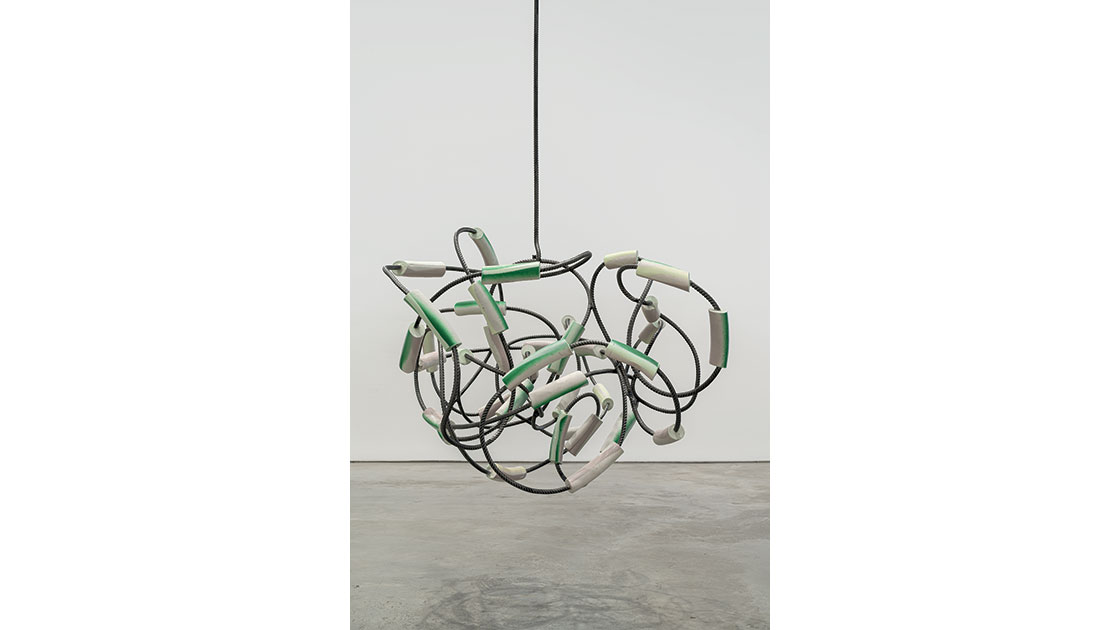
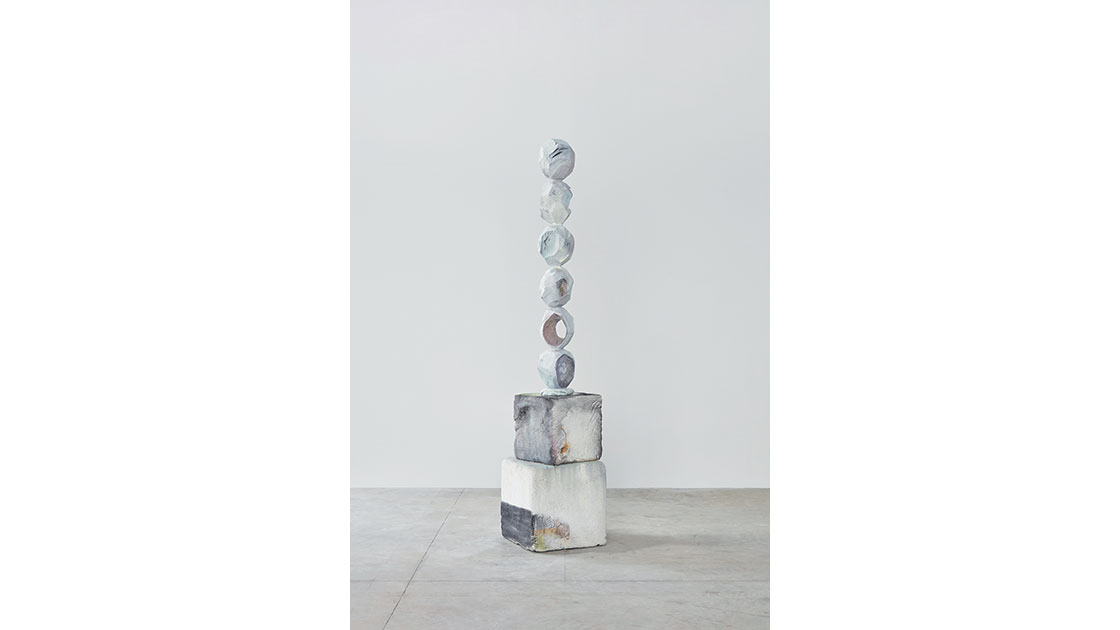
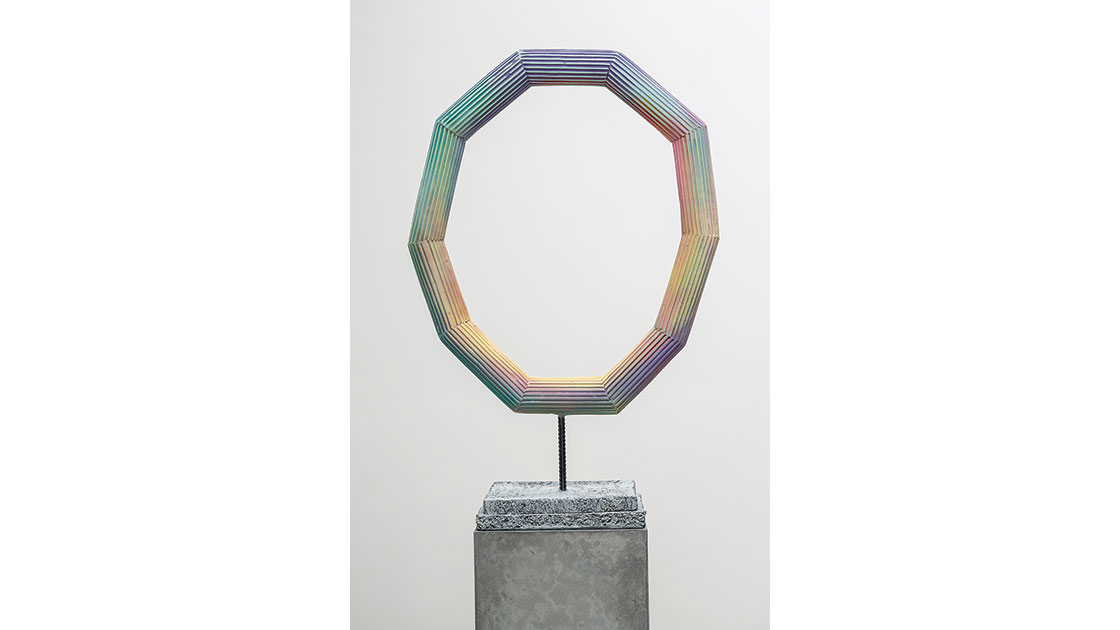
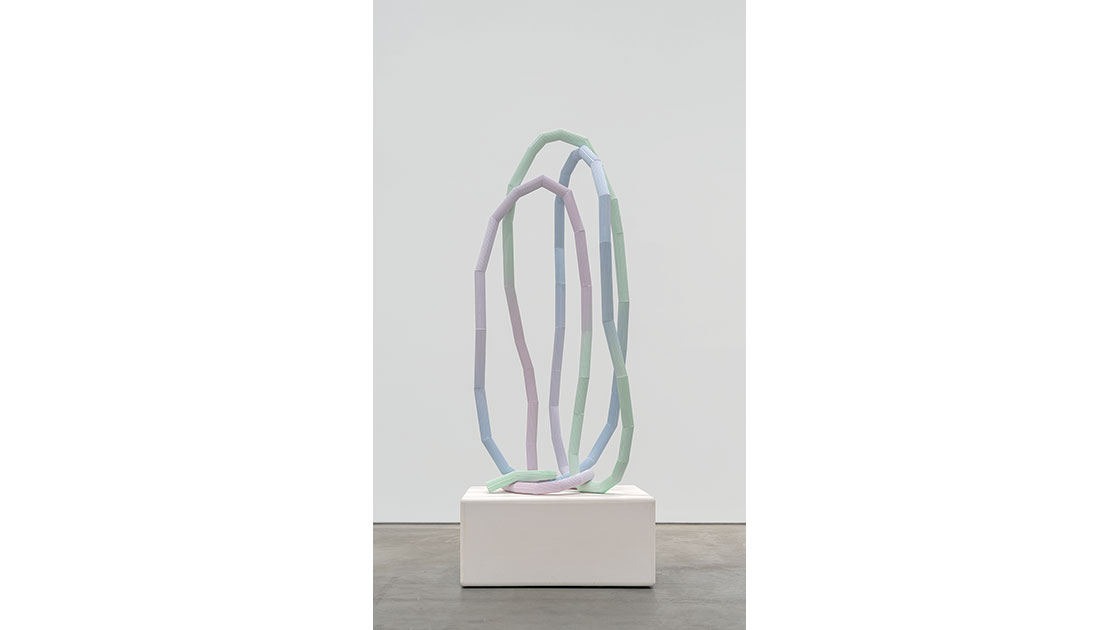

On a workbench sits a scale model of the exhibition space for an upcoming show at PALAS, Sydney. Rothschild looks into the model, then looks up and gestures to works-in-progress for the exhibition resting around the studio. Segments of rebar and jesmonite hang on the walls, and float at eye-and hand-levels in pieces on shelves and tables. These snippets echo some of the works Rothschild presented at Modern Art’s Helmet Row gallery earlier this year. There Garland, 2024, a gentle jesmonite form, curled in on itself like a portrait or a portal. Tribute, 2024, felt like an apocalyptic climbing frame in the centre of the room. Plateau, 2024, took the rebar of Tribute and treated it as a soft material, forming it into a pillowy cloud which floated in the space like a haunting, three-dimensional Mr. Messy (and which in turn recalls a work actually titled Mr. Messy, 2007. These works, and the fragments that now echo them in Rothschild’s studio, parse the forms and materials that have captivated her over the three decades of her career, in cycles of return and revision.
In her own account, Rothschild “took quite a long time” to arrive at the practice she now frames broadly, in our discussion, as “making.” This term really describes the proliferation of things brought into the world in the crucible of this studio. Here arise more and more sculptures, ceramics, pieces of furniture, textiles, and products of industry, in two senses: industrious work alone and with the studio assistants Rothschild has worked with for many years, and large-scale production of works using tools like forklifts, and techniques borrowed from building sites.
Probably, Rothschild thinks, some of her delay in arriving at her making practice was due to having grown up during the high tide of conceptualism, in the eighties and nineties. Though as a young person she was inspired by an artist uncle, Rothschild went to a girls’ school in Dublin, where design technology “wasn’t even on the curriculum.” She then studied art at the University of Ulster in Belfast, where she focused on printmaking, and at Goldsmiths, University of London. She says that she wasn’t always confident with hands-on skills in the workshop, but this gave way over time to an enthusiasm for both the limits and liberation of a “making” practice. “There are things you have to know how to do, and that you have to do correctly,” she says. “But if you’re willing to let a material do something else, and to go with the outcome, that’s different. You can make a decision about where you’re going to follow a process, and where you’re going to disrupt that process.”
It’s sometimes hard to distinguish works-in-progress from tools, ornaments, and other companions to life in her studio. Ceramic bowls, cushions, and chairs made by Rothschild are tucked amongst her artworks. The table she sits at, while pointing out these objects, is also her own work, made from a cast of styrofoam. That Rothschild makes objects with uses—in addition to the strange use of being apprehended in a display context—will be well known to those who have noticed the presence of her own benches and seats in her exhibitions, dating back to 2014. These items can be traced through shows across the US, Europe, and Australia and New Zealand, including her presentation for the Ireland Pavilion at the Venice Biennale in 2019, The Shrinking Universe. Elsewhere, in exhibitions such as A Gated Community, 2016, at Sonneveld House, Rotterdam, Rothschild has placed sculptural objects within domestic display settings, opening the question of how, or indeed whether, sculpture’s function might differ from that of furniture.
Using these strategies and others throughout her career, Rothschild has explored how we live through and against the objects that we encounter every day. She understands such objects as expressions: of power, of rules-based or other orders, or of the abiding loss which accompanies relentless growth in our contemporary economy. She sees this world-making power of objects reflected in urban life: in how hired e-bikes slow down automatically when their riders enter some London parks. She remembers it in the architecture of the seaside town in which she grew up. She sees it in the way remnants of ancient architecture inform the development of modern European cities. In all these instances, objects “seem immovable,” she says. They are magic, slightly mysterious, and potentially coercive catalysts in our lives.
This coercive power can be sensed in Rothschild’s large-scale interventions with public buildings, such as Cold Corners, 2009, which stretched aluminium triangles across the depth, breadth, and height of the Tate Britain’s neoclassical interior. It also accrues in Rothschild’s public commissions, such as Parsloes Memphis, 2021, a modular playground built for a park in Dagenham and based on the stone pyramid on Killiney Hill, and A Double Rainbow, 2022, which sits outside the Central Bank of Ireland’s building in Dublin, looking equally like its eponymous rainbow and a lithe, upbeat spider.
Playing with this power in another register, much of Rothschild’s work shown in Australia has focused on how people are physically moved by installations and sculptures in gallery spaces. Eva Rothschild: Kosmos, 2018, was her most recent major solo exhibition on this continent. During this exhibition at the Australian Centre for Contemporary Art, Melbourne, choreographer Jo Lloyd led a group of ten dancers to perform within Kosmos’ installations. In this collaboration, Rothschild saw her role as “providing a site for the autonomy of another creator,” letting her work move the dancers’ bodies without her intervention. In 2014, The Biennale of Sydney included Rothschild’s film Boys and Sculpture, 2012, which had been made originally for the Whitechapel Children’s Commission. For the film, she invited a group of boys to look at her sculptures, “until they couldn’t look at them anymore,” at which point they could engage with them as they wanted. For Rothschild, this film is “both totally anomalous within my practice, and very important to it. In a way, it’s about making, but also about destruction and remaking. That balance, I suppose, between destructiveness and freedom.”
Rothschild’s iterative creation of things, over and over and at scale, is an almost alchemical world-forging. As we talk, I’m reminded what remarkable work it really is to make something exist which didn’t before—and what deep responsibility can come with this. Rothschild says that “presence and confidence, and confidence in one’s presence, really interest me.” In our conversation, she cites Martin Kippenberger, Deiter Roth, and Mike Nelson as artists she admires for “their full-on-ness,” the way their bodies of work can envelop us in worlds entire. On my way home from her studio, I submit to the awkward navigation of taking my bike on the Overground, for once enjoying the feeling of being subject to the demands and the generosity of the things around me.
Exhibition
Eva Rothschild | Modern Love
5 April – 14 June 2025
PALAS, Sydney
Images courtesy of the artist, PALAS, Sydney and Modern Art, London
Edwards was born on Kaurna Yarta in 1998 and raised on Nauo Country in the small seaside community of Tulka, on the Lower Eyre Peninsula....

Under the auspices of Geelong Gallery’s director, Humphrey Clegg, and co-curated by Marianne Mathieu, former scientific director of the Musée Marmottan Monet, and Claire Durand-Ruel...
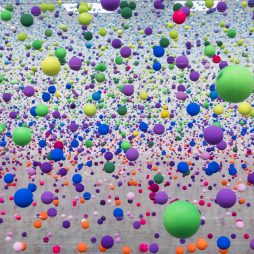
Nike Savvas: Purple Haze presents intimate screen prints and immersive large-scale installation and video work by Savvas from 2005–2026, each evocative of different places and...
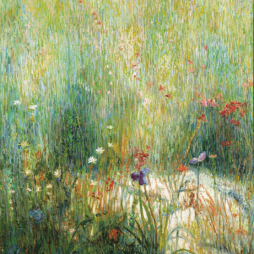
Although physically he is of modest stature, Zofrea has devoted much of his life to grand projects that have been conceived and executed on a...
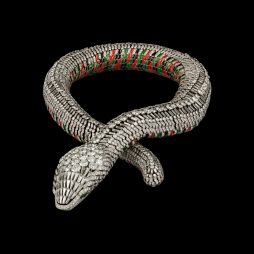
Through a multidisciplinary collaboration between Rotterdam-based curators, architect Paul Cournet of CLOUD and artist-designer Sabine Marcelis of Studio Sabine Marcelis, the exhibition explores the interplay...
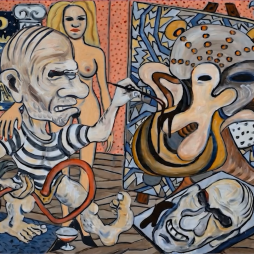
Artificial intelligence will be used by young artists who started using it as kids on their phones. They will see it as a natural extension...

This year’s Biennale arrives under more complex circumstances than most. It is shaped by the profound loss of its curator, Koyo Kouoh (1967–2025), whose exhibition...
No artist creates in isolation. Every painting carries traces of the conversations, places and histories that shaped it, preserving within its surface a particular moment...
The weekend markets at Fairfield Showground have been one of Western Sydney’s great institutions for more than fifty years. Fresh fruit and vegetables, children’s clothes,...