Can’t be found | Tracing lost tapestries in the public domain
In Australia, artist Diana Wood Conroy sets the record straight on her lost tapestries made for public buildings in the 1970-1980s.

How can large woven tapestries, meters high and wide, come to be lost?
Weaving is a primal medium, said to have been the first building material used when humans began to make houses. While working as an illustrator in the British Museum, London, in 1969, I was astonished by ancient Coptic tapestries whose vibrant arabesques of foliage and eccentric pattern would come to foreshadow my own weavings. I hurried to learn weaving from Ruth Hurle at the nearby Stanhope Institute. Enchanted with the tapestry medium, I wanted to make work that was heavy and rich in texture, standing alone like a piece of land.
Tapestry woven on a loom is a slow process, constructed from the ground up like a wall, with innumerable intersecting coloured threads and forms. In Australia, architectural tapestry blossomed in the 1970s as Sydney pushed upwards with glass, steel, and concrete, encouraged by the dynamic international design of Jørn Utzon’s Opera House or Harry Seidler’s breathtaking buildings. Immersive texture from silky jute to ribbed linen and cloudy wool offered a vision of the natural world through an intense materiality. The richness and subtlety of handmade tapestry could offset the cool industrialism of modern architecture.
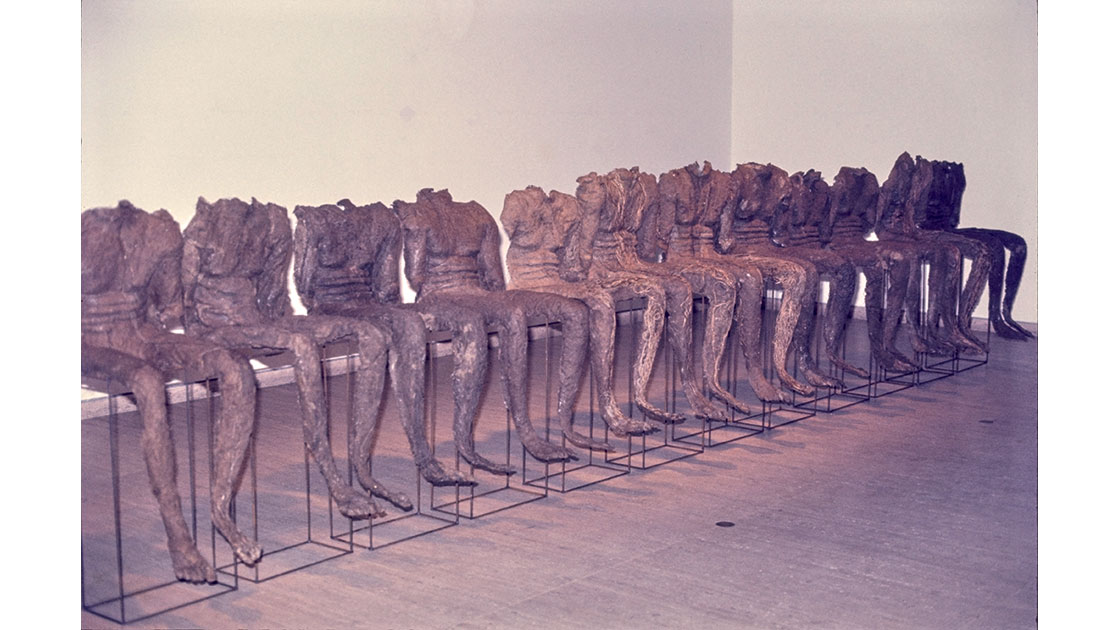
Artists such as Jutta Feddersen, Margaret Grafton, Mona Hessing, and myself, among many others, were commissioned to make large-scale tapestries for the burgeoning city scape of Sydney. Influenced by revivals of Gobelin and Aubusson tapestry in France and Germany (the Bauhaus), as well as postwar movements in eastern Europe and the USA, weaving was on fire. In 1976, the Polish artist Magdalena Abakanowicz’s theatrical sisal structures filled the Art Gallery of New South Wales.
I began assembling my early commissions in 2021 for a large retrospective exhibition at Wollongong Art Gallery in 2024. Were the exuberant tapestries from the 1970s still in existence?
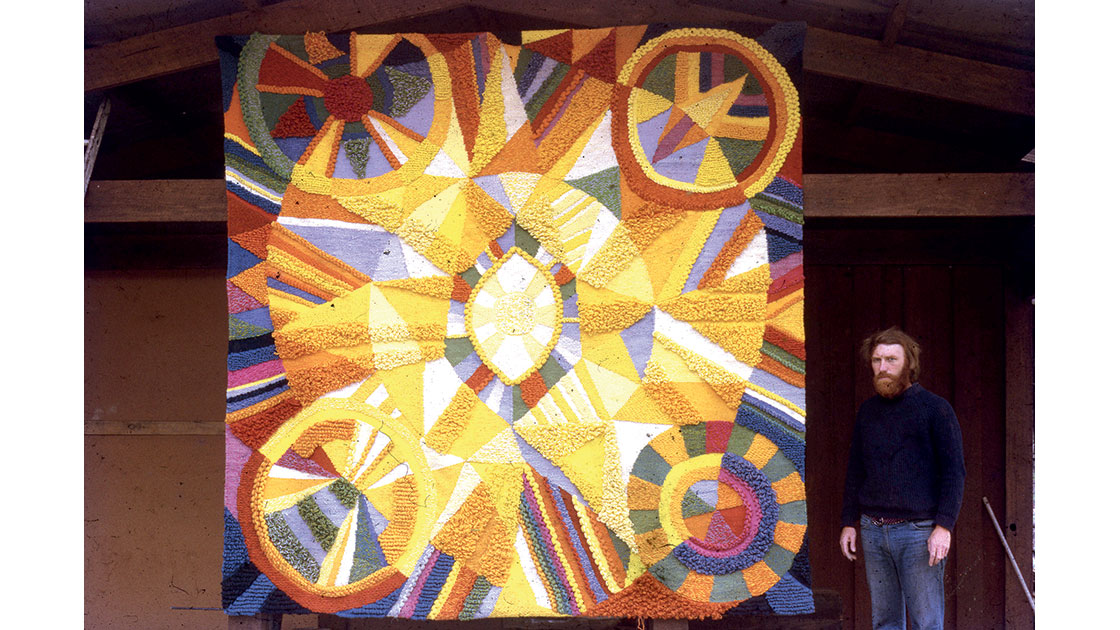
The architects Noel Bell Ridley Smith, public-spirited and Christian, had commissioned me from 1972-1988 to make tapestries. I sensed that the architects believed that the wonder of a woven tapestry could be a kind of redemption in the turmoil of modernity. I made the great tapestries from frame looms attached to the roof beams of our house deep in a forest near Bellingen, a house built by my husband Joseph. An early commission was The Glory of the Lord, 2.7 meters square for the newly designed Robert Menzies College, Macquarie Park, in 1973, but when enquires were made by Wollongong Art Gallery curator Louise Brand in 2022, its location within the college was not known. However, Reverend Dr Peter Davies, Master of Menzies College, was persistent in searching for The Glory of the Lord, consulting a retired maintenance officer who remembered that it was tightly rolled in plastic in a College storage area. To find it made me weep—obliterated in the dark storeroom it was restored to light decades later.
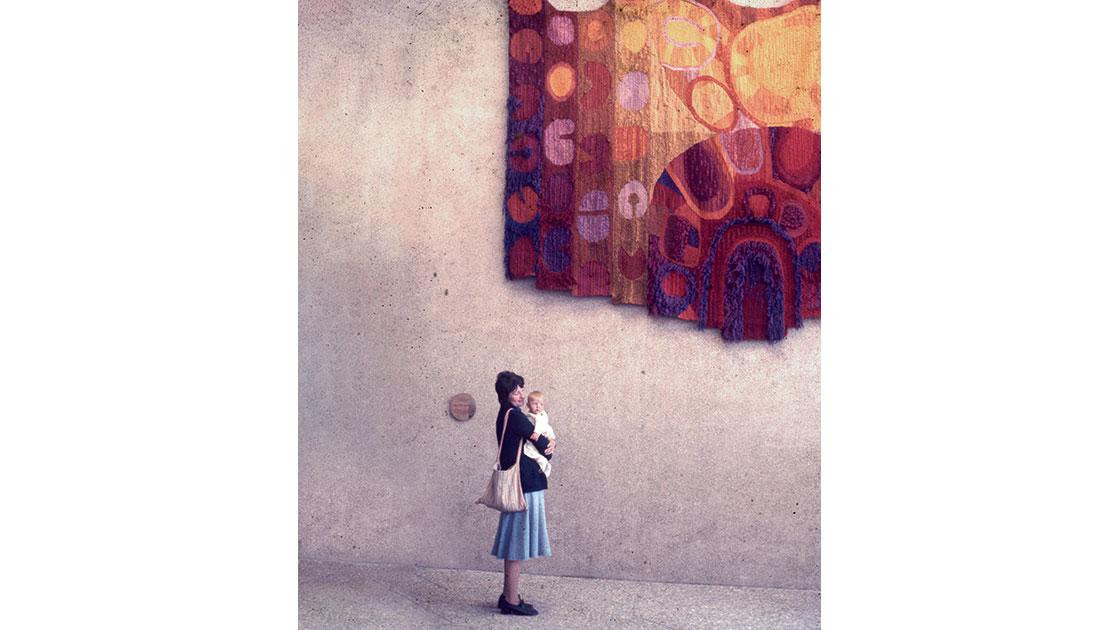
St Andrews House, Sydney Square, held the largest tapestry I have ever made, again through the architects Noel Bell Ridley Smith. Darkness into Light won a design competition in 1975, and I wove the tapestry in three sections over 1975 to 1976, while pregnant with my first child Nicholas and during his early babyhood. Measuring 3.2 x 4.9 meters, it was installed in the foyer of St Andrews House, behind the cathedral, where it stayed for twenty-five years, before being taken down around 2003 to make room for a coffee shop. It is now lost. Despite many enquiries over the last ten years the St Andrew’s Anglican Diocese has no record of what happened to it. Is it concealed in another forgotten warehouse? Or was it just taken to the tip?
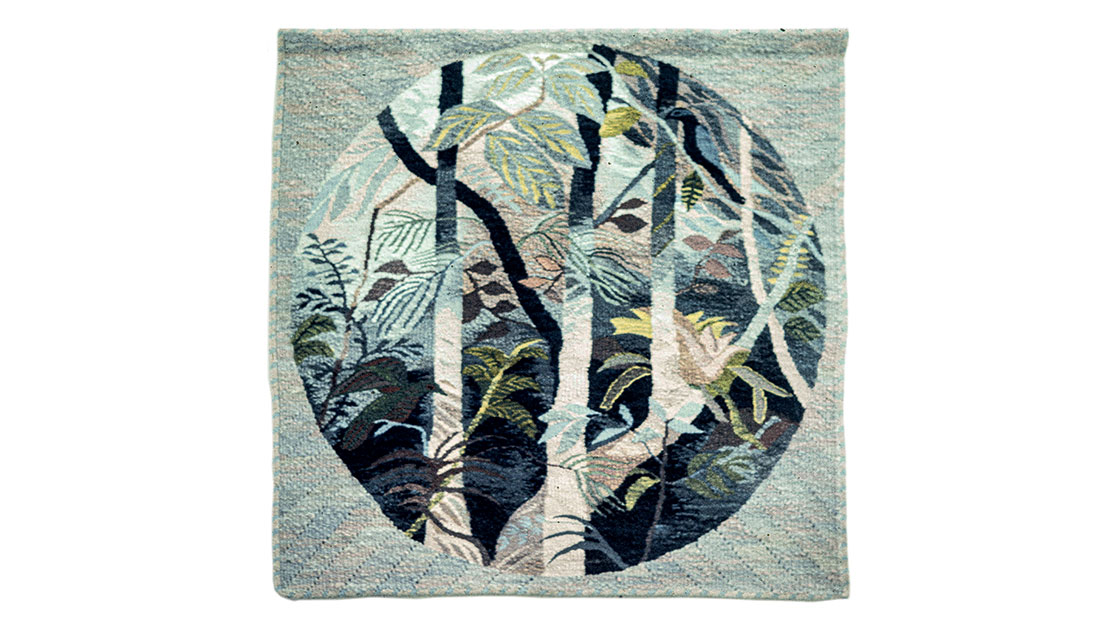
The National Capital Development Commission in Canberra was formed by an Act in 1957 to complete the establishment of the capital as the seat of government. To adorn Canberra’s fast-developing architecture, Noel Bell Ridley Smith was tasked to make an art collection. It purchased two tapestries from me; Dry Season Creek (90 x 180 centimetres) in 1975, and Forest Circle, (1.2 meters square), in 1981. Despite persistent searches in 2023, no one knows where the tapestries are, or what has happened to them. The original Noel Bell Ridley Smith building has been demolished.
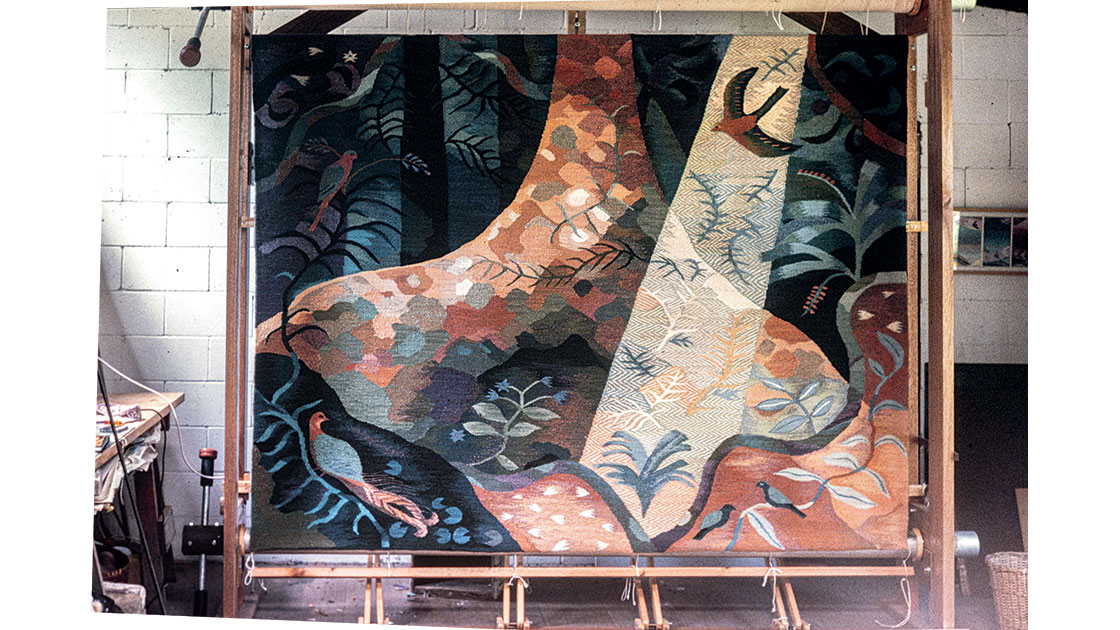
Through the Crafts Council of NSW, a Tropical Rainforest tapestry was commissioned for the new Resort Hotel, Macquarie Street, Sydney, in 1987. I was one of fourteen craftspeople who developed work for the lavish interior, designed to be a watershed in creating public shows of craft in architectural projects. But by 2023, when Paul Sharrad went on the hunt for the large tapestry, delving into layers of documents as intricate as an archaeological excavation, the hotel and its artefacts had vanished. Paul commented that “what emerged was a fascinating story of 1980s Sydney property development—not just the history of craft’s entry into the public art domain, but also a tale of craftiness in business deals.” Paul found that a string of shell companies had been ducking and weaving through financial vicissitudes and that these companies were part of Dainford, a big real estate developer, which collapsed spectacularly in 1991. Astonishingly, it seemed the Resort Hotel lasted barely ten years before the shadowy owners went bankrupt and the hotel was torn down and replaced by a high-rise block of serviced apartments. So much for six months of hard labour, suspended up on a scaffold near the ceiling weaving a two by two and a half meter tapestry. There is only silence about what happened to the contents of the Resort Hotel.
As an archaeologist, I know material culture is perilously fragile. The ancient Greeks made the deity Athena goddess of war, but also of weaving and reparation. After the battle, you took up the spindle and the loom to start repairing the fabric of society. Australia is a country familiar with destruction through fire, flood, and drought as well as the self-inflicted destruction of our built and natural environment. We need our artisans of sustainability, our makers of intricate hand processes not only to redress the balance, but to provide a core of hope.
Exhibition
An Archaeology of Woven Tapestry
8 June – 1 September 2024
Wollongong Art Gallery
Logos / Λογότυπα,
21 September – 17 November 2024
Hazelhurst Arts Centre, Gymea
This essay was published in Artist Profile, Issue 69, 2024.
Images courtesy of the artist, the Art Gallery of New South Wales, Sydney, and the estate of Magdalena Abakanowicz / Copyright Agency
Edwards was born on Kaurna Yarta in 1998 and raised on Nauo Country in the small seaside community of Tulka, on the Lower Eyre Peninsula....

Under the auspices of Geelong Gallery’s director, Humphrey Clegg, and co-curated by Marianne Mathieu, former scientific director of the Musée Marmottan Monet, and Claire Durand-Ruel...
Nike Savvas: Purple Haze presents intimate screen prints and immersive large-scale installation and video work by Savvas from 2005–2026, each evocative of different places and...
Although physically he is of modest stature, Zofrea has devoted much of his life to grand projects that have been conceived and executed on a...
Through a multidisciplinary collaboration between Rotterdam-based curators, architect Paul Cournet of CLOUD and artist-designer Sabine Marcelis of Studio Sabine Marcelis, the exhibition explores the interplay...
Artificial intelligence will be used by young artists who started using it as kids on their phones. They will see it as a natural extension...

This year’s Biennale arrives under more complex circumstances than most. It is shaped by the profound loss of its curator, Koyo Kouoh (1967–2025), whose exhibition...
No artist creates in isolation. Every painting carries traces of the conversations, places and histories that shaped it, preserving within its surface a particular moment...
The weekend markets at Fairfield Showground have been one of Western Sydney’s great institutions for more than fifty years. Fresh fruit and vegetables, children’s clothes,...