Michael Vale
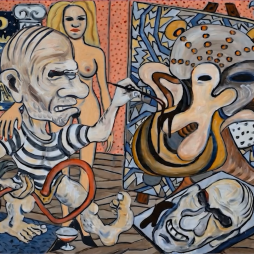
Michael Vale's instantly recognisable "Gothic Absurdism" has recently garnered much attention – not least at the Moran Portrait Prize in December 2021. An upcoming show at Martin Browne Contemporary sees Vale painting between excess and emptiness, parsing various modernist vocabularies to create a visual language all his own.


In PegLeg’s Ghost, 2021, three figures appear with bundles of cloth perching improbably on their heads. Neck-ache and gravitational dynamics aside, the nestling of lively objects into these happenstance headpieces places the picture firmly within the realm of the absurd. From two seated figures emerge small, vertical smoking structures (chimneys?), while the garb of the standing figure, presumably the eponymous ghost, is replete with flat, calamine-pink smoking pipes. Another pipe hangs from the space in his face where a mouth should be, but isn’t. Above this, in place of two eyes, there are a pair of flat, vaguely transparent oval shapes in that same calamine pink. The eyes, instead, are everywhere but this ghostly face: peering at the figures from the visages of two goats to the picture’s right side, and from mid-air in the middle-ground. Perhaps PegLeg’s mouth, like these eyes, is also outside himself, in the gaping oysters in the picture’s foreground. A sense of the human observing itself from a position of estrangement pervades the work. It would be deeply unsettling if the gaze wasn’t so affectionate – a pat on the generously-towelled head.
Michael Vale’s work is set here, as it often is, in a realm at once atemporal and art-historical, where the symbolic and representational vocabularies of various European modernisms are skilfully juggled across the canvas. Vale refers to his style as “Gothic Absurdism,” which he describes as a “use of black humour, or the absurd, interwoven with a kind of benign ghoulishness.” Vale cites the influence of early Bob Dylan songs, Rimbaud, and James Ensor. A certain excess holds all of these predecessors in common: a flowering-over of movement, of feeling, of texture and of colour (literally or not).
Vale, too, works with and in excess. This is true both terms of reference, historical situation, and especially in colour, which is built up lustrously on the canvas, unremittingly intense – like being constantly within the most liquid moment of a sunset. And, yet, what is also striking about the way the paint is applied to the canvas are the moments of thinness. See, for example, the wavering translucence of the mountains in The Cul-de-Sac, 2021. This sparseness ripples through some of Vale’s imagery, too: the skulls where fleshed-out faces should be, the empty graphic speech bubbles, even the patches of pure abstraction which crop up in The Cul-de-Sac. Aesthetic and figurative excess look over into an abyss of content; this is what I’ve long thought it feels like in the register of the absurd, and Vale renders it characterfully on the canvas. Vale writes that he hopes his paintings will “provoke unanswerable questions” – I would add only that the sensations produced by the work, too, are unanswerable, sly and inimitable in their knowing contradictions.
EXHIBITION
Morning Came and Morning Went
3 _ 27 February 2022
Martin Browne Contemporary, Sydney
Nike Savvas: Purple Haze presents intimate screen prints and immersive large-scale installation and video work by Savvas from 2005–2026, each evocative of different places and...
Although physically he is of modest stature, Zofrea has devoted much of his life to grand projects that have been conceived and executed on a...
Through a multidisciplinary collaboration between Rotterdam-based curators, architect Paul Cournet of CLOUD and artist-designer Sabine Marcelis of Studio Sabine Marcelis, the exhibition explores the interplay...
Artificial intelligence will be used by young artists who started using it as kids on their phones. They will see it as a natural extension...

This year’s Biennale arrives under more complex circumstances than most. It is shaped by the profound loss of its curator, Koyo Kouoh (1967–2025), whose exhibition...
No artist creates in isolation. Every painting carries traces of the conversations, places and histories that shaped it, preserving within its surface a particular moment...
The weekend markets at Fairfield Showground have been one of Western Sydney’s great institutions for more than fifty years. Fresh fruit and vegetables, children’s clothes,...
In recent times, Yorgos Lanthimos has shifted toward photography, noting in a Guardian interview, 2026, that he needs respite, saying, “it might be a couple...
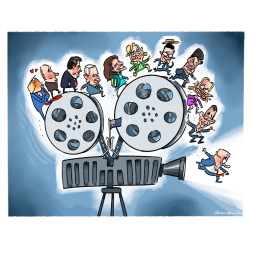
In Australia, political cartoons were altered by several events during the 1960s: the arrival of Les Tanner’s (1927‒2001) instinctual wit at The Bulletin, Bruce Petty’s...