Michael Vale
Celebrating Michael Vale's current exhibition with Despard Gallery, AbsurdiO, we're pleased to share the artist's newest works alongside Lucy Hawthorne's essay on his practice from our print archive. Published on the occasion of Vale's previous exhibition with Despard – entitled "The Guests" – Hawthorne's essay explores notions of the Gothic, the absurd, and the otherworldly, which echo through Vale's new work in ever mysterious ways.


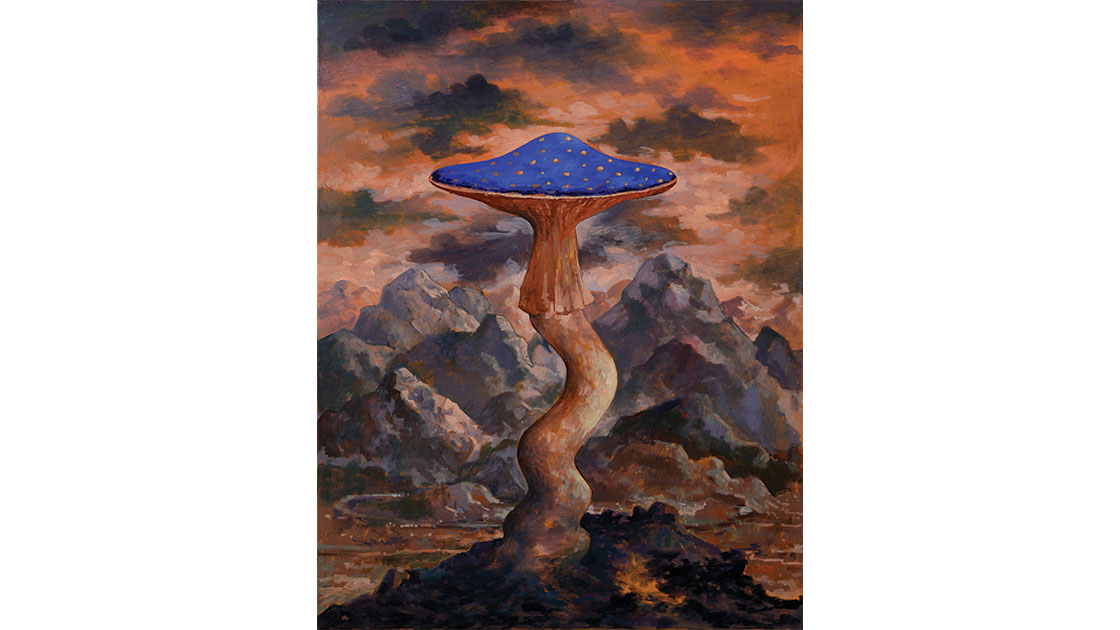


Michael Vale’s paintings contain a melange of art historical references and symbols, from pipe-smoking dogs and skeletons, to surreal landscapes. Describing his work as “Gothic Absurdism,” Vale draws on the dream-like worlds of late nineteenth century symbolists and the rugged mountainscapes of the Romanticists, while his colour schemes and supernatural “guests” are more akin to the covers of 1970s science fiction novels speculating on a post-apocalyptic earth.
The paintings in The Guests feature “visitors, or intruders, from other realms.” Vale explains, “as a Victorian I am a visitor to Tasmania (one that is acutely aware of its gothic charisma), in another way we are all ‘guests’!” He adds, “I am excited to bring my band of visitors to Hobart.”
The exhibition will include Behold! The Pretty Little Thing, 2019, which featured in the pop-up exhibition, Word of Mouth, at the Venice Biennale last year. Curated by Peter Hill, the exhibition focussed on superfictions in art – expressed in Vale’s current work through his grotesque assemblages and mix of art historical styles and tropes. The “pretty little thing” appears to be the colourfully dressed mummy or voodoo priestess, flanked by two skeletons. The skeletons point at the mummy with a gesture reminiscent of the “humblebrag” hand signals popular in celebrity Instagram selfies. As in many of Vale’s current paintings, the skeletons wear thick coats and oversized Karakul fur hats, with comically patterned shirts poking out above the lapels. The patterning is repeated in the layers of fabric adorning the mummy, which could be mistaken for an arte povera totem if not for the flat eyes and round nose that hint at a face. The resulting scene is a strange mixture of horror and cute.
The pipe-smoking, hat-wearing skeletons feature again in The Mystery Man, 2019. In their rich fur-collared coats, they gather around a portrait of a besuited mummy. They could be collectors, protectors, teachers, or even predators. The only relief from the warning red tones are the gentle clouds of smoke from the pipes and the yellow hood worn by the small figure in the foreground. The hood is reminiscent of the bird-like beak masks worn by seventeenth-century doctors in the belief that it would protect from the plague. Although painted just prior to the coronavirus outbreak, this hooded figure can be read quite differently today.
In the larger Strange Rain, 2019, the mummy and skeleton resemble explorers, this time sporting clothes that are more pop than Soviet winter. They are accompanied by dogs, one of which appears to be engaged with a ghost. Perched on the edge of a cliff, with sharp purple peaks in the background, the scene references nineteenth-century Romanticism in a decidedly contemporary way. Pink disks and dots fall from the sky like alien rain, adding to the frenzy of colour and patterning.
While many of Vale’s influences are undeniably macabre, it is important to acknowledge the humour in his work. The smoking skeletons and dogs, the fashion-forward mummies, mutant landscapes, and portrait frames within frames, cleverly combine popular culture with art history and mythology.
Elements like the dogs and pipes have long appeared in Vale’s paintings and films. He received a PhD from Monash University in 2006 for his superfiction project Le Chien Qui Fume – A Smokey Life, which documents the discovery of the pseudo-historical figure, Le Chien qui Fume (the Smoking Dog). While he now works as a senior lecturer at Monash, Vale has previously held jobs writing for children’s television, as well as renovating the Ghost Train at Luna Park. A three-time Archibald finalist, Vale won the 2018 Hutchins Art Prize for The Great Divide, 2016, featuring one of his famous smoking dogs. He also won the 2017 Bayside Art Prize with Snow, which depicted a large gathering of his disturbing beasties.
Vale boasts he was “fortunate enough to actually see a ghost when I was eleven.” His obsession with the Gothic and ghostly was originally influenced by European novels and paintings that located his “dream world” in Central Europe. He cites the paintings of Arnold Böcklin and Salvator Rosa as creating “a template for my Gothic dreams and imaginings” – an influence that can still be seen in the sublime mountain backdrops of Strange Rain and The Great Divide.
More recently, Vale has drawn on influences closer to home. “I have become more aware of the fact that convicts were sent to Australia at precisely the same time that the Gothic novel was capturing the imaginations of European readers,” he says. ‘The horrors of colonisation have imbued the wildernesses of Victoria and Tasmania with added mysteries and foreboding and are now fused in my imagination within the Gothic plane.” The Guests is no doubt a timely opportunity to further explore these links between the Tasmanian landscape and the Gothic tradition.
This article originally appeared in Artist Profile, Issue 52, 2020.
EXHIBITION
Michael Vale: AbsurdiO
12 October – 5 November 2022
Despard Gallery, Hobart
We call on the NSW Government to lift Lisa Havilah’s suspension and reinstate her as Chief Executive of Powerhouse, allowing her to lead the opening...
Two years ago, Macleod returned to his hometown of Christchurch, New Zealand, to be with his mother during the final phase of her life. At...
Edwards was born on Kaurna Yarta in 1998 and raised on Nauo Country in the small seaside community of Tulka, on the Lower Eyre Peninsula....

Under the auspices of Geelong Gallery’s director, Humphrey Clegg, and co-curated by Marianne Mathieu, former scientific director of the Musée Marmottan Monet, and Claire Durand-Ruel...
Nike Savvas: Purple Haze presents intimate screen prints and immersive large-scale installation and video work by Savvas from 2005–2026, each evocative of different places and...
Although physically he is of modest stature, Zofrea has devoted much of his life to grand projects that have been conceived and executed on a...
Through a multidisciplinary collaboration between Rotterdam-based curators, architect Paul Cournet of CLOUD and artist-designer Sabine Marcelis of Studio Sabine Marcelis, the exhibition explores the interplay...
Artificial intelligence will be used by young artists who started using it as kids on their phones. They will see it as a natural extension...

This year’s Biennale arrives under more complex circumstances than most. It is shaped by the profound loss of its curator, Koyo Kouoh (1967–2025), whose exhibition...