The Art of Protest
A new group show at the Newcastle Art Gallery considers the relationships – formal, tactical, historical – between protesting and art-making. Surveying artists who operate from both local and interstate contexts, and including work from the Gallery's collection, works shown elsewhere in the city before, and works new to the area, the exhibition resists any universalising answers to its central questions: what has protest been, and what might it be in days to come?


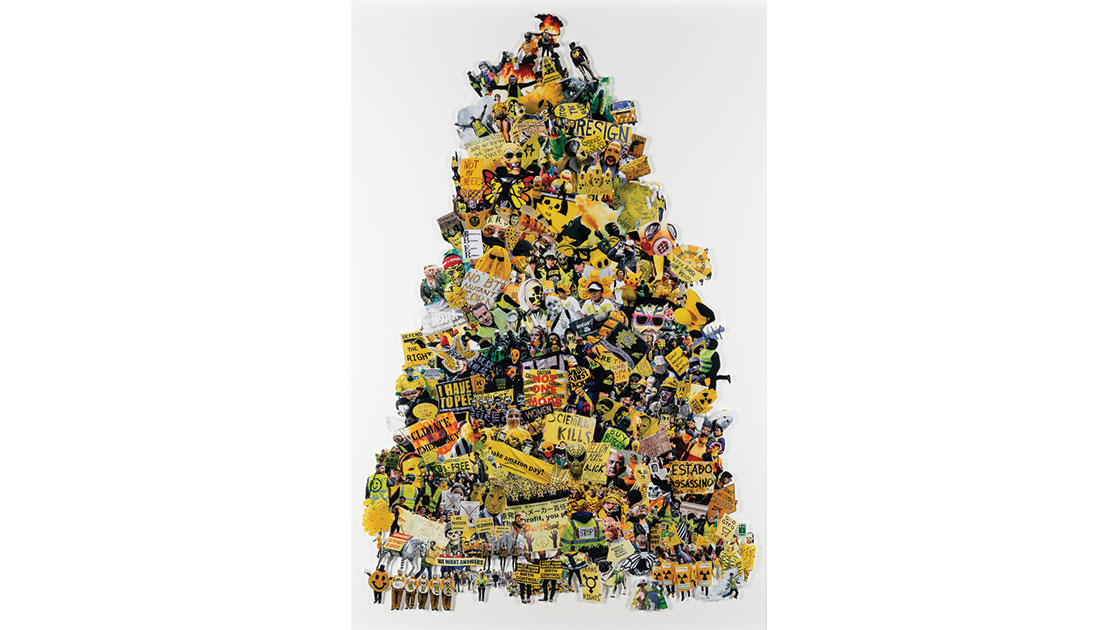
Local audiences might find some moments of familiarity at the Newcastle Art Gallery during the showing of The Art of Protest. The program, which includes the work of some thirty-eight artists, offers at least thirty-eight answers on what art and activism have had to do with each other in this country over the past hundred years. One of these thirty-eight artists is Peter Drew, whose posters – a 2016 series proclaiming alternately that “REAL AUSTRALIANS SAY WELCOME” and that early non-white immigrants such as Monga Khan are, stridently,”AUSSIE” – have become a recognisable feature of the urban landscape across and beyond the Hunter region. Drew’s protest, is was also an interrogation of nationhood and the White Australia Policy, is shown alongside another work that Novocastrians might know: Tina Havelock Stevens’s The Breakwater, 2018. Set and created in Newcastle, and previously shown at The Lock-Up art space, Stevens’s work examines what is sometimes billed as Australia’s first environmental-justice protest, or our first community-activism event, dating to the mid-nineteenth century and relating to the conservation of land at Nobby’s Beach.
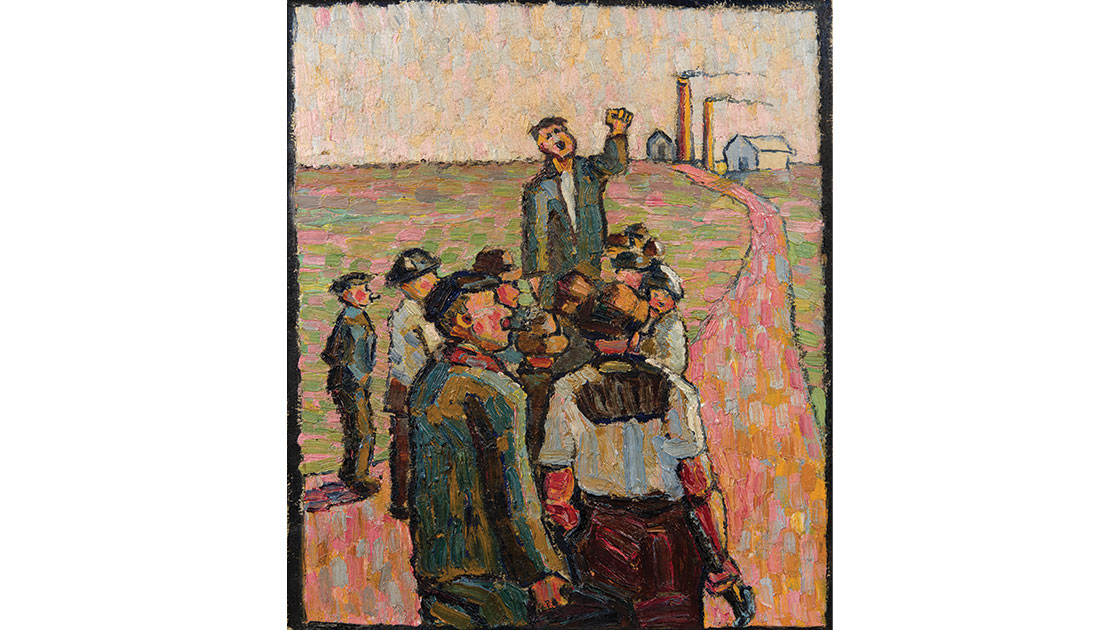
Fiona Lee’s work urgently calls for climate action in the face of the devastating 2019/20 bushfires, while Madison Gibbs’s I Can’t Breathe, 2021, is billed as “a simultaneous call from Aboriginal people and the environment.” Grace Cossington Smith’s Strike, c. 1917, bears record of the union movements in and around Sydney in the early twentieth century.
The Gallery’s director, Lauretta Morton, emphasises the role of art as activism, stating that “artists have always played a pivotal role as a voice of protest, from the early modernists and social realists tackling workers’ rights in the 1940s, o poster art of the 1970s, through to the current issues of the day including women’s rights, environmental policy, compassion for all Australians and the preservation of local heritage.”
I would also offer the thought that art – which we’re encountering here in the gallery, after all, rather than on the street or in the chambers of Parliament – has some more complex relationship to social change and the tactics we might take up towards it than this equation suggests. Certainly, many of the activist or protest movements that the works in this show interact with, represent, bear witness to, or examine have relied on strong – often graphic – visual cues for their heft. Yet, as this show demonstrates, there is no easy correlation between the imperatives of protest and the impulses of art, which can also be to muddy the waters, to unmoor our casual or comfortable understandings of our political lives, to work as an historical record, or to offer a speculative vision of the future. Taken together, the pluralistic body of work shown in The Art of Protest doesn’t settle the question of art’s relation to activism so much as unsettle it, offering a polyvocal, multifocal approach.
A few more voices will be added, too, on Friday 26 November, when local femme punk band Boycott play at the gallery alongside exhibiting artist and poet Richard Tipping.
EXHIBITION
The Art of Protest
30 October 2021 – 30 January 2022
Newcastle Art Gallery, NSW
Nike Savvas: Purple Haze presents intimate screen prints and immersive large-scale installation and video work by Savvas from 2005–2026, each evocative of different places and...
Although physically he is of modest stature, Zofrea has devoted much of his life to grand projects that have been conceived and executed on a...
Through a multidisciplinary collaboration between Rotterdam-based curators, architect Paul Cournet of CLOUD and artist-designer Sabine Marcelis of Studio Sabine Marcelis, the exhibition explores the interplay...
Artificial intelligence will be used by young artists who started using it as kids on their phones. They will see it as a natural extension...

This year’s Biennale arrives under more complex circumstances than most. It is shaped by the profound loss of its curator, Koyo Kouoh (1967–2025), whose exhibition...
No artist creates in isolation. Every painting carries traces of the conversations, places and histories that shaped it, preserving within its surface a particular moment...
The weekend markets at Fairfield Showground have been one of Western Sydney’s great institutions for more than fifty years. Fresh fruit and vegetables, children’s clothes,...
In recent times, Yorgos Lanthimos has shifted toward photography, noting in a Guardian interview, 2026, that he needs respite, saying, “it might be a couple...
In Australia, political cartoons were altered by several events during the 1960s: the arrival of Les Tanner’s (1927‒2001) instinctual wit at The Bulletin, Bruce Petty’s...