
Sui I Moana: Reaching Across the Ocean
For New Zealand artist Robin White and Tongan artist Ruha Fifita the creation of eight large scale ngatu – including one that is an epic twenty four metres in length – was a natural progression for their practices, friendship and shared cultural history. The patterns of migration between Tonga and New Zealand have been occurring for centuries, and their exhibition Siu I Moana at the National Gallery of Victoria, traces these pathways and today’s contemporary stories across the Pacific.


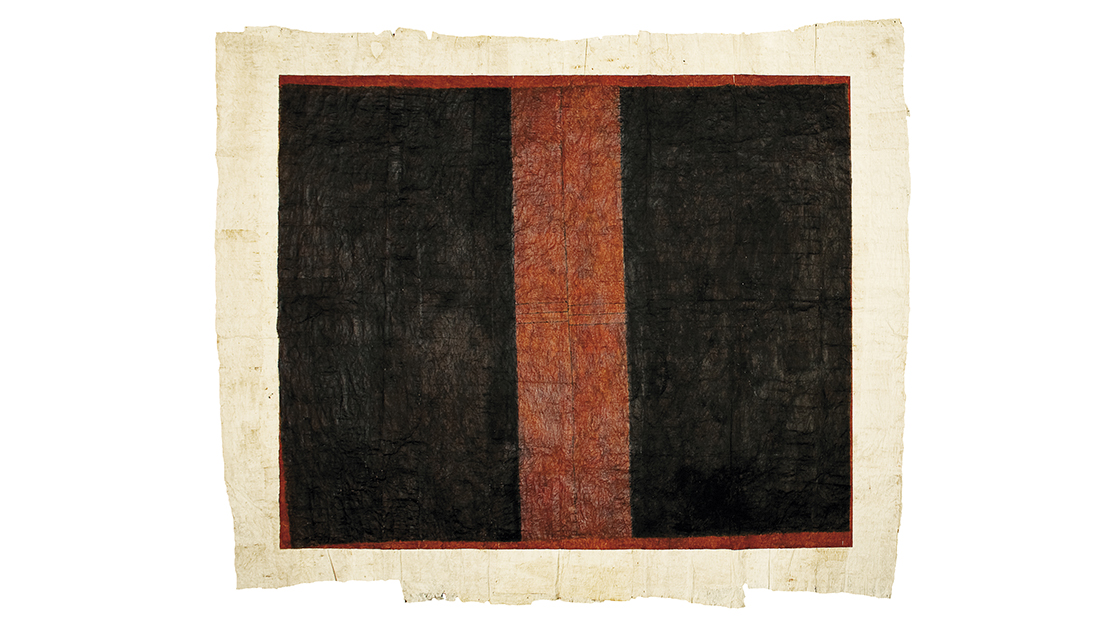


Created over a number of years, White and Fifita collaborated with the women of Haveluloto village on Tongatapu Island, Tonga. A craft that is less practiced today, the creation of fine tapu is a lengthy and demanding process. Beating the bark of the paper mulberry tree, it is softened into small pieces that are then joined and pasted together. Once malleable it is rubbed over patterned rubbing blocks to form huge sheets of dyed and patterned paper skin ready to be painted.
This time honoured and lengthy practice of creating tapu, as well as the size of these works, commands a respect as you enter the room. The large scale, and detailed paintings brim with intense patterns and imagery. Overwhelming at first, it is only through time spent with the works that the layered stories of past and present migration emerge and present themselves to the patient viewer. Situated within the natural brown, burnt red and black coloured patterns are contemporary images from the humorously relevant thongs, items of trade such as tea and sugar, to cars, shells and houses, or the lurking military presence of tanks. However, while there are clues left for the keen eye, there is an awareness of the dense and rich stories of past and present migration and trade that remain hidden for only the knowing eye.
The largest work, an aisle that leads the eye into the exhibition, is the 24 metre work Seen on the Avenue. Within this work traditional Tongan patterns intertwine with present day symbols. Using a traditional Tongan pattern called the Hala Paini – the pathway of pine – which presents the straight road fringed with Norfolk Pines that leads to the King’s palace in Tongapatu. Literal as a straight path, metaphorically it acts as a path, or course of action that directs you to where you need to be. Seemingly unending, the epic work has multiple folds at the middle of the work as if to suggest obstacles and challenges unseen.
In the composition of the ngatu series, White and Ruha consulted local elders on pattern patenting, and key aesthetic elements to maintain the symbols and stories underlying the ancient practice. The addition of The Crimson Sea was crucial to completing the narrative of the exhibition. Dark and all consuming, the dark-toned work is created by a precious black produced only from the soot collected from burning candlenut. The Tongan barkcloth, ngatu ta’uli, is a time consuming production, only created for royalty or solemn occasions, and barely undertaken today. It is a black void beyond comprehension, but can be understood as representing the beginning and the end of life’s cycle.
For both artists story-telling grounds their practices, connecting with their cultural and social histories of past and present to share with contemporary audiences. The strong thread of a journey ties Sui I Moana together, as the artists successfully present a modern day visual narrative of migration and trade embedded in ancient traditions. Engaging in the traditional forms of ngatu they map and narrate the powerful histories that connect Tonga and New Zealand. It is an exciting way forward for both the artists and the continuation of their cultural practices and traditions.
EXHIBITION
Sui I Moana: Reaching Across the Ocean
Until 11 September 2016
NGV International, Melbourne.
Courtesy the artists and the National Gallery of Victoria.

Under the auspices of Geelong Gallery’s director, Humphrey Clegg, and co-curated by Marianne Mathieu, former scientific director of the Musée Marmottan Monet, and Claire Durand-Ruel...
Nike Savvas: Purple Haze presents intimate screen prints and immersive large-scale installation and video work by Savvas from 2005–2026, each evocative of different places and...
Although physically he is of modest stature, Zofrea has devoted much of his life to grand projects that have been conceived and executed on a...
Through a multidisciplinary collaboration between Rotterdam-based curators, architect Paul Cournet of CLOUD and artist-designer Sabine Marcelis of Studio Sabine Marcelis, the exhibition explores the interplay...
Artificial intelligence will be used by young artists who started using it as kids on their phones. They will see it as a natural extension...
This year’s Biennale arrives under more complex circumstances than most. It is shaped by the profound loss of its curator, Koyo Kouoh (1967–2025), whose exhibition...
No artist creates in isolation. Every painting carries traces of the conversations, places and histories that shaped it, preserving within its surface a particular moment...
The weekend markets at Fairfield Showground have been one of Western Sydney’s great institutions for more than fifty years. Fresh fruit and vegetables, children’s clothes,...
In recent times, Yorgos Lanthimos has shifted toward photography, noting in a Guardian interview, 2026, that he needs respite, saying, “it might be a couple...