Chutzpah: Spirit. Recollection. Self.
Ten Jewish artists from Australia and beyond refute monolithic notions of Jewish life through their unique styles and stories. The Jewish Museum of Australia, Melbourne, brings together an unprecedented exhibition of contemporary Jewish art that showcases the diversity of Jewish identity in our times.


Hebrew is not merely the language of the Jews. Jewish people trace their lineage to Abraham, the first Hebrew—Ivri—a word derived from traversing to the other side of a river. However, rather than a strictly oppositional phenomenology, Ivri is a perplexing and sacred non-positionality. It is the fluidity between homeland and here, wherever “here” may be. It is perpetual ethical debate. It is limbo between safety and peril, acceptance and otherness. It is the obligation to cultivate both the self and the tribe. Ivri is the continuous and precarious, liminal positionality that shapes the Jewish experience. To turn that into art, like Marc Chagall, Mark Rothko or Judy Chicago takes a certain brazen, unapologetic and absurd confidence.
Jews have a word for that too. Chutzpah.
First mentioned in the Mishnah Torah as a form of righteous indignation, chutzpah has transformed and colloquialised over the centuries, especially in Yiddish, to mean a certain audacity that, for better or worse, defies taboo. Think Curb Your Enthusiasm.
But chutzpah is more than that. Chutzpah is the Ivri’s engagement with the status quo, reckoning with rigid norms as an abnormal other. It therefore makes an excellent namesake for the Jewish Museum of Australia’s (JMA) groundbreaking new exhibition, Chutzpah: Spirit. Recollection. Self., which confronts notions and prescribed distillations of Jewishness with a survey of multifaceted, multidisciplinary contemporary Jewish art from all over the world.
As a scholar of Jewish art I am usually skeptical of contemporary work that claims Jewish roots. Chutzpah, impressively, gets it right, with curator Alana Kushnir skillfully balancing Jewish authenticity with contemporary aesthetic excellence. Conceptually the show’s greatest strength is the large tent in which Kushnir welcomes the artists to bring their respective practices and varied, lived experiences of Jewishness. Despite its cultural specificity, Chutzpah is remarkably relatable to visitors of all backgrounds, not least thanks to the accompanying audio content that is available globally through Bloomberg Connects.
Is it a political show? No. Is it not a political show? No. Ask any Rabbi and they will tell you that those are acceptable answers. The exhibition is confronting, but it’s not polemical. Photographer Ori Gersht’s latest works taken at the now-depopulated sites of the October 7 massacres in southern Israel are hauntingly matter-of-fact, as is Nina Sanadze’s exterior installation of salvaged chairs from the fire-bombing of Adass Israel Synagogue in 2024. The works are not talking points. They speak for themselves.
Interplay amongst memory, history and emotion plays a greater role, as does the spectrum and experimentation with material and form. Inbal Nissim’s large paper works sway with fragile resilience while Stephania Windholz Leigh’s ensemble uses minimalist abstraction to explore the medicinal role of food in Jewish family lineages.
Playfulness is intriguingly bittersweet in the chutzpadik context. Jordy Kerwick’s vibrant, faux-naïvete venerates the righteous among the nations who saved Jews during the Holocaust in the area of France where he now resides. Meanwhile, Brooklyn-based Allison Zuckerman reorients her feminist pop-art toward Jewish art historical references such as Amedeo Modigliani, Philip Guston and Chaim Soutine to generate atemporal interconnectedness.
I am also struck by the show in itself. In an underfunded Australian arts sector compounded by a public underappreciation of aesthetics, tall poppy syndrome, and a wave of anti-Jewish hate, especially in the cultural industries, the JMA has defied expectations to create an enticing, accessible, world-class exhibition. Aside from the domestic tentpole exhibitions, biannual events, and occasional art fairs, there is sparce interaction between Australian art and audiences, patrons, and collectors elsewhere in the world. Chutzpah gives a taste of Untitled, Armory Show, and Frieze fairs down under, and unashamedly showcases emerging Australian artists with their international peers. The chutzpah of Chutzpah is its refutation of isolationist, cultural cringe with an audacious vision for an Australian arts future that is confident enough to compete on the global stage.
Dancing between light and dark, silence and song, Chutzpah captures an illuminating glimpse of the vast plurality of Jewish identity that exists today. Of the entire exhibition, Navot Miller’s work is the brightest crescendo of Ivri and chutzpah together. Like an unspoken aliyah, Miller’s fabric installation Parochet (Curtains), 2024, beckons us forth to the ark of A Pink Shul, which he exhibited in Berlin in 2024. Housed within, instead of a Torah scroll, is his own Jewish story—a magnificent triptych of loved ones, depicted as radiant nudes, in Berlin’s Rykestrasse Synagogue. To me, Miller’s works are the pièces de résistance of Chutzpah. As his painting collapses the boundaries between the religious and the erotic, the sacred and the secular, Miller displays the chutzpah to present an alternative to our current reality—an alternative where devastation, extremism and polarisation do not control our destinies.
Exhibition
Chutzpah: Spirit. Recollection. Self.
1 May – 27 July 2025
Jewish Museum of Australia: Gandel Centre of Judaica, Melbourne
This profile was published in Artist Profile, Issue 71, 2025.
Images courtesy of the artists and Jewish Museum of Australia: Gandel Centre of Judaica, Melbourne
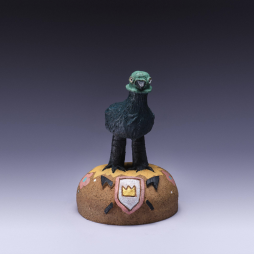
Edwards was born on Kaurna Yarta in 1998 and raised on Nauo Country in the small seaside community of Tulka, on the Lower Eyre Peninsula....

Under the auspices of Geelong Gallery’s director, Humphrey Clegg, and co-curated by Marianne Mathieu, former scientific director of the Musée Marmottan Monet, and Claire Durand-Ruel...
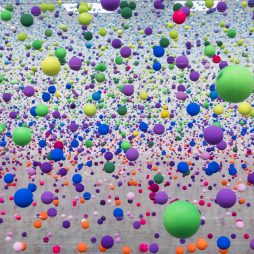
Nike Savvas: Purple Haze presents intimate screen prints and immersive large-scale installation and video work by Savvas from 2005–2026, each evocative of different places and...
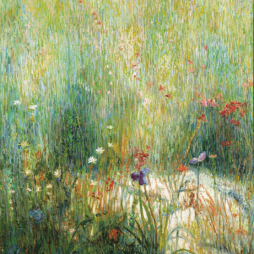
Although physically he is of modest stature, Zofrea has devoted much of his life to grand projects that have been conceived and executed on a...
Through a multidisciplinary collaboration between Rotterdam-based curators, architect Paul Cournet of CLOUD and artist-designer Sabine Marcelis of Studio Sabine Marcelis, the exhibition explores the interplay...
Artificial intelligence will be used by young artists who started using it as kids on their phones. They will see it as a natural extension...

This year’s Biennale arrives under more complex circumstances than most. It is shaped by the profound loss of its curator, Koyo Kouoh (1967–2025), whose exhibition...
No artist creates in isolation. Every painting carries traces of the conversations, places and histories that shaped it, preserving within its surface a particular moment...
The weekend markets at Fairfield Showground have been one of Western Sydney’s great institutions for more than fifty years. Fresh fruit and vegetables, children’s clothes,...