REVIEW | Resistance and Aching Truths
Underpinning Rememory, the 25th Biennale of Sydney, is Artistic Director Hoor Al Qasimi’s hope to develop “new knowledge that centres on unrecognised voices.” This is a profoundly relevant curatorial framework in a country whose colonial mainstream chokes at the proposition of truth- telling, a country housing one of the world’s most multicultural populations, a country that has just introduced “hate speech” laws that undermine fundamental human rights. In the global context, Al Qasimi’s agenda is close to being incendiary.
For those of us who seek out unfamiliar voices and see the potential for diverse cultures to create new meanings and memories in a postcolonial world, Rememory holds immense value. While visiting various Biennale venues, I was often transfixed by projects exquisitely presenting content previously untold, but there are four works I will never forget.
Top of the list is Songs for Life: A Choral Offering from The Children’s Choir at Granville’s Blouza Hall on Sunday 15 March—the culmination of a six-month project led by Biennale Community Ambassadors Paula Abboud and Claudia Chidiac, together with refugee children from Gaza. The audience sat on either side—elegant women in an array of traditional, exquisitely embroidered Palestinian thobes in the front rows.
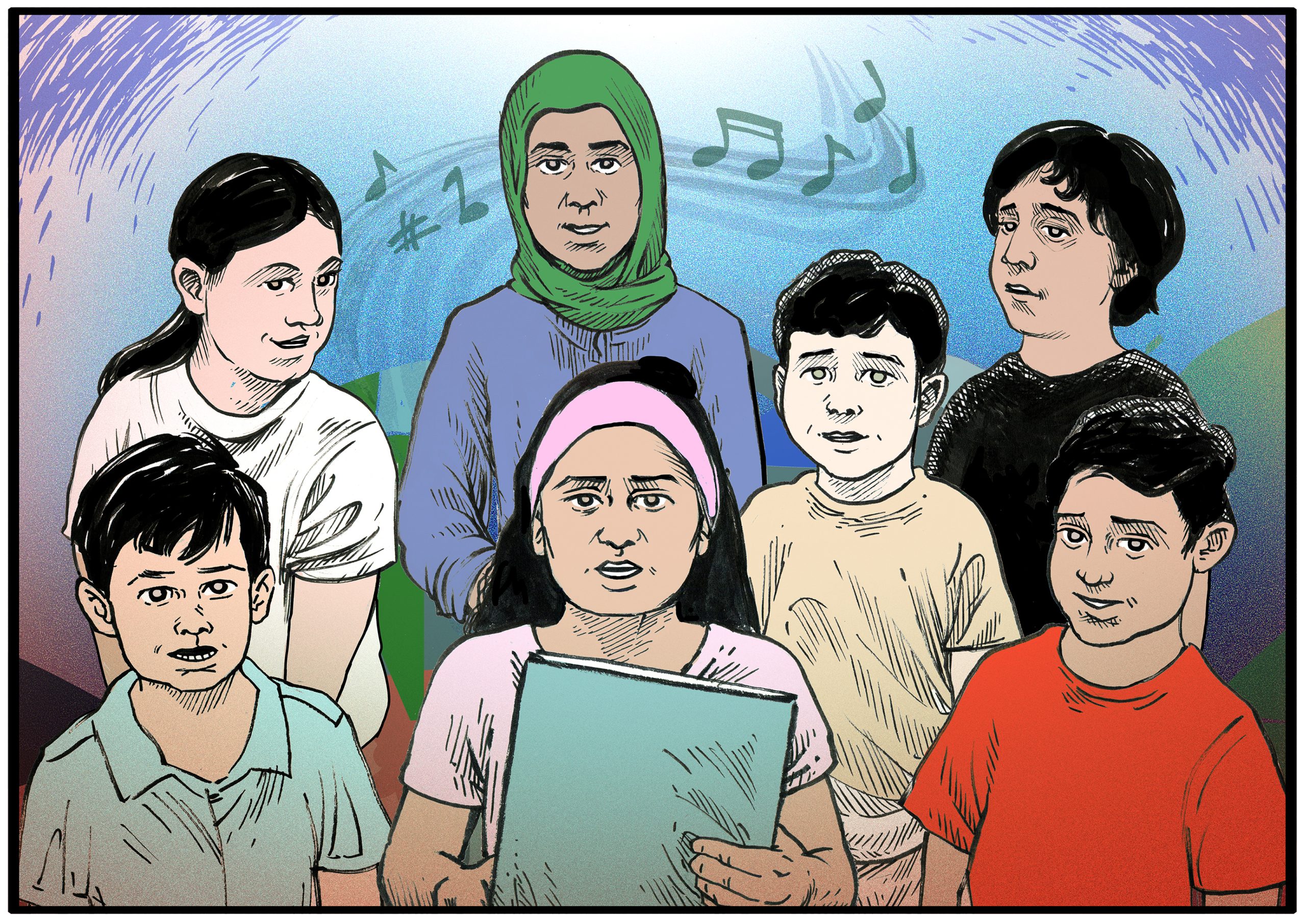
Safdar Ahmed, Singing, 2025-2026, digital image. Illustration for Songs for Life, A Choral Offering from The Children’s Choir, 25th Biennale of Sydney, Rememory, 2026.
After a bilingual introduction from Masters of Ceremony Aisha and Fatima, Atoona at Toofooli, the first choral piece was elegiac. Mine weren’t the only wet eyes there. The tone shifted with the choir’s next piece, Tik Tik Tik and then a joyous dabke, a Levantine folk dance which has become a cultural and political marker of resistance for Arabs globally. The performers’ deft effervescence was intoxicating. This energy flowed into the next performance: the darbuka, a traditional Middle Eastern and North African hand-drum, played expertly by smiling women with children on vocals. The audience was hooting, the performers beaming. The women sitting together in thobes sang Shiddo Ba’dkum (Mother’s Lullaby), plaintive and comforting. The trance-like song, Haddi ya Bahr featured astonishing solos by boy soprano Amir. With each line he sang, conductor Rania’s hand instructed him to go higher. Each time his voice was pure. The Palestinian adults were jubilant. The children apparently led this project. Abboud and Chidiac created a sanctuary of ebullient self-expression for the fortunate audience to witness. In that temporary safe haven, we were able to collectively honour the humanity of and hold the grief of these women and children.
At Campbelltown Arts Centre, in Dread Scott’s Lockdown, 2000–2026, a series of silver gelatin photos with wall-mounted speakers, we enter the closed world of male American prisoners. Although Scott’s portraits of these eleven men and boys are photographed with sharp clarity, the series radiates quiet tenderness. They sit still, dignified. In their cells or tiled spaces, most subjects meet Scott’s lens directly, their expressions ranging from blustery, guarded and weary to shy smiles and open grins. The four speakers are dispersed amongst the images, murmuring interviews between Scott and his subjects. For these conversations to become audible, the visitor must lean towards the wall. The caption states that the combination of these intimate portraits and conversations, the pairings not necessarily corresponding, “creates a moving choral effect.” Agreed. However, to me the interviews were startlingly compelling, particularly one prisoner’s assessment of the criminal system as not so different from Scott’s world.
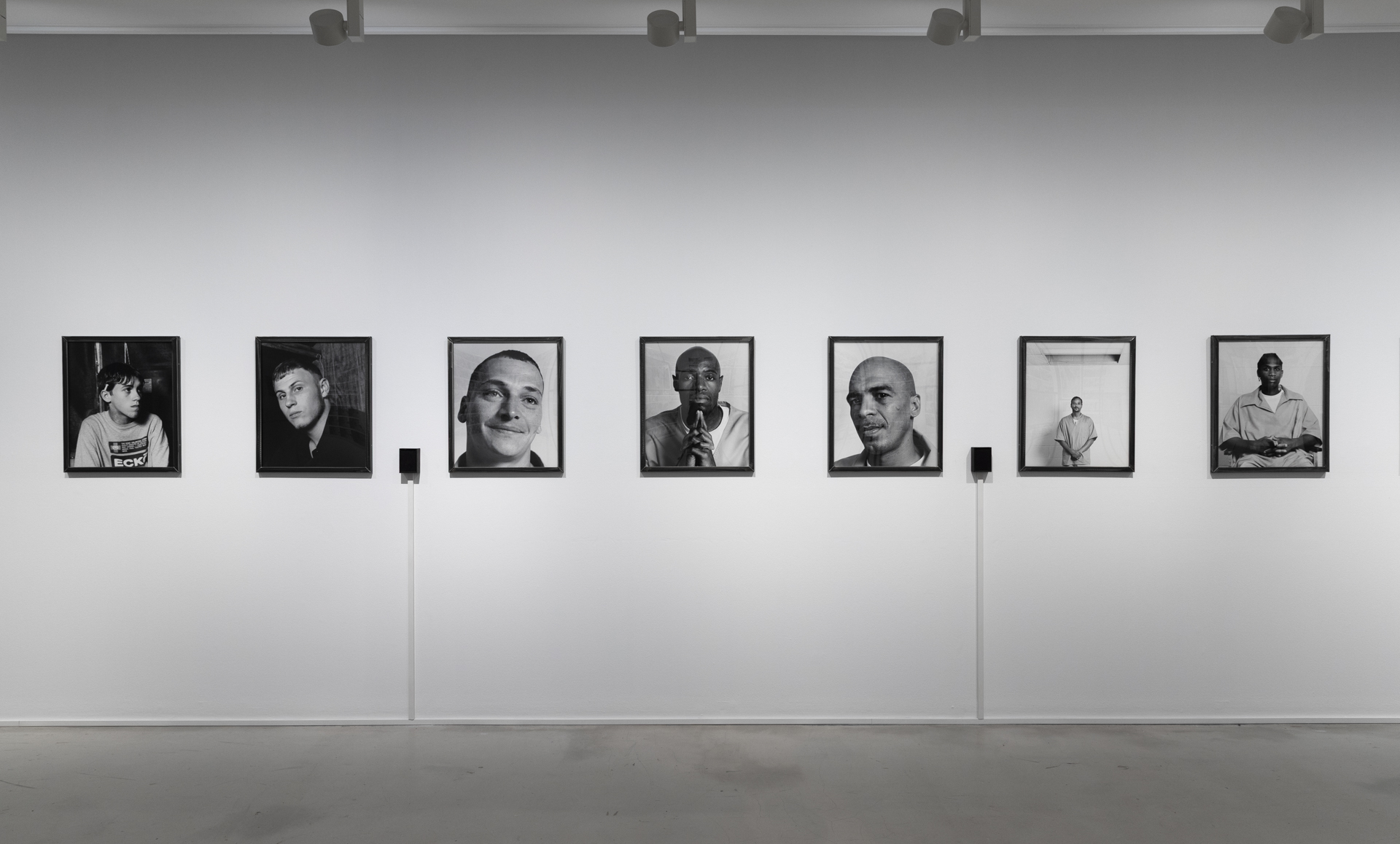
Installation view of Dread Scott, Lockdown, 2000-2026, 25th Biennale of Sydney, Rememory, 2026, Campbelltown Arts Centre. Photographed by Silversalt Photography.
This prisoner explained, “If you went to an art gallery, I’m sure you would see some guy who maybe paints, or you take pictures, maybe he paints or maybe he sculpts you and you get to know each other cos you got similar ideas and talents. Well, I might be similar to a guy from a different neighbourhood, he hears that I’ve stuck up so many people, he might need a strong gun behind him, he may be a big drug dealer as well, and we can link up.”
At Lewers: Penrith Regional Gallery, British artist Keith Piper’s single-channel video 22 Yards of Earth, 2026, is a tour de force. Sitting comfortably in an armchair against a video backdrop of newspaper clips and news footage, an elegantly clad, older West Indian male cricket enthusiast shares thirteen rich minutes of salient moments in the history of test matches between Australia, the West Indies and England since 1960, valorising West Indies greats such as Frank Worrell, the first African to captain the West Indies. The narrator’s animated, affected delivery combines with his sartorial elegance to conjure La Sape, the Congolese movement embodying the elegant style and manners of the dandies of colonial predecessors.
Piper seamlessly stitches powerful archival imagery with the lively narration, effortlessly forcing history to erupt into the present and corrupt linear chronology, creating, as Lewers’ Director Toby Chapman points out, “an impression of resistance to colonial rationality” while skewing perception of the game of cricket, itself an emblem of Western colonial values.
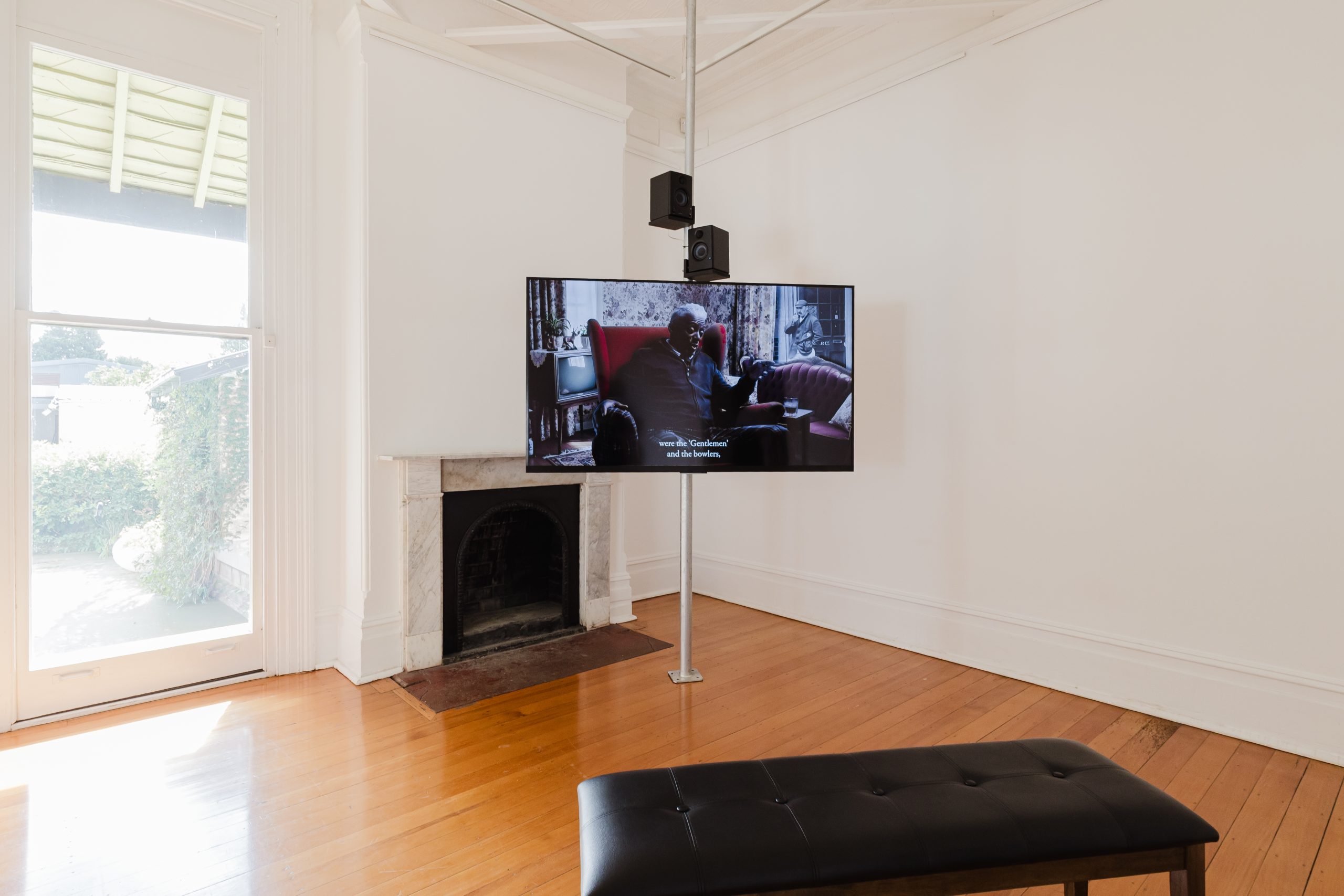
Installation view of Kieth Piper, 22 Yards of Earth, 2026, 25th Biennale of Sydney, Rememory, 2026, at Lewers: Penrith Regional Gallery. Photographed by Maja Baska.
Vernon Ah Kee’s contributions to this Biennale are outstanding, none more so than his monumental “minimalist” paintings, Many lies, 2017, and Code Black, 2025, at Chau Chak Wing Museum at the University of Sydney. Initially commanding for their colossal scale and stark reductivism, closer scrutiny reveals hard, aching truths. Ah Kee upends American minimalist Frank Stella’s iconic assessment of the genre, “What you see is what you get,” with painstakingly rendered texts barely visible beneath the flat paint.
These virtuoso paintings share difficult narratives. Under the shiny flat black paint of Many lies is a powerful, abstracted reflection on a lifetime’s experience of being lied about. The narrator tries numerous strategies to understand the lies and the trauma they caused, but only experiences more harm and isolation, ending up bitter and alone:
I live
and all I have are pieces of truth
but with my little pieces
I am unflinching and unforgiving
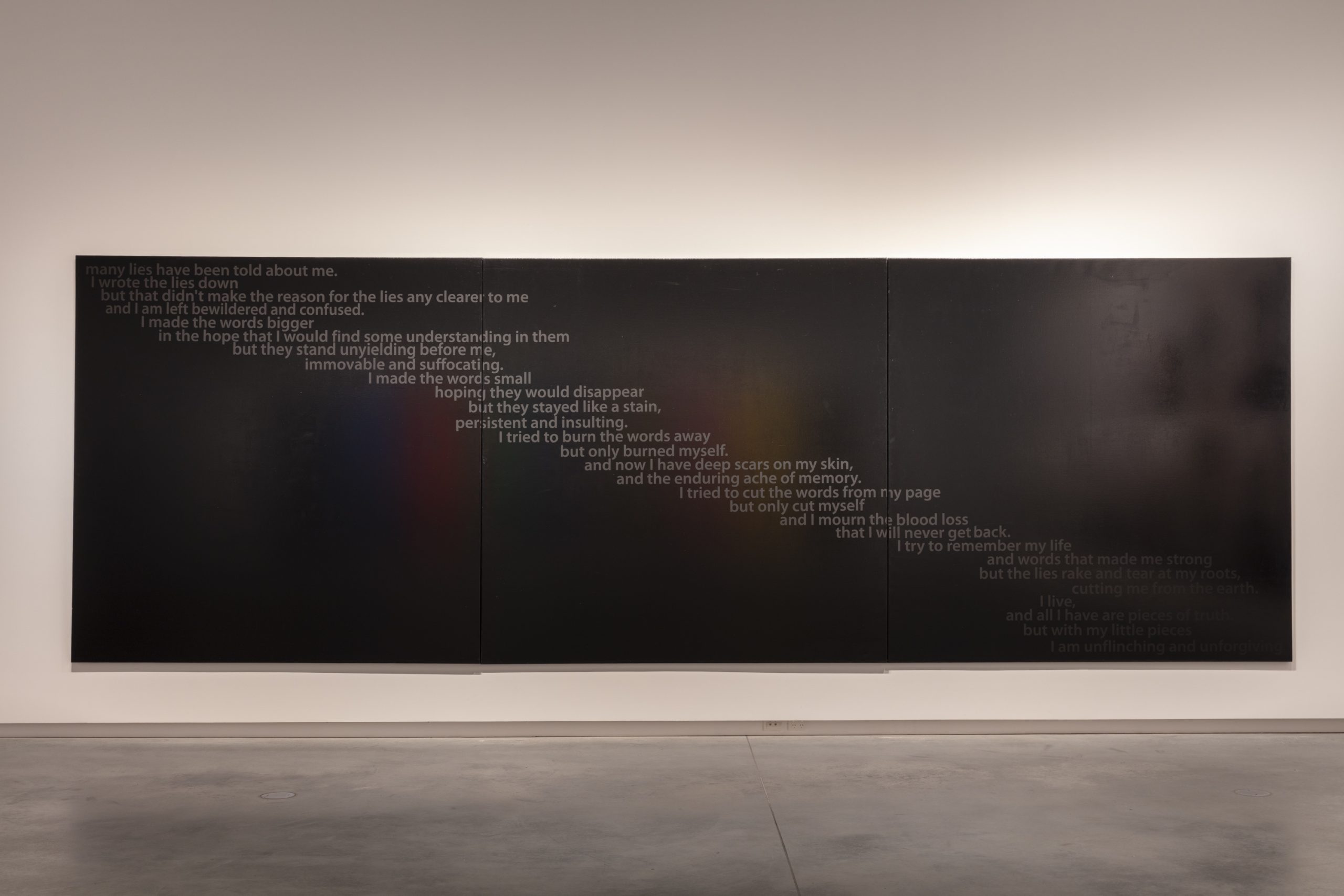
Installation view of Vernon Ah Kee, Many lies, 2017, 25th Biennale of Sydney, Rememory, 2026, Chau Chuk Wing Museum. Photographed by David James.
With biting irony, Ah Kee uses a spectrum of bright colour for Code Black, a new painting that links directly to Code Black/Riot, 2025, the harrowing, magnificent four-channel video about Australia’s mass incarceration of First Nations young people, created in collaboration with Hoda Afshar and Behrouz Boochani at Campbelltown Arts Centre. The palette also refers to internal institutional codes: Code Black—riot; Code Pink—medical emergency for suicide; Code Yellow—prisoner violence. The text on the nine panels, left to right, forms a dire narrative of a too-frequent situation: hostage; officer assistance required; self-harm; young people on roof; external threat; attempted escape; medical emergency; riot.
Qasimi hopes her Biennale will support development of “new knowledge that centres on unrecognised voices through non-canonical methods.” For me, this latter phrase reveals the weakness of her project. The best contemporary practice is endlessly inventive, using fresh methodologies as needed; the Children’s Choir is a brilliant example. The phrase suggests a disregard for connoisseurship or curatorial rigour; Rememory included too many works that were heavy-handed in tone and rudimentary in execution. Regrettably, an ardent human rights agenda got in the way of a consistently high standard of selection.
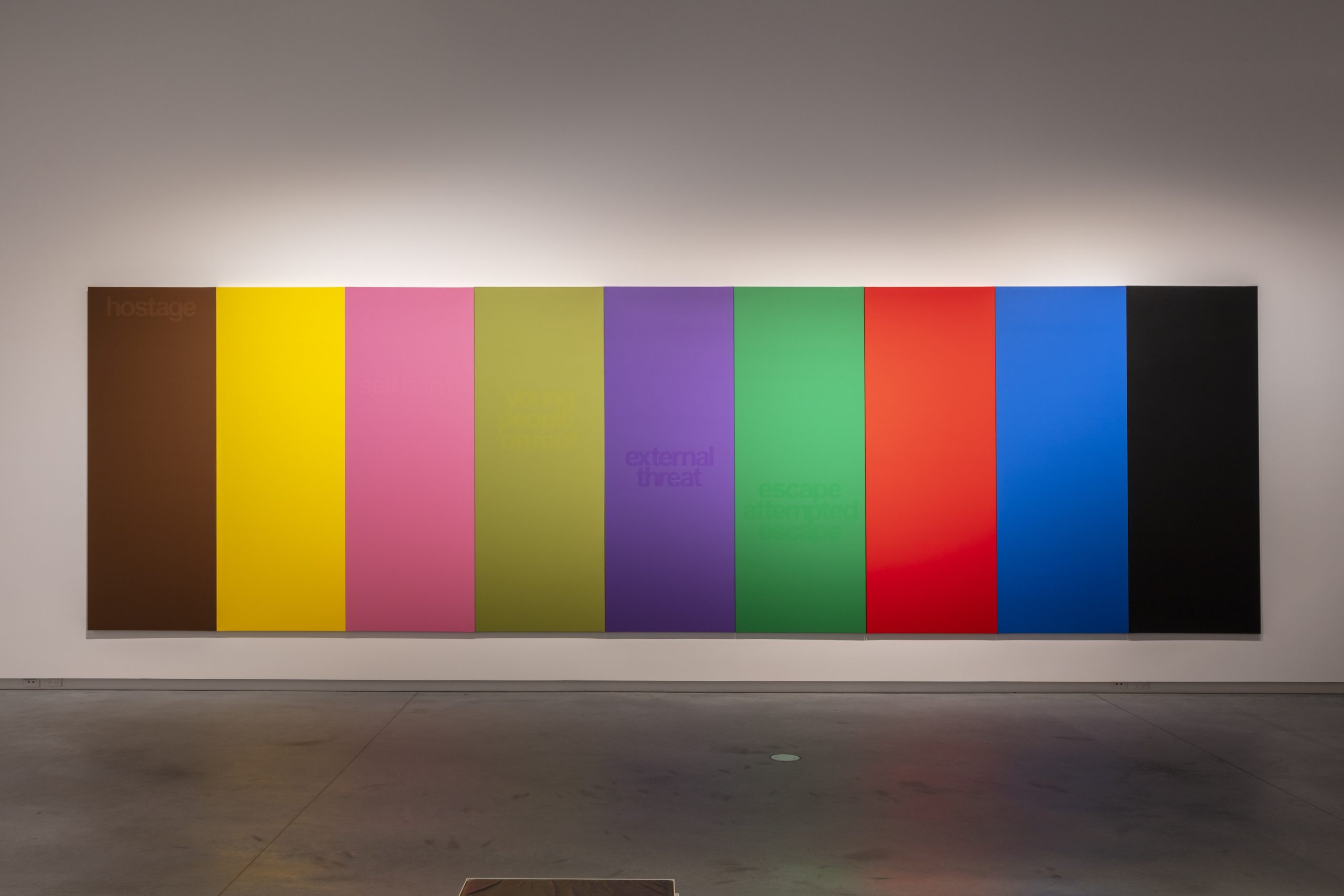
Installation view of Vernon Ah Kee, Code Black, 2025, 25th Biennale of Sydney, Rememory, 2026, Chau Chuk Wing Museum. Photographed by David James.
Exhibition
Rememory: 25th Biennale of Sydney, 14 March ̶ 14 June 2026, White Bay Power Station, Art Gallery of New South Wales, Chau Chak Wing Museum at the University of Sydney, Campbelltown Arts Centre, and Lewers: Penrith Regional Gallery.
Images courtesy of the artists; Sydney of Biennale, Sydney; White Bay Power Station; Art Gallery of New South Wales; Chau Chak Wing Museum at the University of Sydney; Campbelltown Arts Centre and Lewers: Penrith Regional Gallery.
Anne Loxley is the Executive Director, Arts & Cultural Exchange, lives on Bidigal Land and works on Dharug Land.
The article was first published in Artist Profile Issue 75, 2026.

Under the auspices of Geelong Gallery’s director, Humphrey Clegg, and co-curated by Marianne Mathieu, former scientific director of the Musée Marmottan Monet, and Claire Durand-Ruel...
Nike Savvas: Purple Haze presents intimate screen prints and immersive large-scale installation and video work by Savvas from 2005–2026, each evocative of different places and...
Although physically he is of modest stature, Zofrea has devoted much of his life to grand projects that have been conceived and executed on a...
Through a multidisciplinary collaboration between Rotterdam-based curators, architect Paul Cournet of CLOUD and artist-designer Sabine Marcelis of Studio Sabine Marcelis, the exhibition explores the interplay...
Artificial intelligence will be used by young artists who started using it as kids on their phones. They will see it as a natural extension...

This year’s Biennale arrives under more complex circumstances than most. It is shaped by the profound loss of its curator, Koyo Kouoh (1967–2025), whose exhibition...
No artist creates in isolation. Every painting carries traces of the conversations, places and histories that shaped it, preserving within its surface a particular moment...
The weekend markets at Fairfield Showground have been one of Western Sydney’s great institutions for more than fifty years. Fresh fruit and vegetables, children’s clothes,...
In recent times, Yorgos Lanthimos has shifted toward photography, noting in a Guardian interview, 2026, that he needs respite, saying, “it might be a couple...