ESSAY | Jorge Mariño Brito: Between Bodies
Jorge Mariño Brito transforms archival imagery into layered encounters, where queer intimacy emerges through gesture, material and the charged space between bodies.
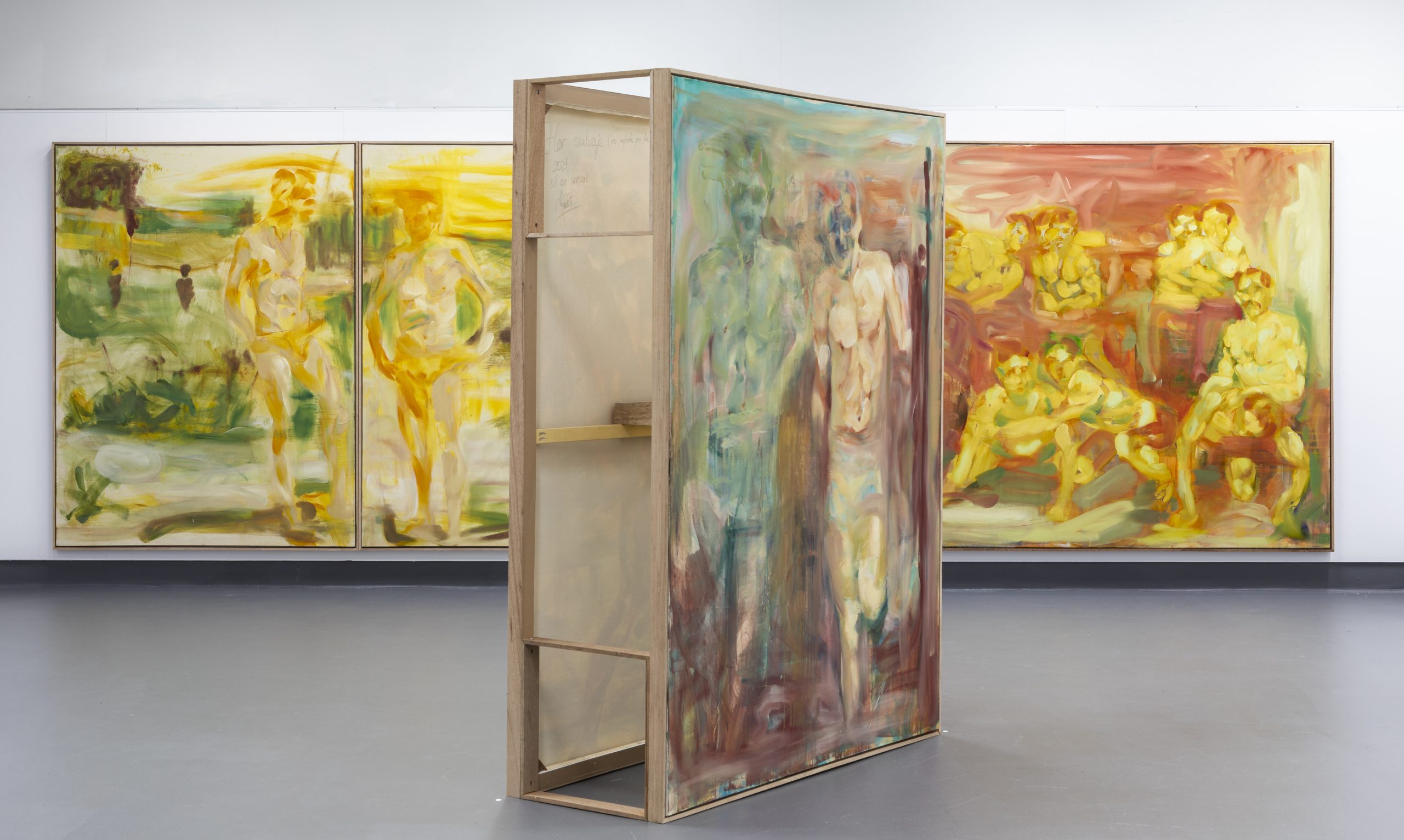
Cuban-born, Brisbane-based artist Jorge Mariño Brito’s practice unfolds across two material registers that are best understood not as parallel tracks but as entwined explorations. Both his figurative oil paintings and works made using “Stratpulp” (a handmade paper technique the artist developed that creates fibre from second-hand linen clothes) operate within a shared conceptual field, one grounded in the question of how intimacy might be made visible and more precisely, how it might be held. This intimacy is shaped by queer perception, by the charged act of looking, reading and recognising desire when it is not openly declared. His rich paintings build intimacy in tonal layers, flesh built in duration and revision, while his Stratopulp works compress it into the very fabric of their making. Brito himself frames this relationship with clarity, noting, “I think of oil painting and Stratopulp as one body of work approached through two material logics, not two separate practices.” Across both, intimacy is not simply represented. It is constructed as a spectrum, moving between tenderness, erotic tension and the quiet gravity of bodies held in relation.
The images that anchor Brito’s work are drawn largely from archives, both institutional and vernacular. Photographs from military collections, state libraries and historical repositories depict men gathered under conditions of labour, rest or duress. These are images that arrive already coded, catalogued under the neutralising language of history. Yet what compels Brito is not what these images were intended to show but what they inadvertently contain. Within them, gestures of proximity, care and unguarded presence persist without acknowledgment. A hand resting too long, a body leaning without defence, a glance that does not resolve. These are the fault lines where another register becomes visible. His engagement with the archive does not seek to expose or correct. It draws attention to the ways intimacy and desire have always existed within these images, held just beneath the surface of their official meanings.
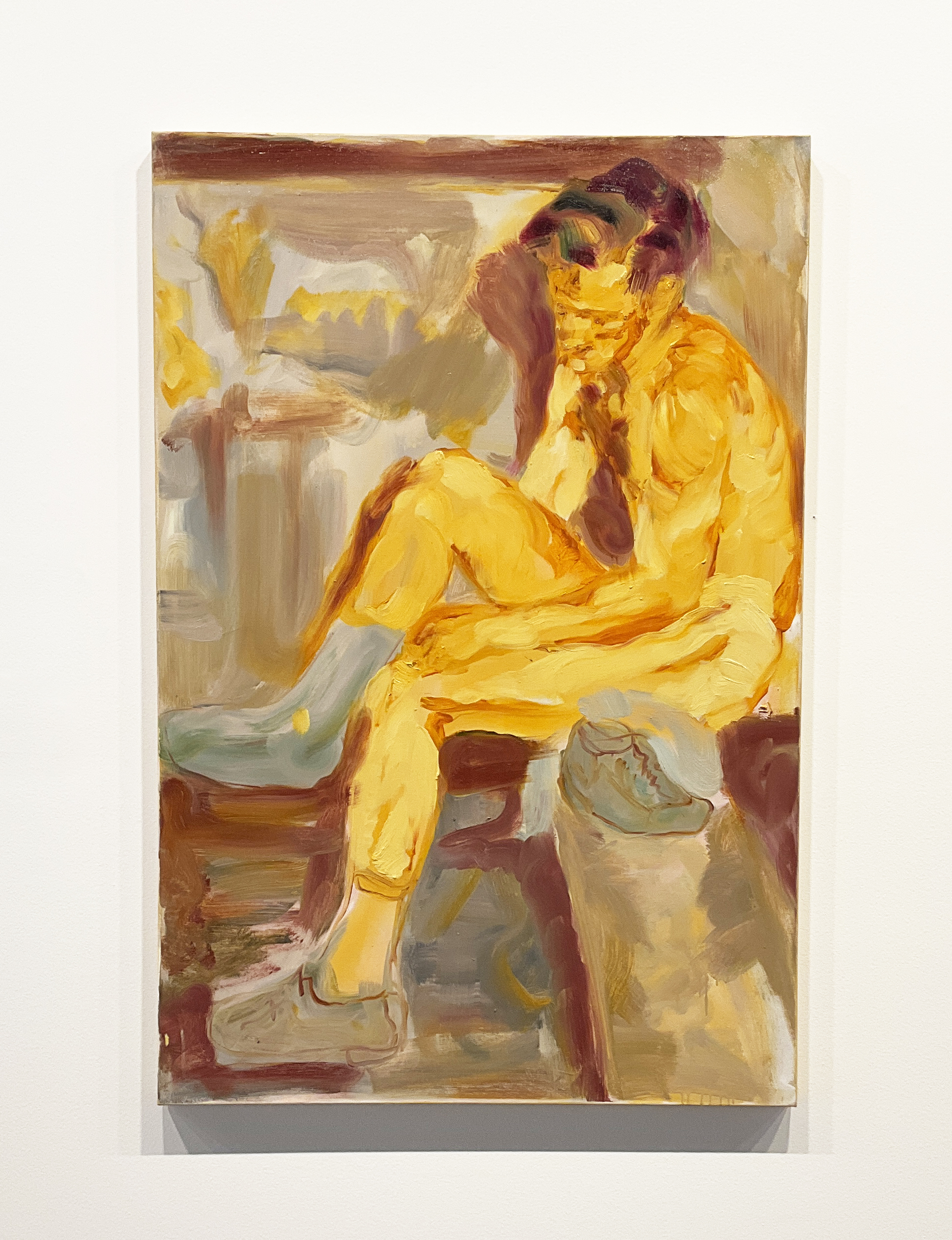
Single Figure and Space II, 2025, oil paint, canvas, 140 x 94 cm.
Selection is central to this process. Brito does not approach the archive as a field to be exhaustively mined but as a space of encounter. Certain images surface with a particular force, carrying something that exceeds their apparent subject. He describes this moment as a starting point. “I recognise a moment of intimacy that the image contains but that was never acknowledged. That recognition is the beginning of the work.” What is recognised here is not only closeness but tension. The spectrum he works within includes tenderness and aftermath but also erotic charge, the anticipatory and the unresolved. These are moments where masculinity is not performed but suspended, where small signals circulate between figures. Once translated into painting, the photograph undergoes a series of transformations that alter its temporal and emotional register. The instantaneous capture of the camera gives way to a slower, accumulative process. Brito builds the image through layers and revision, reworking and destabilising its forms.
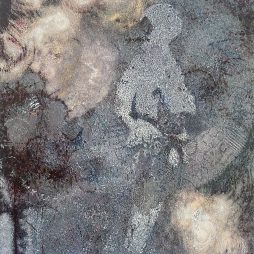
In Stratopulp, Brito extends this inquiry into a different material logic. Developed through a process of papermaking, it involves the reduction of discarded clothing into fibre, which is then suspended in water and poured into image and surface simultaneously. “There is no moment when the paper exists without the image, or the image without the paper.” The image does not sit on the surface. It emerges with it, inseparable from the material that holds it. The soft diffusion of fibre allows forms to appear and recede with a different kind of sensitivity, as though the image were breathing in and out of visibility. One particularly striking large-scale work, Tarlatan Series V (By the Lake), 2025, exemplifies this otherworldliness. Its nude figures float within the loose field of the composition, a familiar scene of recreation reduced to a monochromatic ghostliness where between the figures, a charge can still be felt.
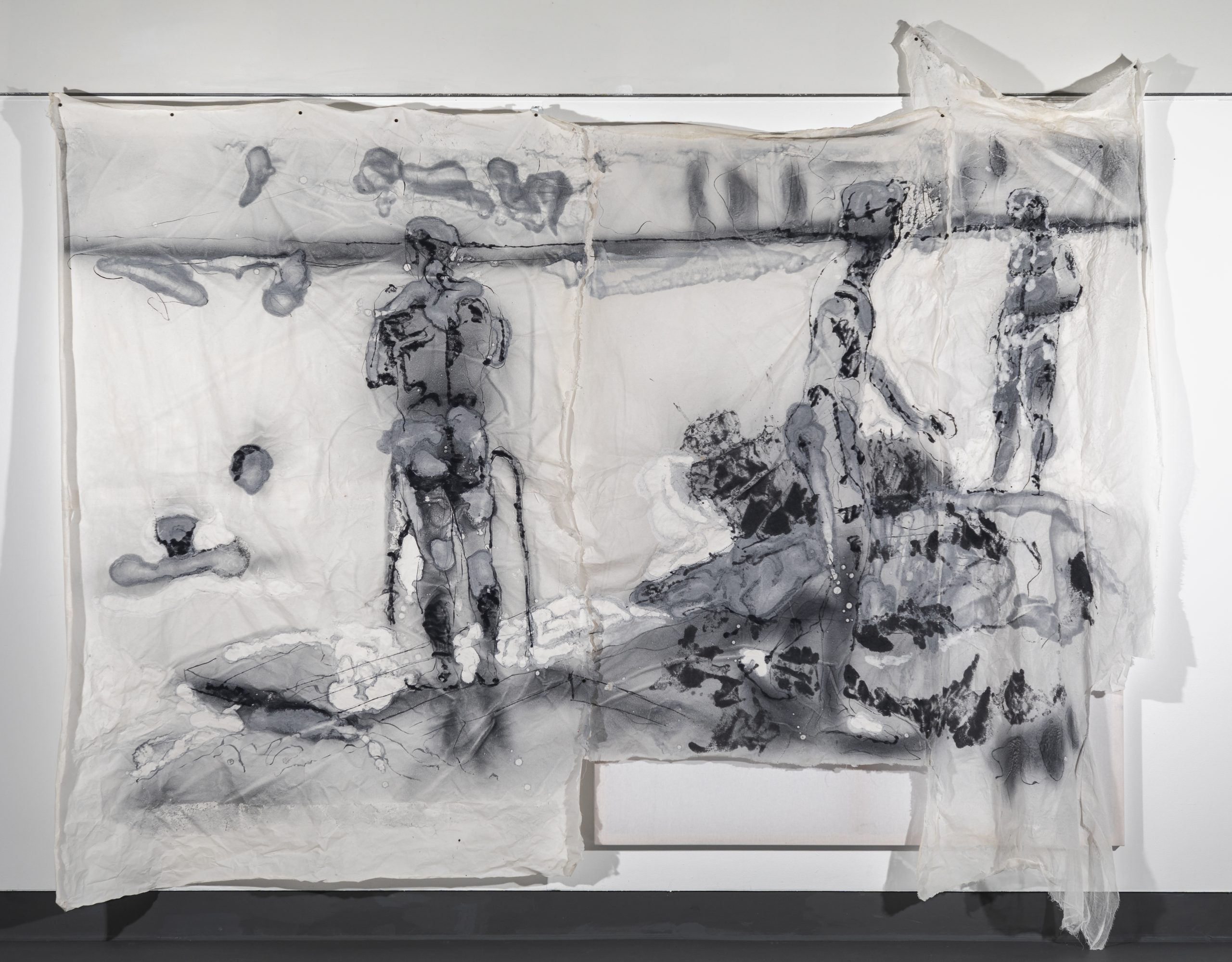
Tarlatan Series V (By the Lake), 2025, cotton, linen fibre pulp, tarlatan, dimensions variable. Photographed by Andrew Willis.
Across both threads of Brito’s practice is the balance of desire and vulnerability. It moves between figures and between the work and its viewer. The archive image provides one layer, the act of painting or making another. What binds them is a sustained attention to the small signals that carry intimate meaning. These are not grand declarations. They are moments of contact, tension and release that accumulate. What ultimately distinguishes Brito’s practice is the way it holds these layers in suspension. The archival image, the painterly intervention and the material history in Stratopulp do not resolve into a single narrative. Instead, they produce a field in which intimacy and queer desire can be sensed as something both present and elusive. The viewer is drawn into a mode of looking that mirrors the artist’s own, attentive to nuance, to shifts in proximity, to the quiet intensity of bodies in relation. In this space, intimacy is not simply shown. It is activated, held in the tension between what is seen and what is felt.
Exhibition
These, I, Singing in Spring | Jorge Mariño Brito
14 July – 15 August 2026
Mitchell Fine Art, Brisbane
Images courtesy of the artist, Mitchell Fine Art, Brisbane, and Queensland College of Art and Design, Griffith University, Brisbane.
Bradley Vincent is an independent curator and writer based on Queensland’s Gold Coast.
The article was first published in Artist Profile Issue 75, 2026.
Nike Savvas: Purple Haze presents intimate screen prints and immersive large-scale installation and video work by Savvas from 2005–2026, each evocative of different places and...
Although physically he is of modest stature, Zofrea has devoted much of his life to grand projects that have been conceived and executed on a...
Through a multidisciplinary collaboration between Rotterdam-based curators, architect Paul Cournet of CLOUD and artist-designer Sabine Marcelis of Studio Sabine Marcelis, the exhibition explores the interplay...
Artificial intelligence will be used by young artists who started using it as kids on their phones. They will see it as a natural extension...

This year’s Biennale arrives under more complex circumstances than most. It is shaped by the profound loss of its curator, Koyo Kouoh (1967–2025), whose exhibition...
No artist creates in isolation. Every painting carries traces of the conversations, places and histories that shaped it, preserving within its surface a particular moment...
The weekend markets at Fairfield Showground have been one of Western Sydney’s great institutions for more than fifty years. Fresh fruit and vegetables, children’s clothes,...
In recent times, Yorgos Lanthimos has shifted toward photography, noting in a Guardian interview, 2026, that he needs respite, saying, “it might be a couple...
In Australia, political cartoons were altered by several events during the 1960s: the arrival of Les Tanner’s (1927‒2001) instinctual wit at The Bulletin, Bruce Petty’s...