REVIEW I Grounding Ambition at Newcastle
The Newcastle Art Gallery has just completed its major renovation. It opened to the public in late February with great fanfare, with collections-based exhibition, "Iconic Loved Unexpected," spanning all thirteen of its galleries, and an opening night event that culminated in a free street party. Street parties are not what art galleries are generally known for. That the celebration of the newly remade gallery took place outside the institution, on the street, was a significant gesture. It was well repaid. Despite the light rain, the line to get in stretched around the block, and the festival itself crowded the promenade, spilling into Civic Park on the other side. It is very rare to see an art institution event this well attended in Australia.
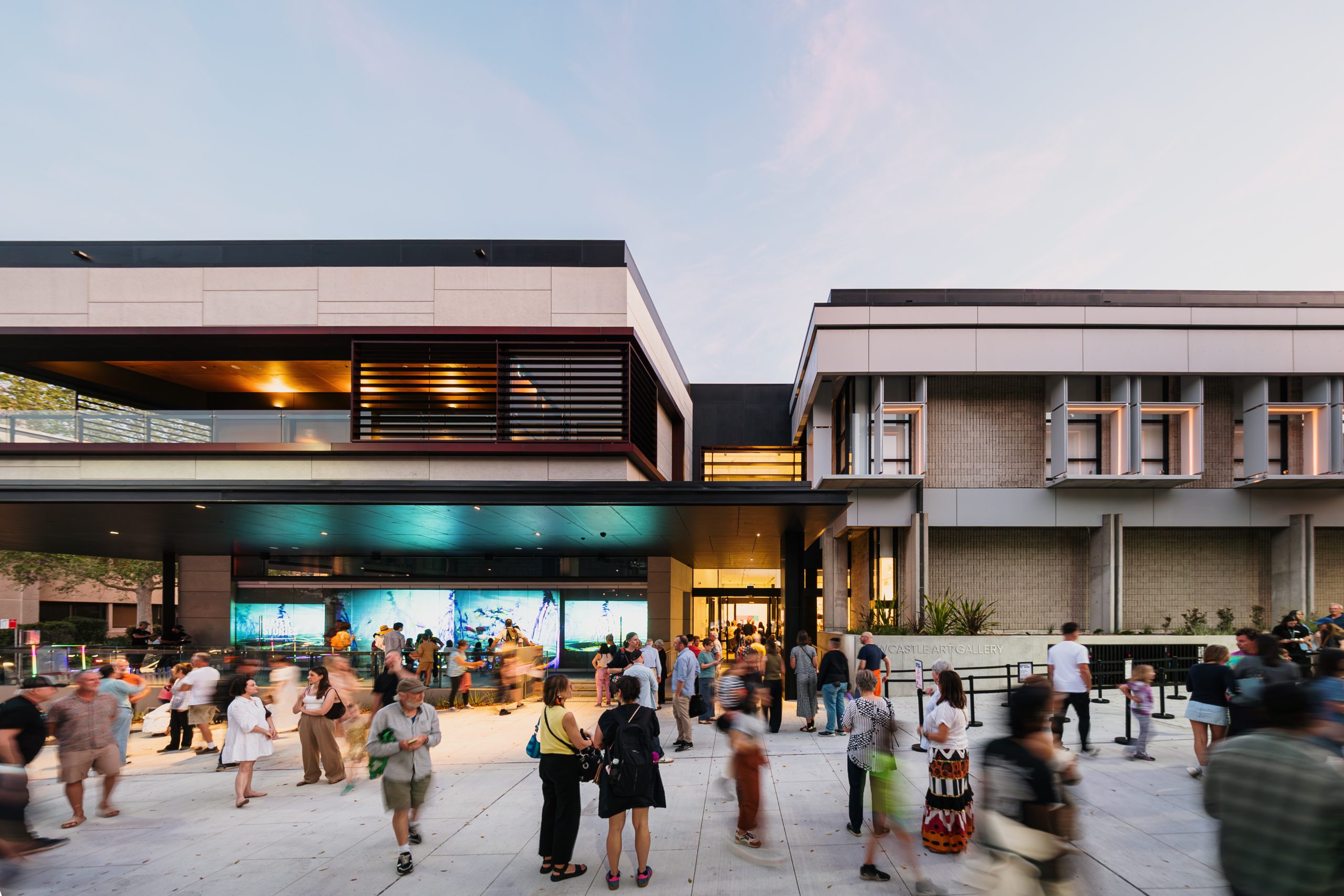
I had come to see my daughter sing in Deborah Kelly’s Creation Choir and was fortunate enough to make it inside the gallery for the opening performances (many did not). Creation, 2020, is a beautiful work and was perfectly chosen for this event, celebrating the spirit in art that doesn’t look at what is but dreams of what might be. In its world-creating capacity, the refugee of our hope is sung with all the childish earnestness of a school recital, dressed up in the baroque op-shop-ulence of Kelly’s collage aesthetic, translated into a collection of lush and elaborate costumes. Sadly, the acoustics in the ground floor rooms of the gallery were challenging and the chattering of the audience crowded the music until you had to strain to hear it. It was a miscalculation, but one for which I had sympathy as the kind of result that will occur on the first time of anything, when the unforeseen consequences of the newly unveiled reveal themselves. Credit to the Creation crew and the gallery staff, who spontaneously arranged a second performance outside, in the rain, with the crowds of Newcastle.
After the performance, I detached myself from the milling audience to wander around the new gallery. If I was surprised at the size and enthusiasm of the crowd outside, I was certainly not prepared for the scale of the gallery itself. Clearly, I had not read the media release because I was expecting to see a large-ish regional gallery, spruced up with modern architectural flourishes and draped with the work of some hometown hero of early modernism. , what I wandered into was metropolitan in scale and character, with thirteen galleries that flowed into one another, creating unique, discrete spaces that articulated the continuity between them. It’s the kind of gallery that I love to wander through, the kind you can get lost in, the kind that offers you doorways that open to unexpected vistas or turn sudden corners to reveal unforeseen worlds. The opening exhibition was an impressive display of the considerable Newcastle Art Gallery collection (comprising over 7,000 works), coupled with a raft of new commissions and purchases, especially from early- to mid-career Newcastle-based artists.
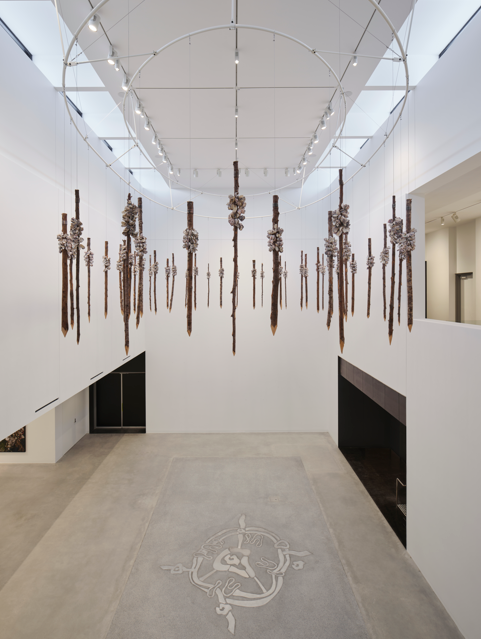
Installation view: Megan Cope, Kinyingarra Guwinyanba (Off Country), 2022, Newcastle Art Gallery, Central Atrium Gallery 3, Ground Floor, 2025. Photographed by Matt Carbone.
The experience left me with a single intrusive question. What’s in the water in Newcastle? At a moment when the arts are contracting on all fronts, and the grim visage of diminishing funding, declining markets and the intrusion of political interference in the arts has the rest of the art world on the back foot, how has this regional city managed to pull off such an ambitious feat of expansion? It reminded me (and I needed reminding) of what cultural ambition feels like. It feels like risk. It feels like hope and the courage to pursue a vision. This is not what I have come to expect from public galleries these days. So how did Newcastle manage to pull off such a coup?
Lauretta Morton OAM, director of the Newcastle Art Gallery, answered this question with a story that’s a little too long for the scope of this article but is fascinating enough to demand a short telling. The gallery renovation took twenty years to complete, having begun in 2005 with a fifty-million-dollar plan to knock down and build a new gallery from scratch. This first project was rejected, especially by the local community, over the loss entailed in tearing down the existing Brutalist edifice, the first art building in this style built in Australia. Another attempt at a more modest proposal in 2013 failed to get across the line due to a lack of support from Council, before the dream was rejuvenated for its final leg in 2018, when Lauretta took up her position at the gallery.
The success of its final attempt can be put down to a combination of circumstances. A very committed and driven staff that understood the value of the project, a highly sympathetic lord mayor and a passionate and engaged local community were the bedrock on which momentum was built over eight years. This was capitalised with a highly successful philanthropic drive that raised thirteen million dollars and dovetailed into a build-ready project when Covid-19 struck, motivating state and federal governments to contribute the final ten million.
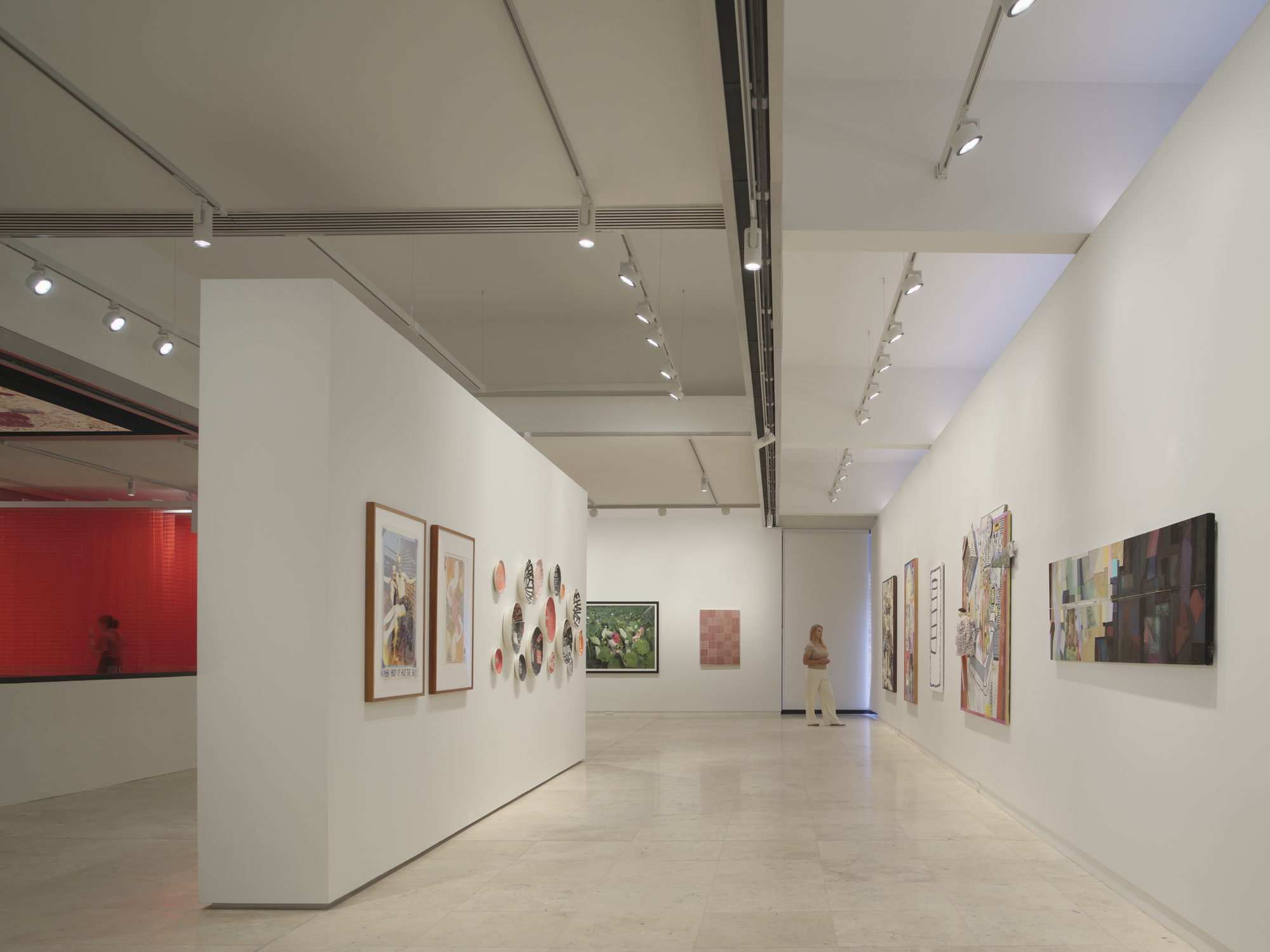
Installation view of Iconic Loved Unexpected, Newcastle Art Gallery, NSW, 2026. Photographed by Matt Carbone.
It’s important to recognise that over half of the funding came from the local community and that the drive and passion for this project from local government backing made this project happen. This project is grounded in Newcastle, from the crowd at the opening to the local philanthropic support to the commitment of council and staff. While this project has a national profile, it was possible because of the local momentum in Newcastle.
If you also consider the strength of the local arts scene and the city’s current transition out of its industrial past, this project is an expression of a growing city’s desire to emerge from its provincial identity and build a national profile. What is surprising is the political instinct to invest in its cultural identity, a value that is overlooked in regional centres where there is often a lack of understanding of the role the arts play in lifting the prestige and status of a place to the level at which it can earnestly participate in national culture. This seems to be the moment when Newcastle either assumes its place on the national stage or fails to do so.
Morton confirmed that the Newcastle Art Gallery will now compete with institutions in the major cities. I agree. As I walked through the building, with its additional 1,600 square metres of exhibition space, I wondered how they were going to keep all that space filled. Far smaller regional galleries struggle to keep their programs full, so it is daunting to think about the actual ambition of this place. There are some who would not like to hear this, but building of the institution is the easy part. It is the culture that will inhabit the institution as its relatively passive vehicle that is the true litmus test of its ambition. It is often much harder to find funding for the actual art than it is to build monuments to it and Newcastle has just built one that puts itself in another league.
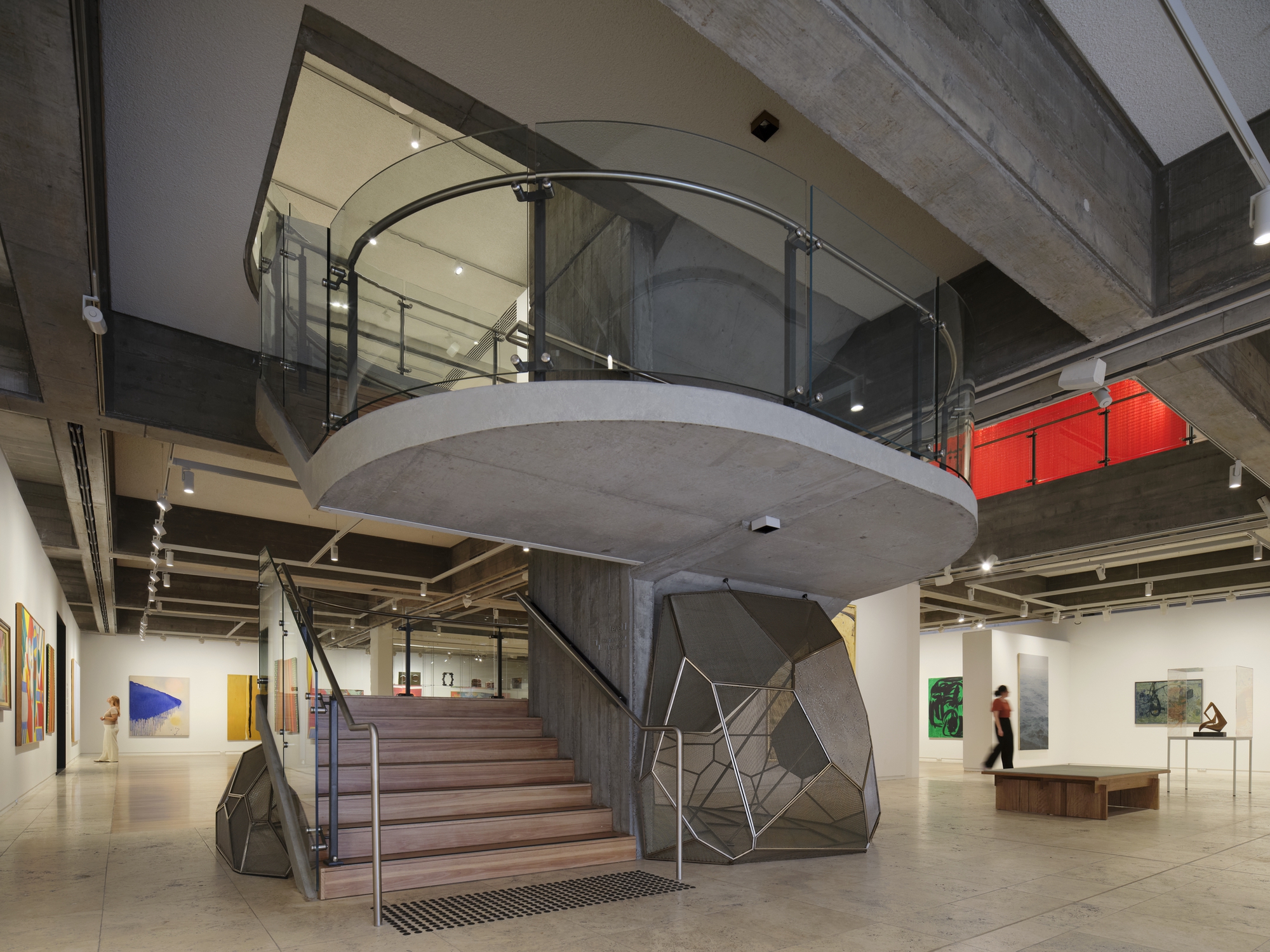
Installation view of Iconic Loved Unexpected, Newcastle Art Gallery, NSW, 2026. Photographed by Matt Carbone.
This competition demands of all national art institutions that they draw the attention of our common society toward the conversation taking place within their walls. For years that conversation has settled into a complex of established institutions with a numbing effect on the dialogue they share. It is exciting to think that there might be a new player on the block, one without the resources or established cultural capital to cruise along with the “big boys” and so will have to prove itself through taking risks and demonstrating initiative that their competitors might not need to. This is what I mean by cultural ambition.
Newcastle Art Gallery describes its ambition as “locally grounded, nationally engaged and globally minded.” It’s a broad claim and the kind of rhetoric you would expect from an institutional strategic vision statement. Until you accomplish that ambition, everything you say about it remains rhetoric. When rhetoric refuses to pursue its promise, it takes on a negative form. This particular instance of it (if you take it at its word) expresses an outwardly-looking ambition, but one that directly reflects the story told above: that anything Newcastle achieves culturally will have to ground itself in the cultural strength that exists there. What good are national and international exhibitions in Newcastle if all they demonstrate is that culture is made elsewhere? The distance between the local and the international is vast, and I’m not sure how you bridge it. I look forward to seeing what Newcastle Art Gallery does to live up to its ambition.\
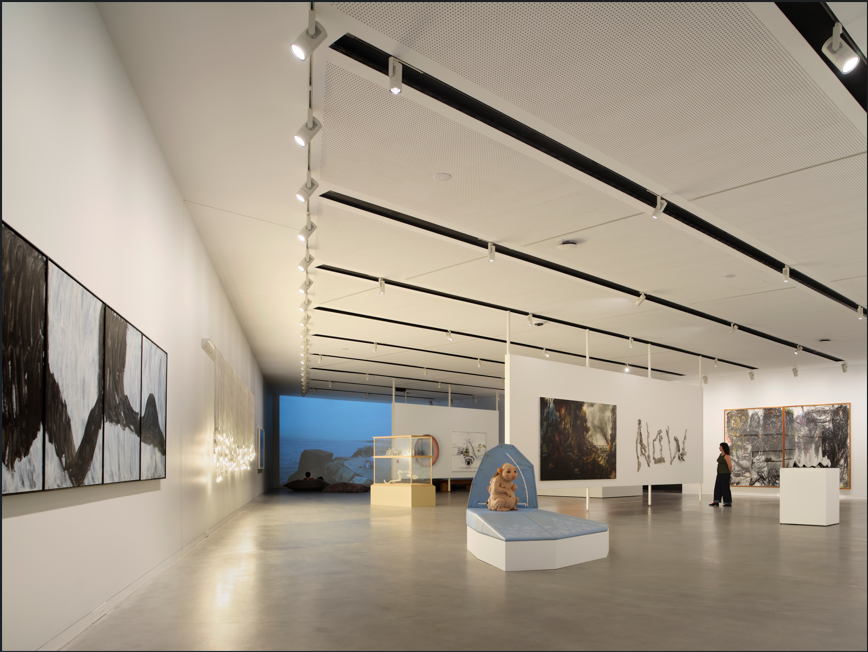
Installation view of Iconic Loved Unexpected, Newcastle Art Gallery, NSW, 2026. Photographed by Matt Carbone.
Exhibitions
Tiyan Baker – Mouth Mnemonica, 23 May – 6 September 2026
The Mordant Family Gift, 23 May – 15 November 2026
Open Space: Michelle Gearen, 11 July – 6 September 2026
Newcastle Art Gallery, Newcastle, New South Wales
Images courtesy of the artists, Newcastle Art Gallery, Newcastle, New South Wales.
Alex Wisser is an artist, writer and poet living and working on Wiradjuri Country at Kandos, New South Wales.
The article was first published in Artist Profile Issue 75, 2026.

Under the auspices of Geelong Gallery’s director, Humphrey Clegg, and co-curated by Marianne Mathieu, former scientific director of the Musée Marmottan Monet, and Claire Durand-Ruel...
Nike Savvas: Purple Haze presents intimate screen prints and immersive large-scale installation and video work by Savvas from 2005–2026, each evocative of different places and...
Although physically he is of modest stature, Zofrea has devoted much of his life to grand projects that have been conceived and executed on a...
Through a multidisciplinary collaboration between Rotterdam-based curators, architect Paul Cournet of CLOUD and artist-designer Sabine Marcelis of Studio Sabine Marcelis, the exhibition explores the interplay...
Artificial intelligence will be used by young artists who started using it as kids on their phones. They will see it as a natural extension...

This year’s Biennale arrives under more complex circumstances than most. It is shaped by the profound loss of its curator, Koyo Kouoh (1967–2025), whose exhibition...
No artist creates in isolation. Every painting carries traces of the conversations, places and histories that shaped it, preserving within its surface a particular moment...
The weekend markets at Fairfield Showground have been one of Western Sydney’s great institutions for more than fifty years. Fresh fruit and vegetables, children’s clothes,...
In recent times, Yorgos Lanthimos has shifted toward photography, noting in a Guardian interview, 2026, that he needs respite, saying, “it might be a couple...