ESSAY I The Architecture of unconcealment: exploring Mona’s new wing
The new wing of The Museum of Old and New Art’s (Mona) includes an expanded library, an immense Anselm Kiefer installation and new commissions by Julian Charrière, Joshua Yeldham and Lucas Grogan. It is connected by a disorienting series of tunnels, stairs and annex spaces, rewarding the curious. It’s no wonder the museum has done away with paper maps.
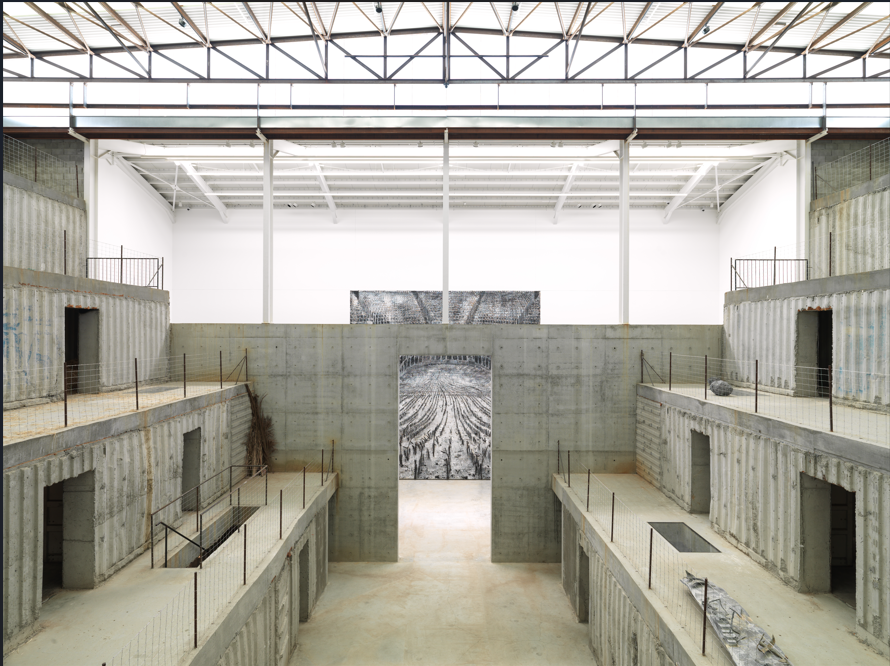
Mona reveals itself slowly. Unlike classical museum architecture that conveys authority through monumental facades and grand, towering entranceways, visitors enter the Nonda Katsalidis-designed building through a one-storey mirrored entrance, literally reflecting its human scale and obscuring the magnitude of the floor space below. Subsequent extensions to Mona’s original 2011 layout—Pharos and Siloam—complicated the structure through additional tunnels and interconnecting rooms but this new development truly celebrates the tunnel as immersive experience, the beautifully patterned sandstone walls often dark, occasionally dank.
Navigating these transitional spaces, there’s a sense of discovery and delight with every new art encounter. At one tunnel’s end is Julian Charrière’s art-meets-science installation, Breathe, 2026: a solitary experience breathing air from the ancient atmosphere that allegedly “has never been breathed before.” Embedded in the bedrock of another tunnel is Charrière’s cabinet of fossilised ammonites, Spiral Economy, 2025, while at a junction, Heather B. Swann’s curious seating, Cabinet of knowing and weeping and the Cabinet of seeing and knowing, both 2026, glitter with glass eyes. Watch your back.
Mona’s tunnels are inspired by Anselm Kiefer’s studio at La Ribaute in southern France, a rural property that houses dozens of massive buildings filled with evolving artworks, as well as tomb-like underground spaces connected by tunnels. In the O (Mona’s digital visitor guide), museum owner David Walsh describes a transformative moment in a dimly lit tunnel when he visited La Ribaute in 2007. “I was sanctified there,” he writes. At the time, he worried that the yet-to-be-opened “Mona was going to be so drab, so unwhole compared to this.” Desperate to share his experience with an audience at the other end of the world, Mona commissioned a facsimile, or perhaps rather, an iteration, of an amphitheatre-like space that Kiefer had developed over many years, constructed from concrete casts of shipping containers.
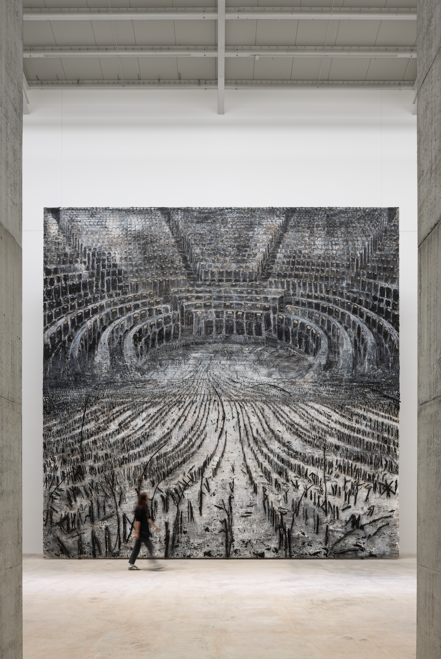
Installation view (detail): Anslem Kiefer, Die Lebenden und die Toten (The Living and the Dead), 2019, emulsion, oil, acrylic, shellac, wood, canvas, 470 x 560 cm. Photographed by Jesse Hunniford.
To encounter Elektra, 2025—as the Mona installation is titled—the visitor must navigate a series of un-signposted tunnels, before winding around from the back of Kiefer’s monumental painting, Die Lebenden und die Toten (The Living and the Dead), 2019, the twist-tie construction laid bare to see. The sudden transition from dark to light enhances the cathedral effect of the space.
Although the tiers of Elektra are visible from the entry level, the work reveals itself as something much larger and more complex when explored via a maze of narrow staircases. Loose hay crunches underfoot and a bunch of dried palm fronds lie stacked in a corner. Standalone sculptures are dotted around the tiers, including three of Kiefer’s headless women from his Women of antiquity, 2002, series. During a day visit, children skitter up and down the metal staircases, pointing out discoveries to their parents: small lead planes, a roughly crafted ceramic train. It feels cold, sharp and echoey. By contrast, an evening performance of devotional songs by The Gesualdo Six during Dark Mofo transforms the space into a modern secular cathedral, the auditory effect enhanced by the resonant high ceiling and angular concrete.
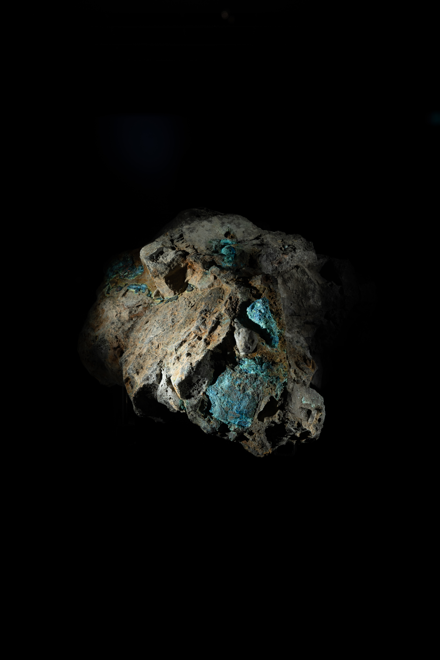
Installation view (detail): Julian Charrière, Metamorphism, 2016, artificial lave, molten computer waste, dimensions variable. Photographed by Jesse Hunniford.
From the outside, the new wing has the appearance of a shed. It must be Tasmania’s most expensive rusted corrugated iron finish. However, given Kiefer’s original was built intuitively over time without architectural plans, it’s likely Mona’s highly engineered version will outlast the original, sea levels willing. On the grounds surrounding the extension, standalone outdoor artworks jostle for space, including a new acquisition, In Absence, 2019, by Kokatha/Nukunu artist Yhonnie Scarce and architects Aaron Roberts and Kim Bridgland. The tower’s shape is inspired by traditional eel traps and decorated with deliciously shiny glass murrnong (daisy yams). Originally commissioned for the National Gallery of Victoria gardens where it was dwarfed by Melbourne city buildings, the work’s new location, adjacent to the River Derwent and with a backdrop of Kunanyi Mount Wellington, gives it space and new context.
Built into the negative space of the Kiefer installation is an expanded library, replacing Mona’s original small library once squeezed into the roundhouse. Called Phrontisterion after The Thinkery in Aristophanes’s (c .445–c. 386 BCE) The Clouds, 423 BCE, the library is a counter to the cold, concrete grey of the Kiefer space. It’s warmly carpeted in green with velvety seating. Even Pete Mattila’s brutal metal spiral staircase and reference desk—described by Walsh in the O as “coal mine chic”—are somewhat softened by the space. Like Elektra, Phrontisterion’s multi-storey layout reveals its treasures gradually, encouraging visitors to slow down and linger, to curl up in the cosy downstairs study with a book. On the mezzanine level is Ben Jakober and Yannick Vu’s Leer con Prisa III, 2025. The kinetic sculpture of 127 books rotates slowly, the soft flop of pages telling users this library doesn’t demand silence.
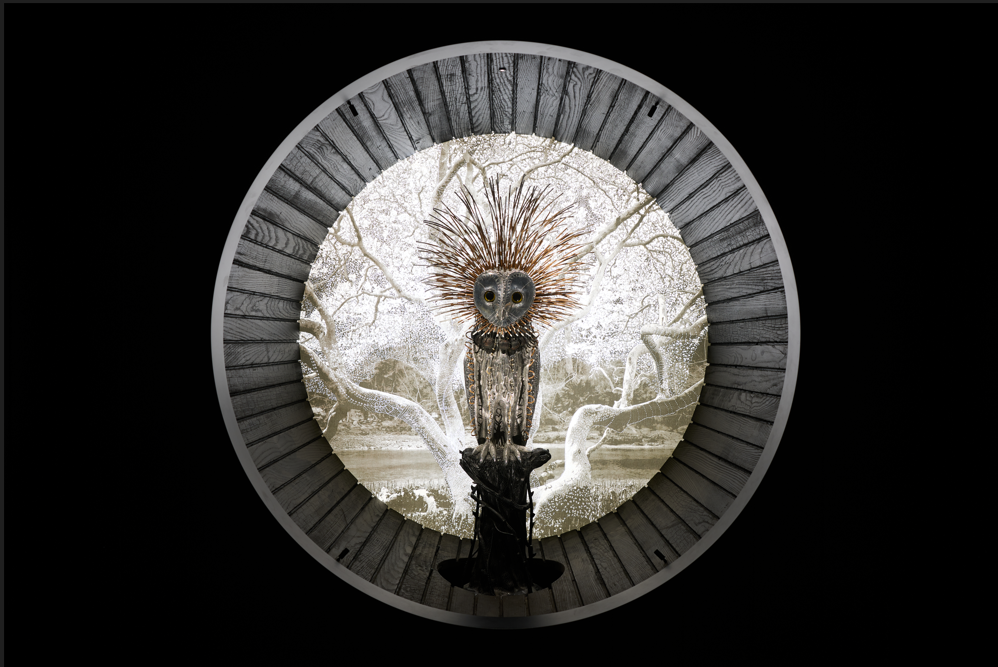
Installation view (detail): Joshua Yeldham, Surrender Room, 2025-26, site specific installation, mixed media, dimensions variable. Photographed by Jesse Hunniford.
Joshua Yeldham’s enchanting musical installation, Surrender Room, 2025–26, is burrowed into an annex under the library. It tells the deeply personal story of his family’s fertility issues. Hanging elements whirr and twist, plucking the strings of an instrument stretched over the bust of a woman, discordant but not unpleasant. A ceiling-mounted drum joins in with a steady beat, complemented by the gong of a singing bowl. The finely patterned owl in the centre, representing the embryo thief, looms large over a pregnant woman, a clock chiming in her swollen stomach, time marching on. The owl motif is repeated in the nearby bathrooms. Clad to mimic the inside of what could be the hollow of a tree or cave, toilet users are watched by moving images of owls—an intimidating experience.
Commissioned to fill the library entry corridor is Lucas Grogan’s twenty-seven-panelled A Library (Imagine Sisyphus Happy), 2026. Emphasising Walsh’s sway as a collector, the work is green to match the library’s carpet and bookshelves, instead of Grogan’s signature blue. At first glance the ceiling-high painted bookcase appears to be a modern-day Theatrum Pictorium—a visual record of the collection. Scaled-down iconic Mona artworks are slotted between the bookshelves: a tiny Francis Upritchard figurine, Nell’s smiling silver poo, and an Egyptian falcon. However, on closer reading, the book titles reveal themselves as comic jabs at Mona and the art world with titles like North Shore Baby Names, The Great Indoors, Performance Art is a Cry for Help, and Art to Match the Couch.
Grogan’s subtitle, Imagine Sisyphus Happy—a quote from Albert Camus’s (1913–1960) The Myth of Sisyphus, 1942—could be considered a comment on the act of collecting, seeking fulfilment in building an ever-expanding private collection. Like Sisyphus’s rock, the growing museum seems to have no finish point, no end goal. After all, the half-excavated tunnel underneath the painting ends with a decorative “to be continued” embedded in the bedrock. It’s an exciting promise of more to come from a museum that constantly surprises.
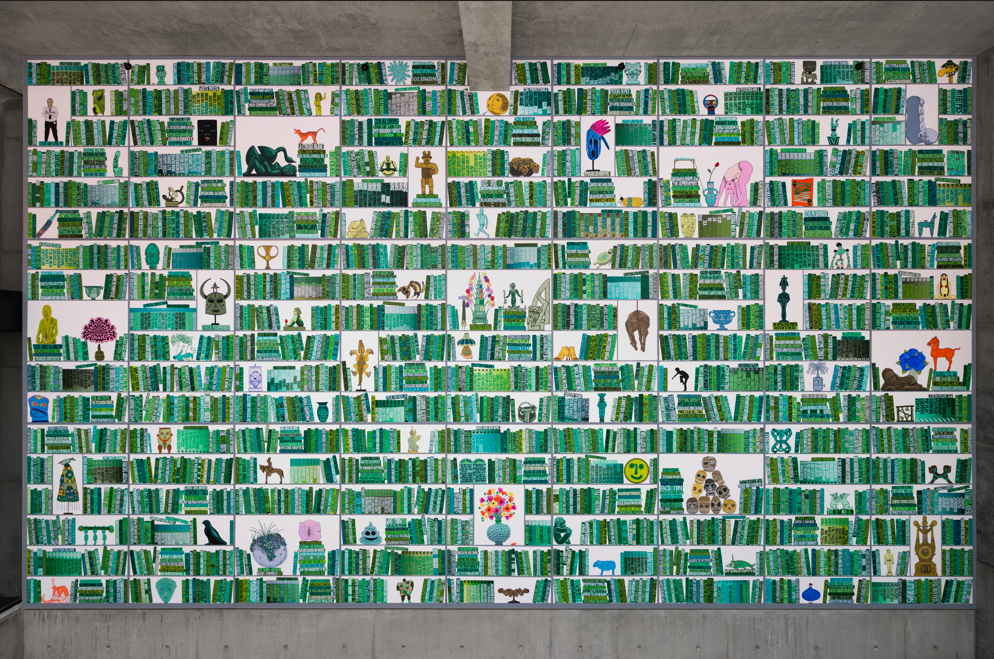
Installation view: Lucas Grogan, A Library (Imagine Sisyphus Happy), 2025-26, acrylic paint, hoop pine ply, 561 x 967.5 cm, 27 panels, each panel 187 x 107.5 x 1.8 cm. Photographed by Jesse Hunniford.
Exhibitions
Manipulation
8 May – 26 October 2026
Julian Charrière: Hard Core
6 June 2026 – 29 March 2027
The Museum of Old and New Art, Hobart, Tasmania.
Dr Lucy Hawthorne is Hobart-based arts writer, artist and librarian.
Images courtesy of the artists and The Museum of Old and New Art, Hobart, Tasmania.
The article was first published in Artist Profile Issue 76, 2026.
Tarr may not be a household name but he is an arthouse-hold name, known primarily for his mature, signature works as director—Damnation, 1987, Sátántangó, 1994,...
We call on the NSW Government to lift Lisa Havilah’s suspension and reinstate her as Chief Executive of Powerhouse, allowing her to lead the opening...
Two years ago, Macleod returned to his hometown of Christchurch, New Zealand, to be with his mother during the final phase of her life. At...
Edwards was born on Kaurna Yarta in 1998 and raised on Nauo Country in the small seaside community of Tulka, on the Lower Eyre Peninsula....

Under the auspices of Geelong Gallery’s director, Humphrey Clegg, and co-curated by Marianne Mathieu, former scientific director of the Musée Marmottan Monet, and Claire Durand-Ruel...
Nike Savvas: Purple Haze presents intimate screen prints and immersive large-scale installation and video work by Savvas from 2005–2026, each evocative of different places and...
Although physically he is of modest stature, Zofrea has devoted much of his life to grand projects that have been conceived and executed on a...
Through a multidisciplinary collaboration between Rotterdam-based curators, architect Paul Cournet of CLOUD and artist-designer Sabine Marcelis of Studio Sabine Marcelis, the exhibition explores the interplay...
Artificial intelligence will be used by young artists who started using it as kids on their phones. They will see it as a natural extension...