REVIEW I Impressions and Impressionism: A Collector’s Delight
Impressionism is certainly ‘dans l’air du temps’, perhaps because 2026 marks the centennial of Claude Monet’s (1840–1926) death. To celebrate the anniversary there are major Impressionist exhibitions in France, the United States, Canada, Italy, Germany, Japan, and Australia. Geelong Gallery, one of Australia’s oldest regional galleries, is hosting Discovering the Impressionists: Paul-Durand Ruel, Art Dealer Among Artists.
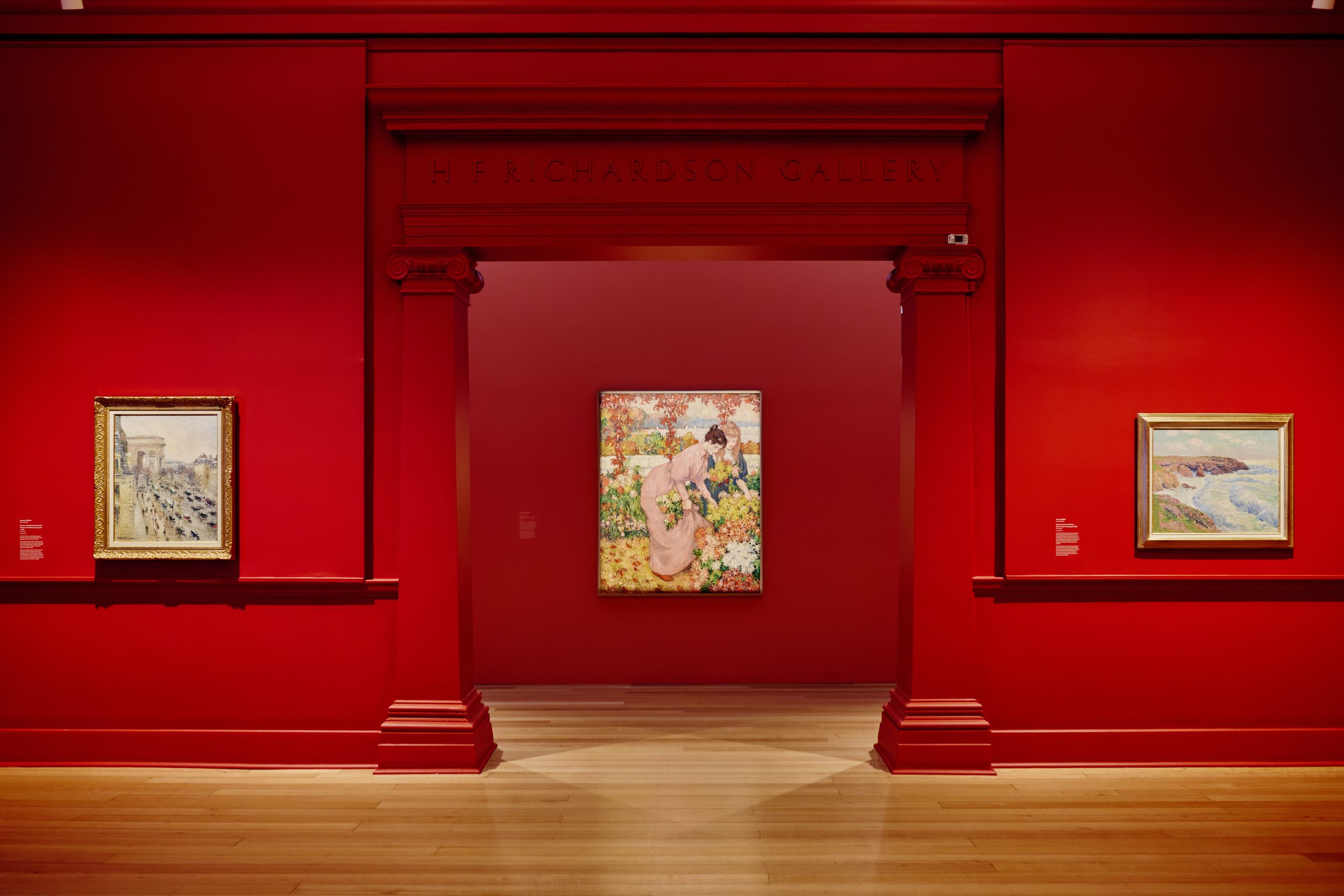
Under the auspices of Geelong Gallery’s director, Humphrey Clegg, and co-curated by Marianne Mathieu, former scientific director of the Musée Marmottan Monet, and Claire Durand-Ruel Snollaerts, the great-great-granddaughter of Paul Durand-Ruel (1831–1922), Discovering the Impressionists coincides with Geelong Gallery’s 130th anniversary. The exhibition also complements the gallery’s own extensive collection, which Clegg says, “was built on Impressionism” and to be more precise, Australian Impressionism. A notable example is Frederick McCubbin’s (1855–1917) A bush burial, 1900, the gallery’s first acquisition.
The linchpin of Discovering the Impressionists is Paul Durand-Ruel, immortalised in Pierre-Auguste Renoir’s (1841–1919) 1910 portrait of him which hangs at the entrance to the exhibition. A prominent impresario and art dealer who ran prestigious galleries in New York, London, Vienna and other cities, Durand-Ruel died in 1922 at the age of ninety-one. It’s worth adding that he was also the subject of the more recent exhibition, Paul Durand Ruel and the Twilight of Impressionism, at the Madrid art and cultural institution, Fundación MAPFRE, in 2024 –25. Organised by Mathieu and Snollaerts, the two curators behind the Geelong exhibition, it differed in scope and content.
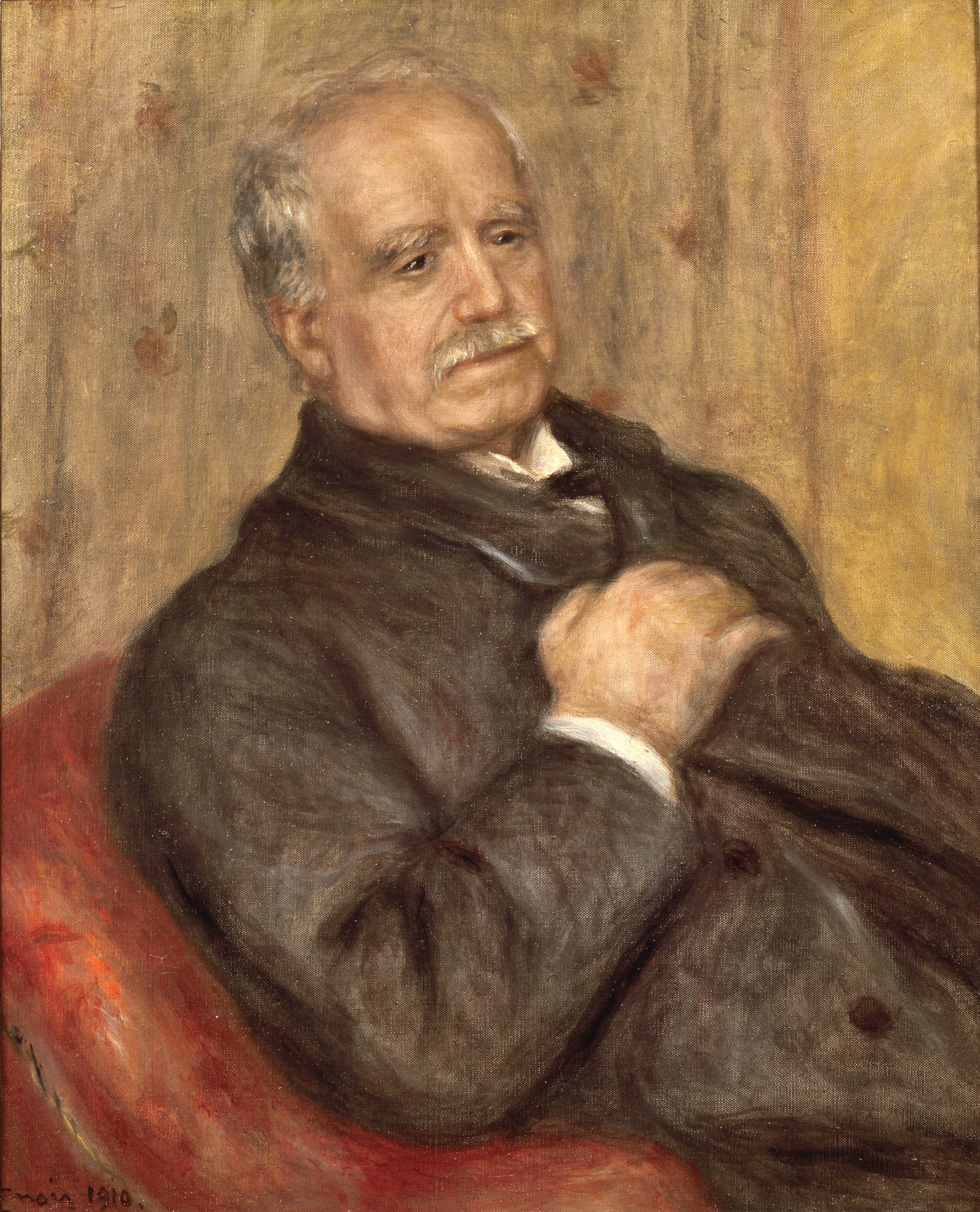
Pierre-August Renoir, Portrait of Paul Durand-Ruel (Portrait de Paul Durand-Ruel), 1910, oil paint, canvas.
A powerful advocate for Monet, Renoir, Camille Pissarro (1830–1903), and later Berthe Morisot (1841–1895), four key impressionists, Durand-Ruel, we read in the exhibition’s handsome catalogue, would soon turn to a “new generation of artists whose work extended and reimagined the impressionist approach.” Chief amongst them were Gustave Loiseau (1865-1935), Albert André (1869–1954), Georges d’Espagnat (1870–1950), Maxime Maufra (1861-1918) and Henry Moret (1856–1913)—artists whose names, until recently, had attracted comparatively little attention. Together, this group is represented in Discovering the Impressionists by forty-nine paintings (out of the seventy exhibited), positioning them as heirs to the impressionist legacy alongside the movement’s better-known figures.
Loiseau and Maufra strike me as the two most engaging artists in this exhibition. Loiseau’s Bridge, Tiel-sur-Seine, c. 1917, shows the impressive suspension bridge set against the chalky limestone buildings of the village in the background. Painted at the time when Tiel-sur-Seine was experiencing the hardships and deprivations of the latter years of World War I, Loiseau instead focused on its tranquil character. His Etretat, 1902, on the other hand, depicts the extraordinary rock formations in the Normandy coastal village. Disturbing in their impastoed whites, greys and pinks, they stand, insect-like, with the vast English Channel behind them.
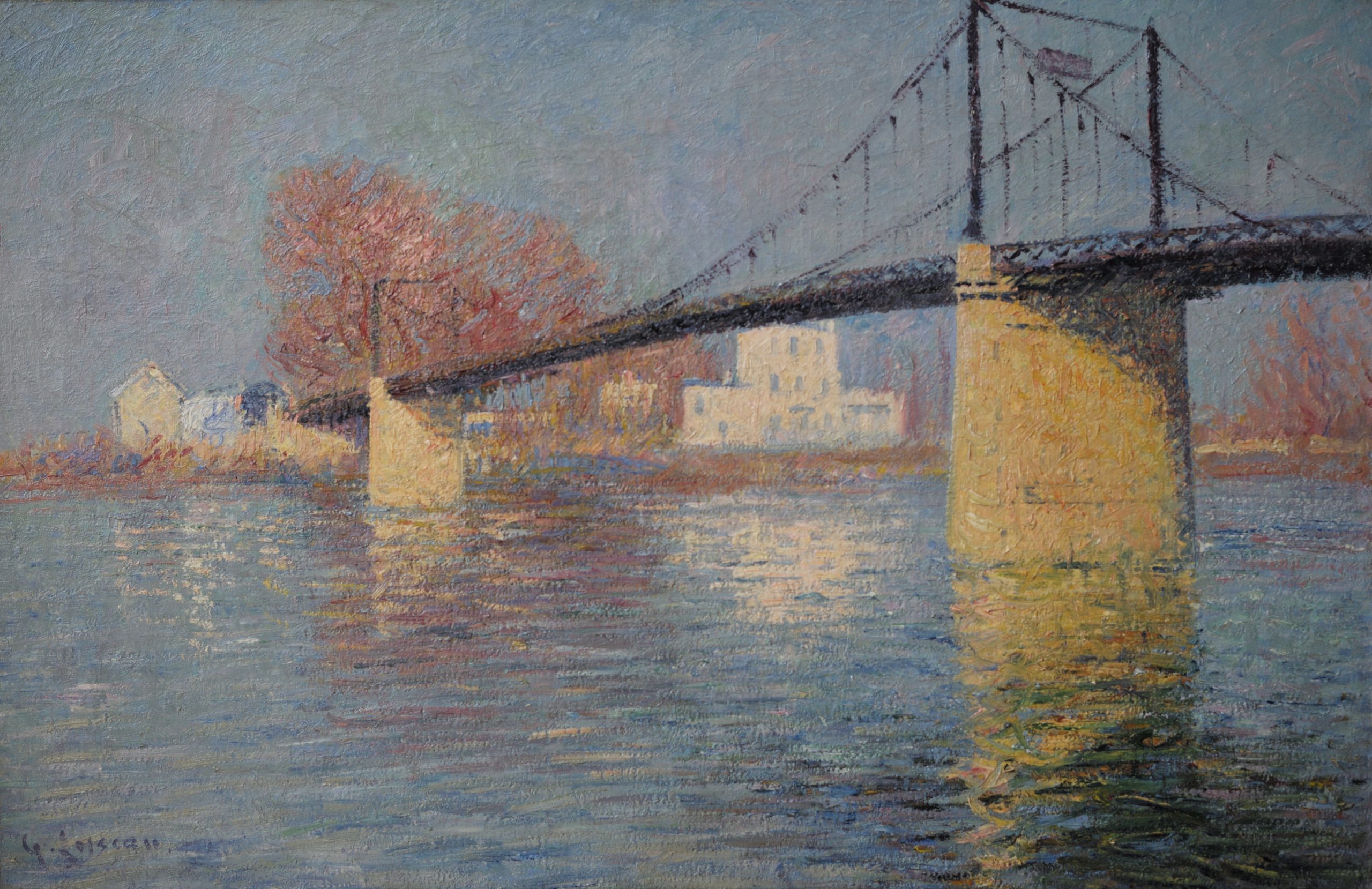
Gustave Loiseau, Bridge, Triel-sur-Seine (Le pont de Triel-sur-Seine), c. 1917, oil paint, canvas, 60.7 × 92.7 cm.
Described by Durand-Ruel as “more entirely in love with painting than anyone else I ever knew,” Maufra visited Scotland twice while living in England. Holburn Head (Scabster) (Scotland) Thurso, 1895, and The black cliffs at Thurso, 1895, are thickly painted, tactile images of the rocky headland on the north coast of Caithness. Swarms of flying seagulls in both paintings simply enhance the enormity and menace of the sea cliffs.
The Lyon-born André gained significant visibility and success in the United States through Durand-Ruel’s galleries. Taught by Renoir who was his lifelong friend, André painted his portrait seven years before his death in 1919 at the age of seventy-eight. Seen in the Geelong exhibition, it shows a warmly dressed, behatted Renoir with palette in hand. Montmartre, view of the Boulevard de Clichy, c.1921, another one of André’s nine works in the exhibition, is noteworthy for its unusual view of what at the time was a lively, pleasure-seeking locality. None of this is evident in the André work, which is a view from a balcony capturing trees, buildings with their slender chimneys and, in the distance, the famous Sacré-Coeur. André’s painting Interior, c. 1938 is similarly denuded of people. Carefully composed of verticals and horizontals—door, doorway, cropped cabinet, rug and hanging picture—the scene smacks of a paused domesticity.
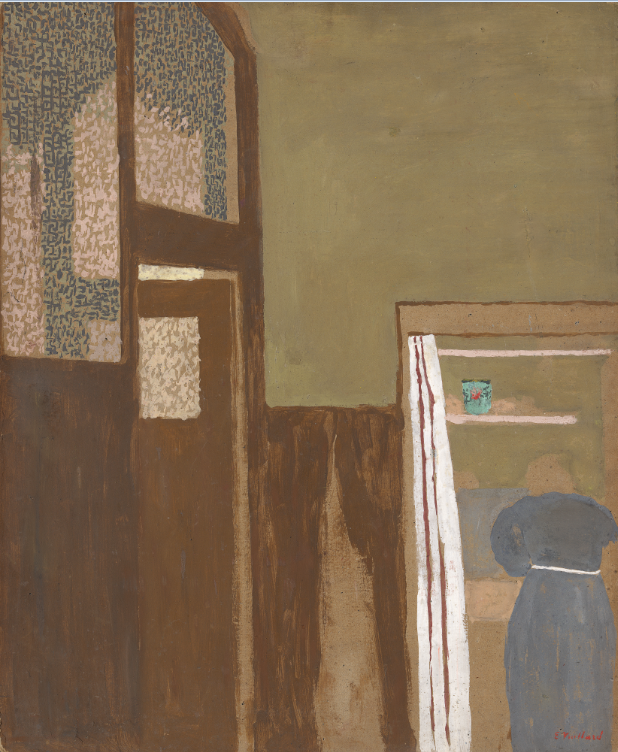
Édouard Vuillard, The doors (Les portes), 1894, gouache, cardboard, 50.8 × 41.6 cm.
Doors also make their presence felt in Jean-Édouard Vuillard’s (1868–1940) small gouache on cardboard, The doors, 1894. A good friend of André, they became associated with the avant-garde Nabis, active in Paris in the late 1880s. Strikingly cropped, The doors, with its flattened space gives us a glimpse of the family apartment: Vuillard’s mother, a dressmaker, is in the background, seen from behind. A turquoise vase on a shelf above her is the one note of vibrant colour in this otherwise drab interior,
D’Espagnant held his first solo exhibition in 1895 at Le Barc de Boutteville Gallery in Paris. Three years later he showed at Galerie Durand-Ruel. His paintings in Discovering the Impressionists, including the panels from the salon doors of Joseph Durand-Ruel (1862–1928)—Paul Durand-Ruel’s eldest son—concentrate on children, young women, activities such as sewing, and all this for the most part in bucolic surroundings.
That Monet is well represented in this exhibition should come as no surprise. There are some wonderful paintings. My picks are Peonies, 1887, with its phantasmagoria of colours, and Japanese bridge, 1918–24, scrubbed with all manner of greens and smatterings of red, purple and blue.
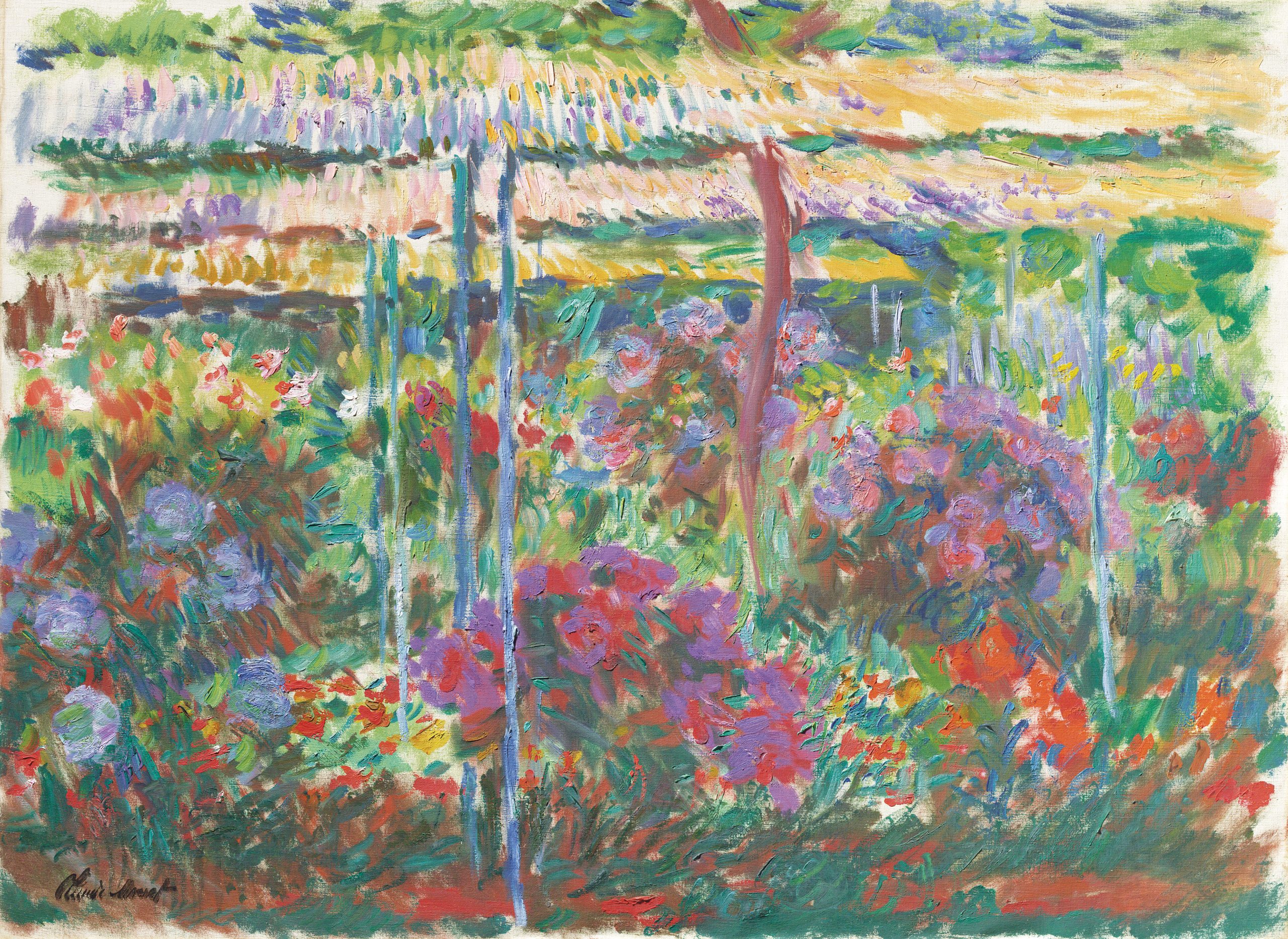
Claude Monet, Peonies (Pivoines), 1887, oil paint, canvas, 73.7 x 110.3 cm.
As a coda to the exhibition, there are contemporary works by the Franco-American painter, Vicky Colombet, and the Australian artist Louise Weaver that directly and in more oblique ways pay homage to Monet. Invited in 2017 by the Musée Marmottan Monet to enter into a “dialogue” with the artist, Colombet’s Monet series: #1396 (cobalt green, bluish-Mars black), 2018, and Monet series: Night in the garden #1421 (black iron oxide, cobalt, green, black Ivory), 2019, are dexterous applications of nuanced pigment. Weaver’s Cave of a seashell, 2025, and For the time being, 2025, meanwhile, are intricate configurations made up of Japanese Kozo natural paper and cotton thread on linen which link to Monet’s strong attraction to the medium.
Discovering the Impressionists: Paul Durand-Ruel, Art Dealer Among Artists has much to please the eye and satisfy the curious about a passionate and adept art collector and dealer. This notwithstanding, I left the exhibition feeling that its central focus is less Impressionism itself than a loosely connected group of artists with varied talents and personal histories, and only tangential ties to the movement.
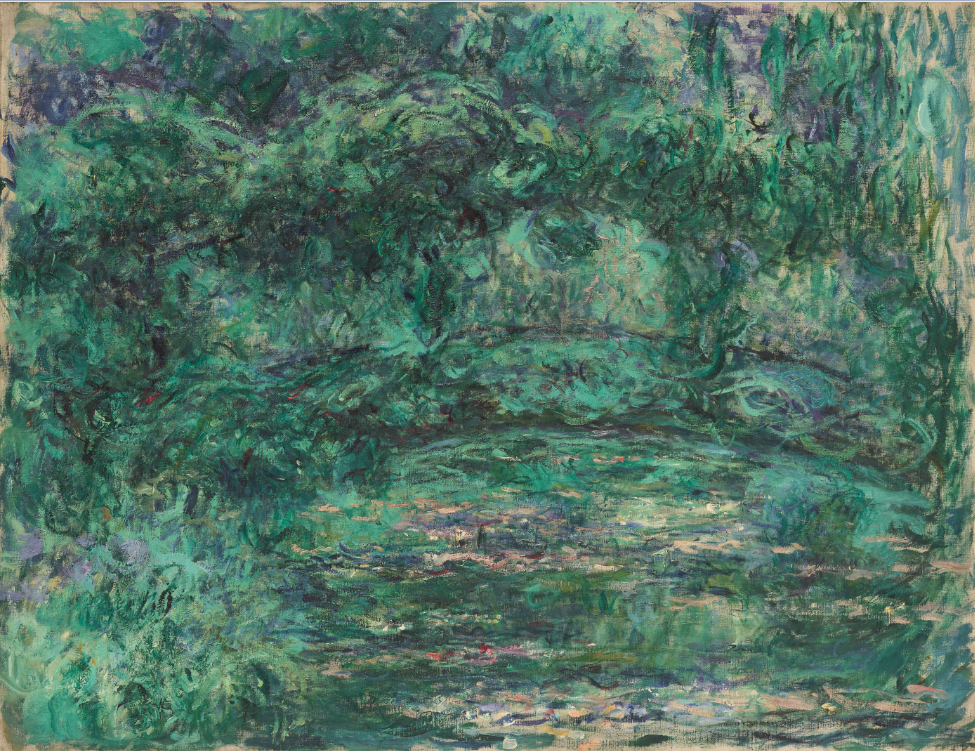
Claude Monet, Japanese bridge (Le pont japonais), 1918-24, oil paint, canvas.
Exhibition
Discovering the Impressionists: Paul Durrand-Ruel, Art Dealer Among Artists
20 June – 11 October 2026
Geelong Gallery, Victoria
Images courtesy of Geelong Gallery, Victoria.
Dr Alan Krell is a Sydney based art historian, writer, and lecturer. He specialises in Manet and late nineteenth century French modernity.
The article was first published in Artist Profile Issue 76, 2026.
We call on the NSW Government to lift Lisa Havilah’s suspension and reinstate her as Chief Executive of Powerhouse, allowing her to lead the opening...
Two years ago, Macleod returned to his hometown of Christchurch, New Zealand, to be with his mother during the final phase of her life. At...
Edwards was born on Kaurna Yarta in 1998 and raised on Nauo Country in the small seaside community of Tulka, on the Lower Eyre Peninsula....
Nike Savvas: Purple Haze presents intimate screen prints and immersive large-scale installation and video work by Savvas from 2005–2026, each evocative of different places and...
Although physically he is of modest stature, Zofrea has devoted much of his life to grand projects that have been conceived and executed on a...
Through a multidisciplinary collaboration between Rotterdam-based curators, architect Paul Cournet of CLOUD and artist-designer Sabine Marcelis of Studio Sabine Marcelis, the exhibition explores the interplay...
Artificial intelligence will be used by young artists who started using it as kids on their phones. They will see it as a natural extension...

This year’s Biennale arrives under more complex circumstances than most. It is shaped by the profound loss of its curator, Koyo Kouoh (1967–2025), whose exhibition...
No artist creates in isolation. Every painting carries traces of the conversations, places and histories that shaped it, preserving within its surface a particular moment...