REVIEW | Designed to Impress: Epic Times
The intensity of the media storm created in 2023 by The Australian newspaper’s accusation against the APY Art Centre Collective (APYACC) of “white hands on black art” indicated it was about much more than authorship or art, though its divisive politics was reflected in opinion about the art. What admirers found “breathtaking,” The Australian’s art critic dismissed as “a breathlessly promoted” middlebrow con of garish “hyperactive, spineless doodles.” Yet, when the APYACC exhibition, "Ngura Pulka – Epic Country" opened three years late at the National Gallery of Australia (NGA), it was an anti-climax. The minimal wall texts, riot of colour and explosive energy enveloping the rooms grab our full attention as art, as if the politics had defused.
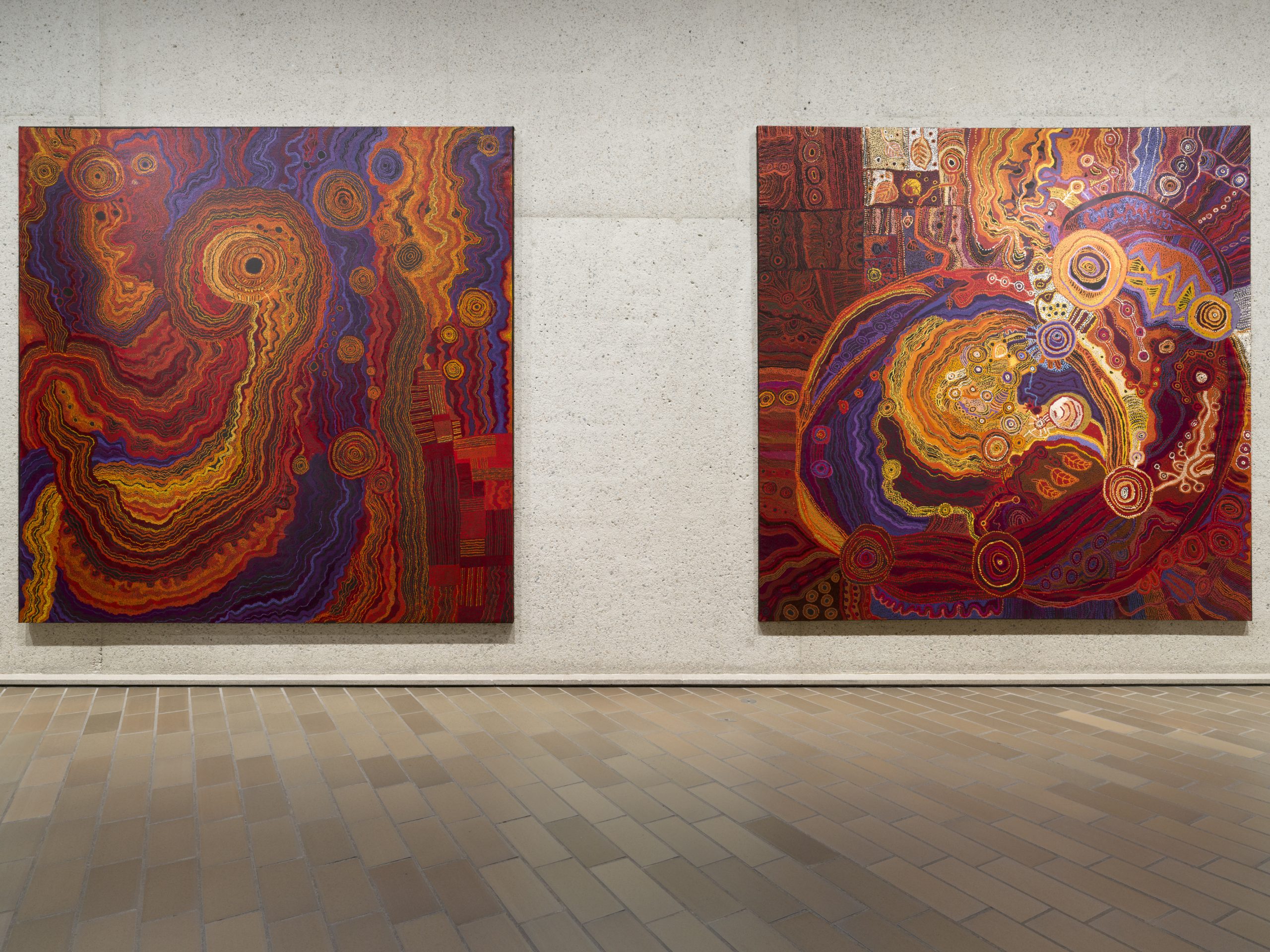
Designed to impress, the number and size of paintings—twenty-nine at nine square metres each and one even bigger—are a spectacle, lifting the exhibition from an overview of recent Anangu art and its recent politics to an epic dimension. In this respect, Ngura Pulka is akin to the The Aboriginal Memorial, 1987–88, installed nearby. Forty-three artists from nine aligned family groups in Ramingining and nearby communities produced something greater than their individual parts. The APYACC adopted a similar multi-clan ceremonial form to similar effect: fifty-one artists from six of its ten art centres imagine an overarching Anangu identity. Its collective power is felt in the widely shared style (expressionism) and motif (Country), and the seriality of the same-size paintings. It helped that nearly all the works were made in 2021–23 by a relatively homogeneous group. Eighty-five per cent of the artists are over fifty (nearly forty per cent are over seventy), and ninety per cent of paintings are by women, with the exhibition’s visual machismo most apparent in their sweeping abstract compositions. As well, many are kin, and thirty per cent of works are collaborative, knitting any differences into a singular statement.
The danger of such a tightly conceived project is a set “house style.” It was already my opinion of APYACC art, perhaps due curators preferencing a signature style, exemplified by the Ken sisters’ paintings at the exhibition’s entrance. But Ngura Pulka doesn’t shy away from idiosyncratic artists. Two of the five men’s paintings (by George Cooley and Robert Fielding) seem to come from another country. So too does Iluwanti Ken’s black-and-white scribbly graphics woven into a kitschy eye-catching ancestral Eagle story, echoing her origins as a Tjanpi weaver.
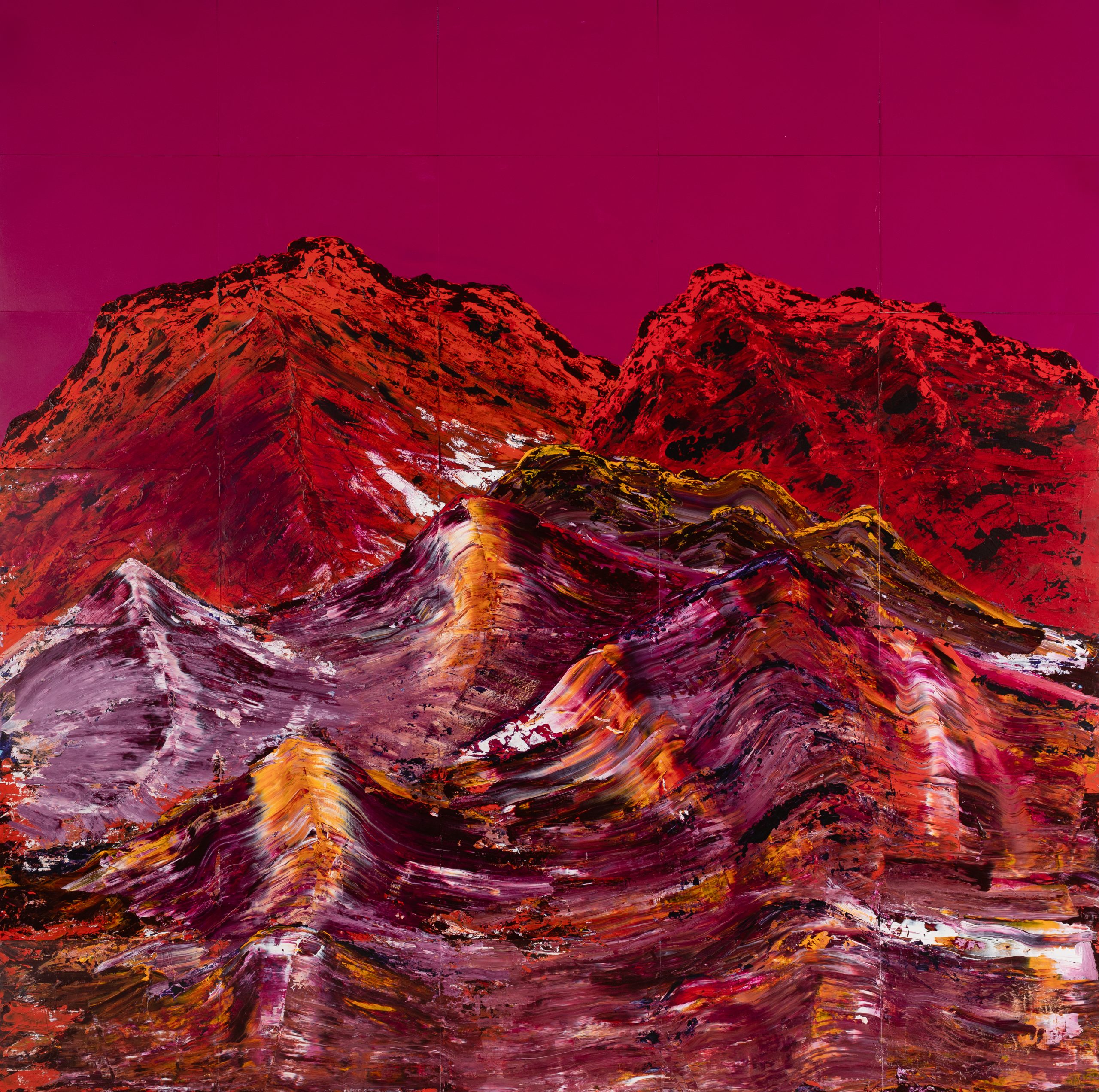
George Cooley, Blue Ground Country, 2025, acrylic paint, board, 290 x 290 cm.
Nor are the more traditional painters all of a type. The subtle off-white monochromatic grid of ghost-like roundels in Matjangka Nyukana Norris’s Nguru Pilti (Dry Country) is a rare oasis of cool, meditative calm in Ngura Pulka’s fiery call to arms. Different again is the more conceptual rectilinear gridded composition of Ngura (Country) by the Iwantja Arts Men’s Collaborative (Alec Baker, Kunmanara (Peter) Mungkuri and Eric Barney). Its icon-like trees make it one of the few paintings that references the woodwork and land rights paintings made a decade earlier that were formative in the men’s contemporary art.
The NGA also provides historical context by supplementing the main show with work from its collection in three smaller rooms, two of which contain earlier Anangu paintings and the other works from Hermannsburg, home of Albert Namatjira (1902–1959). While pleasing my historical bent, these smaller, more hesitant and searching works distract from the effect of the large, mural-like paintings. Scaled to the architectonics of the room, their designs, freed from the confines of the canvas, own the walls, creating an immersive environment that is more alive the closer you are to the paintings.
A large canvas is not necessary to picture a big country, as the very different scale of Namatjira’s small watercolour landscapes hanging in the adjoining room demonstrate, but it sure helps if you want to convey an epic feeling. This is why they have been a feature of contemporary art since the mid-twentieth century. Impressed by how Pablo Picasso’s (1881–1973) Guernica, 1937, and José Clemente Orozco’s (1883–1949) and David Alfaro Siqueiros’ (1896–1974) 1930s murals of oppression and revolution plumbed the tragic depths of what Albert Camus called “this century of fear,” a new generation of artists abandoned the easel for the wall. Several examples hang near the entrance to Nugra Pulka: Jackson Pollock’s (1912–1956) Blue Poles, 1952, Morris Louis’ (1912—1962) Beta Nu, 1960, and Colin McCahon’s (1919–1987) Victory Over Death 2, 1970. While poorly displayed, around the corner The Aboriginal Memorial is installed with much greater acuity to its spatial architectonics.
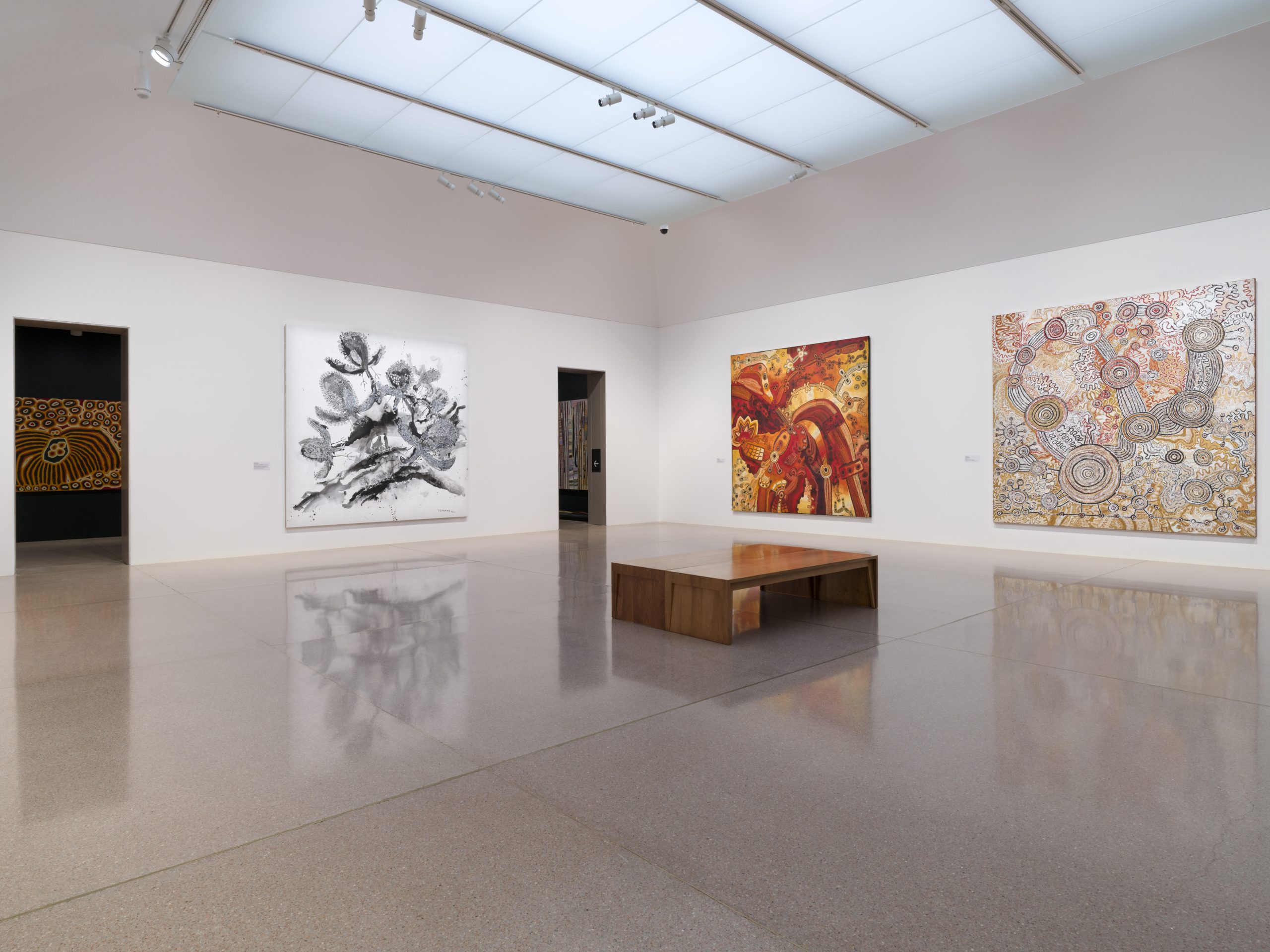
Installation view, Ngura Puḻka – Epic Country, National Gallery of Australia, Canberra, 2026, artworks left to right, Iluwanti Ken, Walawuru nguynytju munu mama kukaku ananyi (Mother and father eagles going hunting), 2022, Teresa Baker, Minyma Malilunya, 2022, Leah Brady, Piltaṯi, 2021.
Unlike the Memorial’s pathos, the ambiance of Ngura Pulka is celebratory, of both its own sense of achievement and the Western Desert contemporary painting movement more generally. Seeded at Papunya fifty-five years ago, the movement’s artisanal beginnings were turbo-charged by the creation of a modern Aboriginal art industry. Its art centres quickly grasped the capitalising potential of aestheticising Tjukurpa and the aesthetic play of scale and size in much contemporary Western art, by which they could assert their contemporaneity and claims of sovereignty. Hence the criticism by art critic Christopher Allen, once made of Papunya art, that APYACC paintings “in many cases look uncomfortably like pastiches of John Olsen’s abstraction.”
Once the fiercest critics of the Papunya painters for disclosing their Tjukurpa, the Anangu took over twenty years to come around. Ironically, now fully signed up to the art world machine, they are reaping a rich harvest. But it also binds them to the compelling artworld myth of the artist’s unique artisanal hand authorising the capitalisation of art. Hence the impact of The Australian’s takedown.
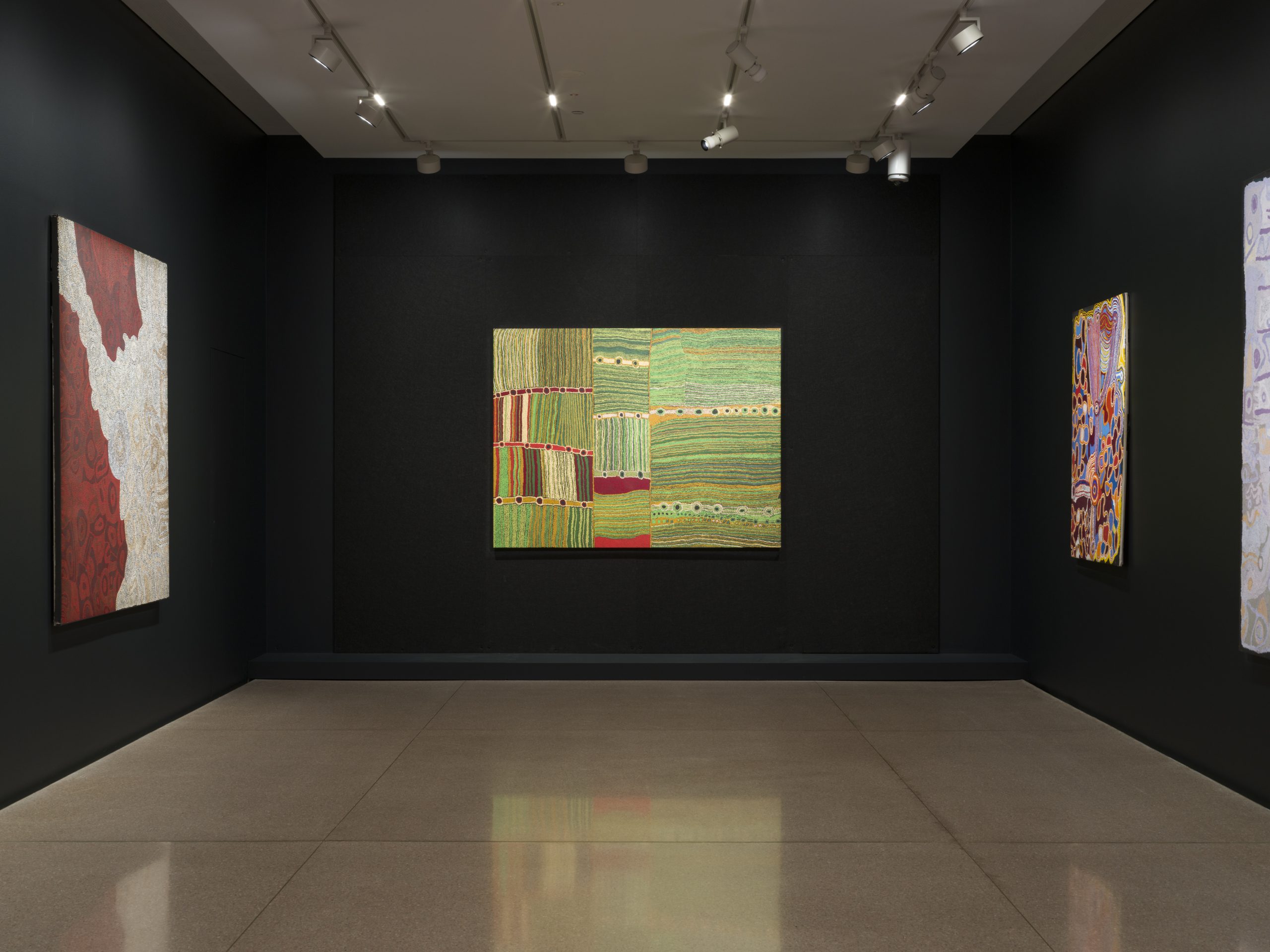
Installation view, Ngura Puḻka – Epic Country, National Gallery of Australia, Canberra, 2026, centre artwork, Maringka Baker, Kuru Ala, 2007.
White hands have always run the art industry, but black hands, exemplified by the APYACC in its mediation between the artists and the industry, are increasingly evident. Headquartered in Adelaide, with its own galleries in three capital cities and producing its own exhibitions and promotional material, the APY Collective seemingly takes “control over the means of production and distribution” of its art in “the white fella art world.” But it is beholden to the industry’s myth of the artist’s hand even when The Australian weaponises it in such racial terms. Ngura Pulka dodges this catch-22 by doubling down on the myth, trumping The Australian’s charge with a blinding spectacle of black APY hands. The catalogue insists Ngura Pulka is “artist-led” as if NGA curators have become redundant. Indeed, the very straight hang keeps curatorial and industry machinations invisible, foregrounding the paintings, allowing the artists to shine.
Exhibition
Ngura Pulka – Epic Country
11 April – 23 August 2026
National Gallery of Australia, Canberra
Images courtesy of the artists, APY Art Centre Collective and the National Gallery of Australia, Canberra.
Prof. Ian McLean has published extensively on Australian art and particularly Indigenous art.
This article was first published in Artist Profile Issue 75, 2026.

Under the auspices of Geelong Gallery’s director, Humphrey Clegg, and co-curated by Marianne Mathieu, former scientific director of the Musée Marmottan Monet, and Claire Durand-Ruel...
Nike Savvas: Purple Haze presents intimate screen prints and immersive large-scale installation and video work by Savvas from 2005–2026, each evocative of different places and...
Although physically he is of modest stature, Zofrea has devoted much of his life to grand projects that have been conceived and executed on a...
Through a multidisciplinary collaboration between Rotterdam-based curators, architect Paul Cournet of CLOUD and artist-designer Sabine Marcelis of Studio Sabine Marcelis, the exhibition explores the interplay...
Artificial intelligence will be used by young artists who started using it as kids on their phones. They will see it as a natural extension...

This year’s Biennale arrives under more complex circumstances than most. It is shaped by the profound loss of its curator, Koyo Kouoh (1967–2025), whose exhibition...
No artist creates in isolation. Every painting carries traces of the conversations, places and histories that shaped it, preserving within its surface a particular moment...
The weekend markets at Fairfield Showground have been one of Western Sydney’s great institutions for more than fifty years. Fresh fruit and vegetables, children’s clothes,...
In recent times, Yorgos Lanthimos has shifted toward photography, noting in a Guardian interview, 2026, that he needs respite, saying, “it might be a couple...