BOOK REVIEW | Paris in Ruins: Love, War, and the Birth of Impressionism
Pulitzer Prize winning art critic Sebastian Smee’s new book brings together art, biography, and social history. Its tantalising title Paris in Ruins: Love, War, and the Birth of Impressionism, 2024, is tailor-made for a movie, or better still, a television series, as indeed are the verve and gusto that characterise the writing. Divided into four parts, the book begins with the “Salon of 1869” and continues with “The Siege of Paris” (by the Prussians), “The Commune” (1870–71), and finally “The Birth of Impressionism,” surprisingly the shortest of the sections. A major theme is the intriguing relationship between the artists Édouard Manet and Berthe Morisot.
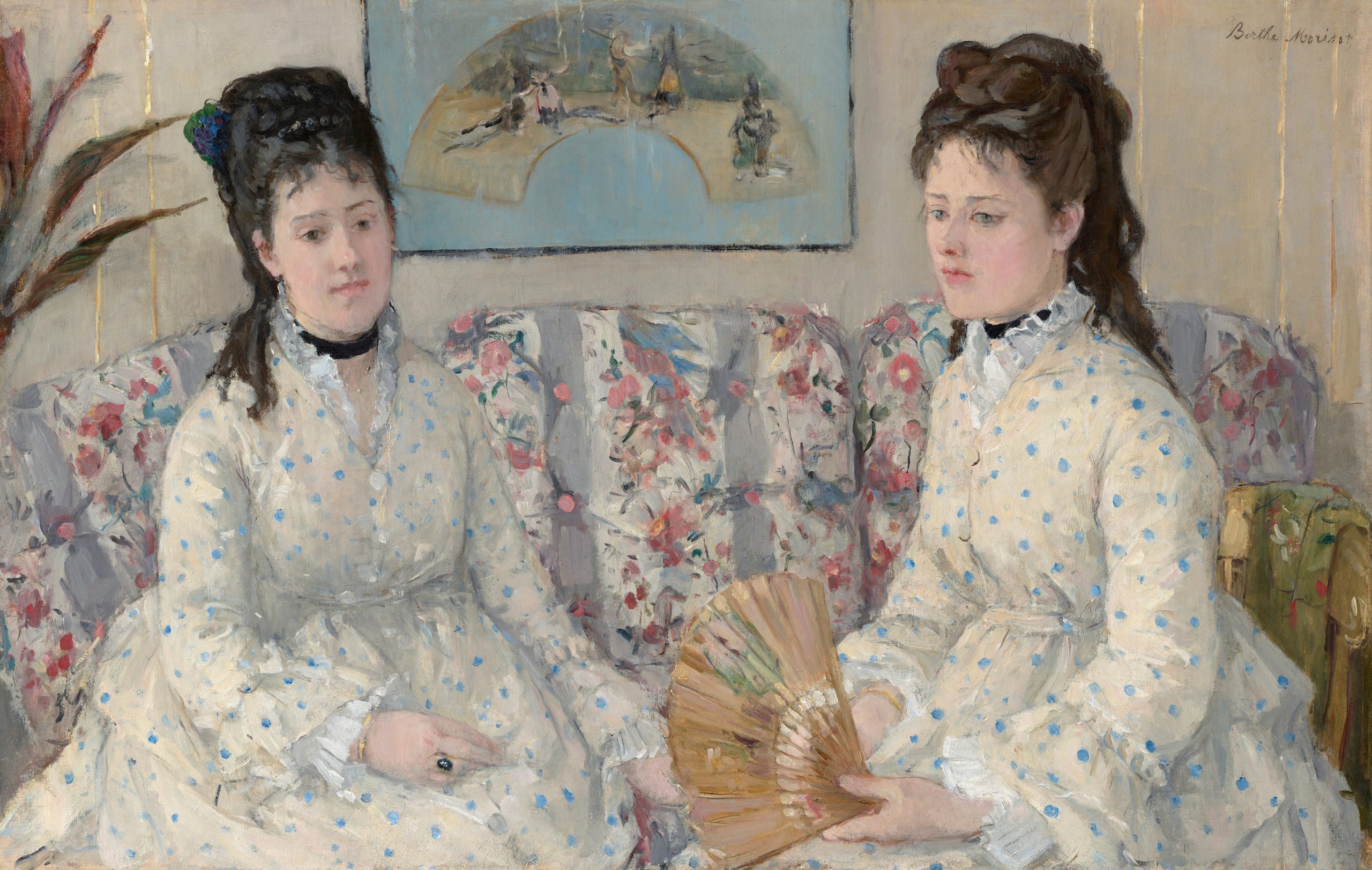
Skilfully assimilating secondary sources throughout Paris in Ruins, Smee at the conclusion of Part One, “Salon of 1869,” writes that Auguste Renoir’s and Claude Monet’s 1869 paintings of La Grenouillère, a popular rowing and bathing resort on the Island of Croissy at Bougival, in effect “invented Impressionism.” Painted in plein air with” short, staccato strokes, one contrasting colour beside the other,” these small works rendered the physical world “as coloured light broken into discrete units, rather than meticulously modelled space….” That the Impressionists would not go on to “depict the realities of 1870-71” [the Franco-Prussian War and The Commune], Smee argues, was probably more to do with their foundational disdain for the hierarchies of academic painting rather than any broader political concern. Yet, in a way hedging his bets, Smee does observe that artists like Monet, Sisley, Morisot and Renoir had “recoiled from the delusional ravings of men, whether left or the right, who were willing to sacrifice sons and daughters, stability and security for absurd and hopeless causes.”
Smee discusses at length Manet’s affection for Morisot as well as her attachment to family and friends. So, for instance, we find Berthe writing to her sister, Edma, about her sibling’s recent marriage: “Come now, the lot you have chosen is not the worst one. You have a serious attachment, and a man’s heart utterly devoted to you. Do not revile your fate.” Morisot would reflect later, however, “that no matter how much affection a woman has for her husband, it is not easy for her to break with a life of work.”
One of Manet’s “greatest portraits” of Morisot, writes Smee, is Repose, painted in 1871. Surprisingly, it is not illustrated in the book. In the painting, Morisot is seen seated rather awkwardly on a voluminously proportioned sofa, a large Japanese print by Utagawa Kuniyoshi on the wall behind her. “Wearing a white dress,” Smee says, “she looks physically relaxed, and yet the pose seems somehow unsustainable, so that the painting feels tremendously volatile, fired by an erotic energy that borders on the inappropriate.” This strikes me as a rather fanciful reading. If anything, Morisot seems absorbed in thought, exhibiting a strongly melancholic air.
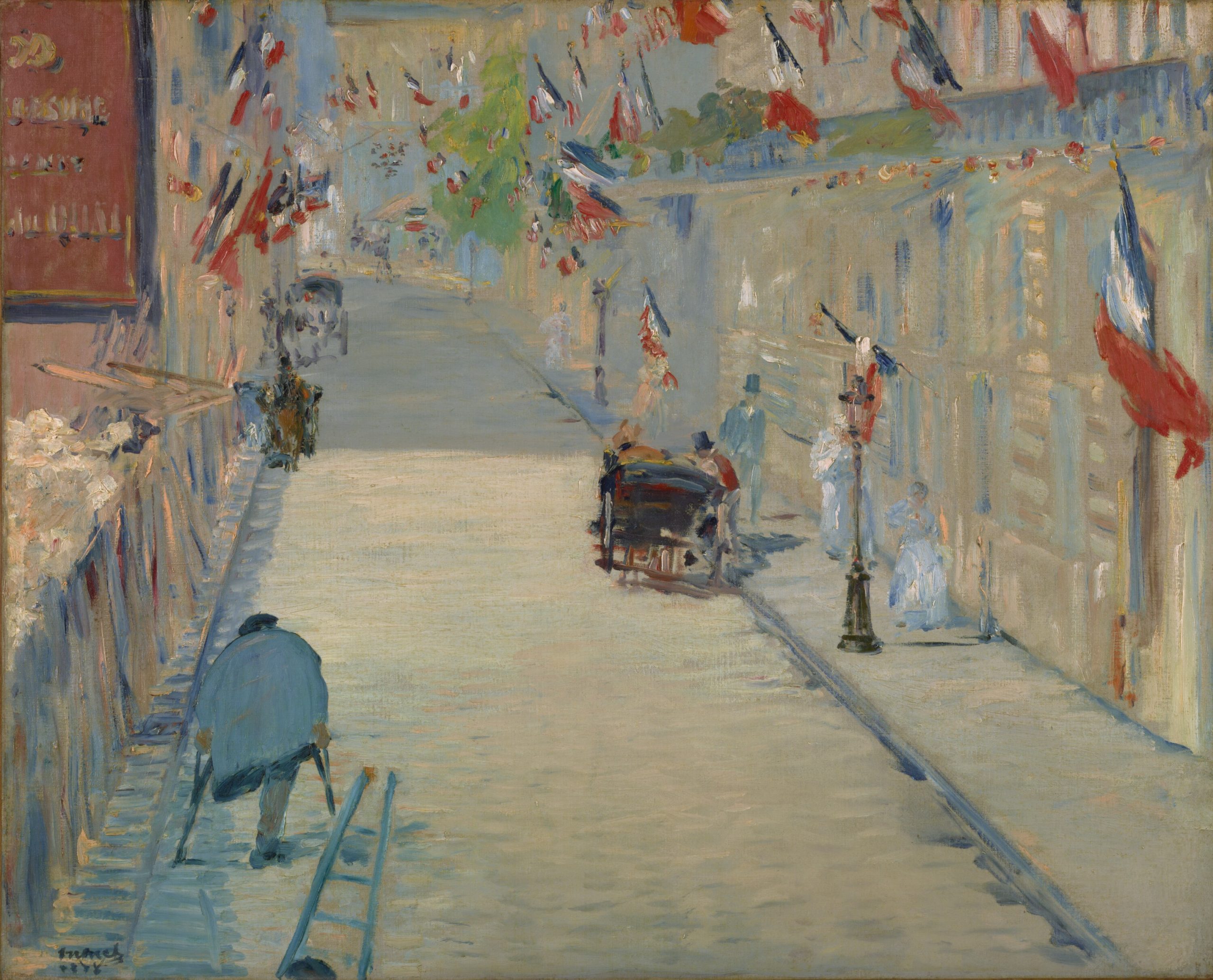
Édouard Manet, The Rue Mosnier with Flags, 1878, oil paint canvas, 96.5 × 112.4 cm (framed). Getty Museum Collection.
Berthe Morisot was a good friend and colleague of Edgar Degas whose draftsmanship she was “in awe of.” An important character in Paris in Ruins, Degas, like Manet and Morisot, “did very little painting during the siege.” But we do learn that he hired a model “to pose, fully clothed, in a chair by the window in the shadowy interior of his apartment.” A little piece of intimacy during a time of bitter conflict. I suspect this painting is Woman at a Window, c.1871-72, in the Courtauld Galleries, London. Enigmatically, Smee writes that “One cannot tell if she is calm, anxious, or perhaps obscurely ashamed.”
Manet who had joined the National Guard during the hostilities would write to his wife, Suzanne, saying, “I wish you could see me in my huge gunner’s greatcoat.” Nothing like a touch of the droll! His brief exposure to battle had “compromised” his health, however, and he tells Suzanne that he had asked for a transfer to the general staff. Meanwhile, Berthe’s own health had worsened appreciably.
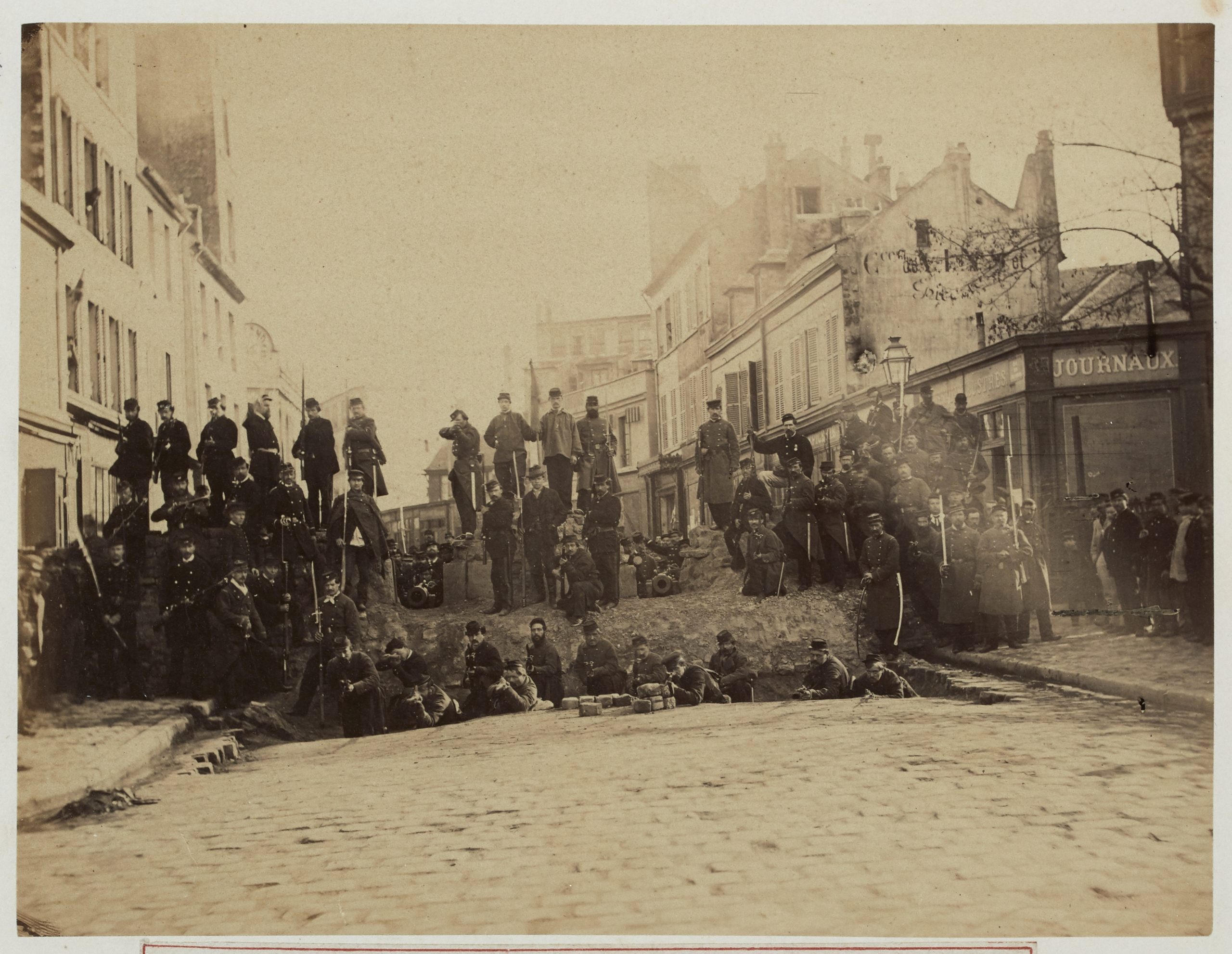
Anonymous, Album de photographies et d’articles de journaux sur la guerre Franco prussienne et la Commune de Paris, c.1870-71, Albumen paper (print), 8 x 20.7 cm, Carnavalet Museum, Paris.
For Smee, “In the period between the demise of the Commune and the first Impressionist exhibition in 1874, Édouard seemed to want to spend as much time as possible in the company of Berthe.” Smee ponders over Morisot’s “loneliness,” her aloofness, and her charm. At the same time, he writes that “Édouard could hardly avoid noticing her artistic progress. She often sought his opinion. But she was no longer deferential.”
Morisot’s artistic development is evident in her 1875 painting of her husband, Eugène Manet, whom she had married the previous year. Created during their honeymoon on the Isle of Wight, it is reproduced in Paris in Ruins. The painting captures Eugène seated by a window and wearing a boater. He looks beyond a garden and a fence at a woman and child walking beside the harbour. For Smee, it “signals a critical shift in Impressionism–a move away from mere ‘views’ of pleasant settings to pictures that tremble with social and psychological pressures.” This is a mighty claim, to be sure, but I find it unsupported by the painting itself.
Paris in Ruins is certainly an entertaining story. Placing impressionism against a backdrop that is highly troubling but also invigorating, it combines keen observations and engaging anecdotes with some assertions that should be treated with a degree of caution.
Book
Paris in Ruins: Love, War, and the Birth of Impressionism
By: Sebastian Smee
Published by: Text Publishing, 2024
ISBN: 9781923058057
RRP: $36.99
This article first appeared in Artist Profile Issue 74, 2026.
Dr Alan Krell is an art historian, writer, and lecturer. He specialises in Manet and late 19th Century French modernity.
Images courtesy of The Text Publishing Company, Melbourne; National Gallery of Art, Washington; , Carnavalet Museum, Paris.
Two years ago, Macleod returned to his hometown of Christchurch, New Zealand, to be with his mother during the final phase of her life. At...
Edwards was born on Kaurna Yarta in 1998 and raised on Nauo Country in the small seaside community of Tulka, on the Lower Eyre Peninsula....

Under the auspices of Geelong Gallery’s director, Humphrey Clegg, and co-curated by Marianne Mathieu, former scientific director of the Musée Marmottan Monet, and Claire Durand-Ruel...
Nike Savvas: Purple Haze presents intimate screen prints and immersive large-scale installation and video work by Savvas from 2005–2026, each evocative of different places and...
Although physically he is of modest stature, Zofrea has devoted much of his life to grand projects that have been conceived and executed on a...
Through a multidisciplinary collaboration between Rotterdam-based curators, architect Paul Cournet of CLOUD and artist-designer Sabine Marcelis of Studio Sabine Marcelis, the exhibition explores the interplay...
Artificial intelligence will be used by young artists who started using it as kids on their phones. They will see it as a natural extension...

This year’s Biennale arrives under more complex circumstances than most. It is shaped by the profound loss of its curator, Koyo Kouoh (1967–2025), whose exhibition...
No artist creates in isolation. Every painting carries traces of the conversations, places and histories that shaped it, preserving within its surface a particular moment...