ESSAY | Between Skyline and Stars: Shireen Taweel and Jasper Knight at Mosman Art Gallery
If you ever find yourself gazing out over the city, where the skyline cuts cleanly into the night sky, where distant stars flicker alongside the restless glow of city lights; that quiet, electric moment is what the upcoming shows of Jasper Knight and Shireen Taweel feel like. Presented concurrently at Mosman Art Gallery in separate spaces, they form a subtle curatorial dialogue between Knight’s experimental, immediacy-driven works on paper and Taweel’s expansive, celestial and diasporic reflections, offering two distinct but resonant ways of navigating perception and making.
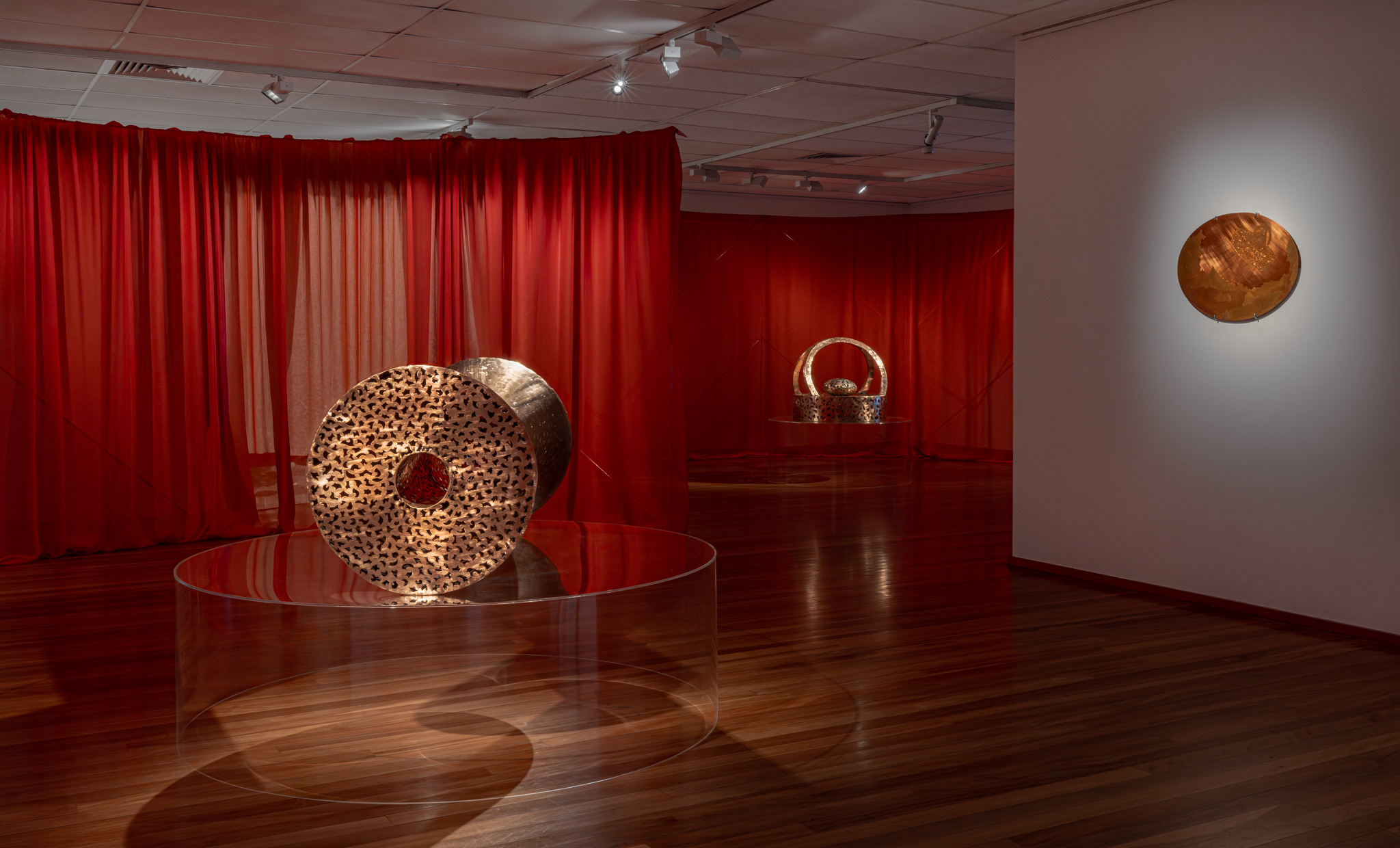
Multidisciplinary artist Shireen Taweel looks skyward, into the night and beyond, with her exhibition the trig point. Drawing on fieldwork in 2025 at the Siding Spring Observatory, Warrumbungle National Park, New South Wales, she traces deep connections between current scientific questions of space and enduring notions of the sacred, extending an earlier focus on ritual and diasporic histories of Islamic cameleers operating in Australia’s desert regions. Her sculptures unfold as intricate, hand-wrought forms: copper flares into bold, brazen tones before dissolving into softer grey sparks. They recall golden star maps and the rich legacy of Arabic astronomy, reflected both in their visual language and in Taweel’s handmaking, which draws on techniques once used to craft astronomical and navigational instruments across the Arab world.
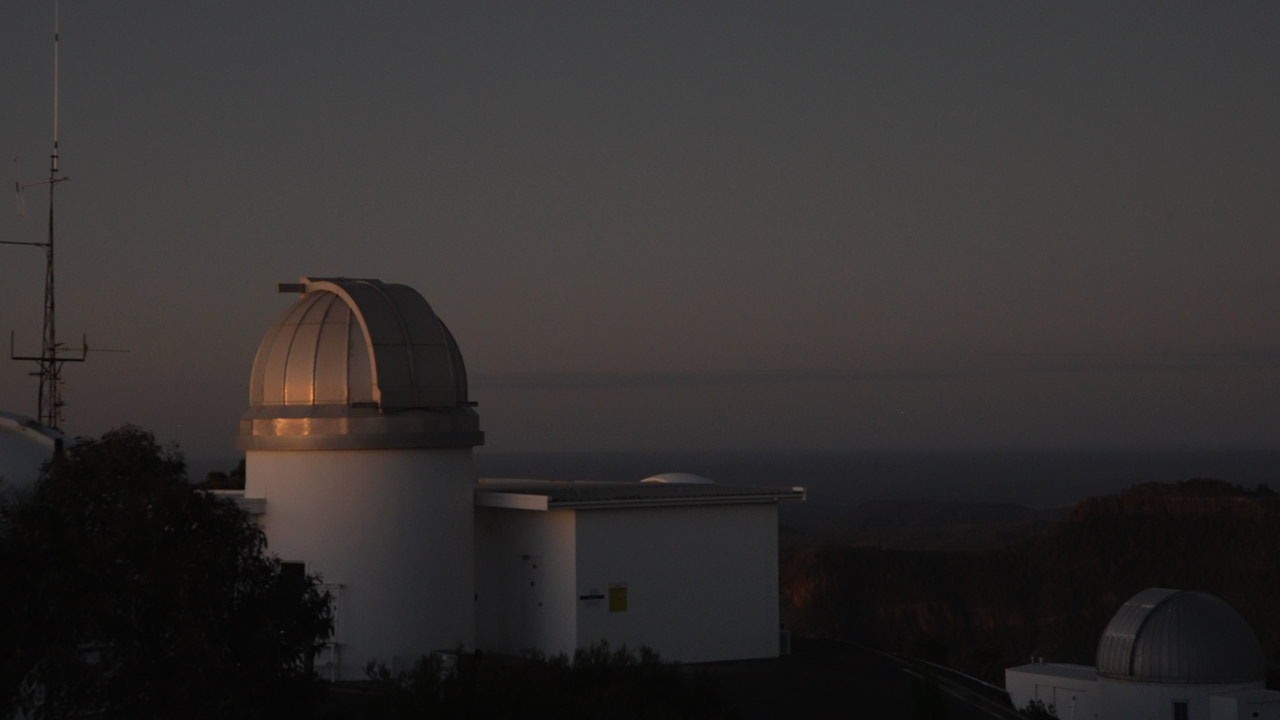
Shireen Taweel, Nautical twilight, 2025, digital image, Siding Spiring Observatory, Kamilaroi Country.
You are drawn into the spiraling voids of the hollow copper sculptures as they begin to feel almost organic. Yet it is precisely this sense of estrangement that Taweel is exploring: the space between diasporic ways of knowing and new forms of knowledge. For her, ancient practices and mechanics are not fixed in time. Rather, she seeks “to bring forward the notion of the sacred through fabric architecture, and build that onto a speculative site, one connected to an ecology on another planet, where astronomy, the sacred and culture are fully intertwined.” This connection between the sacred and the scientific runs throughout the work. References to Arabic astronomical devices and fluid identities appear repeatedly, the sculptures shifting between cultural, spiritual and scientific registers, never settling into a single meaning but instead echoing the layered, diasporic nature of identity itself. Instead, they invite questions. Taweel says she is interested not just in how these medieval Islamic instruments were made, but why, and how they connect to culture and belief.
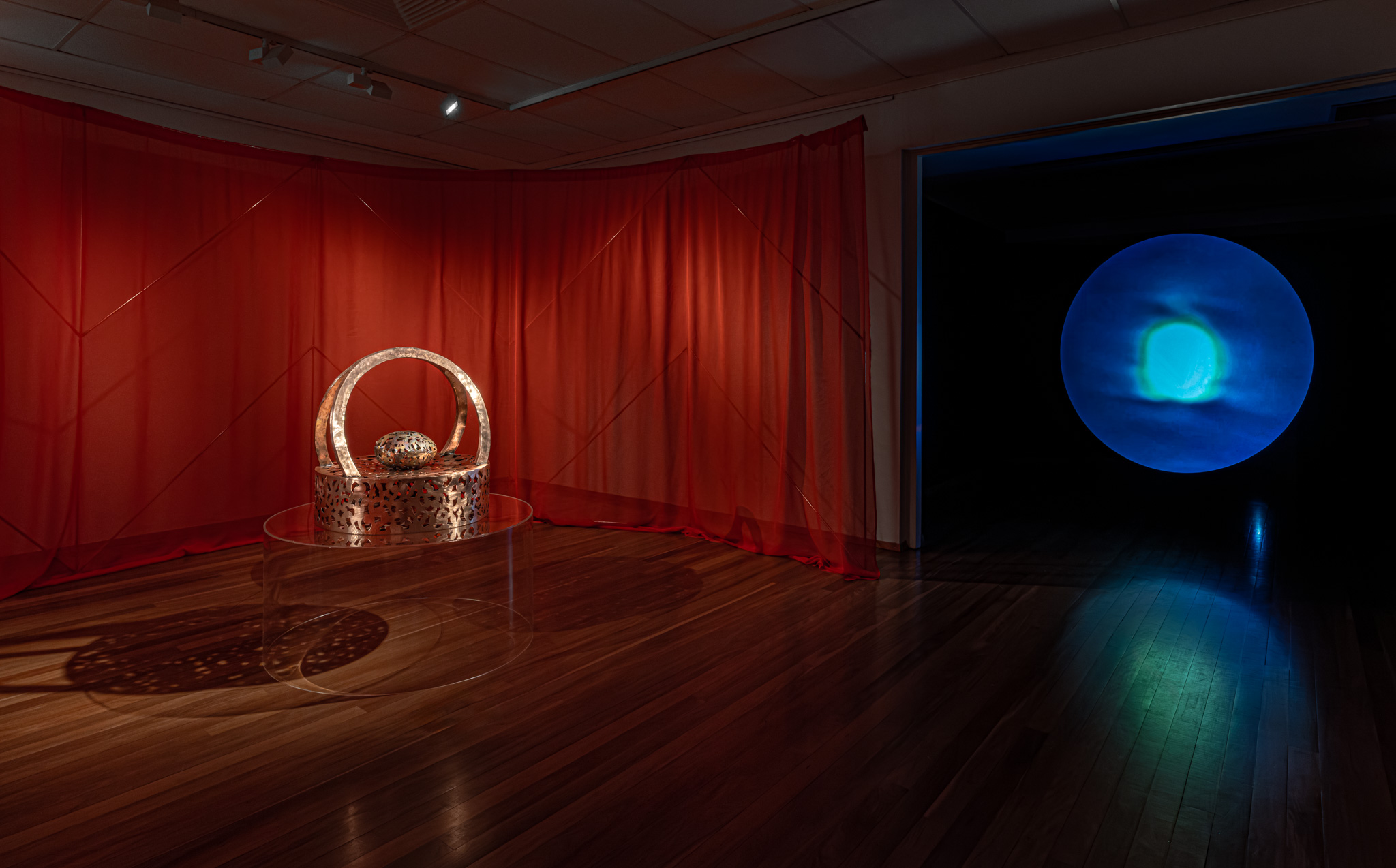
Installation view (detail), Shireen Taweel, the trig point, Mosman Art Gallery, NSW, 2026. Photographed by Jacquie Manning.
In another strand of her fieldwork, she spent time with the five-hundred-strong Muslim community in Dubbo, central west New South Wales, as they worked towards building a new mosque. “What struck me most,” she recalls, “was that the mosque holds a piece of Kiswah, the silk covering of the Kaaba in Mecca.” Kiswah is replaced annually, during Hajj, with the old Kiswah cut into pieces and gifted or sold. This sacred fragment becomes a point of departure: a way of thinking through how sacred architecture is formed and how fabric itself has long functioned as a kind of infrastructure for migration and world-building. This is understood through the slow, material construction of lived and imagined environments through textiles and their movement across borders, carrying memory, belief and belonging as they are remade elsewhere. For Taweel, it is not just material, but a carrier of memory, movement and belief—an idea she continues to develop in her upcoming exhibition.
It’s easy to imagine the quiet, immersive space: Taweel’s copper sculptures softened by lengths of flowing fabric, dyed in the same rich, burnished tones. Like looking up at the night sky, the work invites you to slow down, to sit with its vastness. “That sense of slowness connects my studio practice with observing the cosmos,” she says, “and I’m involved in every step of making, so that intimacy carries through.”
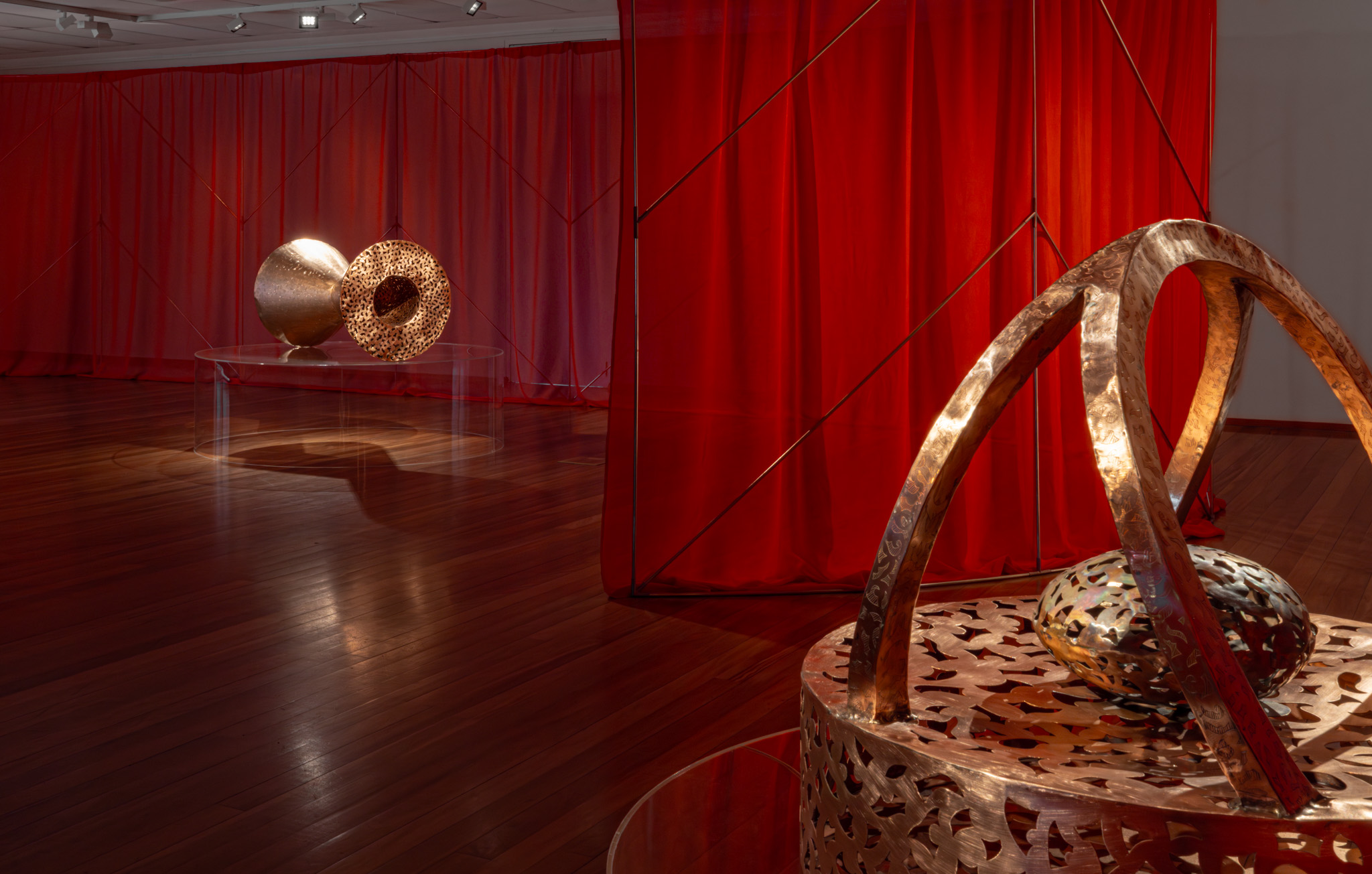
Installation view (detail), Shireen Taweel, the trig point, Mosman Art Gallery, NSW, 2026. Photographed by Jacquie Manning.
Known primarily as a painter, Jasper Knight extends his practice into intimacy-driven themes in this presentation with a selection of collages, prints, drawings and works on paper marking over twenty years of art making. In contrast to his large-scale enamel and acrylic paintings, where paint drips and pools, these pared-back sketches and experiments on paper reveal the foundations of his practice, with several works shown publicly for the first time.
The exhibition moves between looking forward and looking back. Knight’s recent works feel grounded—whether immersed in flowing blues, a metallic grey sheen or bold primary colours breaking into industrial scenes. Yet a persistent push and pull emerges as he revisits early experiments on paper and cardboard that continue to shape his practice. Collages of insects, made as playful works for his young children at the time, sit alongside experiments with shiny Perspex materials, palm trees and imagery drawn from furniture catalogues, the latter reflecting a period of material testing. These works reveal a more intimate register, offering insight into aspects of the artist that sit beyond the resolved surfaces typically seen on the wall.
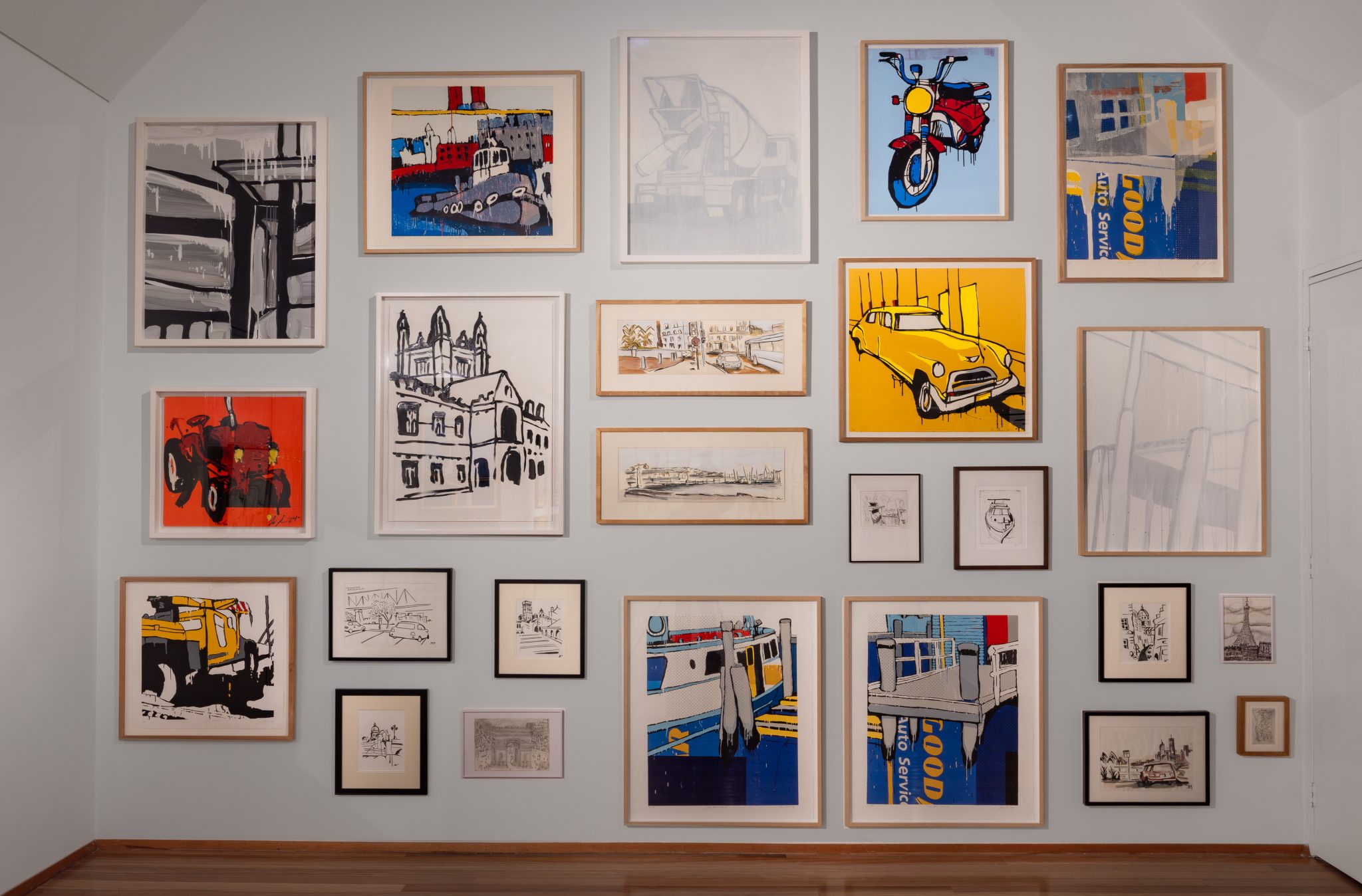
Installation view (detail), Jasper Knight, Collage, prints and works on paper, Mosman Art Gallery, NSW, 2026. Photographed by Jacquie Manning.
Reflecting on his time undertaking his master’s, Knight recalls searching for a distinct visual language: “I let go of the idea that the work had to mean something straight away and just played with surface: cutting cardboard, exposing the corrugation, using PVA glue, tape, acrylic paint and sticking it onto board.”
The exhibition explores the challenges of developing a recognisable artistic language, its rewards as well as its constraints. Knight reflects that “you’re grateful, because it’s what you always wanted, people recognise your work straight away, but at the same time you can get a bit bored of it.” It appears liberating, and even more so in Knight’s own account of his practice: paintings made on a deck in Bangkok, iPhone references skewing perspective, drawings for family, studies and experiments together form this selection. There’s an immediacy that carries across the works, felt in their deliberate, visible gestures. Even in his early collages, the simple acts of layering and gluing hold that sense of movement and responsiveness.
What is particularly compelling is how this immediacy translates into screenprints, etchings and collagraphs. Their inclusion in the exhibition marks another step within Knight’s broader field of experimentation: print proofs where layers of ink and block colours accumulate over time, and the functionality of the line itself. While created in collaboration with master printmakers, where Knight’s role is comparatively hands-off, he notes that “screenprint probably suits my style best. . .it’s bold, graphic and quite loud.”
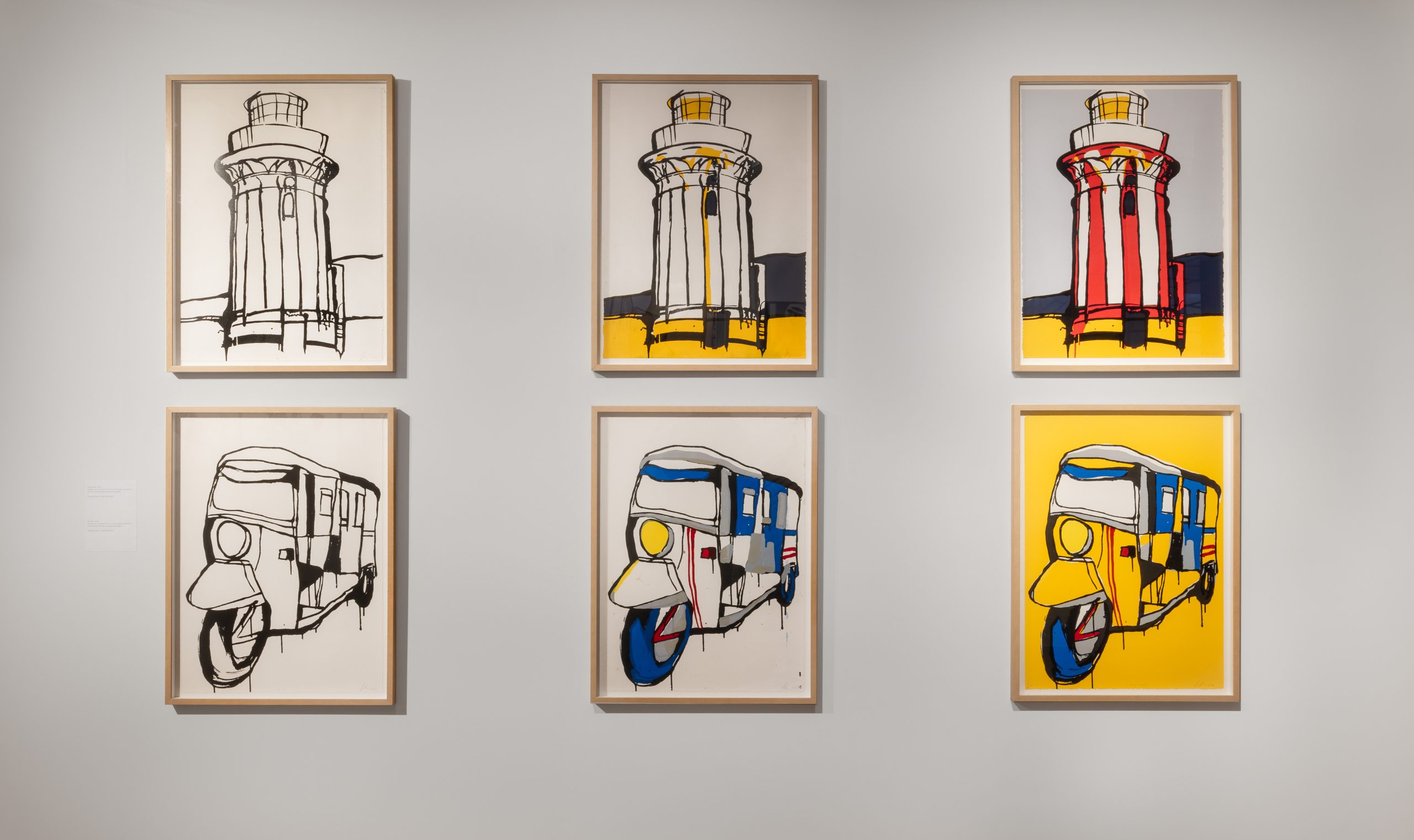
Installation view (detail), Jasper Knight, Collage, prints and works on paper, Mosman Art Gallery, NSW, 2026. Photographed by Jacquie Manning.
Across these shifts in medium, continuity remains. Moving from the accidental to the deliberate, the prints begin to echo drawing—more produced yet still anchored in instinct. For Knight, it is ultimately the line that matters: thick, heavy outlines that carry across drawing, painting and print alike. Placed in proximity to Taweel’s expansive, materially symbolic systems, Knight’s insistence on line reads as another form of orientation—mapping the visible world rather than the celestial or ancestral.
Together, Shireen Taweel and Jasper Knight return us to that quiet, electric moment, where the glow of the city meets the vastness beyond it. At Mosman Art Gallery, their works hold that same tension: between intimacy and expanse, process and perception, and between two distinct ways of constructing worlds through making and seeing, inviting us to linger a little longer in looking.
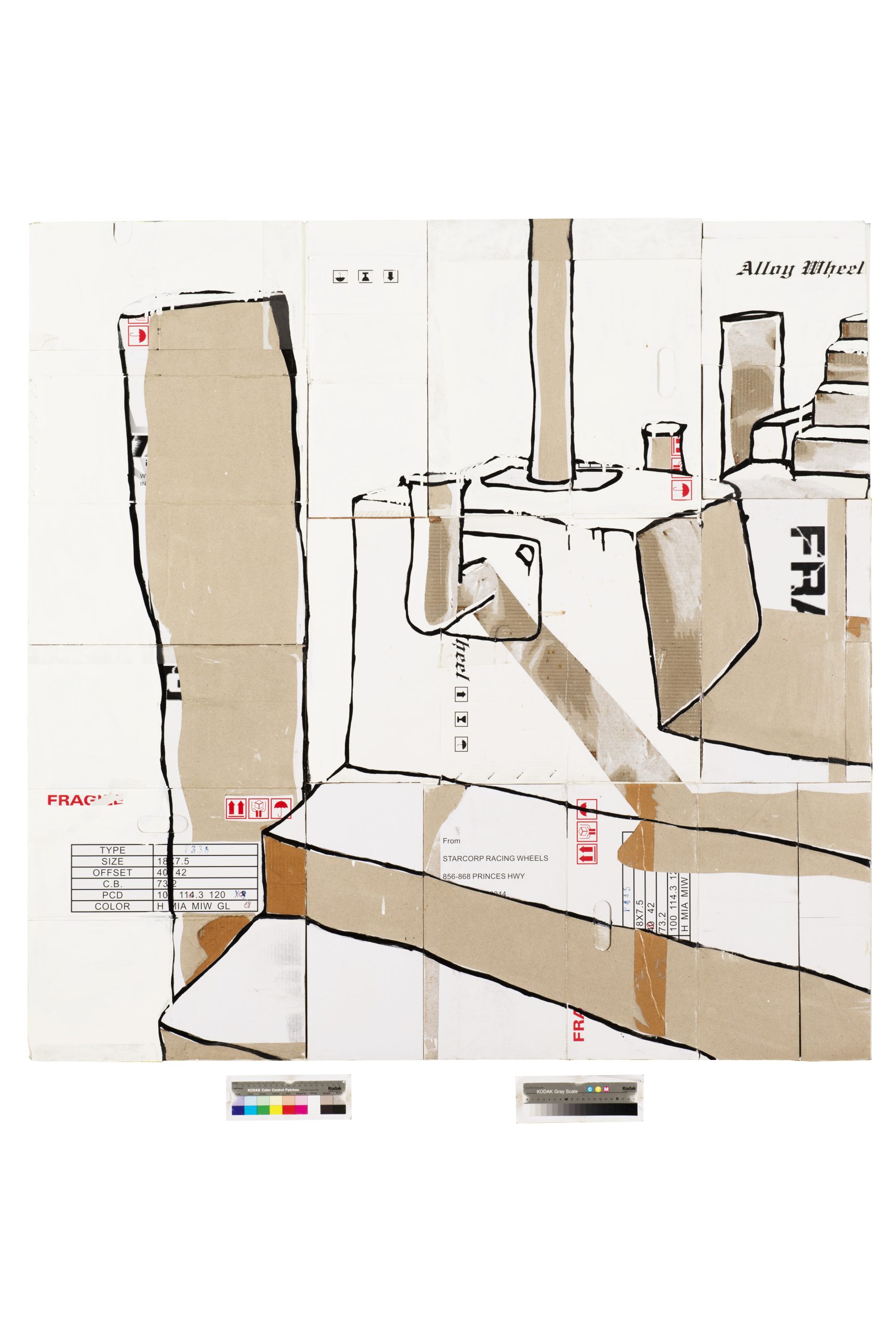
Jasper Knight, Chair Overlooking Street, 2003, acrylic paint, pencil, pastel, cardboard boxes, PVA, 120 x 90 cm.

Under the auspices of Geelong Gallery’s director, Humphrey Clegg, and co-curated by Marianne Mathieu, former scientific director of the Musée Marmottan Monet, and Claire Durand-Ruel...
Nike Savvas: Purple Haze presents intimate screen prints and immersive large-scale installation and video work by Savvas from 2005–2026, each evocative of different places and...
Although physically he is of modest stature, Zofrea has devoted much of his life to grand projects that have been conceived and executed on a...
Through a multidisciplinary collaboration between Rotterdam-based curators, architect Paul Cournet of CLOUD and artist-designer Sabine Marcelis of Studio Sabine Marcelis, the exhibition explores the interplay...
Artificial intelligence will be used by young artists who started using it as kids on their phones. They will see it as a natural extension...

This year’s Biennale arrives under more complex circumstances than most. It is shaped by the profound loss of its curator, Koyo Kouoh (1967–2025), whose exhibition...
No artist creates in isolation. Every painting carries traces of the conversations, places and histories that shaped it, preserving within its surface a particular moment...
The weekend markets at Fairfield Showground have been one of Western Sydney’s great institutions for more than fifty years. Fresh fruit and vegetables, children’s clothes,...
In recent times, Yorgos Lanthimos has shifted toward photography, noting in a Guardian interview, 2026, that he needs respite, saying, “it might be a couple...