
Max Berry – ‘The Inwardness of Place’
In his latest collection of work, Berry presents place as something shaped by a person's movement and affective counters within it.
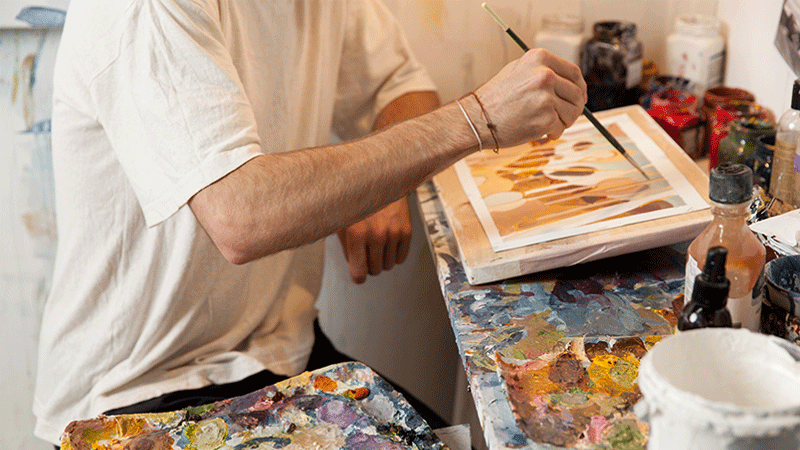
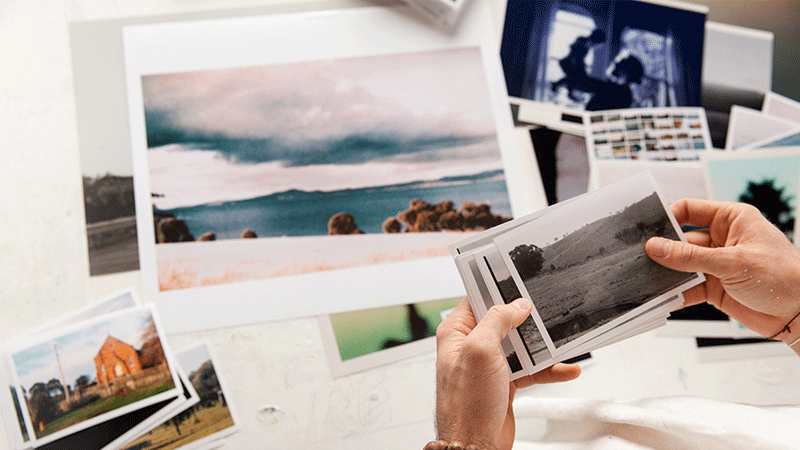
What constitutes place? Across Max Berry’s work to date, place has emerged as a defining interest. In this, his latest solo exhibition, place is again evoked through the exhibition’s title, as well as through the works predominant subject matter, landscape. However marking a departure in approach to his previous work, Berry’s interest in landscape has turned from its fantastical imaging to its direct experience, with the artist venturing out of his studio on excursions to locations throughout Australia. These have included Hill End and the Colo Valley in inland New South Wales, and further south to Tasmania’s hinterland.
Across the exhibition, Berry has distilled something of these locations into paintings that are vivid in colour and decisive in stroke. Be it a view of rolling hills, an immense horizon line, a solitary tree, a river or a dam, each painting offers the viewer a vignette, an invitation to experience a moment in time and space, and to position themselves where the artist once stood. Upon viewing these landscapes what quickly becomes noticeable however is that they are largely unpopulated. But while people do not abound they are not inhuman. A tree for example might ask for greater attention announcing itself as a prominent character through a stroke that intensifies its form, while the presence of a road might clarify the painter’s point of interest in a composition, or the shade of the sky’s hue have been given a concentrated vibrancy to evoke its emotional impact.
Significantly for this collection of works, Berry first translated his experience of these places through photography, capturing a days shifting light or a detail that caught his interest through the rich impression of film. Then back in the studio, the resulting photos were used to reinterpret these moments through the poetic potentials offered by paint. Like flipping through the pages of a photo album, the works in The Inwardness of Place are decidedly nostalgic and sting with emotion, with each work seeming to encourage a particular quality or feeling that lingers and marks its own time as it is viewed. This may suggest that the answer to what constitutes place exists in each person’s encounter, residing within.

Two years ago, Macleod returned to his hometown of Christchurch, New Zealand, to be with his mother during the final phase of her life. At...
Edwards was born on Kaurna Yarta in 1998 and raised on Nauo Country in the small seaside community of Tulka, on the Lower Eyre Peninsula....
Under the auspices of Geelong Gallery’s director, Humphrey Clegg, and co-curated by Marianne Mathieu, former scientific director of the Musée Marmottan Monet, and Claire Durand-Ruel...
Nike Savvas: Purple Haze presents intimate screen prints and immersive large-scale installation and video work by Savvas from 2005–2026, each evocative of different places and...
Although physically he is of modest stature, Zofrea has devoted much of his life to grand projects that have been conceived and executed on a...
Through a multidisciplinary collaboration between Rotterdam-based curators, architect Paul Cournet of CLOUD and artist-designer Sabine Marcelis of Studio Sabine Marcelis, the exhibition explores the interplay...
Artificial intelligence will be used by young artists who started using it as kids on their phones. They will see it as a natural extension...
This year’s Biennale arrives under more complex circumstances than most. It is shaped by the profound loss of its curator, Koyo Kouoh (1967–2025), whose exhibition...
No artist creates in isolation. Every painting carries traces of the conversations, places and histories that shaped it, preserving within its surface a particular moment...