ESSAY I Connecting Culture: Bark Masters
Two paintings of dancing spirit figures by Samuel Wagbara (1926–1979) are central to D Lan Galleries’ "Bark Masters," 2026 exhibition. While these works were painted in the 1960s, their composition and execution have a level of dynamic energy which feels both present and timeless. In this curated collection are others with a similarly strong presence and provenance. It acknowledges the significance of bark paintings with, wherever possible, the attribution of individual authorship.
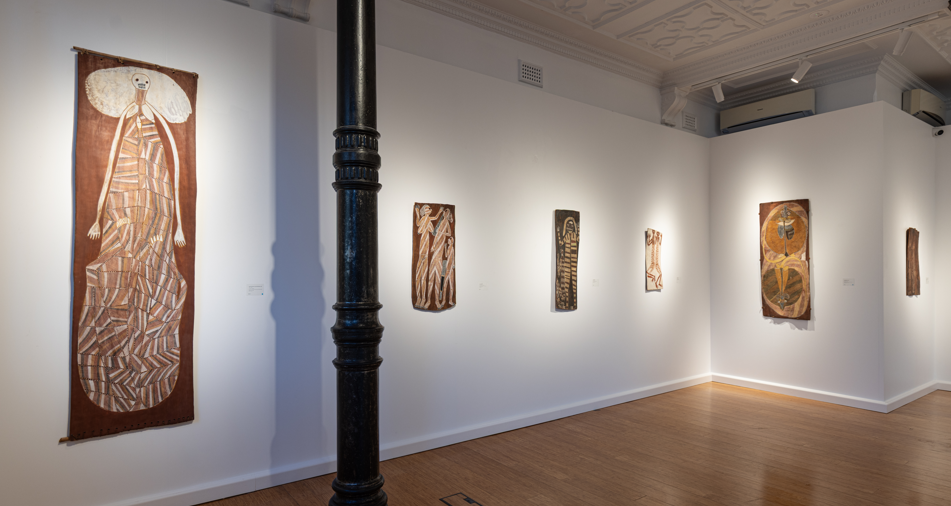
Recognition of the importance of early bark paintings and their link to the world’s oldest continuing culture, is what makes them both highly sought and rarely available. Early anthropologists and collectors were alert to their importance, with fine examples acquired and now in institutional collections. Key collecting expeditions in the mid-twentieth century see the National Museum of Australia now holding the largest group of bark paintings in the world, dating from the 1930s. Another strong collection emerged from the 1959 Yirrkala commission, which was initiated by the Art Gallery of New South Wales’ former deputy director Tony Tuckson (1921–1973) with Stuart Scougall (1889–1964). This group of works predominantly feature the Marika and Yunupingu families. The acquisitions by the Art Gallery of New South Wales were notable in the era as the works were displayed within an art (rather than museological or ethnographic) context. Their importance was profiled in an exhibition titled Australian Icons: Twenty Artists from the Collection, 2000, acknowledging the barks as part of “the generation of artists who developed serialisation of the ancestral narratives into discrete episodes.”
The direct connection between bark paintings and the ceremonial life of the past, which continues to join Aboriginal people to Country, was expressed in 1963 when the Yirrkala Church Panels were used by community in North East Arnhem Land as evidence of legal title to their land. D Lan Galleries’ director and exhibition curator Luke Scholes explains, “They’re a visual expression of culture that conveys identity, belief, continuity and immense depth of cultural knowledge and ancestral stories.”
‘’There is renewed interest in bark painting, both historical and contemporary. Working within continuing cultural boundaries, today’s practitioners are expanding the medium’s visual language and, in doing so, casting fresh light on the bark paintings of the 1950s, 60s and 70s.”
In 2022 Jeremy Eccles cited the experience of German dermatologist Gerd Plewig, who first encountered bark painting in Sydney in 1969. It created for Plewig an awareness in these works of “a reflection of radically different religious beliefs, customs and social structures.”
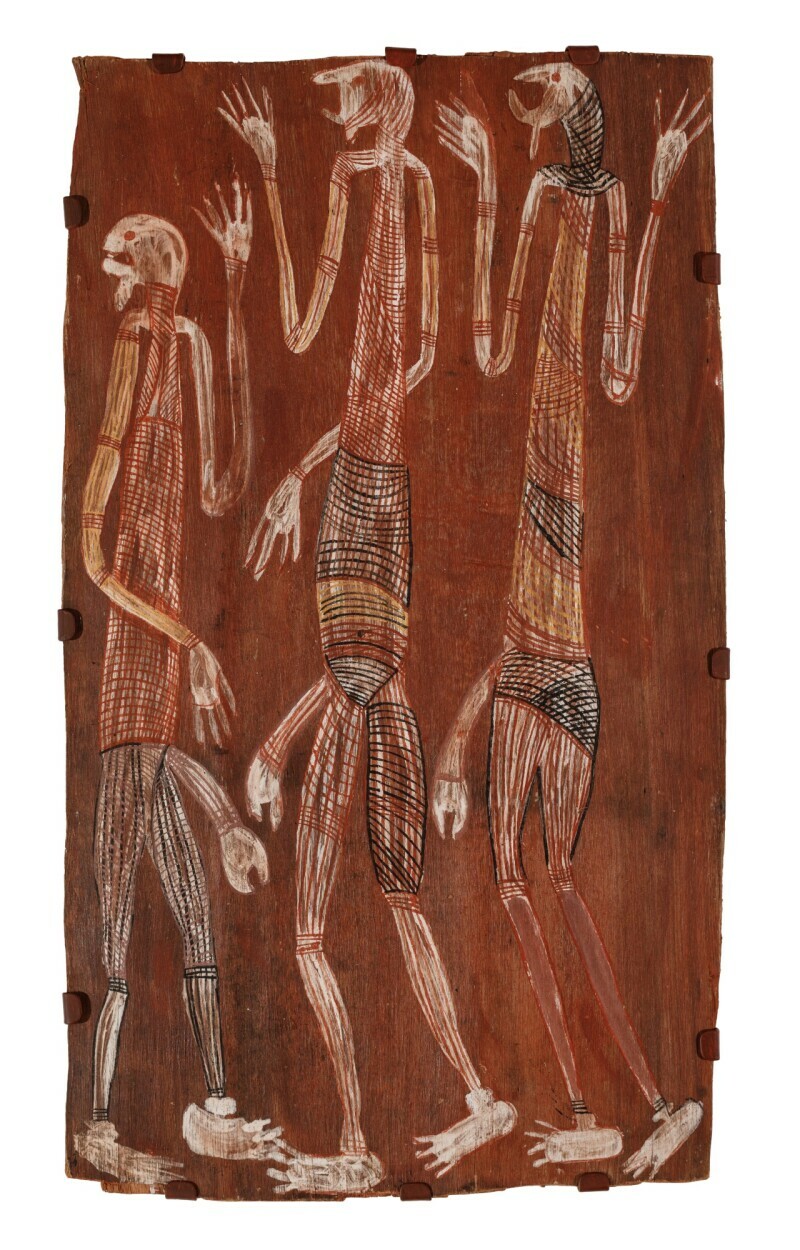
Samuel Wagbara, Namarnday Spirits, 1960, earth pigments, eucalyptus bark, 86 x 44 cm.
The Gerd and Helga Plewig Collection,1950–1970s, comprising 170 pieces from Arnhem Land and the Kimberley region, is considered the best group of bark paintings outside Australia. The collection was donated to the Museum Fünf Kontinente Munich in 2018. Another well-known collection with significant barks is Kluge-Ruhe Aboriginal Art Collection of the University of Virginia. An exhibition developed with the Buku-Larrnggay Mulka Art Centre, Maḏayin: Eight Decades of Aboriginal Australian Bark Painting from Yirrkala, toured the United States between 2022 and 2025, receiving a rapturous response.
For Scholes, what is most powerful about high quality, early bark paintings is their material link between “those two types of substrates, rock and bark. Some of the last major painters of those significant rock shelters in Arnhem Land were also renowned bark painters (and these may be maintained by family members on special occasions). They applied the techniques they had used on rock when they started painting on bark.” This is evident in the translation of techniques used in rock painting, with the varying regional styles, into the bark medium.
In this second iteration of Bark Masters, the most recent works are from the 1980s, the earliest 1950. Scholes explains: “The thing about bark paintings is that, particularly older bark paintings, are so deeply loved by their owners that people often just don’t want to sell them. They tend to stay in private collections and remain tightly held. The majority of consignments we get are paintings that have been in the same collection for a long time.”
Scholes continues: “Occasionally if we see particularly good examples in far off places we might buy them from auction to present in this annual show. To us it is about exhibiting the very best paintings we encounter; that is why it can’t be more than an annual event.”
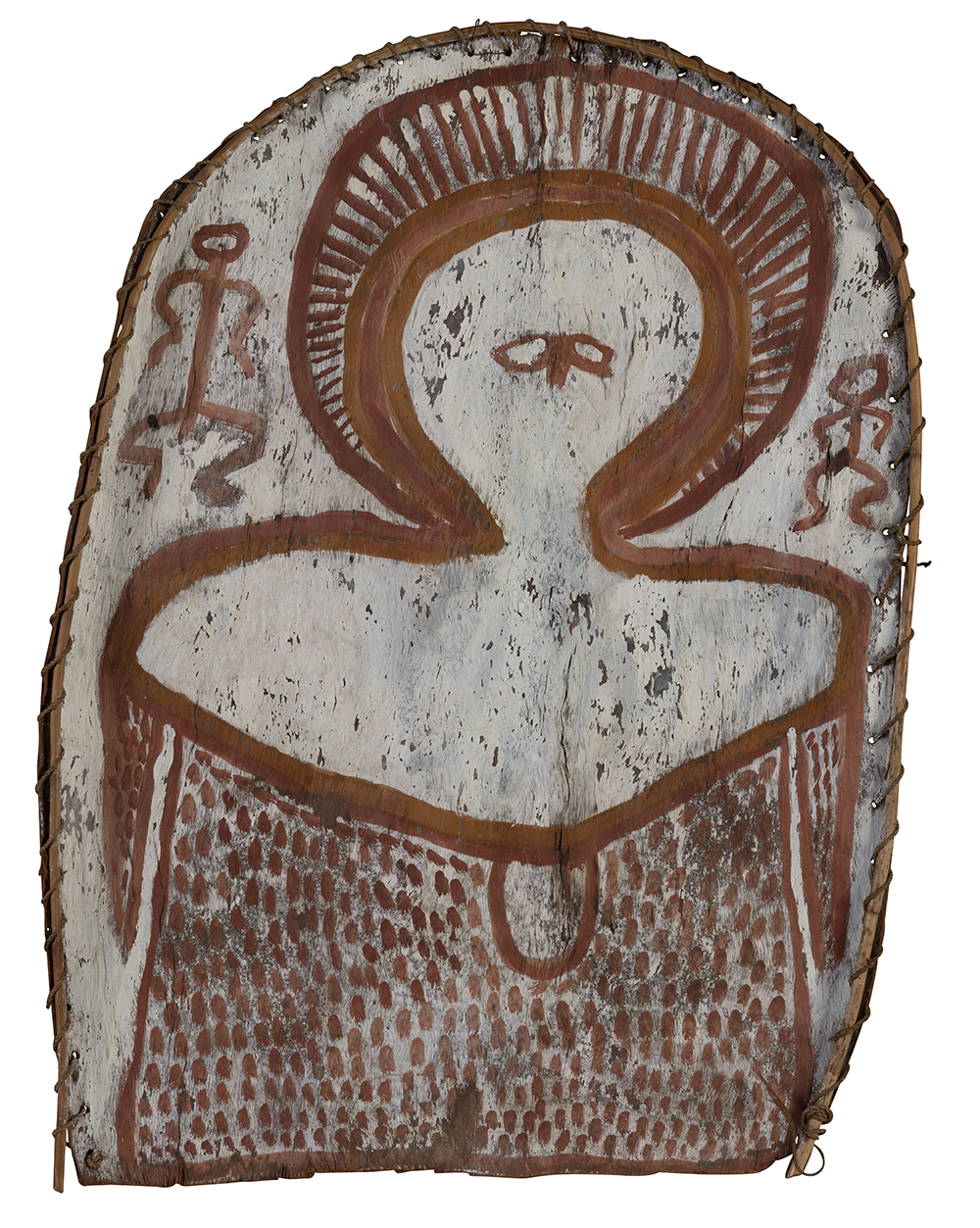
Jack Karadada, Wandjina Spirit, 1973, earth pigments, bark, 80 x 58 cm.
A highlight of Bark Masters, 2026, are three Wandjina figures from the Kimberley region, depicting mythological beings associated with the creation of the world. Originally found in caves, painted on walls and ceilings, usually in ochre and white, Wandjina are characterised by enlarged white faces and no mouths.
The example by Jack Karadada (1920–2003), The Wandjina Spirit, 1973, is edged with wrapped and stitched native cane with the bark shaped to echo the figure. The aura of the Wandjina head features radiating stripes, the torso infilled with brushstrokes, with a sense of three-dimensionality created against the otherwise white background.
Another older example by Mickey Bunkuni (c.1902–1978), gives the Wandjina a more fluid form, with head tilted and large eyes. The torso is fuller, clothed by dotting into the body areas. The third and most valuable by Alec Mingelmanganu (1905–1981), Untitled – Wandjina, c.1976, is beautifully rendered, with a sprayed effect on the background. The characteristic halo form for the head frames eyes like dark pools extended with lashes and a distinct nose form. Arms extending from the torso are shortened, as though receding into the space behind, while stripes and dots clothe the figure.
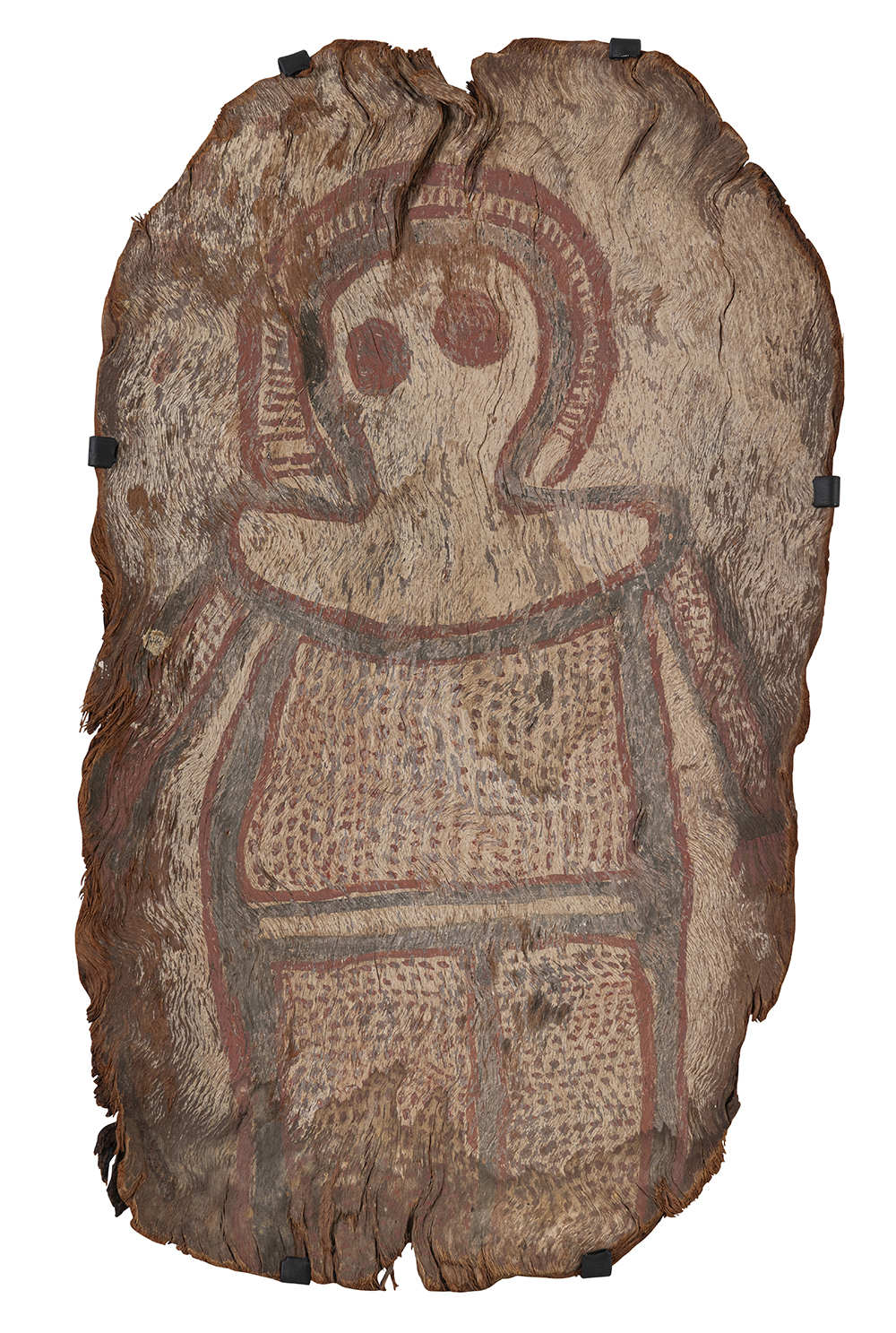
Attributed to Mickey Bungkuni, Wandjina, 1965, earth pigments, bark, 34 x 26 cm.
Scholes explains: “These major Wandjina paintings are unusual within the genre. We don’t easily associate bark with the Kimberley region; yet we have these iconic, graphic visual figures.”
Stylistically distinct from the Kimberley works is The Lightning Man, painted in northern Australia’s Oenpelli (now Gunbalanya) by Peter Marralwanga Namarrkon (1916–1987) in 1980. This story appears on many rock faces in central Arnhem Land. Only one metre tall, the detailed depiction of a mythical figure who created thunder and lightning during pre-monsoon storms has stone axes on hands and feet.
Another, by Charlie Barramundi Nadjombolmi (c. 1895–1967), Untitled Namorrordo, 1958, is a powerful depiction of the spirit, emphasising elongated limbs and a prominent male sexual organ. It was acquired by Dorothy Bennett (1923–2003), who was working in the Northern Territory as a medical assistant (with Scougall) when she encountered Aboriginal art, going on to become an advocate and curator.
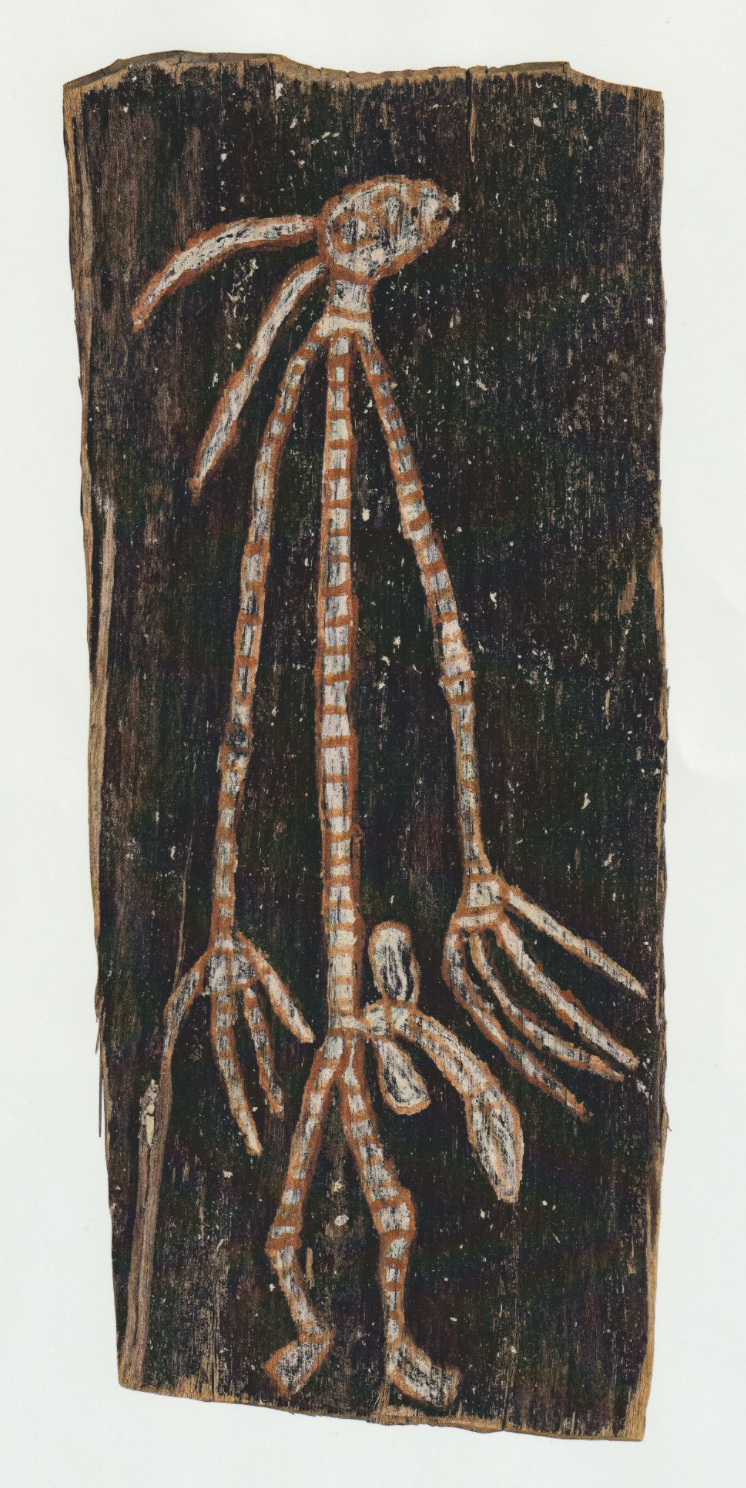
Charlie Barramundi Nadjombolmi, Untitled, 1958, natural earth pigments, eucalyptus bark, 45 x 20 cm.
Other items with strong provenance are the three-dimensional figures that have come through the estate of Tony Tuckson. He travelled with wife Margaret into remote places, with his own abstract expressionist paintings influenced by what he saw. The beautifully balanced figure by Munggurrawuy Yunupiŋu (1907–1979), has a feathered headdress, finely detailed rarrk torso and tapered narrow legs. Wally Caruana, writing for the National Museum of Australia’s Old Masters: Australia’s great bark artists, 2014, says that the cross-hatched (rarrk or miny’tji) pattern optically conveys “the presence of ancestral forces.”
Mimi (Mimih) figures by Crusoe Giningbal (c.1922–1984) from Maningrida were initially in the collection of researcher and writer, Jennifer Hoff, with dramatic rich red colour and yellow contrast. Mimi were ancestral beings who lived adjacent to Aboriginal people, thought to emerge at night, depicted with long, thin limbs and often dancing.
Other important collections noted in the provenance of Bark Masters works include the Clive Evatt (1900 –1984) collection which went to market in 2013, the Samuel and Esther Sarick Collection sold off in lots in 2025, and the Martin Rae Collection, New York. For Scholes: “People are able to realise by looking just what a tremendous link quality bark paintings are to the transmission of cultural knowledge and ancestral stories. These works are visual expressions of culture that convey connection.”
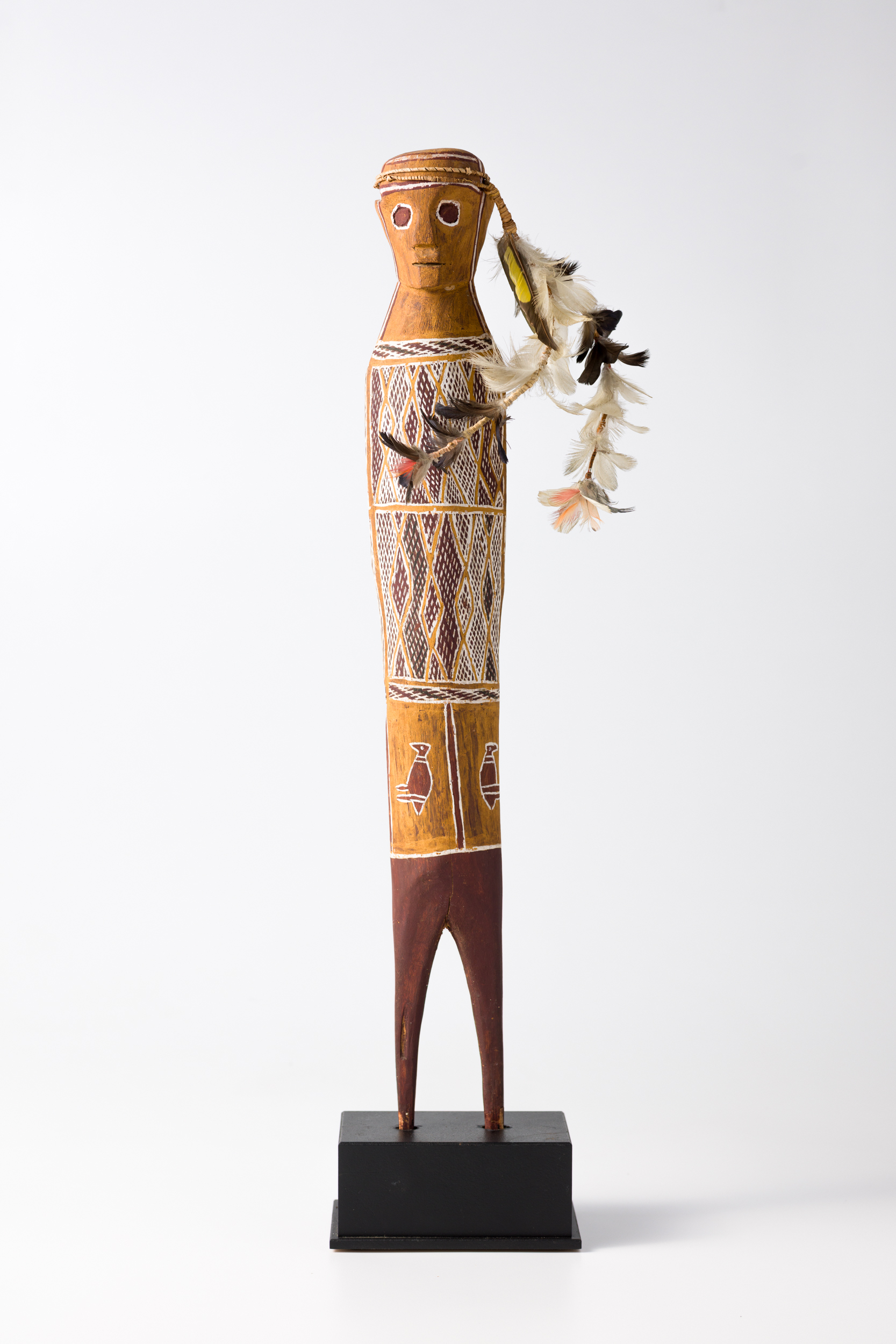
Muŋgarawuy Yunupiŋu, Untitled, n.d. natural earth pigments, carved wood, 60 x 16 cm.
Exhibition
Bark Masters,
11 July-21 August, 2026
D Lan Galleries, Sydney
Dr Louise Martin-Chew is a freelance art writer who contributes regularly to national magazines and books.
Images courtesy of D Lan Galleries, Sydney, Melbourne and New York.
The article was first published in Artist Profile Issue 75, 2026.
Edwards was born on Kaurna Yarta in 1998 and raised on Nauo Country in the small seaside community of Tulka, on the Lower Eyre Peninsula....

Under the auspices of Geelong Gallery’s director, Humphrey Clegg, and co-curated by Marianne Mathieu, former scientific director of the Musée Marmottan Monet, and Claire Durand-Ruel...
Nike Savvas: Purple Haze presents intimate screen prints and immersive large-scale installation and video work by Savvas from 2005–2026, each evocative of different places and...
Although physically he is of modest stature, Zofrea has devoted much of his life to grand projects that have been conceived and executed on a...
Through a multidisciplinary collaboration between Rotterdam-based curators, architect Paul Cournet of CLOUD and artist-designer Sabine Marcelis of Studio Sabine Marcelis, the exhibition explores the interplay...
Artificial intelligence will be used by young artists who started using it as kids on their phones. They will see it as a natural extension...

This year’s Biennale arrives under more complex circumstances than most. It is shaped by the profound loss of its curator, Koyo Kouoh (1967–2025), whose exhibition...
No artist creates in isolation. Every painting carries traces of the conversations, places and histories that shaped it, preserving within its surface a particular moment...
The weekend markets at Fairfield Showground have been one of Western Sydney’s great institutions for more than fifty years. Fresh fruit and vegetables, children’s clothes,...