REVIEW I Beaming through Cartier
Across artistic disciplines, light is one of the artist's most fundamental materials. In the National Gallery of Victoria's (NGV) Melbourne Winter Masterpieces: Cartier, light becomes more than a means of illumination; it is the exhibition's guiding curatorial device.
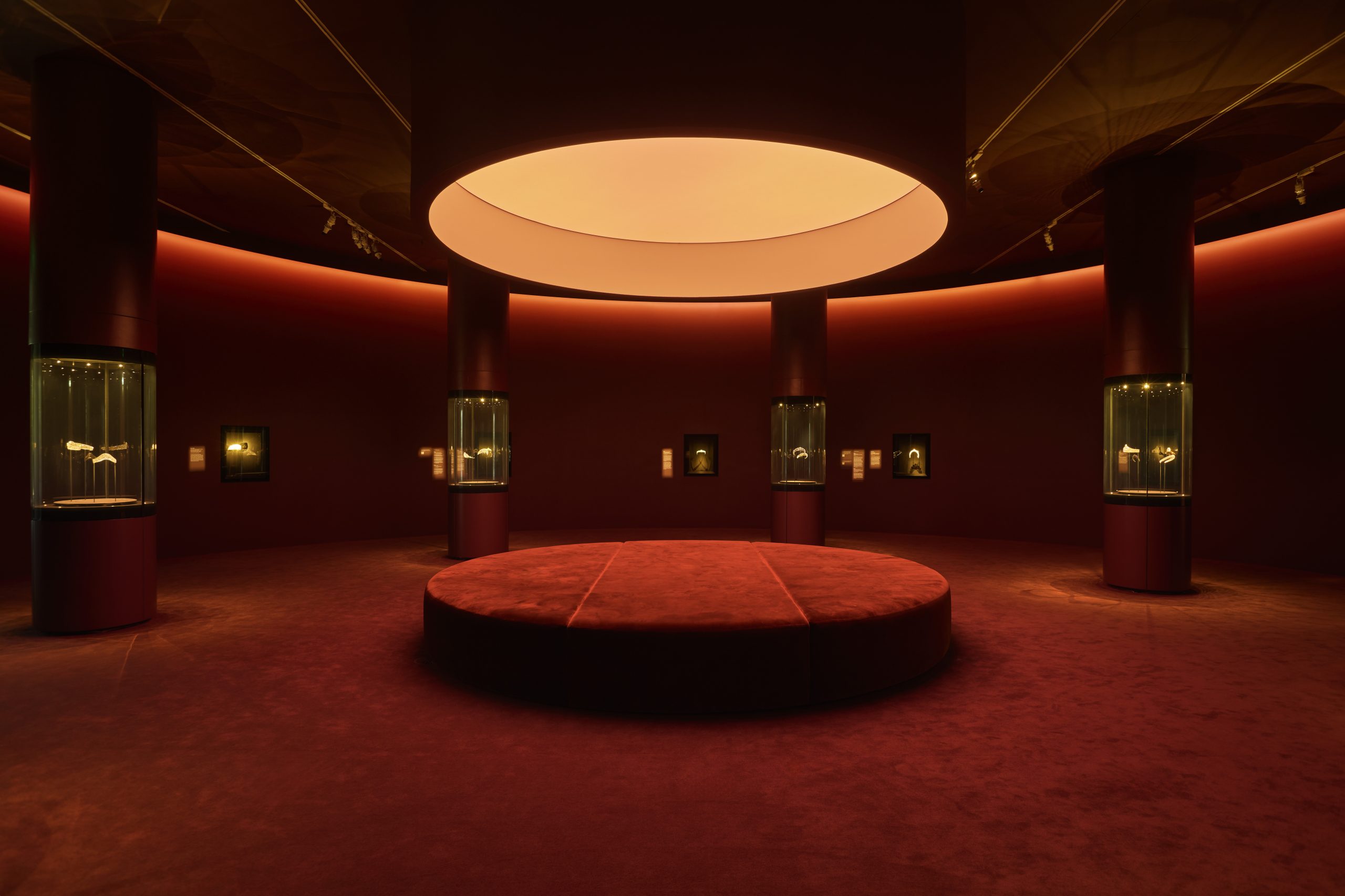
Through a multidisciplinary collaboration between Rotterdam-based curators, architect Paul Cournet of CLOUD and artist-designer Sabine Marcelis of Studio Sabine Marcelis, the exhibition explores the interplay of light, colour and material that has come to define Cartier’s distinctive aesthetic. Spanning the early twentieth century to the present day, the exhibition charts the evolution of the house from its global expansion under Louis (1875–1942), Pierre (1878–1964) and Jacques Cartier (1884–1941)—the grandsons and successors of Louis-François Cartier (1819–1904), who founded the Maison in 1847—to its present-day designs under the Richemont Group ownership. Melbourne Winter Masterpieces: Cartier presents nearly 400 jewels, precious objects and archival materials, tracing the evolution of one of the world’s most influential luxury houses while foregrounding its craftsmanship
Upon entering the exhibition, I was met by a twenty-seven-metre-long mirrored installation running along the walls of a narrow corridor; not a jewel insight. Instead, Facet, horizontal, 2026, by Marcelis, eases audiences into the exhibition, encouraging an appreciation of light, colour and gemstones before revealing extraordinary jewels, gems and precious objects. The installation refracts light in much the same way as a gemstone’s facets, splitting it to reveal all seven colours of the visible spectrum simultaneously. Facet, horizontal functions as an amuse-bouche, offering a first taste of the exhibition while cultivating an appreciation for the qualities that define Cartier’s creations. Marcelis teaches visitors how to look before revealing what to look at.
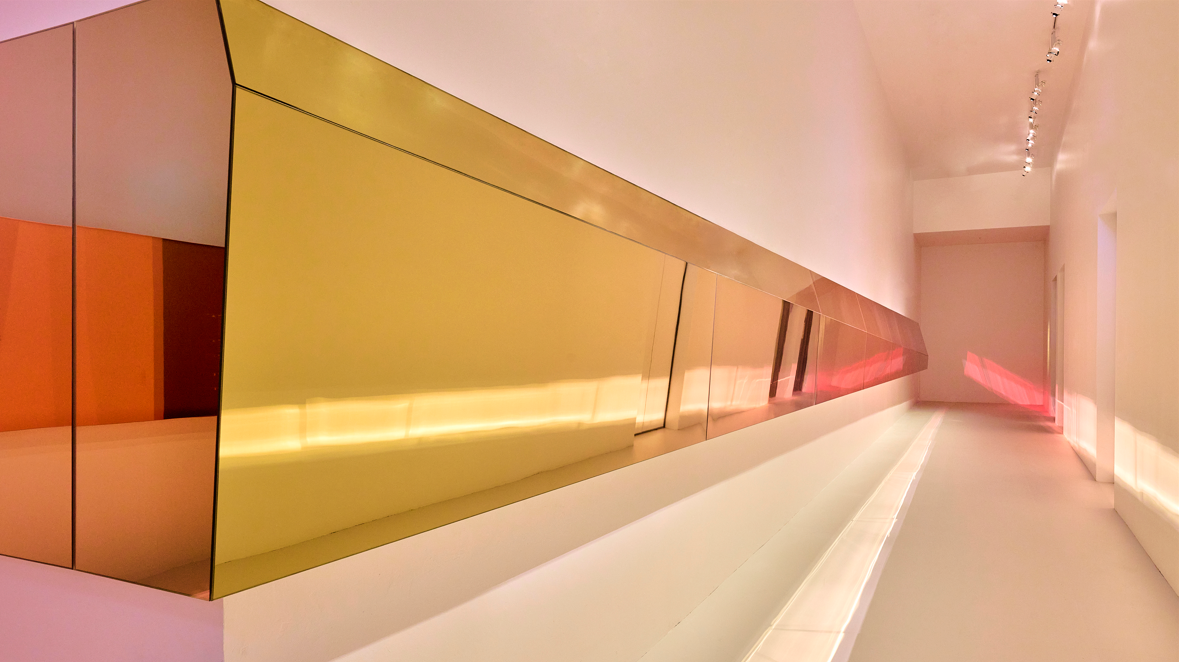
Installation view (detail): Sabine Marcelis, Facet, horizontal, 2026, laminated, mirrored glass with colour treatment, metal, Multiplex. CARTIER, 2026, NGV International, Melbourne. Photographed by Sean Fennessy.
The exhibition design demonstrates a collaborative curatorial approach that draws on multiple disciplines, including architecture, design, sound and art. Rather than following a strictly chronological narrative, each gallery is organised around a specific object, with the surrounding space shaped by its geometry, colour and formal qualities.
Aware of the exhibition’s curatorial emphasis on colour, I initially feared an overly experiential exhibition in which the display design would overshadow the objects themselves. My concerns stemmed from a previous NGV exhibition, Pierre Bonnard: Designed by India Mahdavi, 2023. While beautifully executed, I found the intersection of the post-impressionist painter’s oeuvre and the contemporary designer’s immersive scenography resulted in a reductive interpretation of Bonnard’s practice.
In Melbourne Winter Masterpieces: Cartier, however, Marcelis’s intervention achieves something different. Rather than competing with the collection, the exhibition design complements, highlights and celebrates the Maison’s creations. The result is a curation that deepens the viewer’s appreciation of the visual qualities, craftsmanship and materiality of the pieces on display.
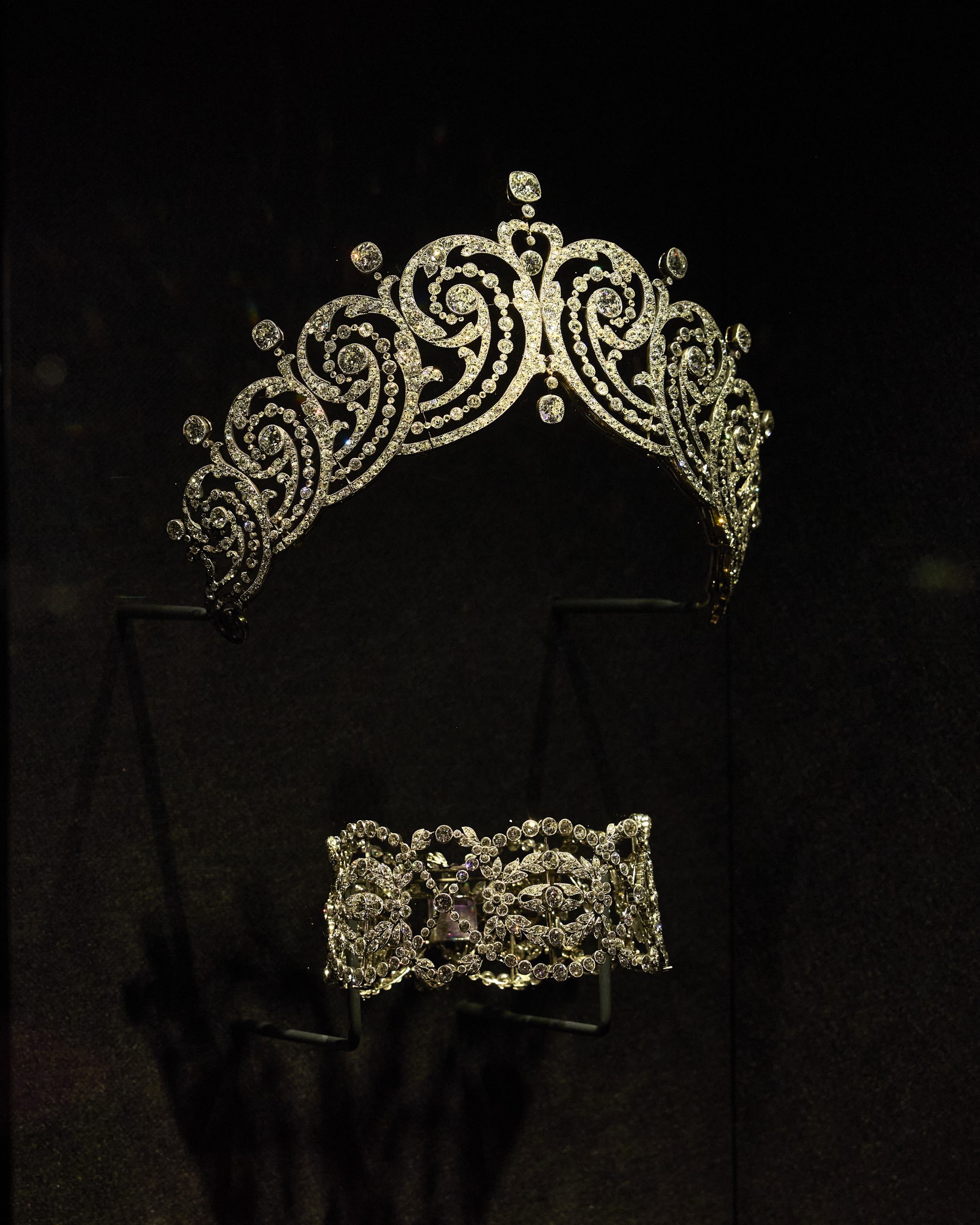
Installation view (detail): top, Scroll Tiara, 1902, diamonds, silver, gold, bottom, Choker Necklace, 1906, diamonds, platinum. CARTIER, 2026, NGV International, Melbourne. Photographed by Sean Fennessy.
These objects, though often modest in scale, command attention, capturing the eye and filling the space around them. The exhibition unfolds across eight distinct galleries. Firstly, “Maison Cartier” which traces the history and origins of the luxury house. From this foundation, visitors move through “A World of Inspiration,” “Cartier Style Room,” “An Obsession with Stones,” “Cartier’s Panther: Evolution of a Motif,” “Cartier and Film,” “A Philosophy of Design: Constant Reinvention” and finally “Tiaras: Pinnacle of the Jeweller’s Art.” Each gallery is anchored by a different gemstone, with its interior architecture reflecting the stone’s unique qualities. Emeralds, jade, sapphires, lapis lazuli and turquoise sparkle majestically within carefully considered displays.
Cartier’s mastery lies not only in design but in its ability to work with materials in ways that amplify and celebrate the natural beauty of the stones themselves. Through a sophisticated exploration of colour theory and gemstone families, the exhibition encourages visitors to appreciate not only the jewellery but also the remarkable qualities of the gems.
Walking through the exhibition was a regal experience. I was immersed in a world of delicacy, luxury and excess. The carefully commissioned soundtrack, composed by Melbourne-based composers, Ai Yamamoto and Erkki Veltheim, heightened this sense of immersion. I felt momentarily invited into a world once inhabited by kings, queens, aristocrats and cultural icons from across the globe. Yet, ironically, it is a world in which jewellery functions as a marker of status and privilege, reserved for an elite few. Precisely because it remains so distant from everyday experience, it becomes—for me, and I imagine for many visitors—not a world to which we belong, but one of fantasy.
The exhibition emphasises the Maison’s international outlook. Influences from traditions of ancient Egypt, India, Japan, China, Iran and the Islamic world appear throughout the collection. Cartier’s designs emerge as products of cultural exchange, adapting and reinterpreting motifs, forms and materials from around the world.
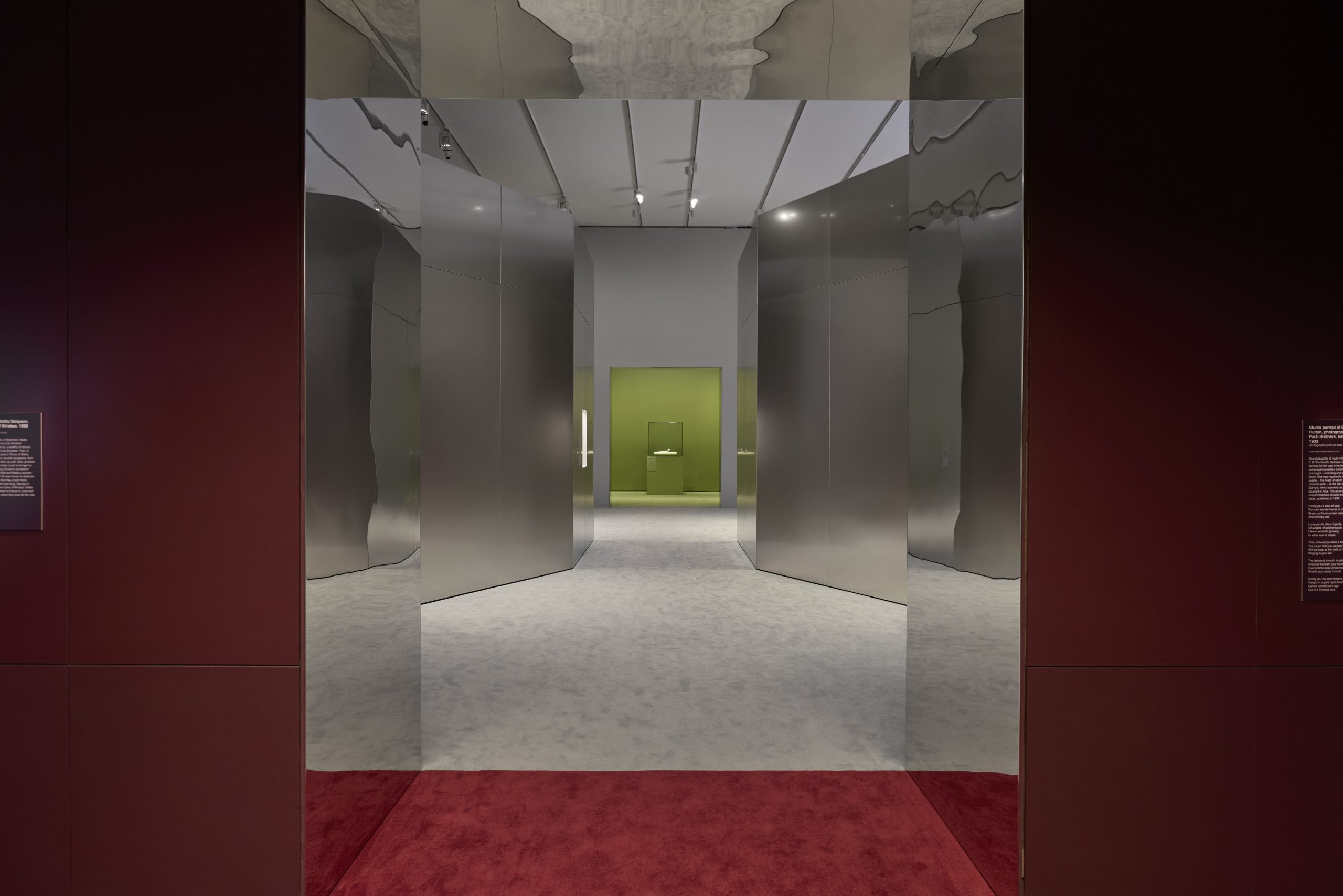
Installation view (detail): CARTIER, 2026, NGV International, Melbourne. Photographed by Lillie Thompson.
Yet while the exhibition excels in presenting Cartier’s global influences, it leaves another aspect of that global story underexplored. Although one wall label, in “An Obsession with Stones,” acknowledges that the extraction and trade of gemstones have historically been entangled with colonial practices, exploitation and questions of transparency, this critical context remains largely confined to a mention. Throughout the exhibition, global exchange is overwhelmingly framed as a story of artistic inspiration, technical innovation and cross-cultural dialogue, while the unequal political and economic systems that enabled the circulation of gemstones, luxury materials and wealth receive comparatively little attention.
Ethical contemporary museum practices require institutions to confront colonial histories, not simply acknowledge them in passing. Here, the brief reference to colonial extraction feels superficial rather than meaningfully woven into the curatorial narrative. As a result, I left with a sophisticated understanding of Cartier’s craftsmanship and global aesthetic influences, but only a limited awareness of the historical conditions that made many of those exchanges possible.
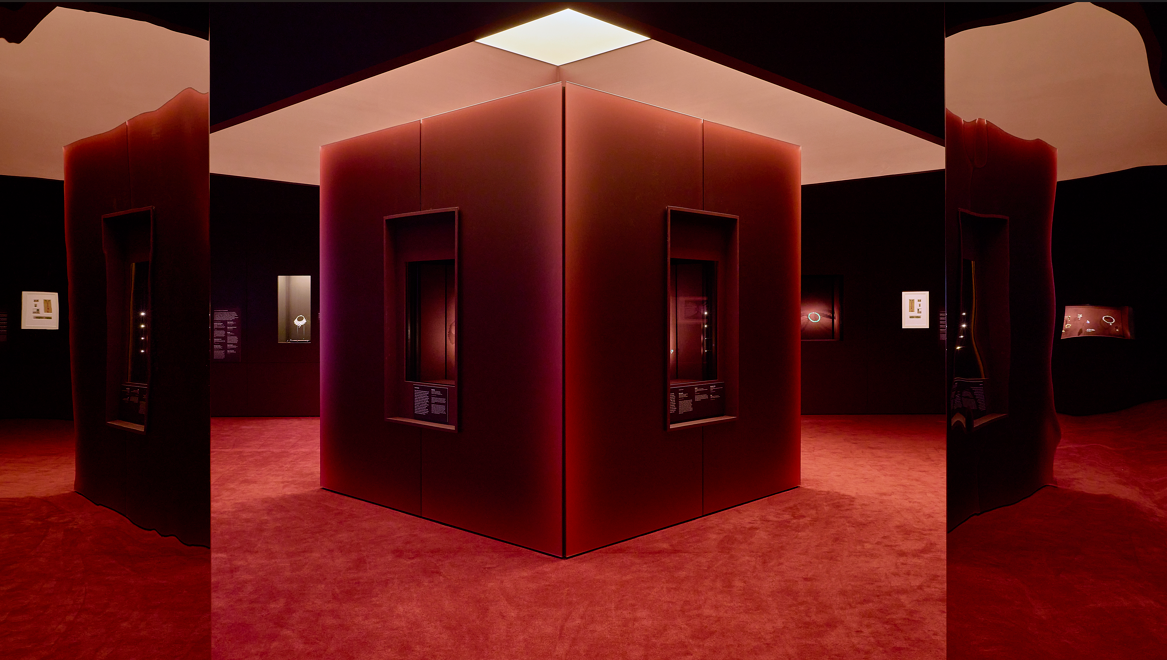
Installation view (detail): CARTIER, 2026, NGV International, Melbourne. Photographed by Sean Fennessy.
At the conclusion of the exhibition, I was met by another of Marcelis’s installations, Facet, vertical, 2026, once again framing the show through light. The symmetry of these works at the beginning and end of the exhibition brought me back to Facet, horizontal, transforming it from a simple introduction into a curatorial device that bookended the entire experience. Moving through the eight galleries, I felt almost as though I had followed a beam of light as it passed through Cartier’s creations, refracted by gemstones, precious metals and colour, before emerging on the other side.
The installation provided a gentle transition out of the exhibition, allowing me to carry a renewed awareness of light and its relationship to materiality. Marcelis’s interventions did not merely frame the collection; they enriched the way it was experienced, creating a sense of immersion that extended from the first gallery to the last.
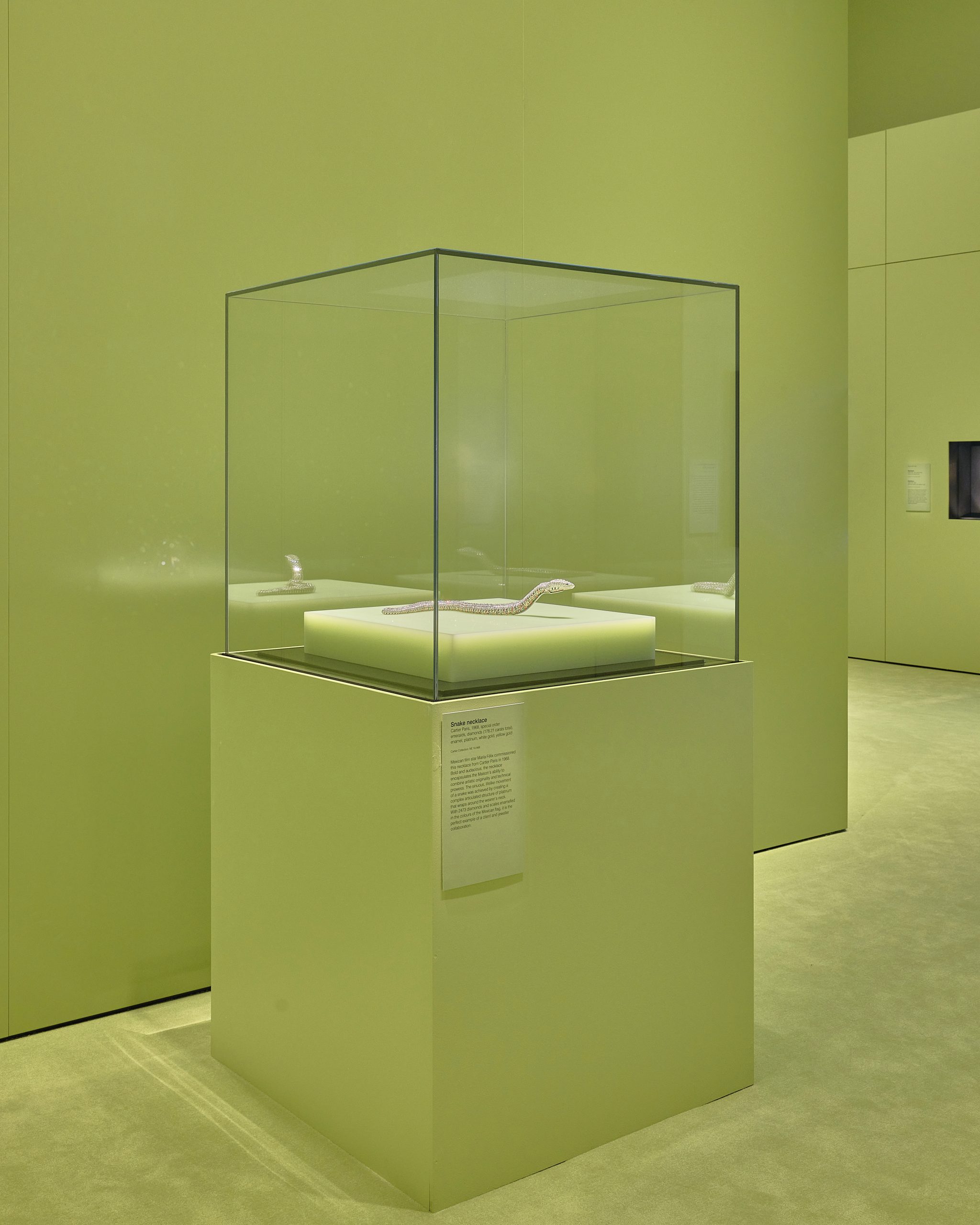
Installation view (detail): Snake Necklace, 1968, emeralds, diamonds (178.21 carats total), enamel, platinum, white gold, yellow gold. CARTIER, 2026, NGV International, Melbourne. Photographed by Sean Fennessy.
Exhibition
Melbourne Winter Masterpieces: Cartier
12 June – 4 October 2026
National Gallery of Victoria; Melbourne
Amélie Blanc is an arts writer based in Naarm, Melbourne.
Images courtesy of National Gallery of Victoria, Melbourne; CARTIER, Paris; Victoria & Albert Museum, London.
The article was first published in Artist Profile Issue 76, 2026.
Nike Savvas: Purple Haze presents intimate screen prints and immersive large-scale installation and video work by Savvas from 2005–2026, each evocative of different places and...
Although physically he is of modest stature, Zofrea has devoted much of his life to grand projects that have been conceived and executed on a...

Artificial intelligence will be used by young artists who started using it as kids on their phones. They will see it as a natural extension...

This year’s Biennale arrives under more complex circumstances than most. It is shaped by the profound loss of its curator, Koyo Kouoh (1967–2025), whose exhibition...

No artist creates in isolation. Every painting carries traces of the conversations, places and histories that shaped it, preserving within its surface a particular moment...
The weekend markets at Fairfield Showground have been one of Western Sydney’s great institutions for more than fifty years. Fresh fruit and vegetables, children’s clothes,...

In recent times, Yorgos Lanthimos has shifted toward photography, noting in a Guardian interview, 2026, that he needs respite, saying, “it might be a couple...

In Australia, political cartoons were altered by several events during the 1960s: the arrival of Les Tanner’s (1927‒2001) instinctual wit at The Bulletin, Bruce Petty’s...
Recognition of the importance of early bark paintings and their link to the world’s oldest continuing culture, is what makes them both highly sought and...