REVIEW I If You’re Going to Be a Smart-Arse, You Bloody Better Be Right
Caricature in political satire was first used in Italy during the early seventeenth century and arrived in England courtesy of well-to-do young men rounding off their education with a Grand Tour of Europe. It was George Townshend, 1st Marquess Townshend (1724‒1807), who was one of the earliest to use political caricature in Britain. His exaggeration of physical features was employed to comic effect, and his cartoons were featured in the London Magazine and Town and Country Magazine. By the eighteenth century the political cartoon had become an accepted form of social and political observation.
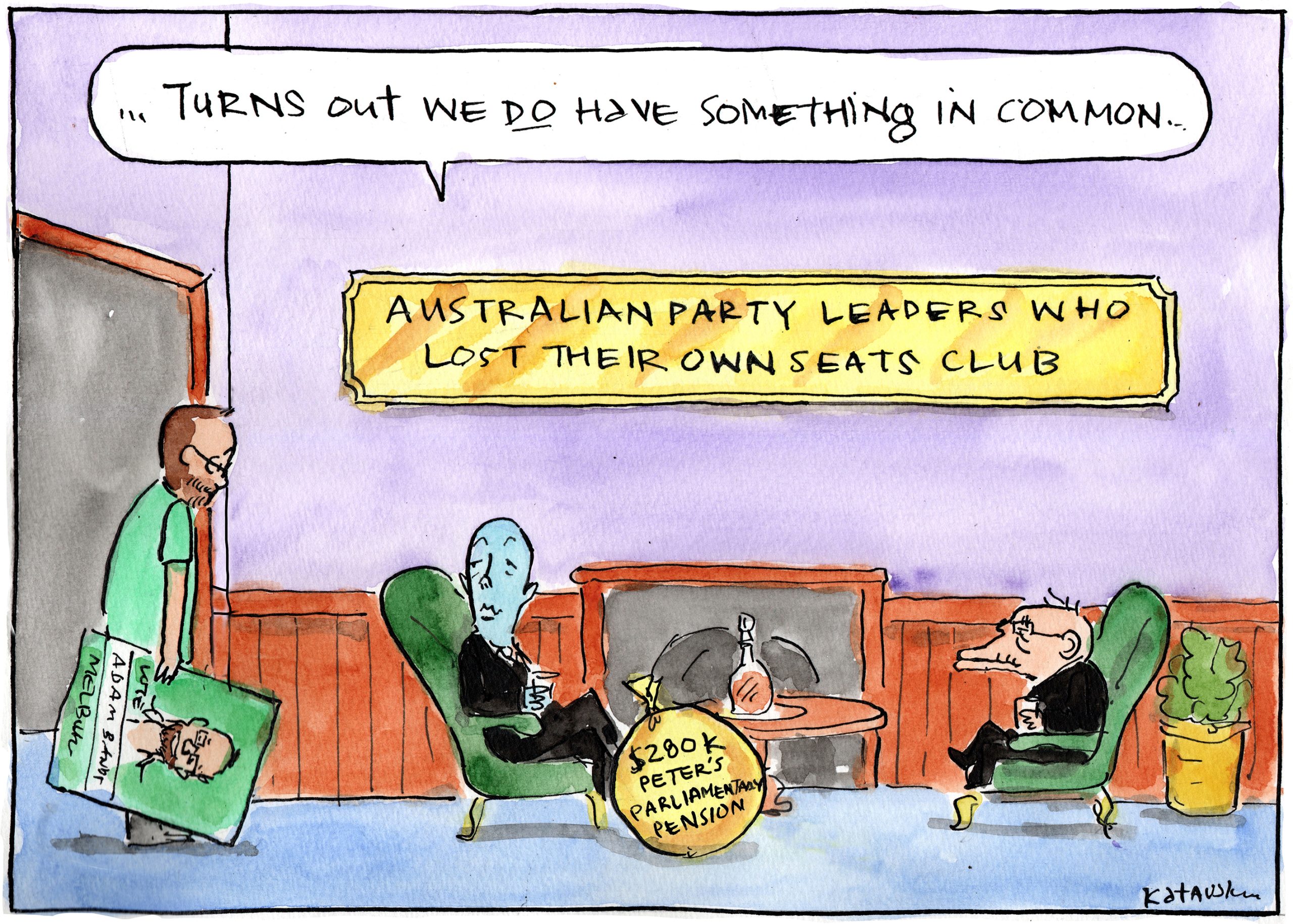
In Australia, political cartoons were altered by several events during the 1960s: the arrival of Les Tanner’s (1927‒2001) instinctual wit at The Bulletin, Bruce Petty’s (1927‒2023) “doodle-bombs” at The Australian and a group of anti-establishment cartoonists at The Age. This tradition of political satire continues and is honoured in the current exhibition, Behind the Lines 2025: Are We Rolling? with a selection of cartoons from across the Australian political spectrum.
Now in its thirtieth year, this annual exhibition of political cartoons features 130 works from forty-five of Australia’s brightest and wittiest cartoonists. Originally titled Bringing the House Down, the exhibition began in 1996 as a competition for illustrators and cartoonists. It has been held at the Museum of Australian Democracy (MoAD) in Old Parliament House (OPH), Canberra, since MoAD opened in 2010. This year’s theme takes its cue from moviemaking and the news stories that fascinated and horrified us, as well as made us laugh, even if only in disbelief.
Political journalist Barrie Cassidy, chair of the Board of OPH, says the exhibition “has become a cultural landmark, bringing together political commentary, humour and art and where Australians unpack the year with razor-sharp perspicacity,” and that “[it] underscores the enduring power of satire and creativity in our democracy.”
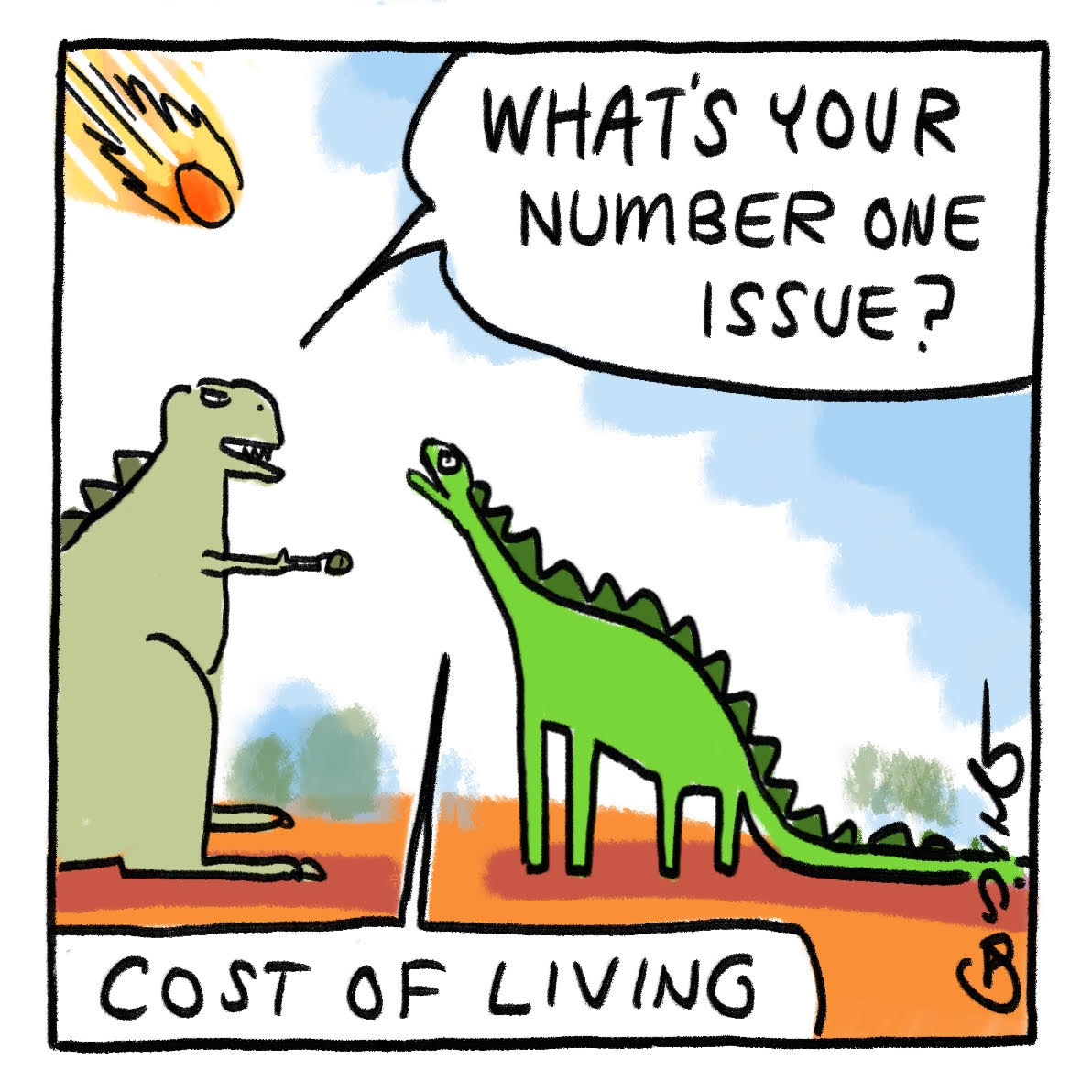
Matt Golding, The Cost-of-Not-Living Crisis, 2025, digital image.
This year the judging panel, including exhibiting cartoonist and president of the Australian Cartoonists Association, Cathy Wilcox, had the unenviable task of shortlisting works from an eventful year. Matt Golding was named the 2025 Political Cartoonist of the Year. It is the second time he has received the award, adding to his Walkley and multiple Stanley Awards. Golding knew from the age of five that he wanted to be a cartoonist. He views it as a method to make sense of society and politics generally. “It’s just a great way to communicate an idea and also just deal with the world,” he says. “There’s a power in the medium in the way it can communicate really complex ideas.” Golding’s “The Cost-of-Not-Living Crises” in the Nine papers, 30 March 2025, has two dinosaurs discussing the cost-of-living crises while a meteor hurtles towards them. It doesn’t have to say anything more. Perspective depends on where you are standing.
David Rowe’s work makes the most of cultural references. “The Beach,” Australian Financial Review, 29 January 2025, gives a nod to Charles Meere’s painting Australian Beach Pattern, 1940, as it identifies notable Australian and international political players in 2025. In “Anthony by Lamplight,” AFR, 1 April 2025, Rowe has Albanese imitating Gene Kelly singing in the rain, revealing “I’m happy again” at the start of the election campaign. It could almost have been visionary given his astonishing landslide victory later in the year.
“Unsolicited Text” by Oslo Davis, The Saturday Paper, 3 May 2025, has a young couple lounging around in front of the television with their sleeping dog, one of them saying to the other, “I’m still undecided. What I need is an unsolicited text message from an insane far-right billionaire telling me how to vote.” The Trumpet of Patriots party, backed by billionaire Clive Palmer, had issued unsolicited text messages to voters across Australia during the 2025 election campaign, greatly irritating recipients. Trumpet of Patriots went on to win not a single seat in the election.
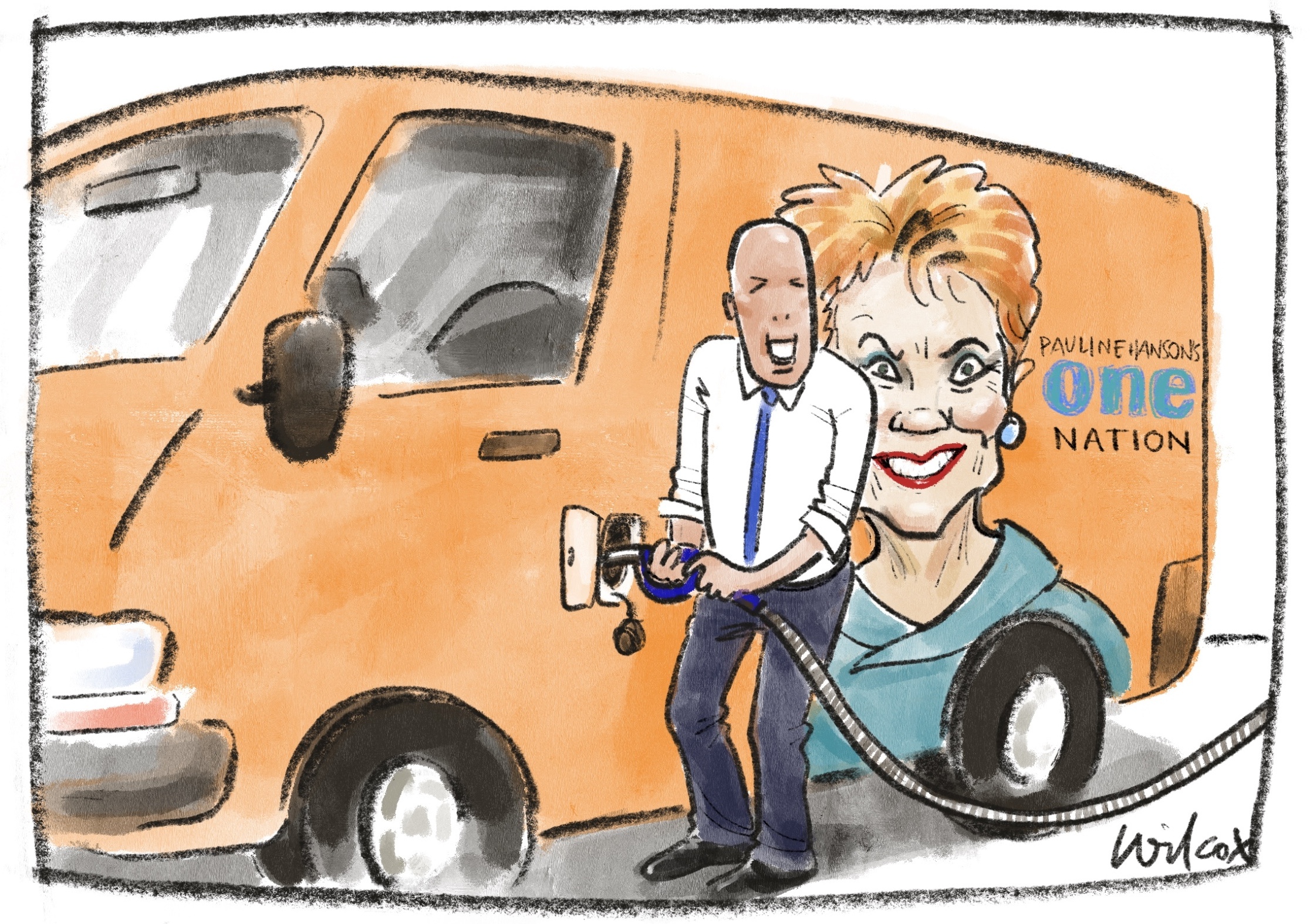
Cathy Wilcox, Pump it UP, 2025, digital image.
Fiona Katauskas’ “World of Hurt” The Guardian, 24 December 2024, puts a mature gender twist on the Earth with her take on a distressed, menopausal planet explaining its symptoms to a doctor. Earth has been experiencing hot flushes in its conflict zones, and its democracies are aching all over the place.
The adage “out of the mouths of babes” gets an update at a twentieth-century technology museum with Megan Herbert’s “Antisocial Media,” Substack, 5 March 2025. A group of children on an excursion inspect analogue telephones used to connect people over a copper wire. One child can’t see how this device could possibly function satisfactorily and asks, “So . . . if it only made phone calls, which device did they use to bitterly divide people along ideological lines?”
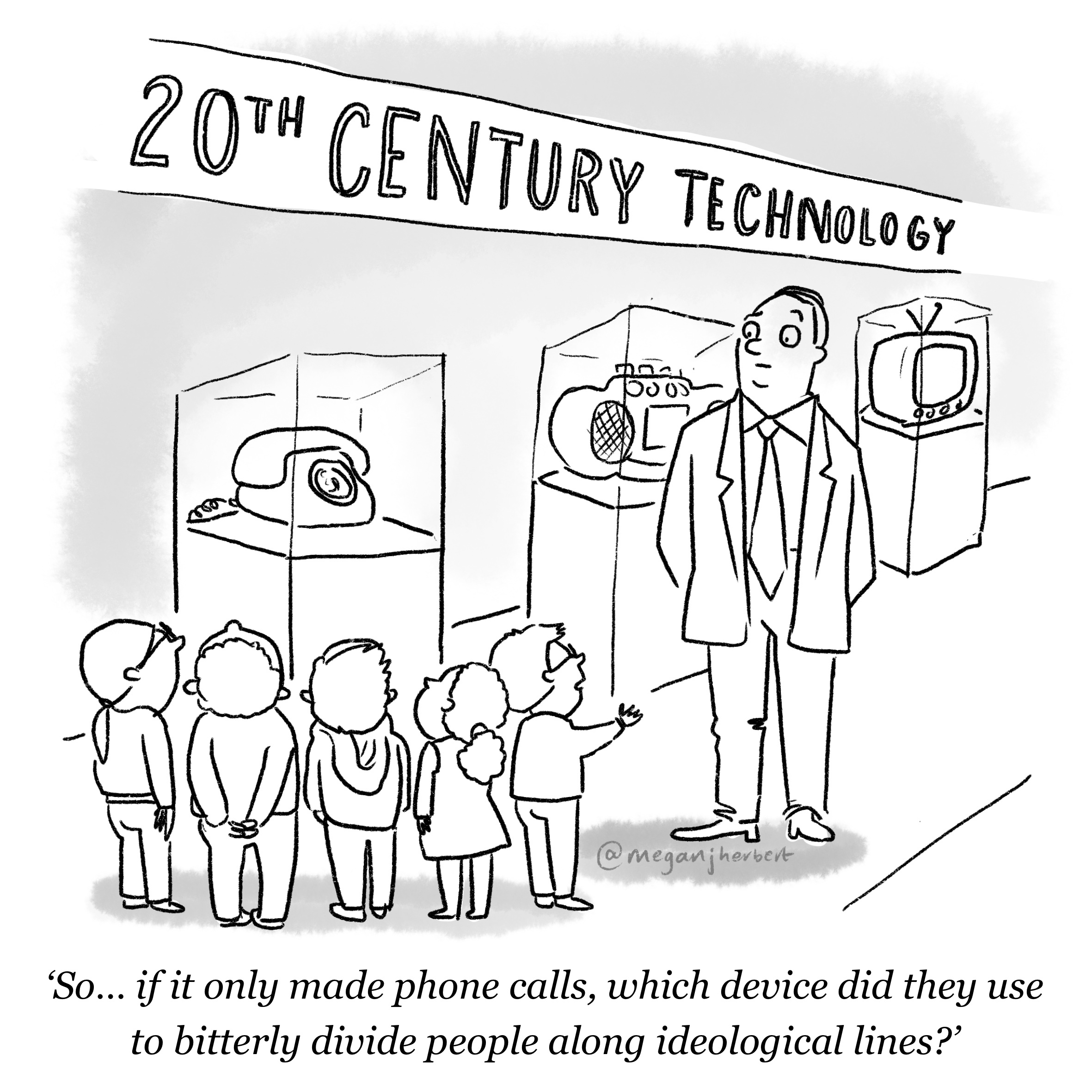
Megan Herbert, Antisocial Media, 2025, digital image.
Glen Le Lievre continues his filmic references with the Monty Python-inspired “The Holy Grail,” AFR, 18 August 2025. In the cartoon Albanese, dressed as King Arthur, rides along on his imaginary horse with his servant—looking a lot like our Treasurer—trotting behind, clip-clopping away with a pair of coconut shells. It was a dig at the government hosting thirty experts and community leaders at an economic roundtable to develop an economic reform agenda.
“The riviera of the Middle East” was Donald Trump’s vision for Gaza. David Pope’s “The Agony of Gaza,” The Canberra Times, 6 February 2025, features a real-estate billboard selling waterfront development with a truck behind it full of Gaza rubble. Trump is “flying” up on the “bow” railing akin to Kate Winslet in Titanic, 1997, with Netanyahu standing behind steadying him.
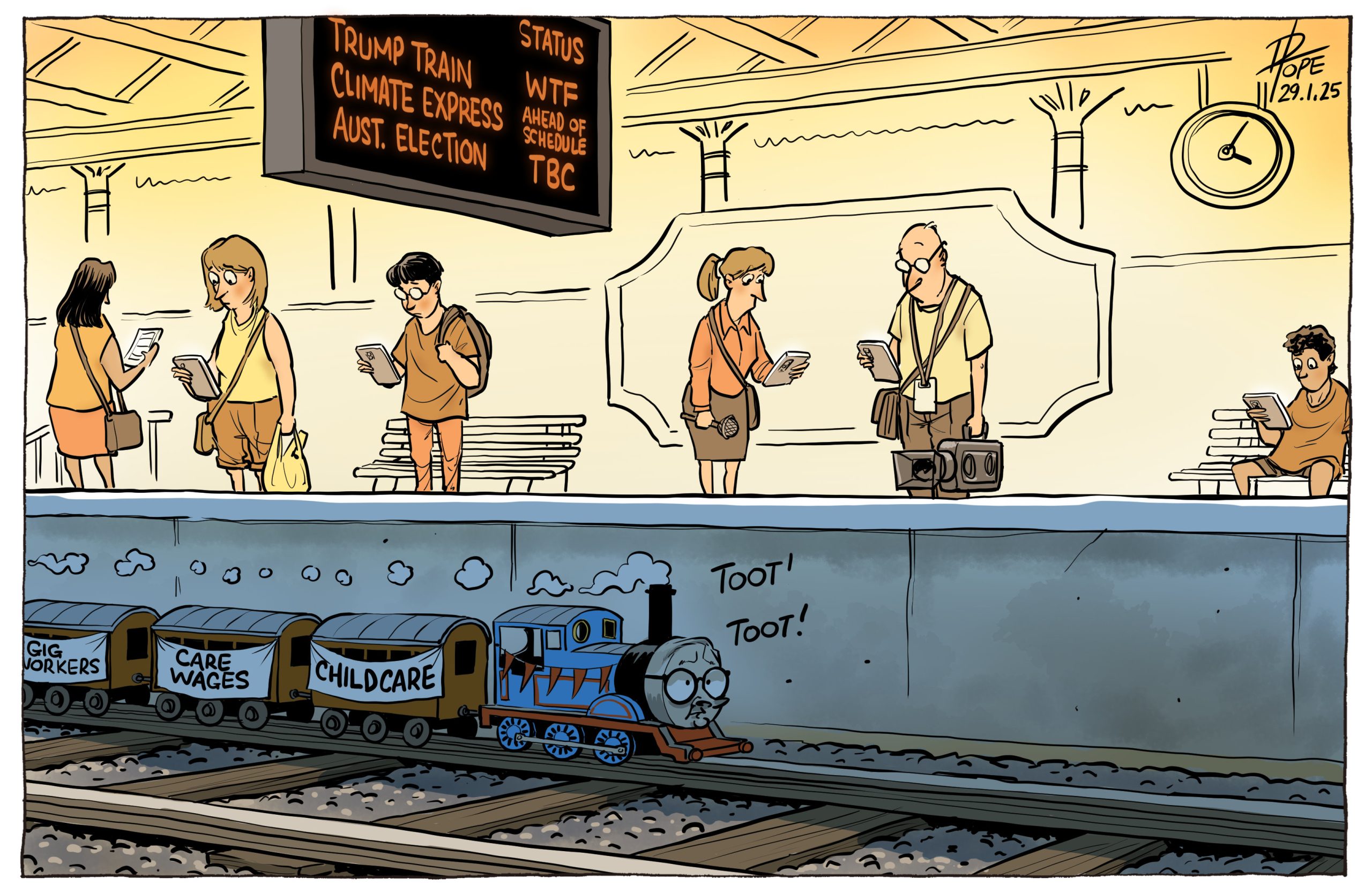
David Pope, Australian Platform, 2025, digital image.
Missing is Jon Kudelka (1972–2026) who died at the age of fifty-three in February 2026 after being diagnosed with inoperable cancer in 2024. His searing political insight and pithy wit were underplayed by his innocently drawn characters, which delivered the bull’s eye message. As Kudelka said, “A cartoonist in a newspaper is like a monkey with an automatic rifle. You need to be bloody careful where you point it.” He was very aware a cartoonist could do a lot of damage with ill-conceived ideas and that doing it well meant making cartooning appear easier to do than it looked. He did rue his crafty little masterpieces never brought down a government even though he thought they warranted it.
Historically, humour has been used to ease tensions, make connections, and communicate ideas as well as just offer entertainment. Cartoons can take on serious, complex issues and present them in a succinct and comprehensible way. I am reminded again of Kudelka’s words regarding the first rule of cartooning: “don’t be boring.” The artists in this exhibition could never be accused of that.
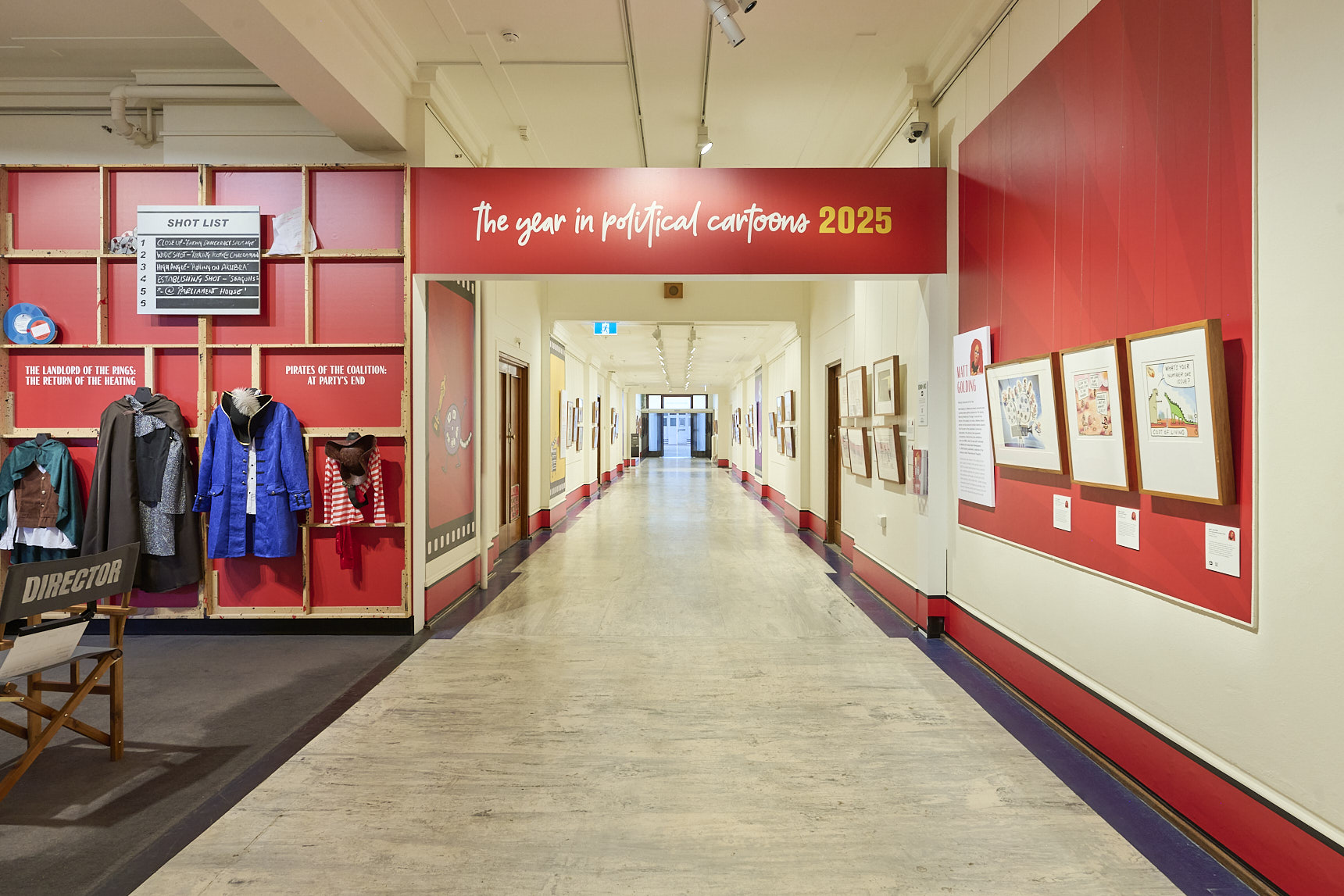
Installation view of Behind the Lines 2025: Are We Rolling?, 2026, Museum of Australian Democracy at Old Parliament House, Canberra. Photographed by Pew Pew Studio.
Exhibition
Behind the Lines 2025: Are We Rolling
4 December 2025-30 November 2026
Museum of Australian Democracy at Old Parliament House, Canberra
H.R. Hyatt-Johnston is an artist and writer, based in Sydney.
Images courtesy of the cartoonists; Museum of Australian Democracy at Old Parliament House, Canberra.
The article was first published in Artist Profile Issue 75, 2026.
Edwards was born on Kaurna Yarta in 1998 and raised on Nauo Country in the small seaside community of Tulka, on the Lower Eyre Peninsula....

Under the auspices of Geelong Gallery’s director, Humphrey Clegg, and co-curated by Marianne Mathieu, former scientific director of the Musée Marmottan Monet, and Claire Durand-Ruel...
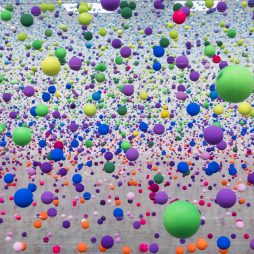
Nike Savvas: Purple Haze presents intimate screen prints and immersive large-scale installation and video work by Savvas from 2005–2026, each evocative of different places and...
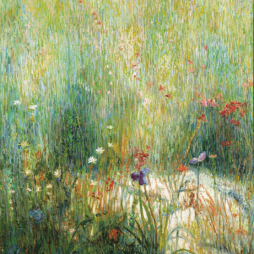
Although physically he is of modest stature, Zofrea has devoted much of his life to grand projects that have been conceived and executed on a...
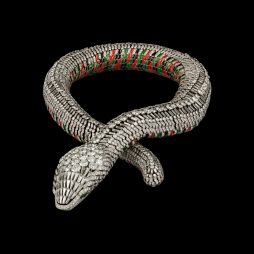
Through a multidisciplinary collaboration between Rotterdam-based curators, architect Paul Cournet of CLOUD and artist-designer Sabine Marcelis of Studio Sabine Marcelis, the exhibition explores the interplay...
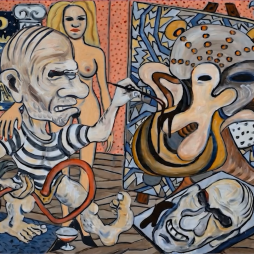
Artificial intelligence will be used by young artists who started using it as kids on their phones. They will see it as a natural extension...

This year’s Biennale arrives under more complex circumstances than most. It is shaped by the profound loss of its curator, Koyo Kouoh (1967–2025), whose exhibition...
No artist creates in isolation. Every painting carries traces of the conversations, places and histories that shaped it, preserving within its surface a particular moment...
The weekend markets at Fairfield Showground have been one of Western Sydney’s great institutions for more than fifty years. Fresh fruit and vegetables, children’s clothes,...