REVIEW | Coming together, coming apart: Adelaide Biennial of Australian Art
A speculative exploration of pressure and transformation in contemporary Australian art.
The Art Gallery of South Australia’s (AGSA) Adelaide Biennial of Australian Art has seen real competition over the past two decades, as other institutions have intermittently committed to recurring surveys of contemporary Australian art. The National, exhibited across the Art Gallery of New South Wales, Museum of Contemporary Art, Carriageworks and Campbelltown Arts Centre, and Queensland Art Gallery of Modern Art’s Contemporary Australia series, once carried a scale and ambition that seemed to sharpen the awareness of AGSA’s ageing spaces. Yet both initiatives have quietly been shelved in recent years as priorities have shifted. Major state institutions increasingly lean toward state-facing surveys, while the biggest investments and promotions gravitate toward international blockbusters. Against that drift, AGSA’s commitments to a national perspective through the Adelaide Biennial, presented since 1990, and the $100,000 Ramsay Art Prize for Australian artists under forty, remain generous and consequential.
In that context, biennial curator Ellie Buttrose’s aptly named iteration Yield Strength (an engineering term for the stress level at which a material permanently deforms) draws attention not only to the forces that bend and break minds, bodies and things, but to institutional reality and its social consequences.
Installation view (detail) of Isadora Vaughan, less than one percent of grasslands remain, dimensions variable. 2026 Adelaide Biennial of Australian Art: Yield Strength, Samstag Museum of Art, Adelaide. Photographed by Saul Steed.
Where some recent editions have pushed spectacle through volume, shock and sparkle under a catch-all title, Yield Strength carries a more complex character: elegantly paced, thoughtfully sequenced, yet still full of challenges. It revisits something of Christopher Chapman’s speculative grunge from 1996, the tight framing of Linda Michael’s 21st Century Modern, 2006, and perhaps most notably the honest, concerted attention given to the anxiety, fragility and political tension that was thoroughly and thoughtfully explored in Felicity Fenner’s Handle with Care, 2008. On one hand, Buttrose’s curatorial approach feels intuitive: artists gathered through overlapping concerns and allowed to unfold in their own ways rather than drafted to illustrate a single thesis. On the other hand, the show reads as strongly authored, becoming a series of continuities rather than isolated statements vying for attention.
With twenty-four artists exhibiting across three spaces, the most successful sections are those where this tension between the individual artists and the curatorial framing is held; where relationships between works generate friction and foreshadow subtle concepts that might otherwise go unnoticed. In AGSA’s basement level, which has historically housed the majority of each biennial and continues to in this iteration, Joel Sherwood Spring’s Diggermode 2: Cloud Ceding, 2025, is a key example. In the catalogue, Adam Ford frames the work as tracing a “genealogy of control” from territorial settlement to global cloud computing, showing how militarised techno-capitalist infrastructures sustain the occupation of unceded Indigenous lands. Colonisation, it argues, is now mediated through “virtual distance and digital abstraction.” Sherwood Spring traces that abstraction back into matter: around the filmic centre of the installation, he assembles objects of measurement and enclosure—a surveying chain, estate fencing and a cloud-seeding flare rack, making the cloud feel like built infrastructure rather than metaphor.
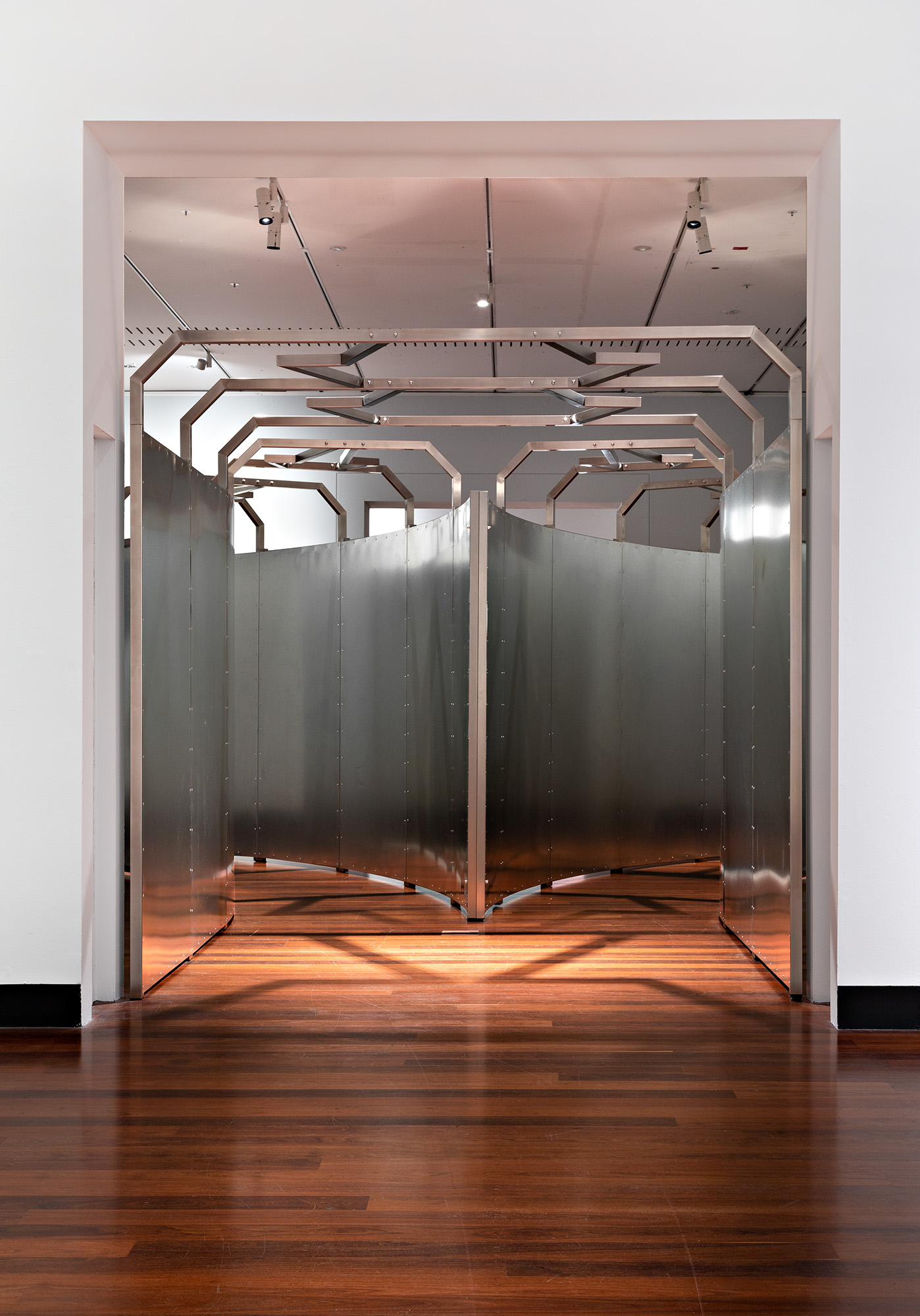
Installation view (detail) of Jennifer Matthews, Yard, dimensions variable. 2026 Adelaide Biennial of Australian Art: Yield Strength, Art Gallery of South Australia, Adelaide. Photographed by Saul Steed.
Coming straight after Cloud Ceding, Jennifer Mathews’s Yard, 2025, gains a sharpened double register. A large stainless-steel livestock barrier, as used to funnel stock into different areas, subjects the audience to an optimised logic of movement. On one level, the reference is clear: animal handling, containment, control. But after Sherwood Spring’s work, Mathews’s clean steel starts to read as a civic diagram. Yard becomes a perpetual sorting mechanism, a contemporary aesthetic that keeps audiences moving, choosing, but restricted. The work becomes a metaphor for the broader choreography of bodies into categories, lanes and permissions; the social “yards” of policy, risk and governance.
Upstairs in AGSA, the biennial’s attention to labour and its psychic aftermath is equally sharp, particularly in the pairing of Emmaline Zanelli and Erika Scott. Zanelli’s video Pocket Money, 2025, maps the lives of a handful of young people and their first jobs. Coloured by isolation and exploitation, exhaustion and thin compensations, it cycles through repetitive labour—mowing lawns, washing windows, operating a supermarket checkout—until routine becomes legible as constraint. The consumption financed by their labour appears less as vanity than as oxygen: toys, games, videos, makeup and clothes sometimes accumulate in excess, as if it were the only available relief.
Situated adjacent, Scott’s Necrorealist Sunscreen, 2026, offers a different register of aftermath: a tangle of rainwater tanks, office chairs and other detritus swept together as if by a flood, now providing a habitat for kitsch figurines. The pairing is quietly brutal. If Zanelli shows work as the repetitive machinery of survival, Scott shows the infrastructure that survives our efforts: furniture, storage, systems—half domestic, half bureaucratic—recomposed into a comedically grotesque ecology. The room flickers between endurance and ruin—between the loop that keeps you going and the pile that remains when it stops.
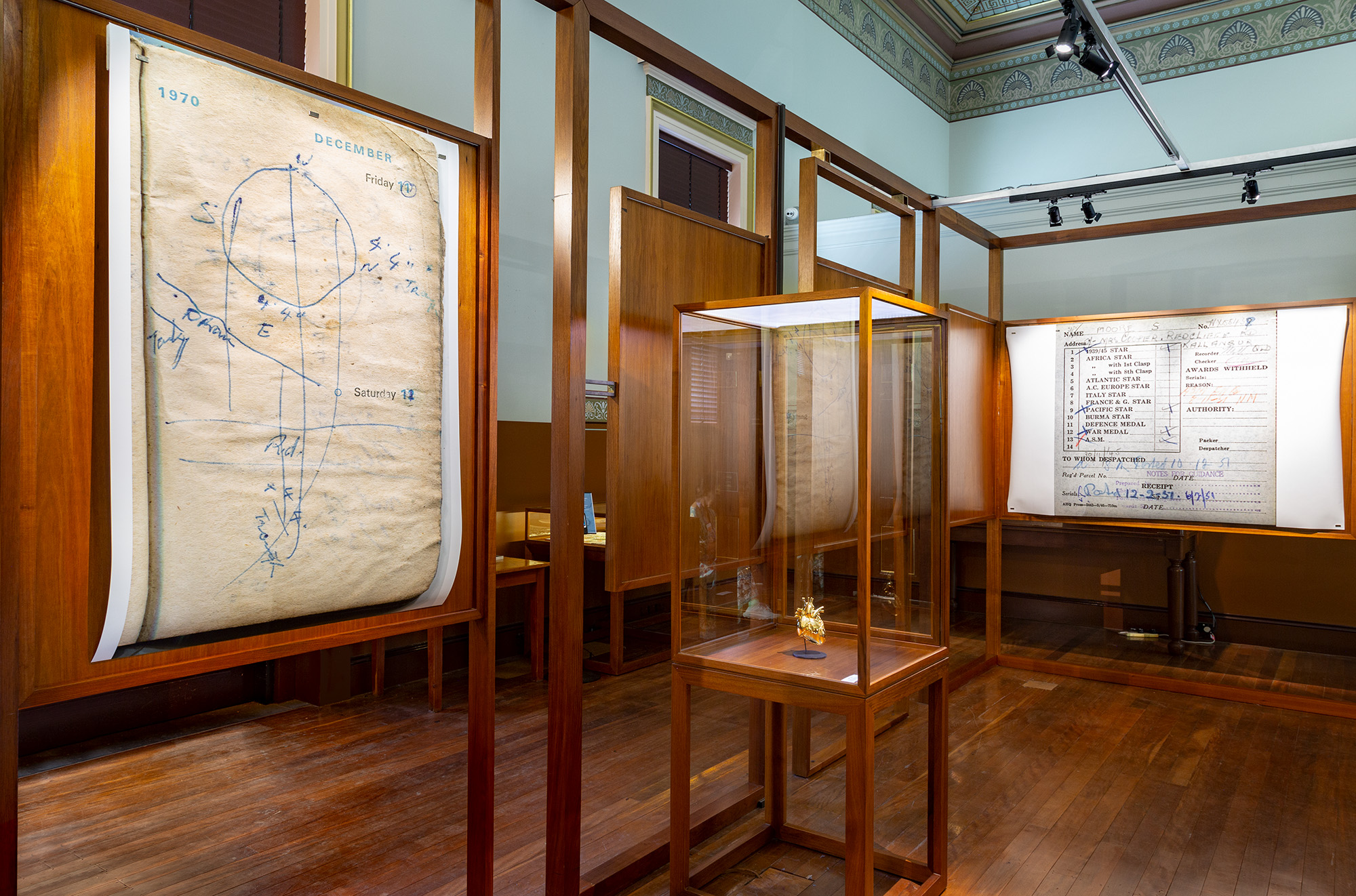
Installation view (detail) of Archie Moore, Remnants Of My Father, dimensions variable. 2026 Adelaide Biennial of Australian Art: Yield Strength, Museum of Economic Botany, Adelaide. Photographed by Saul Steed.
Archie Moore’s Remnants of My Father, 2025, demonstrates how a concise family archive can carry the arc and tensions of life, from the sustaining dream of finding gold to the brutal bodily decline with age, stress, wear and disease. Presented in the Museum of Economic Botany in Adelaide Botanic Garden, the installation adopts the authority of the museum vitrine, but its relics refuse comfort. A 3D-printed and gold-plated anatomical heart titled Heart of Gold, 2025, glints with value yet appears so technological and so literal as to fray the sentiment. Nearby sits Fool’s Gold, 2025, a pyrite specimen, the glittering decoy that gives miners false hope. Above, enlarged documentary images and texts escalate the story into institutional seriousness—newspaper advertisements for his father Stanley’s “Boring & Excavation” business, clinical pathology notes and administrative records; a chorus of systems that locate value not in beauty but in records. Moore’s achievement is not simply to fashion a portrait, but to show how the promise of a dream can sustain us through harsh reality; while hinting at the harsher reality that so many dreams do not materialise.
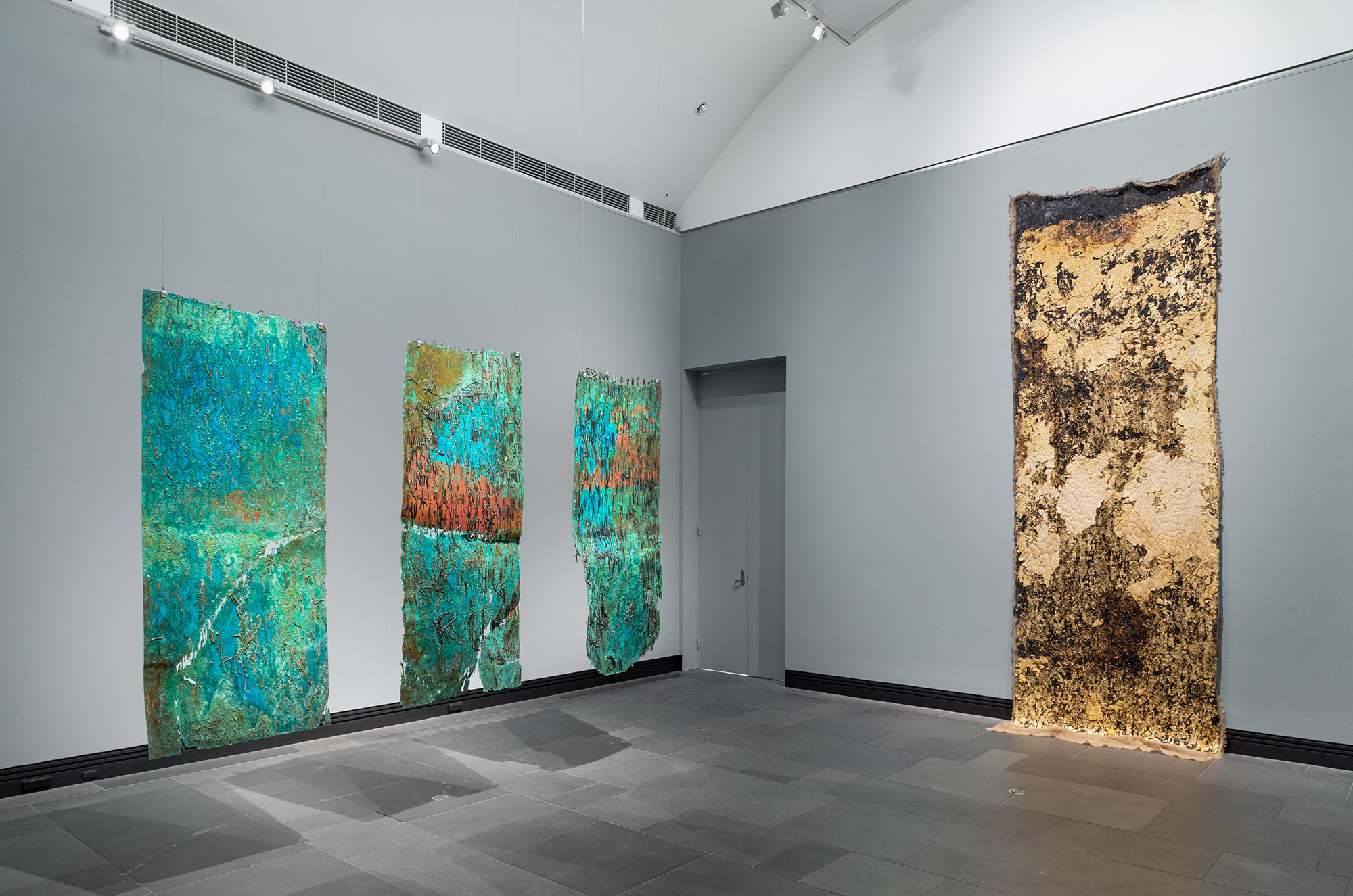
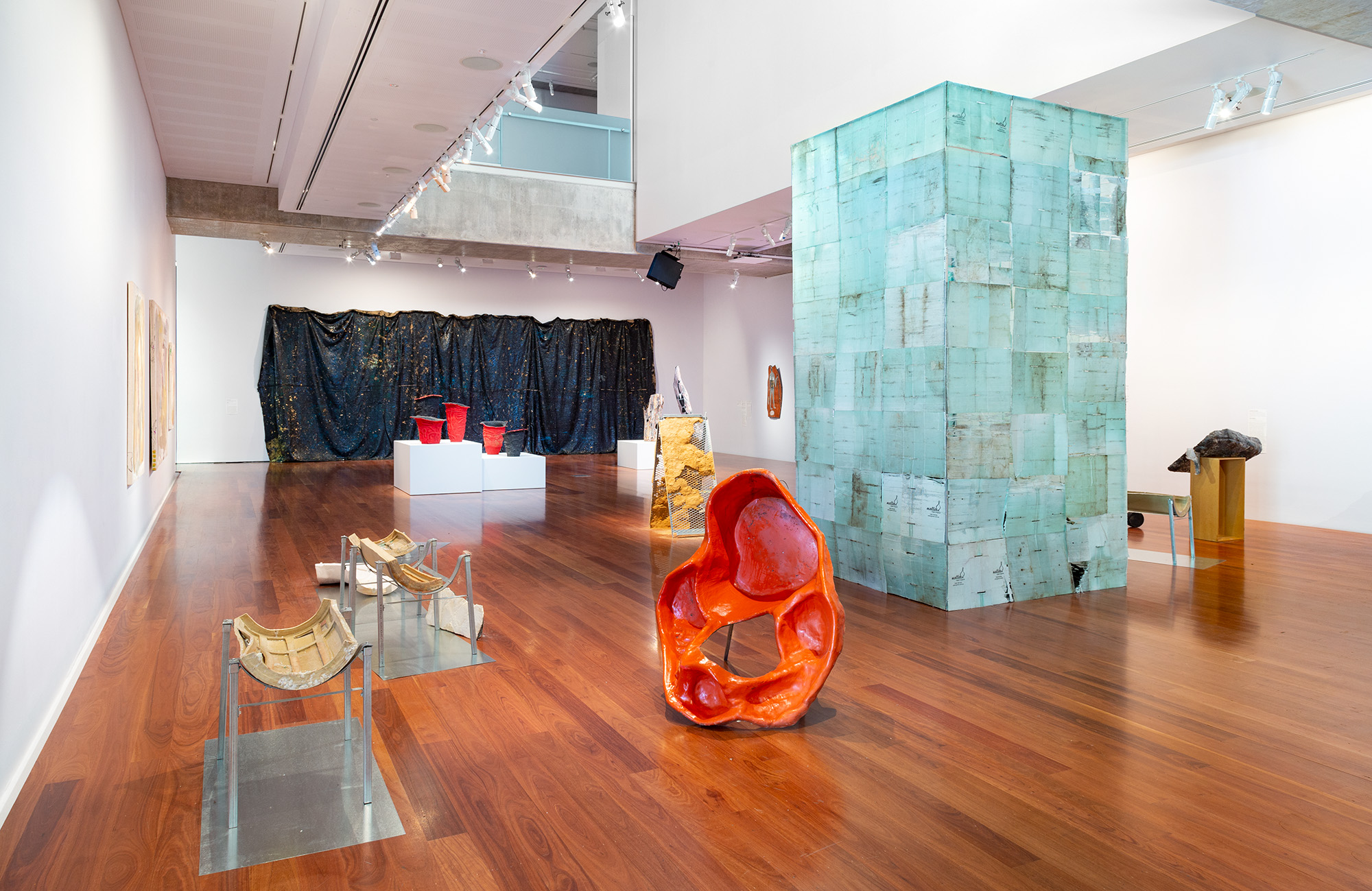
Installation view (detail) of Kirtika Kain, artworks left to right, Chronicles II, dimensions variable, Afterlight, dimensions variable. 2026 Adelaide Biennial of Australian Art: Yield Strength, Art Gallery of South Australia, Adelaide. Photographed by Saul Steed.
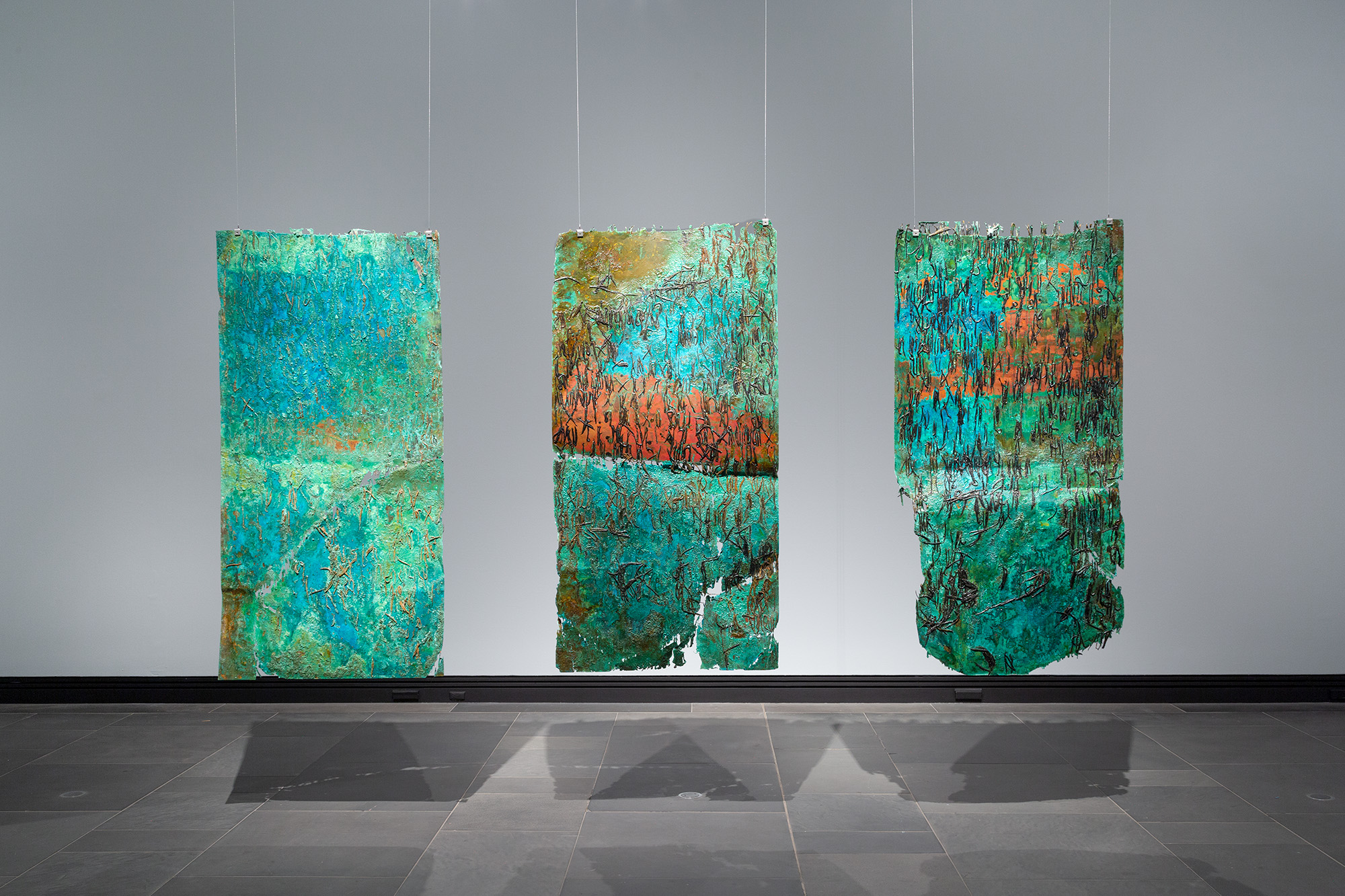
In the Samstag Museum of Art, Kirtika Kain’s immense tar on hessian painting Midnight, 2025, extends that pressure in a different key. From a distance the surface can appear almost celestial; up close it becomes bluntly earthly. Here the gold leaf doesn’t glow so much as peel and crack. The texture and undulations behave more like sculpture than image. The social material is made explicit in the wall text: “tar and gold are associated with hard labour for Dalit communities, historically relegated to the base of the Hindu caste system,” yet in the studio Kain is free to transmogrify these constraints. While at AGSA, Kain’s turmeric, gold leaf, and tar on hessian painting Afterlight, 2025, and heavily corroded copper printing plates turned suspended sculptures Chronicles II, 2025, present a different quality: a sense of transformation, or at least perhaps a state of perpetual transition.
Ultimately, Yield Strength feels like an exhibition that took risks and still found its meaning. Heavy on sculpture and installation, texture and tactility, it is not the biennial as rigid thesis, nor as a free-for-all, but as an orchestrated field. The question this raises—one the exhibition itself seems to invite—is whether coherence here merely improves the experience, or whether it also risks becoming the dominant aesthetic of our major exhibitions. At its best, the works don’t dissolve into ambience; they hold pressure, retain friction and turn coherence into a genuine encounter rather than a managed impression.
Exhibition
Adelaide Biennial of Australian Art: Yield Strength
27 February – 8 June 2026
Art Gallery of South Australia, Adelaide Botanic Gardens and the Samstag Museum of Art, Adelaide.
Images courtesy of the artists and the Art Gallery of South Australia, Adelaide, Adelaide Botanic Gardens, Adelaide, Samstag Museum of Art, Adelaide.
Peter McKay is the Curatorial Manager of Australian Art at QAGOMA, artist and writer.
The article was first published in Artist Profile Issue 75, 2026.
Through a multidisciplinary collaboration between Rotterdam-based curators, architect Paul Cournet of CLOUD and artist-designer Sabine Marcelis of Studio Sabine Marcelis, the exhibition explores the interplay...
Artificial intelligence will be used by young artists who started using it as kids on their phones. They will see it as a natural extension...

This year’s Biennale arrives under more complex circumstances than most. It is shaped by the profound loss of its curator, Koyo Kouoh (1967–2025), whose exhibition...
No artist creates in isolation. Every painting carries traces of the conversations, places and histories that shaped it, preserving within its surface a particular moment...
The weekend markets at Fairfield Showground have been one of Western Sydney’s great institutions for more than fifty years. Fresh fruit and vegetables, children’s clothes,...
In recent times, Yorgos Lanthimos has shifted toward photography, noting in a Guardian interview, 2026, that he needs respite, saying, “it might be a couple...

In Australia, political cartoons were altered by several events during the 1960s: the arrival of Les Tanner’s (1927‒2001) instinctual wit at The Bulletin, Bruce Petty’s...
Recognition of the importance of early bark paintings and their link to the world’s oldest continuing culture, is what makes them both highly sought and...
I had come to see my daughter sing in Deborah Kelly’s Creation Choir and was fortunate enough to make it inside the gallery for the...