
Nicole O’Loughlin
My fascination with decay and growth began at an early age, being raised on a dairy farm in Victoria. I was exposed to and in direct contact with the sequence of life: the birth and death of animals, the growth and decay of plants, and the cycles of nature that continually transform the natural world. This upbringing imbued in me a disposition to always be inquisitive about the processes involved in life and death.
Continuing into adulthood I maintained this desire to understand the functioning of life, and this has influenced the subject matter I investigate in my creative practice, along with inspiring some scientific study.
My creative research approach offers more than a distanced observational account of the world. Aesthetic awareness combined with an inclination to delve beneath the surface of my surroundings provides a foundation to work across the art and science nexus.
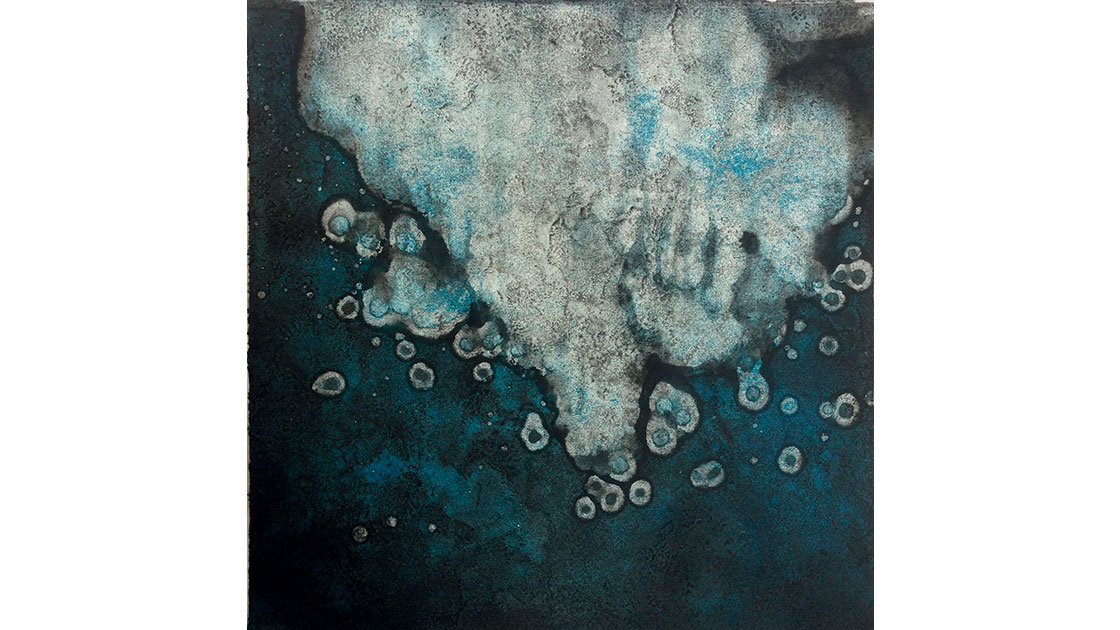
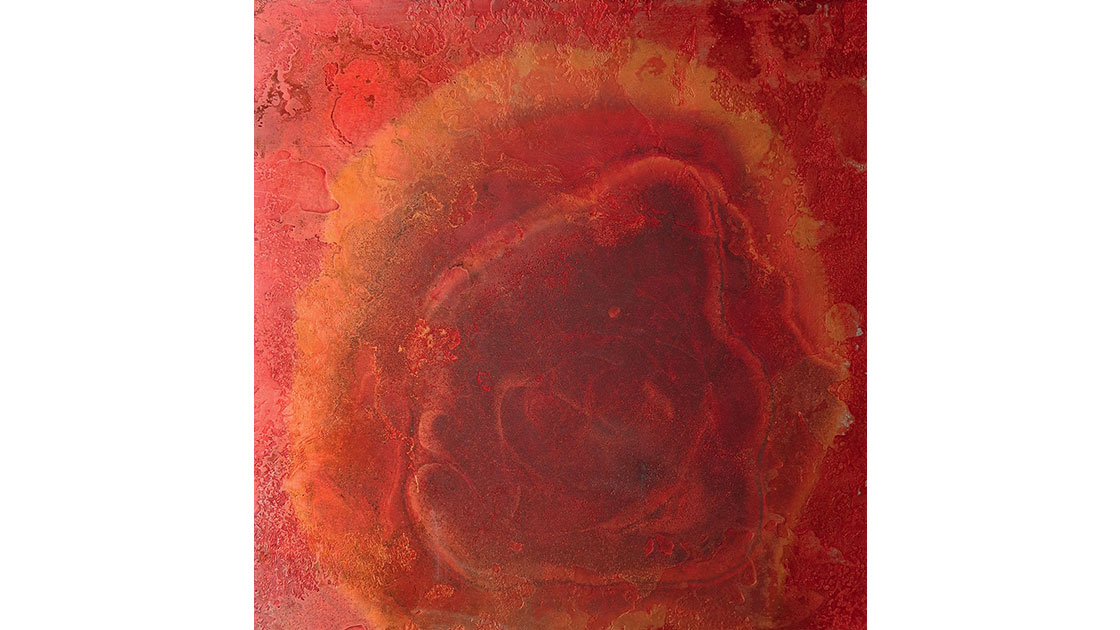
In previous work I have produced illustrative paintings that addressed the formal transformation of plants, animals and other materials during growth and decay. In my recent honours project in printmaking I aimed to move away from a highly representational framework and investigate the physiological process of decay and growth rather than the initial or ultimate states.
Observational findings, gathered from the University of Tasmania Plant Science Lab and studio experiments, were applied to the process of printmaking. Employing decay and growth in the generation of printmaking plates provided the basis from which to create the prints. Systems of printing were developed to replicate the growth and decay processes; to arrive at a certain point of collapse or renewal through repetition and saturation. My colour palette is chosen through the observations of growth and decay in the natural world.
In the generation of the plates I used a white ground process, which is a highly volatile material that breaks down in the acid, leaving residual abstract marks from which I could print. Also, by encouraging the natural process of oxidation of the metal plates to organically etch into the surface, I created printmaking plates that were representational of the concept I was addressing.
As well as the prints produced from decay and growth processes, the steel and copper printmaking plates themselves hold a fascination for me in the surfaces and transformative states that they acquire during artistic experimentation. The plates are incorporated into the final presentation and for me are integral to the work. Presenting the plates in various states with the prints allows the viewer to understand better the vitality of materials present in an artist’s studio.
Addressing vital materialism present in my studio in an investigative and alchemical nature allows for unknown elements in the final product, keeping my work open to the possibilities of new discoveries of ways to address natural phenomena through artistic practice. Overall my work aims to share a fascination with the natural processes of decay and growth and the cycles of life.
Under the auspices of Geelong Gallery’s director, Humphrey Clegg, and co-curated by Marianne Mathieu, former scientific director of the Musée Marmottan Monet, and Claire Durand-Ruel...
Nike Savvas: Purple Haze presents intimate screen prints and immersive large-scale installation and video work by Savvas from 2005–2026, each evocative of different places and...
Although physically he is of modest stature, Zofrea has devoted much of his life to grand projects that have been conceived and executed on a...
Through a multidisciplinary collaboration between Rotterdam-based curators, architect Paul Cournet of CLOUD and artist-designer Sabine Marcelis of Studio Sabine Marcelis, the exhibition explores the interplay...
Artificial intelligence will be used by young artists who started using it as kids on their phones. They will see it as a natural extension...
This year’s Biennale arrives under more complex circumstances than most. It is shaped by the profound loss of its curator, Koyo Kouoh (1967–2025), whose exhibition...
No artist creates in isolation. Every painting carries traces of the conversations, places and histories that shaped it, preserving within its surface a particular moment...
The weekend markets at Fairfield Showground have been one of Western Sydney’s great institutions for more than fifty years. Fresh fruit and vegetables, children’s clothes,...
In recent times, Yorgos Lanthimos has shifted toward photography, noting in a Guardian interview, 2026, that he needs respite, saying, “it might be a couple...