
Martin George
Issue 38 'Discovery' artist, Martin George, talks about his creative process, anti-technicality, materiality, gesture and the relationship between decoration and expression.


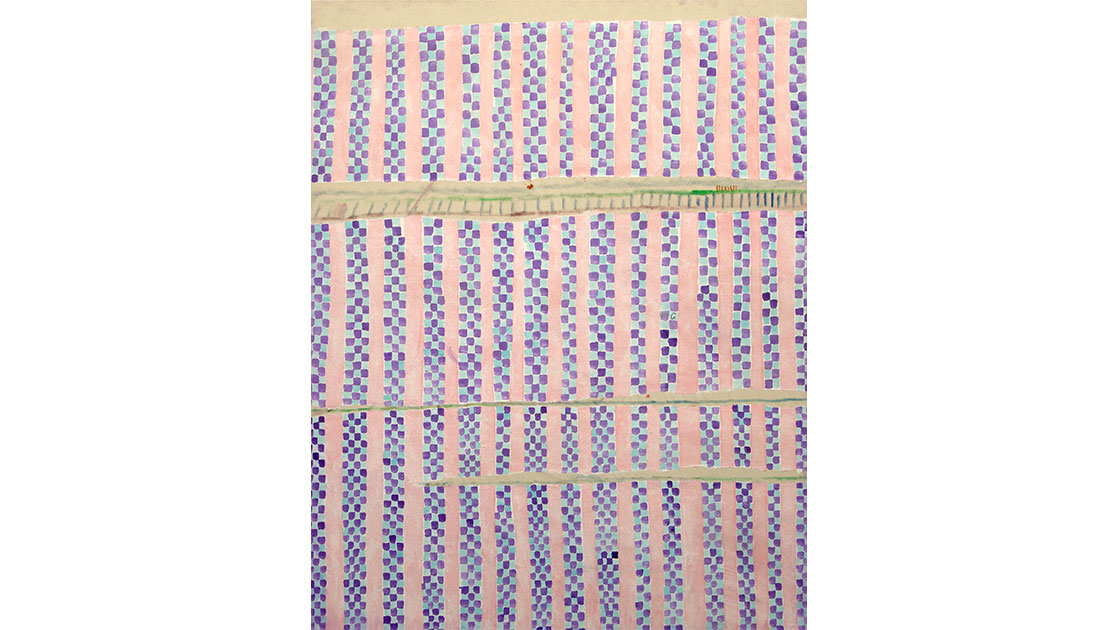
MY PAINTINGS ARE PRIMARILY concerned with the relationship between decorative and expressive gesture. Using gesture, a focus is drawn to the materiality of a work with attention to its whole structure – in other words, the fixtures and supports, the edges of a canvas, as well as its surface. I use decorative gesture and exemplify certain motifs in order to create the no-longer-decorative, and to objectively make a work look garish.
These gestures and the materiality of a work are anti-technical and suggest a quickly finished work, boredom found during production, or a painting that sits in limbo without willingness for it to develop any further. This stage before a realised image – a gesture similar to a clouded thought – is fundamental to all my works.
These motifs in my paintings have links to illustrative or representational form but are situated as unresolved moments, and maintain a quasi-abstract status. I also tend to incorporate my initials into works, either as a foundation for the evolution of an image, or simply camouflaged within an already realised work. This is to exaggerate ideas of artistic authorship and the artist’s ego, which is a commonly executed motif in recent painting practices as an endeavour to distance attachment between an artist and their work.
For my current paintings I have working parameters to structure a picture, for example, using repetitive gesture over an entire surface. I broadly group these works under the title of Checkerfields, a name that could pay homage to Mondrian’s Checkerboard paintings. These works have guidelines incorporated into their making, they are paintings that hold a start and finish point; they let me think about my next painting while I am painting…they aim to speak to the grand abstract gesture, the monochrome, or the intimacy of the colour-field.
These aspirations of the work are ultimately failures; they are a weak attempt to convey characteristics of high-modernist abstraction.
This relation fails because values are subverted by the painting’s materiality – its anti-technicality and manageable scale.
These material characteristics in my work makes them naïve on the surface, caused by their banal image structures. Through forms of poor abstraction, and the desecration of painterly motifs, a light-hearted barrier is placed at the forefront of these works.
The overall naivety acts like a means of protectiveness or a shielding from exterior networks; a subtle defence. In this manner there are no standouts, no statement pieces, and no one-liners. My paintings ultimately exist as a slight action…found under the couch…from behind the bookshelf…salvaged from a bin.
EXHIBITION
Martin George | Checkerfield Paintings
27 March – 21 April
NKN Gallery, Victoria

Two years ago, Macleod returned to his hometown of Christchurch, New Zealand, to be with his mother during the final phase of her life. At...
Edwards was born on Kaurna Yarta in 1998 and raised on Nauo Country in the small seaside community of Tulka, on the Lower Eyre Peninsula....
Under the auspices of Geelong Gallery’s director, Humphrey Clegg, and co-curated by Marianne Mathieu, former scientific director of the Musée Marmottan Monet, and Claire Durand-Ruel...
Nike Savvas: Purple Haze presents intimate screen prints and immersive large-scale installation and video work by Savvas from 2005–2026, each evocative of different places and...
Although physically he is of modest stature, Zofrea has devoted much of his life to grand projects that have been conceived and executed on a...
Through a multidisciplinary collaboration between Rotterdam-based curators, architect Paul Cournet of CLOUD and artist-designer Sabine Marcelis of Studio Sabine Marcelis, the exhibition explores the interplay...
Artificial intelligence will be used by young artists who started using it as kids on their phones. They will see it as a natural extension...
This year’s Biennale arrives under more complex circumstances than most. It is shaped by the profound loss of its curator, Koyo Kouoh (1967–2025), whose exhibition...
No artist creates in isolation. Every painting carries traces of the conversations, places and histories that shaped it, preserving within its surface a particular moment...