
Alan Constable
The expressive clay cameras of Alan Constable are not without irony. Legally blind, the artist’s own limitations of sight have carved open a new field of vision. Working closely with referent objects, he commits the physical forms of optical instruments to memory and then to clay. Pinched, pushed, pummelled and smoothed, Constable’s accentuated cameras and viewfinders bear the markings of his mind.


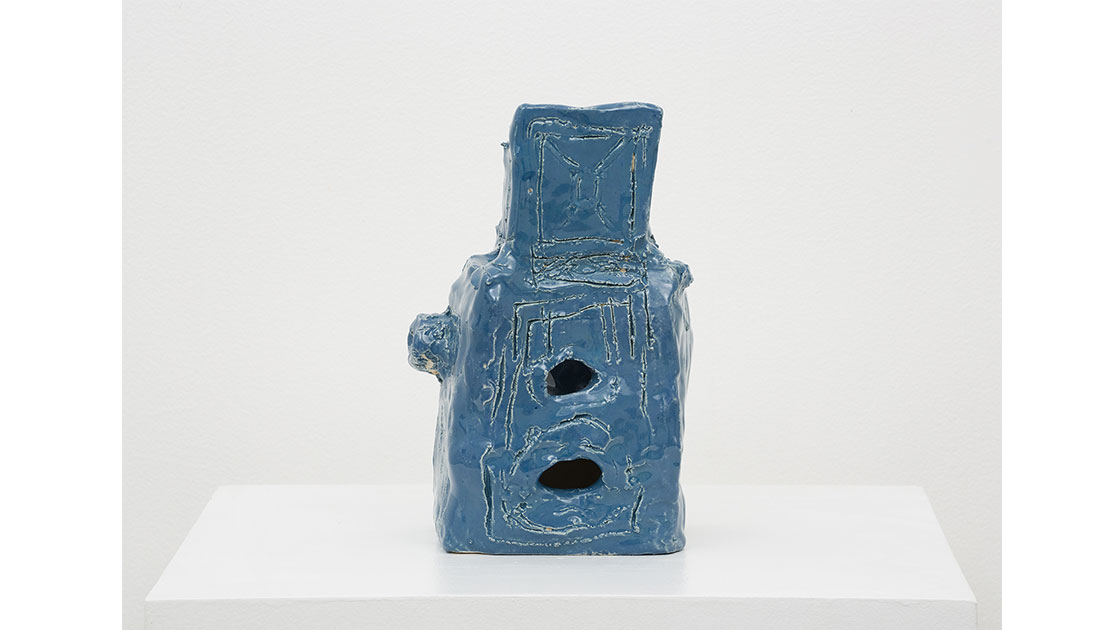


Constable’s enduring fascination with ‘objects that see’ began when he was eight years old, during which time he would create sculptures of cameras with cardboard from cereal boxes. Since 1987, he has been producing his optical art objects at Arts Project Australia in Melbourne. Constable’s solitary practice involves holding the referent object millimetres from his eyes as he scans, traces and touches the surface before intuitively rendering his impressions in clay. He works quickly, building and assembling each camera component —body, lens, viewfinder, buttons, knobs and handles. This tactile translation from object to clay, unmitigated by the subjectivity of optical vision, materialises Constable’s mind’s eye. Each camera is a portal into his inner world, inviting us to look through their distorted and exaggerated viewfinders to see things anew.
Constable’s new series of ceramics, which includes ten cameras and one pair of binoculars, explore different ways of seeing. Expressive embodiments of visual technology, the works prompt us to recalibrate our vision and reassess what is worth looking at. Playing with the function of photography, the artist self-reflexively captures the object that captures the image. He reaches beyond the recording function of the camera to expose the simple beauty of its form. In this way, the works are about distilling revelation from concealment.
EXHIBITION
Alan Constable
7 April – 5 May 2018
Darren Knight Gallery, Sydney
Two years ago, Macleod returned to his hometown of Christchurch, New Zealand, to be with his mother during the final phase of her life. At...
Edwards was born on Kaurna Yarta in 1998 and raised on Nauo Country in the small seaside community of Tulka, on the Lower Eyre Peninsula....
Under the auspices of Geelong Gallery’s director, Humphrey Clegg, and co-curated by Marianne Mathieu, former scientific director of the Musée Marmottan Monet, and Claire Durand-Ruel...
Nike Savvas: Purple Haze presents intimate screen prints and immersive large-scale installation and video work by Savvas from 2005–2026, each evocative of different places and...
Although physically he is of modest stature, Zofrea has devoted much of his life to grand projects that have been conceived and executed on a...
Through a multidisciplinary collaboration between Rotterdam-based curators, architect Paul Cournet of CLOUD and artist-designer Sabine Marcelis of Studio Sabine Marcelis, the exhibition explores the interplay...
Artificial intelligence will be used by young artists who started using it as kids on their phones. They will see it as a natural extension...
This year’s Biennale arrives under more complex circumstances than most. It is shaped by the profound loss of its curator, Koyo Kouoh (1967–2025), whose exhibition...
No artist creates in isolation. Every painting carries traces of the conversations, places and histories that shaped it, preserving within its surface a particular moment...