REVIEW I Enter the edge: Elvis Richardson’s suburbia
Edge City sits at the centre of Wollongong Art Gallery, upstairs in the Dickson Gallery. As a focused survey by Melbourne artist Elvis Richardson, it includes several key works by the artist, alongside a companion exhibition of works from the gallery’s collection.
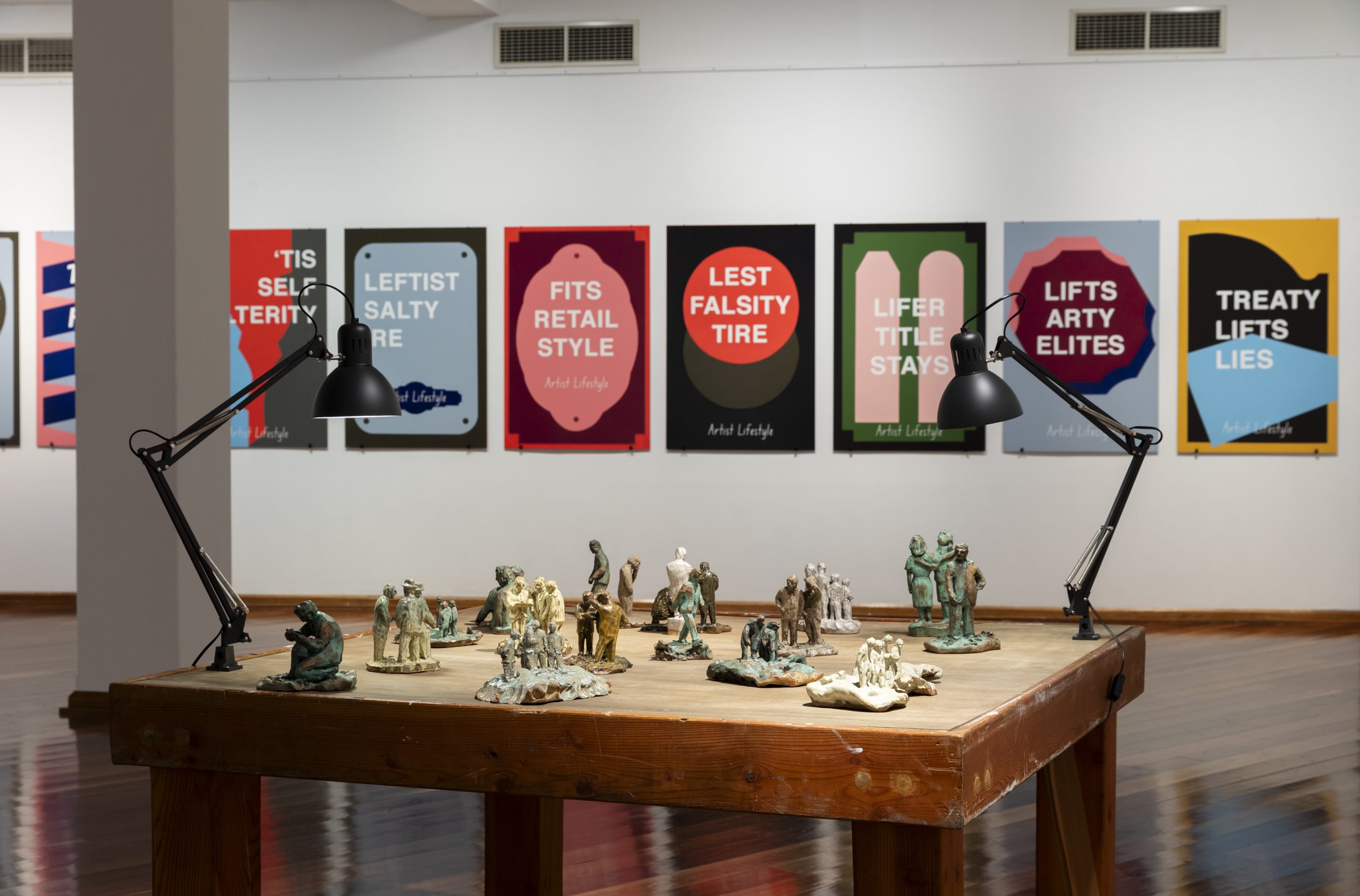
The first work you encounter in Edge City is a gate, Settlement #8, 2025. Not one to pass through (not anymore), but a threshold nonetheless. Salvaged and painted a feminine blush pink, the decorative steel has been altered and embellished with the title of the work in flowing cursive script. Its colour softens the firm stand it takes on settler histories in Australia, alerting the viewer to the complications of power and access through the familiar suburban iron gate. A component Settlement series, commenced in 2016 (with physical structural components introduced in 2020), Settlement #8 is an incursion into the politics of ownership and social disparity—a prelude to Edge City’s broader engagement with suburban iconography and the colonial histories Richardson interrogates. Who can enter? Who is locked out?
Installation view of Edge City, Wollongong Art Gallery, NSW, 2026, Settlement #8, 2025, modified found domestic gate, mild steel, pink blush powdercoat, 200 x 91 x 3 cm.
Richardson, founding editor of the Countess Report and a significant artist with work held in national collections, is known for their interrogations of power and structural inequalities. An earlier work, Settlement, 2016, represents suburbia through a different lens and form. Stepping inside the homes of strangers, this video work layers and transitions between photos collected by the artist from online real estate listings. Not high-end, polished imagery. These low-resolution photos represent an unglamorous, almost abject nostalgia: retro but stripped of charm. With the occupants out of sight, the humanless homes bear the traces of their former owners in stained carpets, old photographs, ceramic ornaments and half-packed boxes. Narratives emerge in fragments—a large portrait of an elderly woman beside a candle on the mantel, a hospital-style bed just in view; a child’s room with carefully arranged dolls on the bed; chairs in odd formations, like someone left suddenly. These interiors feel neglected, airless and economically strained, unsettling the ideal of home ownership and exposing the fragility of this increasingly unattainable Australian dream within the realities of contemporary poverty.
Other works in the exhibition similarly adapt collected imagery, particularly relating to the lived experience of women, an important part of Richardson’s practice as an artist who mines public resources. Assembling video clips of young girls singing Tomorrow, the popular show tune from the musical Annie, 1977, the video work of the same name, originally exhibited in Girls, Girls, Girls, 2008, at the Carlton Hotel, is hopeful and earnest. The girls sing unashamedly, some in their bedrooms or at the dining table, inviting a consideration of popular representations of girlhood and delighting in the innocence of . However, the earnestness gives almost way to desperation as the repetition draws powerfully on the delayed gender equality that shapes lived experience. Will tomorrow ever arrive?
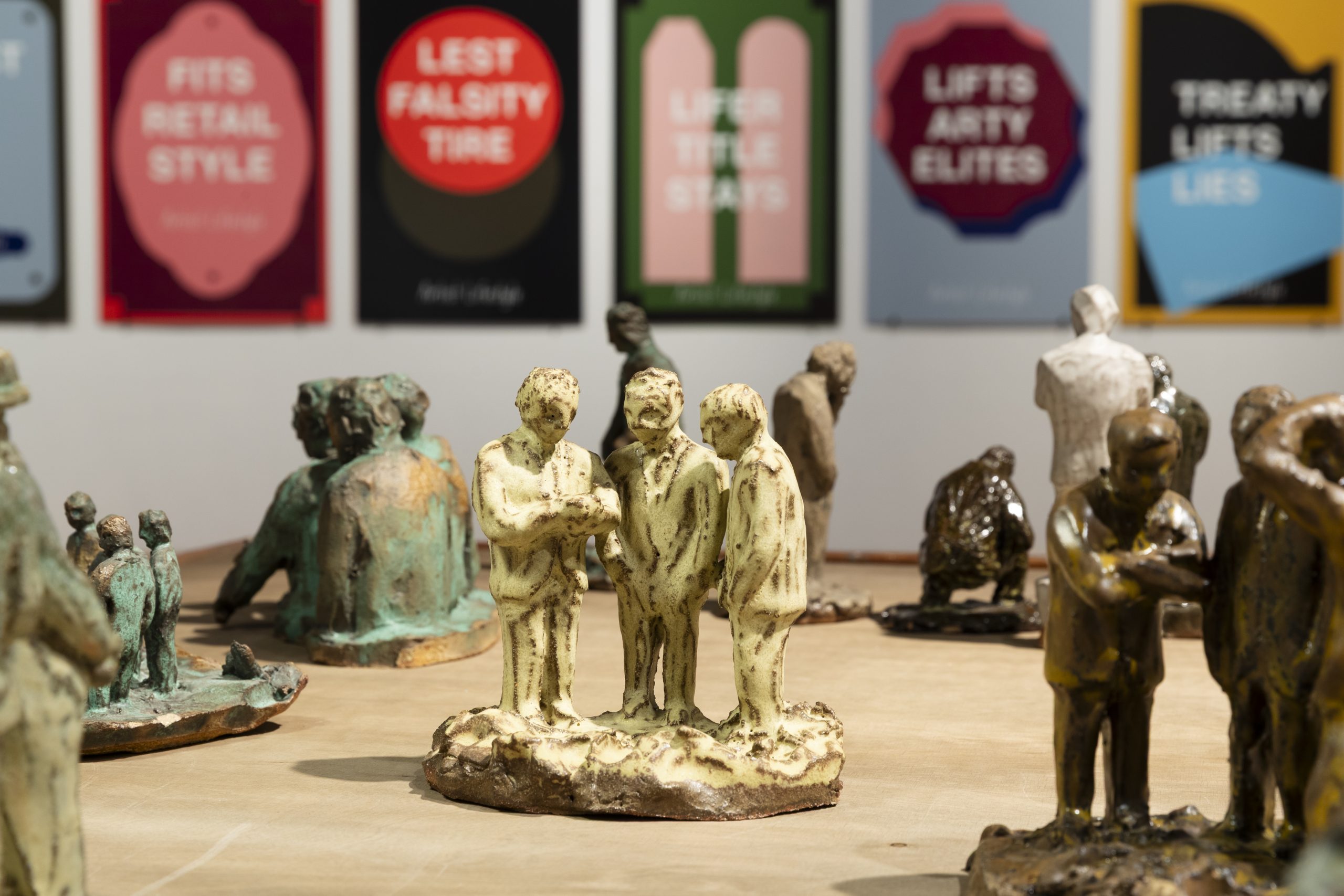
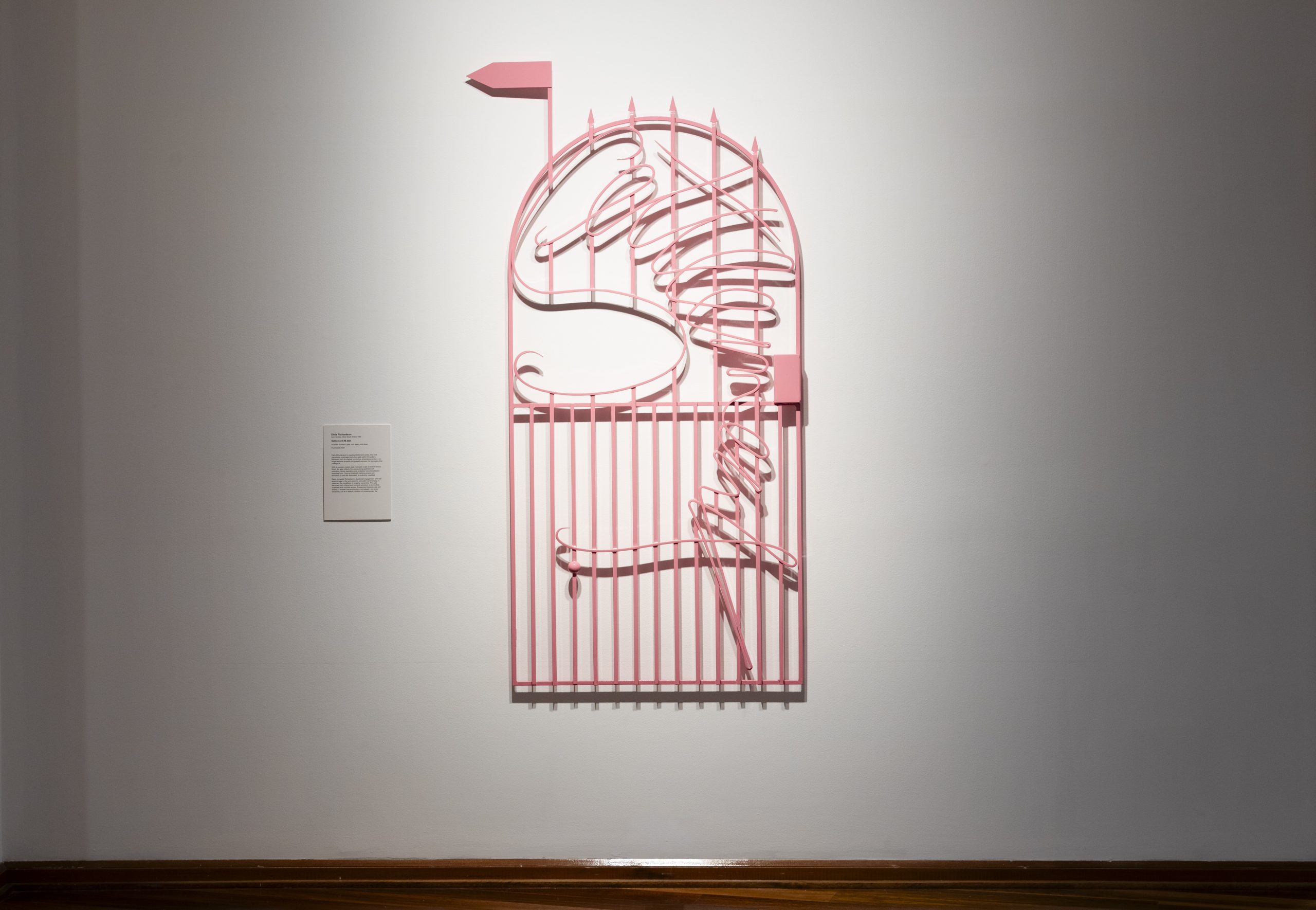
Installation view (detail) of Edge City, Wollongong Art Gallery, NSW, 2026, (background) Artist Lifestyle, 2018, (foreground) An Unsolved Study, 2024.
In a darker turn, in An Unsolved Study #1, 2024, Richardson collects widely circulated media images documenting the investigation into the unsolved murders of two teenage girls at, Cronulla, in 1965. Reconstructing these images over and over again in ceramics and drawings, Richardson suggests the repetition and media fixation with the case. This repetition also speaks to the broader impact of the crime at the time, particularly on women, including the artist herself, who spent a summer as a young girl looking out toward Wanda Beach from Port Hacking. Richardson’s work recalls the event as an inescapable presence, its retelling becoming a deeply unsettling and ongoing confrontation with the reality of violence against women.
As a focused survey, Edge City probes questions of ownership, domestic and gendered space and the material iconography of suburbia and the regional. Richardson’s accumulating, repeated imagery gathers force, exposing how collective identity is constructed and how tenuous it ultimately remains.
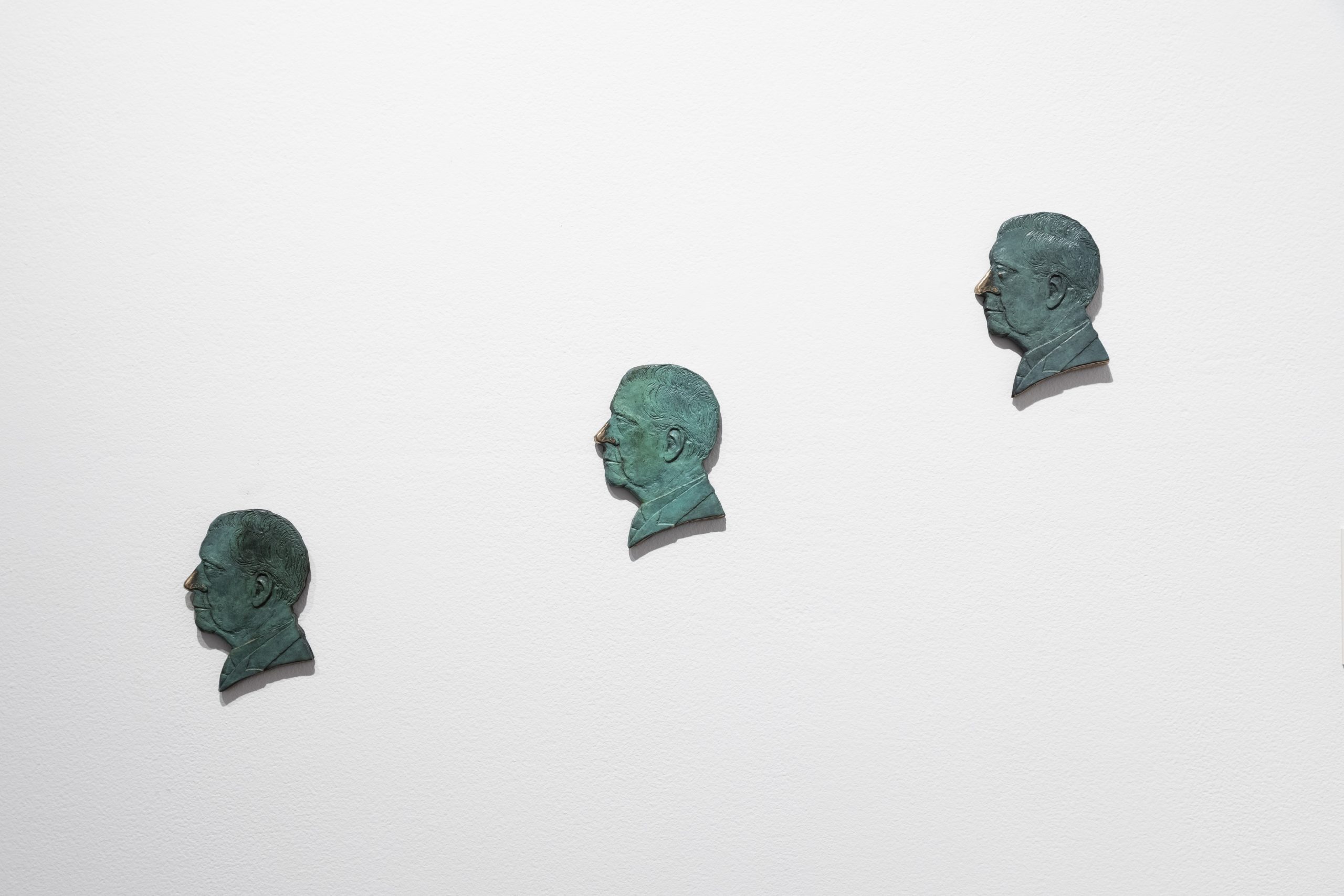
Installation view of Edge City, Wollongong Art Gallery, NSW, 2026, Old Money, New Money, 2025, patinated bronze, 13 x 10cm, edition of 6.
A companion exhibition of works from the collection expands on these inquiries into identity and suburbia, situating them in a local context. Side by side, these two parts form a conversation about the shifting identity of Wollongong: historically a regional centre and industrial hub shaped by steelmaking, mining and successive waves of migration, as well as its coastal geography and proximity to Sydney. In recent years, however, this identity has entered a period of visible transition. Here, the population continues to grow, driven by migration and lifestyle relocations, as well as the introduction of new housing corridors and urban release areas. Caught between the frictions of coast and city, these changes have made Wollongong a frontier of suburban expansion in New South Wales and have greatly altered the identity of its communities.
What emerges in this transition is a city as an expanding urban centre. No longer solely industrial, nor comfortably regional, it is part of a broader metropolitan continuum extending south from Sydney. As new residents arrive and development reshapes its peripheries, the Illawarra’s suburban fabric becomes a space where questions of ownership, belonging and cultural memory are actively contested. In this context, Richardson’s work resonates not simply as observation, but as a critical lens through which these transformations—material, social and symbolic—can be read.
These transformations have influenced a loose assembly of artists connected by location and engagement with the Illawarra’s shifting identity, as represented by works selected from Wollongong Art Gallery’s collection. Including work that represents the area by Christopher Zanko, Judy Bourke, Catherine O’Donnell, Derek Kreckler, Bianca Hester, Kevin Butler, Riste Andrievski, Nick Santoro and others, the companion exhibition reframes Edge City and deepens it. For example, Christopher Zanko’s focus on disappearing residential architecture from the 1950s captures how recent changes have redefined the visual identity of the suburbs where he lives. His work Regent I–V, 2024, documents the façade and interior details of the Regent Theatre in carved and painted woodblock.
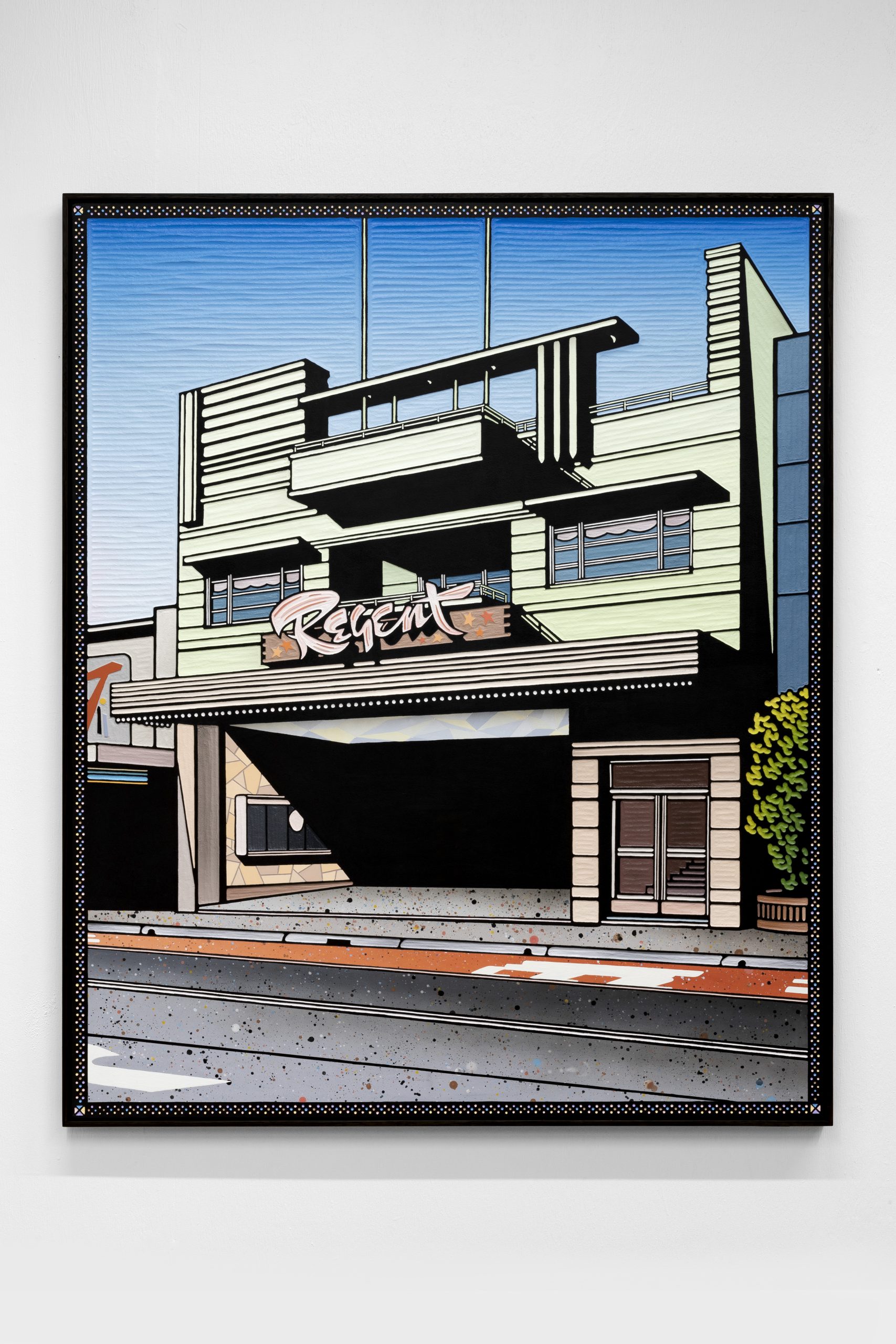
Christopher Zanko, Regent (V) 2024, acrylic paint, wood relief carving. Photographed by Jessica Maurer.
Bianca Hester’s video work Extinction Lines, 2024, a component of her long-term Lithic Bodies project at the University of New South Wales, is also included. This work pans slowly across the Illawarra escarpment, revealing the Permian–Triassic extinction line set around 252 million years ago. It is visible in rock formations that lie above the Bulli coal seam, which was mined extensively in the local area from the 1860s.
Together, these parallel exhibitions resonate thematically, though the companion show lacks the same consideration of gender and power that anchors much of Richardson’s work. What emerges is a focus on how suburban imagery shapes collective identity, revealing both its construction and its underlying fragility.
Exhibition
Edge City
28 March – 18 October 2026
Wollongong Art Centre, Wollongong
Images courtesy of the artists and Wollongong Art Centre, Wollongong.
Dr. Brooke Boland is an arts writer on Wodi Wodi, Jerrinja and Yuin Country, New South Wales south coast.
The article was first published in Artist Profile Issue 75, 2026.
Through a multidisciplinary collaboration between Rotterdam-based curators, architect Paul Cournet of CLOUD and artist-designer Sabine Marcelis of Studio Sabine Marcelis, the exhibition explores the interplay...
Artificial intelligence will be used by young artists who started using it as kids on their phones. They will see it as a natural extension...

This year’s Biennale arrives under more complex circumstances than most. It is shaped by the profound loss of its curator, Koyo Kouoh (1967–2025), whose exhibition...
No artist creates in isolation. Every painting carries traces of the conversations, places and histories that shaped it, preserving within its surface a particular moment...
The weekend markets at Fairfield Showground have been one of Western Sydney’s great institutions for more than fifty years. Fresh fruit and vegetables, children’s clothes,...
In recent times, Yorgos Lanthimos has shifted toward photography, noting in a Guardian interview, 2026, that he needs respite, saying, “it might be a couple...
In Australia, political cartoons were altered by several events during the 1960s: the arrival of Les Tanner’s (1927‒2001) instinctual wit at The Bulletin, Bruce Petty’s...
Recognition of the importance of early bark paintings and their link to the world’s oldest continuing culture, is what makes them both highly sought and...
I had come to see my daughter sing in Deborah Kelly’s Creation Choir and was fortunate enough to make it inside the gallery for the...