REVIEW | Abattoir Blues, Ron Mueck’s Sculpted Humanity
The factory-produced human. Some great algorithm reducing us all to product, processing us. We are plugged in, self-identified for online convenience, carved up for the identity market. Some other creature within us—aching to live, mystified by that ache—keeps pushing on as this strangely addictive conveyor belt controls our destiny, our worth, our sense of meaning.
Ron Mueck’s shockingly alive sculptures hit us at many points along the pathway from birth to death. But it’s more than just mortal decay that concerns him. Mueck is interested in our spiritual life, the spark inside that won’t say die. It’s this soulfulness that drives his work into a struggle zone to understand who and what we are.
Mueck’s faces are what kills you. Slowly and with feeling as you stare into the being he has captured in each sculpture.
Existential torments and agonised calls for compassion are everywhere in the exhibition at the Art Gallery of New South Wales (AGNSW), these human dilemmas and creature un-comforts summed up under the collective title Ron Mueck: Encounter.
Our cage is not just that we are spirits caught inside our bodies. It’s the fading of our will to live, the entrapments that weigh upon and confine us: sadness, need, exhaustion, shame. . . how did they come to be such dominant forces?
I left the Mueck exhibition with the feeling of having passed through an existential abattoir. A type of cold room experience, pieces of meat hanging from hooks. . . hidden behind it, in corrals, and rooms we do not see, the brutal narratives before each human carcass hangs from its own hook. A more moderate and perhaps more accurate metaphor would be the funeral parlour, where the dead are prepared for relatives to pay their last respects and make their goodbyes.
Artistic comparisons spring to mind: Lucian Freud’s relentless portraiture of naked friends; sculptors Jake and Dinos Chapman with their carnivalesque freakouts; and fellow Australian artist Patricia Piccinini’s genetically modified visions of humanoid life, might also serve as parallels in body horror, though Mueck is more empathetic if no less unsettling.
A visit to Mueck’s Encounter does not invite disdain and revulsion so much as sympathy and compassion. We are more than just bones and meat, he seems to say. We are feeling, dreams, moments of uncertain love. . . a child crouching before a mirror, an old woman covered by a blanket, small and tender as the baby she once was. Yes, we are bones and meat, with hearts, with souls.
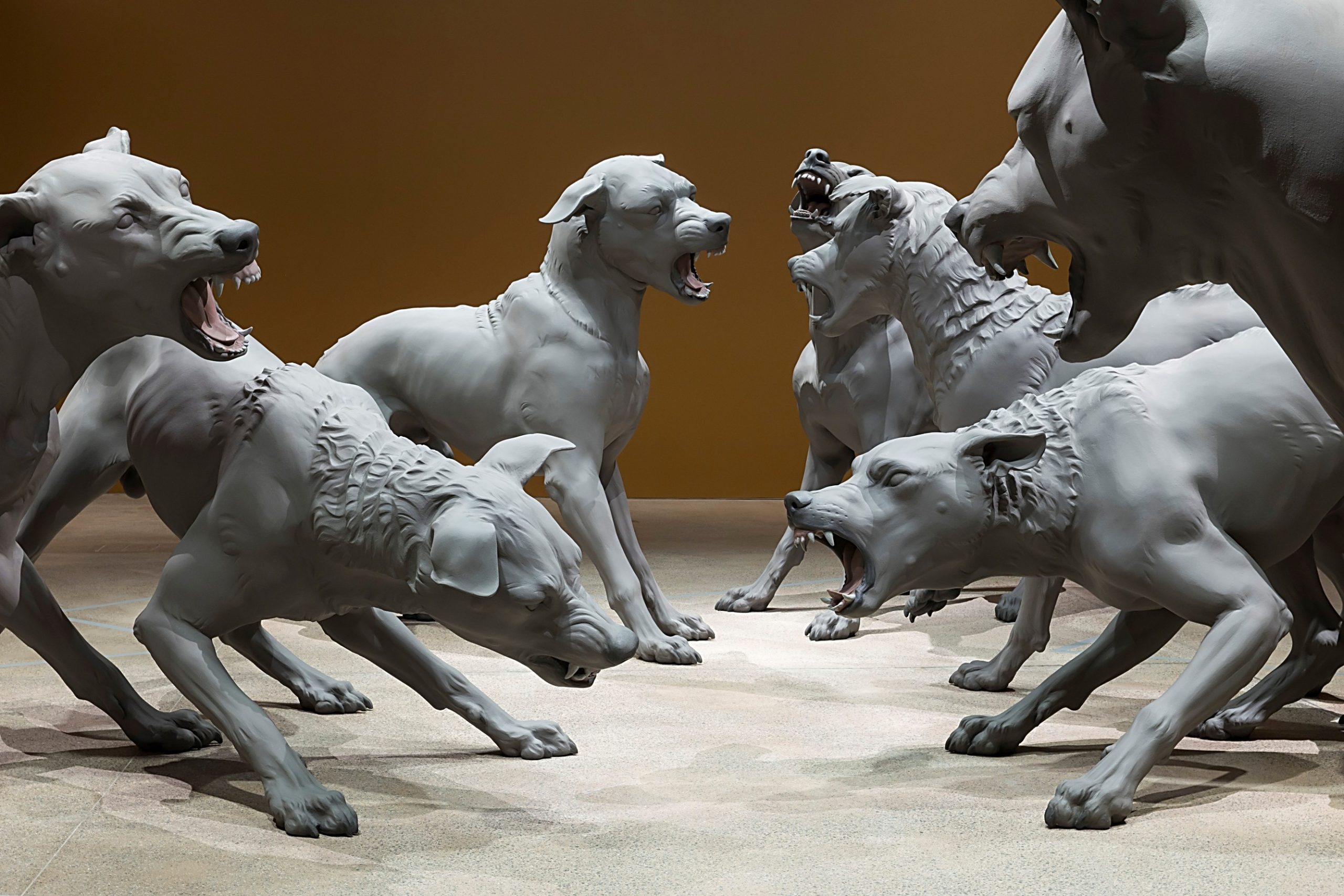
Mueck’s passion for isolated human forms has shifted in recent years to include paired situations that could sit inside a Harold Pinter play, as well as fable-like and frightening scenarios like Havoc, 2025. Which features two dog packs in a writhing face-off, backs arched, jaws open, ready to kill and destroy.
Havoc is large scale. At the Encounter show, Mueck’s dogs tower over us, hackles raised, every detail and muscle rippling. Off to one side, one last night-blue predator is poised, about to enter the fray and ensure a victory.
My first reading of Havoc was instinctive: this is us on the internet, our life on social media amid the mob that haunts our minds. Others might see the sculpted dogfight as a simulation for war. Perhaps it is both. You may as well have had sirens going off above us as we walked around the pack; what was in these monstrous giants very much inside of us too.
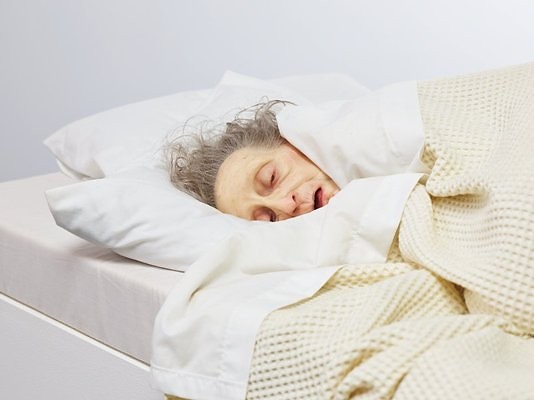
Installation view: Ron Mueck: Encounter, 2025-26, in view, Old Woman in Bed, 2000, 2002, mixed medium, 25.4 x 94.0 x 53.9 cm. Art Gallery of New South Wales, purchased 2003.
Mueck’s decisions on scale are among his most astute powers. The final figure in the Encounters show is an old woman. A little frustratingly, she is located in an entirely separate, slightly darkened room inside the original wing of the AGNSW. This requires an extra effort to walk across from the Naala Badu building where Encounters is located and well-promoted. It is well-worth this effort as Old Woman in Bed, 2000–2002, provides a kind of full stop and summary sensibility to Mueck’s entire show.
She has a blanket cast over her, the whiteness evocative of a hospital bed, her skin pale and papery. Anyone who has encountered friends or relatives dying will be familiar with these last rites. Mueck sculptural veracity comes close to summoning the old woman’s final breaths, though her physical presence is faintly surreal, as a small and swaddled baby you could nurse in your arms. The choice to make her this tiny powerfully accentuates her vulnerability in the same way Mueck’s mythical hellhounds in Havoc are given enough gigantic proportion to menace us all the way into our dreams.
Around the old woman are a series of prints from the AGNSW collection by the German artist Käthe Kollwitz (1867–1945) including Woman Thinking, 1920; The Mothers, 1919; Killed in Action, 1921, and Young Couple, 1904. Apparently Kollwitz is one of Mueck’s favourite artists, thus his request to have her work be paralleled to his own in a room that becomes a kind of micro-exhibition titled Silent and Noisy Tragedies.
There is also an energy shared that can only be described as that of the compelled. To be human, to be humane, is to not shut out the pain one witnesses. Mueck rarely ever gives interviews, so it’s hard to be definitive except as one more witness in relation to the artworks and their presence. But in a conversation way back in 2002, Mueck did say this about his sculptures: “I don’t know why I’m doing it, but I don’t know what else I’d be doing. I’m not driven by art, it’s just all I can do.”
The opening sculpture to Encounter is a monumental figure; a naked and heavily pregnant woman, her arms folded over her head seeking bodily relief. Commentators on Pregnant Woman, 2002, include not just art magazines, but a write up in the British Medical Journal where Mueck’s observational accuracy in depicting stages of motherhood were notably appreciated.
Like any artist, Mueck certainly has his obsessions. A short documentary outside the exhibition shows him at work, drawing from various studies then painstakingly creating his maquettes before moving on to a clay master, then to his sculptures constructed and cast from moulds of silicone, fibreglass, and resin. It is a painstaking and labour-intensive process with oil paint and hair providing the final detailing. You can’t help but wonder at the effort.
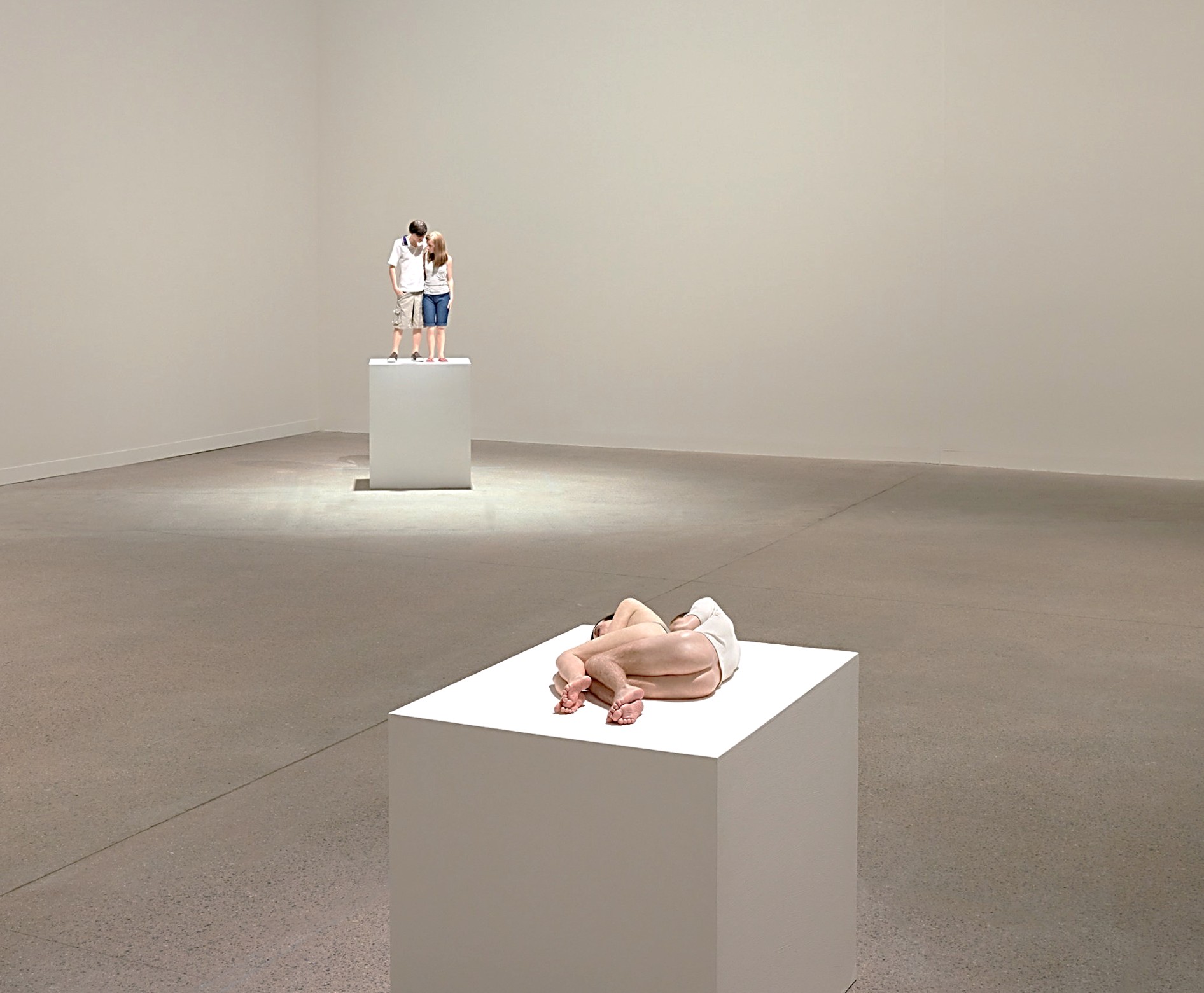
Installation view: Ron Mueck: Encounter, 2025-26, in view, Spooning Couple, 2005, mixed media, 14 x 65 x 35 cm and Young Couple, 2013 (background), mixed medium, 89 x 43 x 23 cm. Art Gallery of New South Wales, Sydney. Photographed by Felicity Jenkins.
At the AGNSW, his Pregnant Woman sculpture leads quickly to diminutive figures: Woman with Shopping, 2013; Spooning Couple, 2005, and Young Couple, 2013, before he upscales again with Ghost, 1998–2014. Ghost depicts a giant adolescent girl in a swimsuit leaning against the gallery wall, turning her head away, oppressed by our gaze and by her own changing body too.
In Young Couple a seemingly tender image invites more sinister interpretations when we walk behind it and see the young man’s hand clutching his girlfriend’s wrist. Spooning Couple shows two people in bed semi-clothed. There’s a feeling of silence and emotional desertion to it. Joy Division’s song Love Will Tear Us Apart, 1980, comes quickly to mind describing the mood: “Why is the bedroom so cold? Why do you turn away on your side?”
Woman with Shopping is another example of Mueck using scale to powerful effect. Here a woman with a baby on her chest beneath her buttoned coat is presented to us at about half the normal size of a human being, gazing outwards, not at her child. She is weary-faced and disengaged, even overwhelmed, with plastic bags of groceries in each hand.
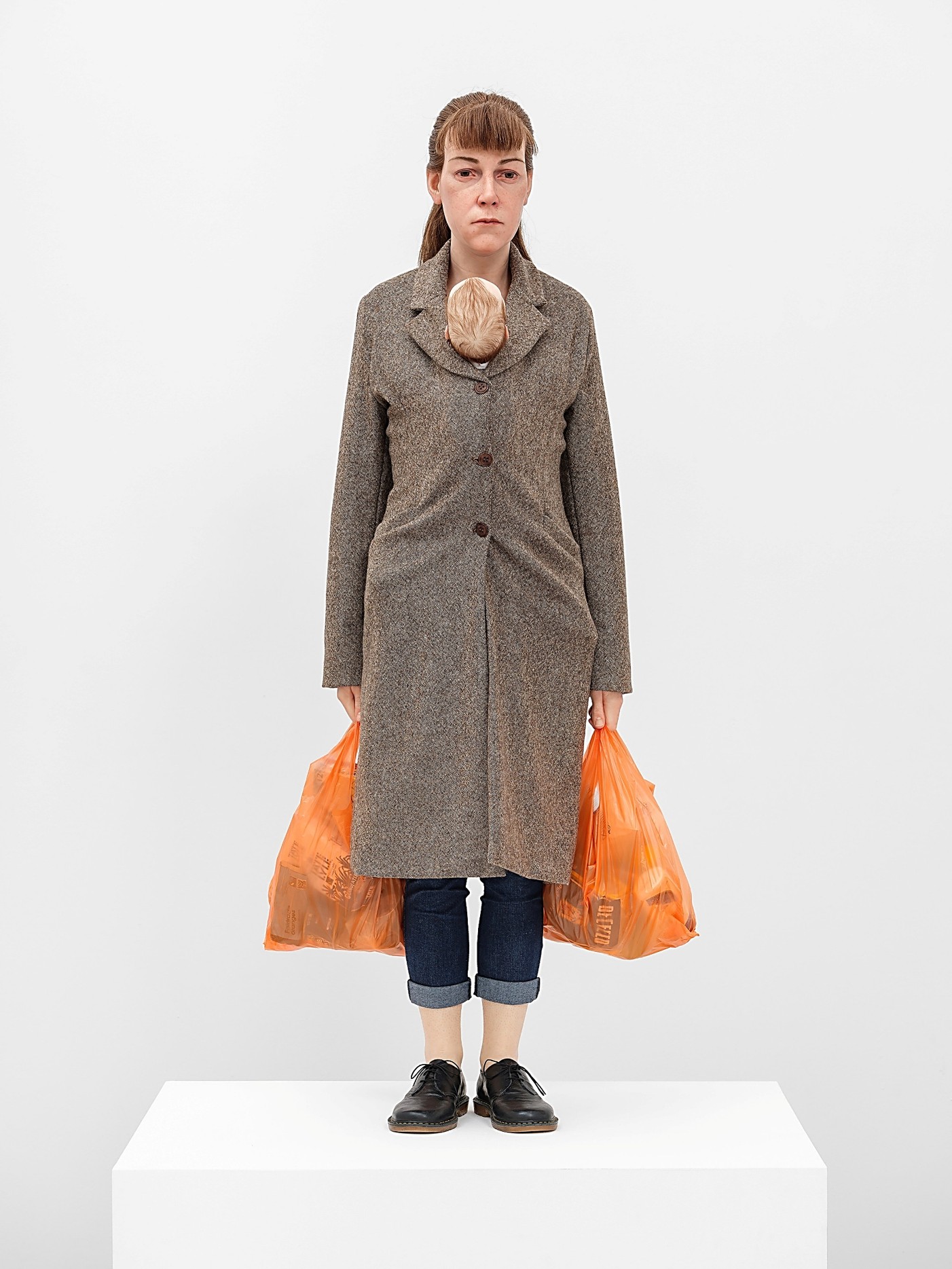
Installation view: Ron Mueck: Encounter, 2025-26, in view, Woman with Shopping, 2013, mixed medium, 113 x 46 x 30 cm. Art Gallery of New South Wales, Sydney. Photographed by Felicity Jenkins.
Mueck’s ability to suggest narratives occurring before-and-after each of his sculptures is quite remarkable. Program notes mention that as well as using people that he knows as models, Mueck often sees figures on the street, quickly stopping to make drawings of whatever he has glimpsed, then developing these impressions later. One feels these fleeting intimacies as depth-charges in the same way we catch insights as we pass by one another, seeing deep into strangers in barely more than a moment.
This penetrating compassion, this humane and costly seeing, is what makes Ron Mueck: Encounter such a great show, along with his intense gift for sculptural veracity. I am not usually a fan of hyper-realism with its void-like photographic specificity and imitative shrillness. But Mueck is beyond any such indifferent or showy surface craft. His creations are terribly alive. Their suffering a moment of shared recognition, a window of being through which we find a common heart.
Exhibition
Ron Mueck: Encounter
6 December 2025 – 12 April 2026
Art Gallery of New South Wales, Sydney
Images courtesy of the artist and Art Gallery of New South Wales, Sydney.
Mark Mordue is an Australian journalist, editor, writer and poet based in Sydney.
This article was first published in Artist Profile issue 74, 2026.
Women Photographers 1900–1975: A Legacy of Light draws on more than 300 photographs and photomedia from the National Gallery of Victoria’s (NGV) collection and the...

Motet Fail, 2026, reshapes Artist Run Initiative, West Space into an immersive backgammon board that operates as a site of reflection, encounter, and quiet concert....

Carvings have been made for all time by Aurukun men. However, the more recent innovation to emerge from Aurukun are paintings. Vested in Country and...

A stone’s throw from the Illawarra escarpment at Campbelltown Arts Centre, the introduction to Draper’s ecosphere is a gathering of rainbow forms which, as an...

In 1991, Maurice and Katia Krafft died during the Mount Unzen eruption on Japan’s island of Kyushu. Herzog’s documentary does meditate on their deaths and...

Ruby Arrowsmith–Todd started attending the AGNSW film program in its early days as a self-educated, die-hard film fan, immersing herself in the cinematic sea of...
For most painters, tape has a prophylactic function. Stuck temporarily onto a canvas (or a doorframe, for that matter), tape protects what lies beneath or...
Deborah Halpern’s studio is engulfed with works in progress occasionally dispersed with other images and sculptures that illicit happiness. In the vast double window space,...
I recently left my home-studio on the Vaucluse clifftops in Sydney, with the whale and ocean views, and have set up a new studio in...