ESSAY I Light it Up
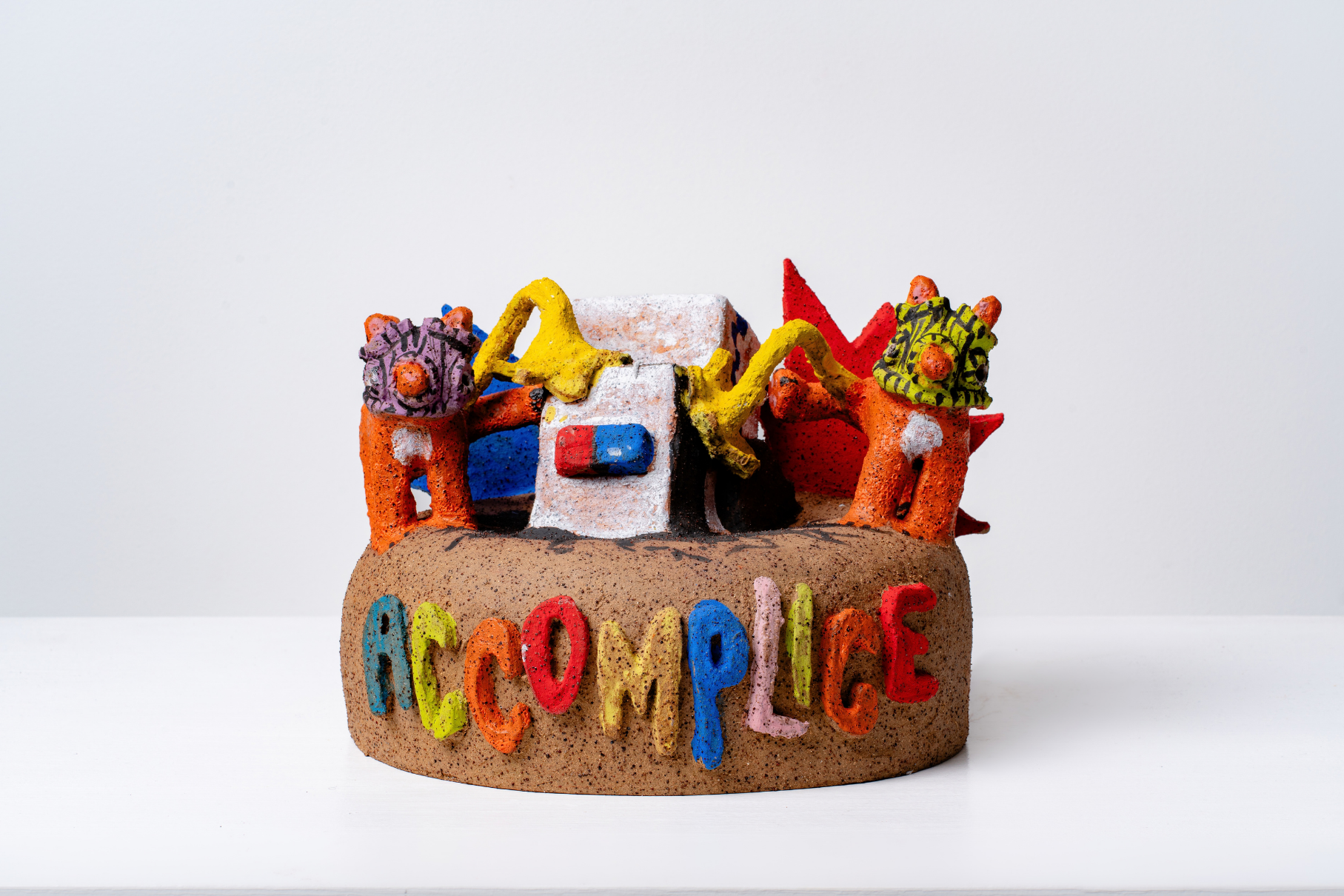
On Kaurna Country in Adelaide, inside the APY Art Centre Collective Studio, young Ngarrindjeri artist Tiarnie Edwards builds small, incendiary animal figures which carry Aboriginal resistance inside a language of eccentricity, cartoon and colour. For their upcoming debut solo exhibition, Accomplices, at Martin Browne Contemporary, Sydney, Edwards presents a body of fifteen new freestanding ceramics. Whilst seemingly visually grounded in whimsy and humour, there is nothing funny about the weight of history and nuance of intent in Edwards’ works, as they extend the current genre of Indigenous protest ceramics into confident new territory.
Edwards was born on Kaurna Yarta in 1998 and raised on Nauo Country in the small seaside community of Tulka, on the Lower Eyre Peninsula. One of nine siblings, as a child Edwards’ mother would take them to the community house next door where they would sit with senior women, copying flower images from old magazines. Edwards recalls, “there wasn’t much else to do. So, I got really into comic books, animation and really nerdy stuff.”
Despite this unassuming origin and entrée into art and creativity—mixed with some doubt from family and friends—by late 2020 Edwards had moved to Adelaide to study a Bachelor of Contemporary Art at the University of South Australia. They graduated in 2023. Ceramics entered their practice almost by accident via a production elective. Edwards remembers being awful at wheel-throwing noting, “It takes a lot of patience. . .precision.” What did take, however, was “something a little bit grittier,” hand-building, a technique where form can organically emerge through touch, rather than the relative discipline of the wheel.
The charge and desire to work with clay crystallised in Outlaws, 2024, Edwards’ graduating work, in which native Australian animals became personified; dingoes and kangaroos emerged as balaclava-clad teenagers, dressed in street clothing adorned with protest slogans. The work was selected for the Helpmann Academy Graduate Exhibition and Hatched: National Graduate Show at Perth Institute of Contemporary Arts (PICA). Outlaws led to a JamFactory residency which resulted in the solo exhibition Good Trouble for the 2025 Tarnanthi Festival, exhibited at JamFactory.
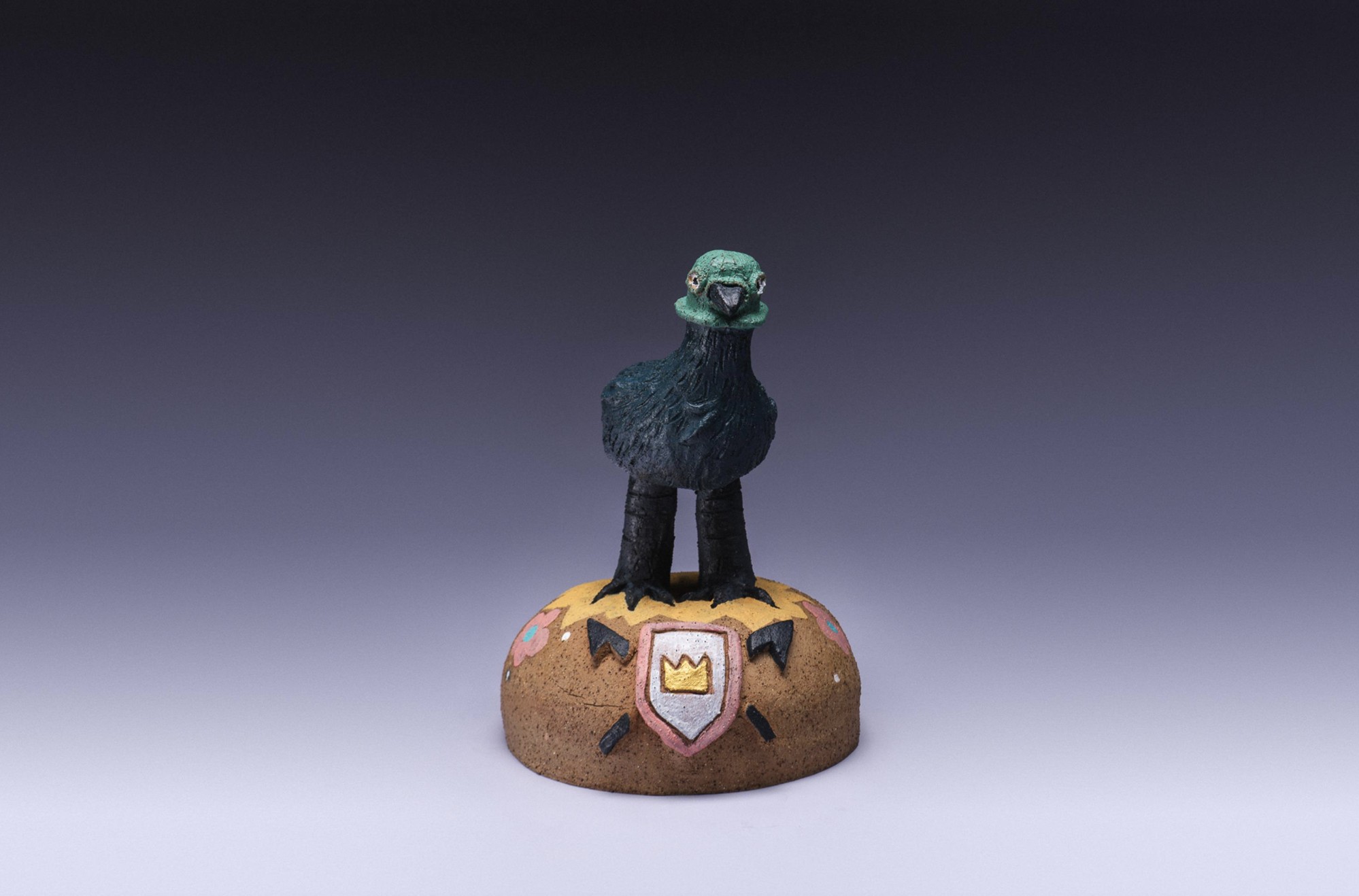
Tiarnie Edwards, Claws, 2025, buff raku trachyte clay, underglaze, acrylic paint, 28 x 20 x 18 cm.
Edwards works within a broader circle of Indigenous ceramicists currently reckoning with colonial histories in clay. Pitjantjatjara artist Josina Nyarpingku Pumani builds unglazed vessels in which scorched black surfaces conjure the impact of the Maralinga nuclear tests on Country and its people; Arrernte artist Alfred Lowe hand builds deliberately non-functional forms outrageously adorned with raffia; and Sydney-based Dharug ceramicist Billy Bain explores his urban, surfing-inflected identity and cultural ideologies of masculinity. Through reclamation of Country and the use of clay, contemporary First Nations artists are expanding modes of self-expression, Aboriginal culture and activism, and redefining what is contemporary Indigenous art through innovation.
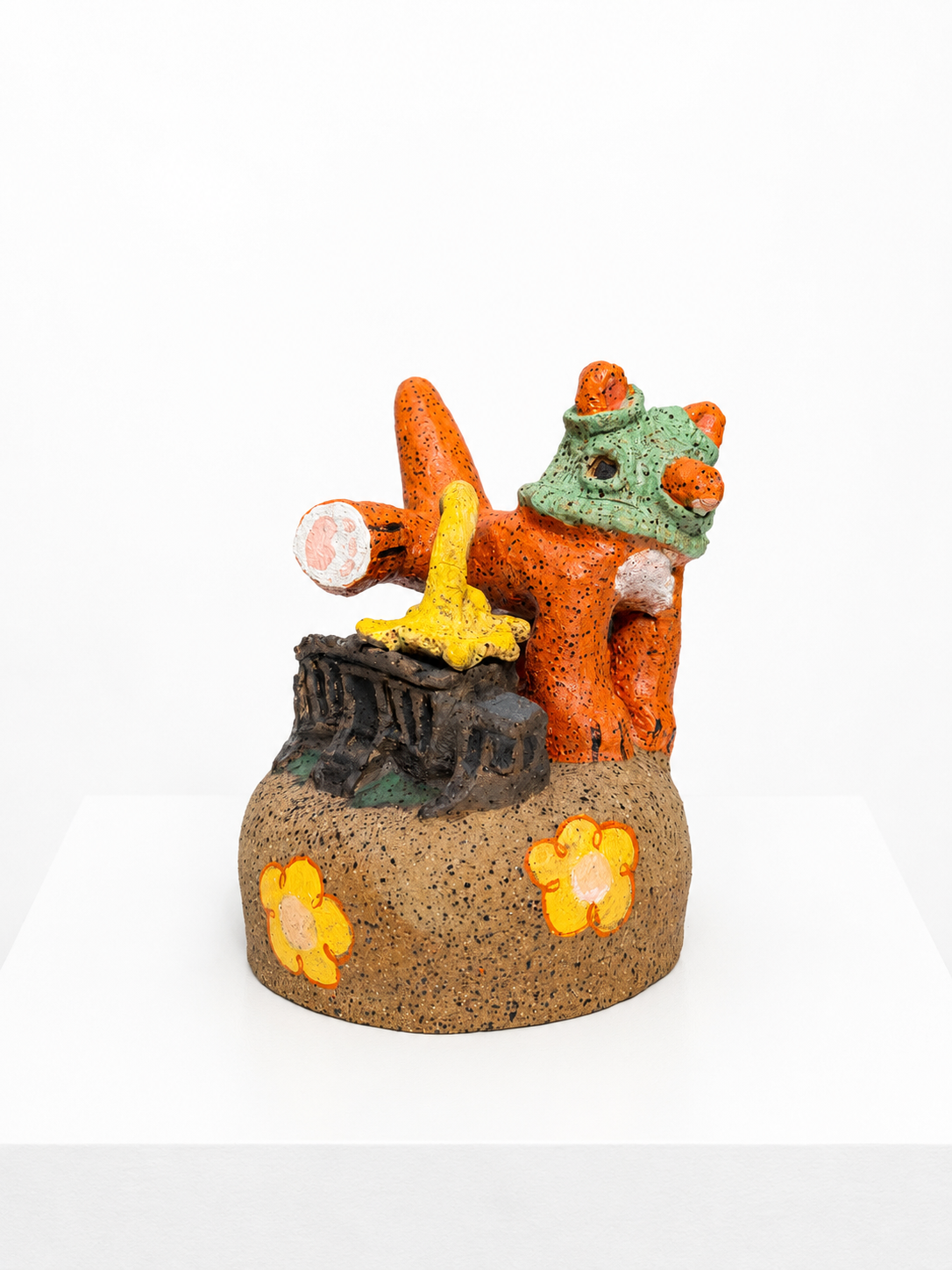
Tiarnie Edwards, Untitled (344-26AS), 2026, unglazed ceramic, 24 x 16 x 12 cm.
For Edwards’ animals carry an equally deliberate charge across the practice. Dingoes, emus and kangaroos—native fauna long flattened by colonial tourism into mascots and logos—are restored in Edwards’ hands to something closer to kin. Edwards explains, “It’s the personification of Australian native animals. . .to give them autonomy, give them narrative.” The connection between Indigenous people and Country’s wildlife is a “very real symbiotic relationship that has lasted throughout colonisation.” In Accomplices, Edwards has added a swan to this cast of creatures.
One Accomplices work, Live Laugh Light It Up, 2026, distils Edwards’ strategy into a disarming object. An orange dingo sits with its muzzle bound in a balaclava-patterned bandana, a flaming bottle slung across its chest, raised in one paw. Pressed into the grassy mound beneath its haunches, in bright hand lettering, is the work’s ironic title. The home decor cliché is repurposed as a call to arms, its combustible subject rendered quirky and adorable. This sleight of hand runs through Edwards’ work, trading on the disconnect between what their figures say and how they say it.
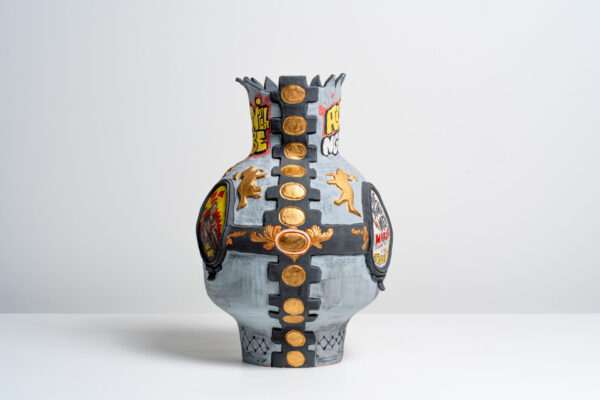
Tiarnie Edwards, Blak Bone, 2025, ceramics, 53 x 40 x 35cm.
This vocabulary first found sharp expression in Edwards’ vessel Blak Bone, 2025, a Churchie Emerging Artist 2025 finalist, where the surface is adorned with jewels and the top appears crown-like in its form—echoes of looted wealth. Inscribed with the phrase “the men marched down the road like thunder,” references the Pilbara Strike and its place in a longer line of Aboriginal workers’ rights movements. The work also folds in contemporary activists such as Gary Foley and Lidia Thorpe, setting present-day discourse within a longer continuum of resistance and Aboriginal Sovereignty Movements.
Of their ceramic practice and process, Edwards is aware of the repetitive nature of clay and kiln firing, however, they are unsentimental about repetition in terms of subject matter and art market demands: “I don’t want to make the same thing over and over again. I make the same thing if I like it.” Edwards fires each piece once, a practical necessity reflected in how they are created and painted, pushing the surfaces towards a bright, retro clarity. What distinguishes the new ceramics in Accomplices is their confidence. Edwards is unafraid to be funny on the way to being serious.
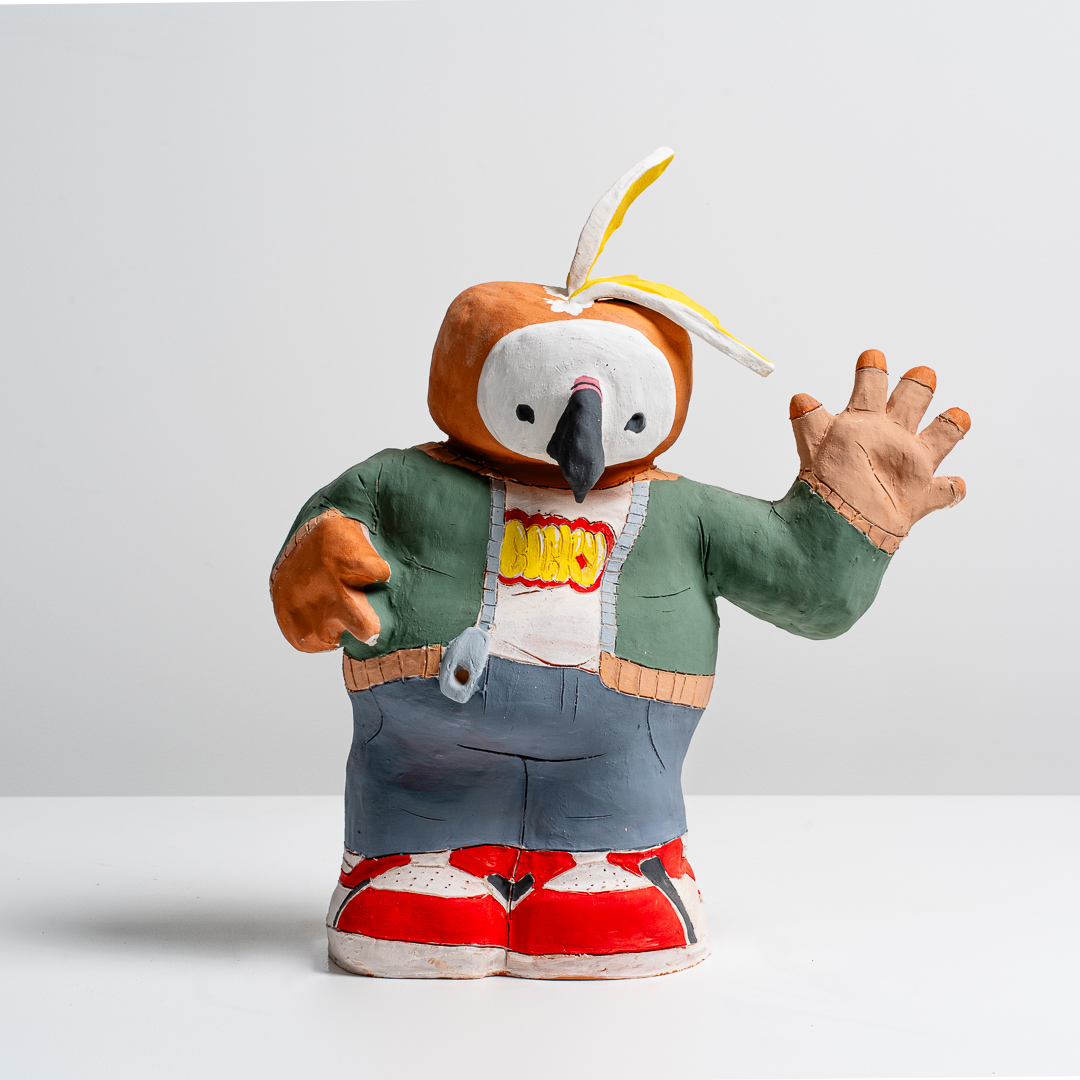
Tiarnie Edwards, Cocky, 2025, terracotta clay, underglaze, 28 x 20 x 18 cm.
Exhibition
Accomplices
26 September – 17 October 2026
Martin Browne Contemporary, Sydney
Images courtesy of the artist, APY Art Centre Collective, South Australia and Martin Browne Contemporary, Sydney.
Sarah Heatherington is a Sydney based arts writer and independent arts advisor.
The article was first published in Artist Profile Issue 76, 2026.

Under the auspices of Geelong Gallery’s director, Humphrey Clegg, and co-curated by Marianne Mathieu, former scientific director of the Musée Marmottan Monet, and Claire Durand-Ruel...
Nike Savvas: Purple Haze presents intimate screen prints and immersive large-scale installation and video work by Savvas from 2005–2026, each evocative of different places and...
Although physically he is of modest stature, Zofrea has devoted much of his life to grand projects that have been conceived and executed on a...
Through a multidisciplinary collaboration between Rotterdam-based curators, architect Paul Cournet of CLOUD and artist-designer Sabine Marcelis of Studio Sabine Marcelis, the exhibition explores the interplay...
Artificial intelligence will be used by young artists who started using it as kids on their phones. They will see it as a natural extension...

This year’s Biennale arrives under more complex circumstances than most. It is shaped by the profound loss of its curator, Koyo Kouoh (1967–2025), whose exhibition...
No artist creates in isolation. Every painting carries traces of the conversations, places and histories that shaped it, preserving within its surface a particular moment...
The weekend markets at Fairfield Showground have been one of Western Sydney’s great institutions for more than fifty years. Fresh fruit and vegetables, children’s clothes,...
In recent times, Yorgos Lanthimos has shifted toward photography, noting in a Guardian interview, 2026, that he needs respite, saying, “it might be a couple...