REVIEW I Deus Ex Lanthimos? Confused or confusing interventions in the work of Yorgos Lanthimos
Philosopher G. W. F. Hegel (1770–1831) speculated that the modern world gravitated toward irony over high tragedy. Oedipus took responsibility for predestined crimes but in modern times, as Hegel wrote, "owing to the complexity and ramification of action, everyone has recourse to everyone else and shuffles guilt so far as possible." Yorgos Lanthimos' films and photography serve as commentary on, maybe even a symptom of a post-tragic absurdity.
In recent times, Yorgos Lanthimos has shifted toward photography, noting in a Guardian interview, 2026, that he needs respite, saying, “it might be a couple of weeks, it might be years.” While bad news for cinephiles, this change presents an opportunity to reconsider his filmography, both as a whole and in relation to his photographs.
With exhibitions at Onassis Stegi in Athens (2026–present) and Webber Gallery in Los Angeles (2025), Lanthimos demonstrates the seriousness of his photography but also considers it a salve from the grind of filmmaking. Yet many of his photographs, almost existing between reportage and staged photography, were taken on sets. This includes an image of actor Jesse Plemmons from Kinds of Kindness, 2024, dressed as a police officer, his back toward the camera. Another photograph shows actor Jerrod Carmichael against a mesmerising backdrop from Poor Things, 2023, revealing the artificiality of the set. A sense of the mismatched extends in a photograph, again from the set of Poor Things, featuring boys in Victorian garb standing on glowing tiles (which reminds me of Dave coming face to “face” with the alien monolith in 2001: A Space Odyssey, 1968). Even Lanthimos’ photographs of non-actor subjects often concentrate on moments without context or on body parts. This underscores the relationship between the individual / part and the whole. Photography tends toward a moment, a fragment, a part of an action or a situation rather than a totality and thus supposes a relation to the whole. But should the captured moment exemplify interrelations, or should it defer to this totality? Lanthimos opts for a third possibility: disruption.
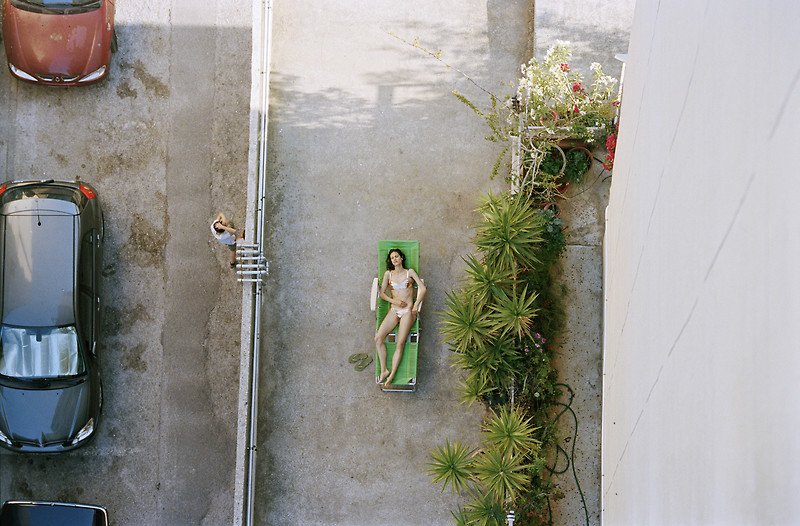
ΘΑΛΑΣΣΑ (Sea), 2019, digital image, Vogue Greece (series).
In contrast, film theorist André Bazin (1918–1958) considered film to be photographic and indexical, referring to the principle of reality and a “reality” constructed through mise-en-scène. For Bazin, the “long take” (a shot uninterrupted by cuts) conveys a coherent world documented to the viewer, whereas the excessive use of editing or stylised sets disrupts filmic reality / totality. Stylisation jumbles a character’s / audience’s relationship to space and thus interrupts the interplay of agency, including the agency of the viewer to engage with the shot. Disregarding Bazin’s realism, Lanthimos’ movies and photographs delight in disruption.
Even his early works, most powerfully Dogtooth, 2009, concerns people acting in odd, unrealistic ways. Dogtooth concerns a family dynamic in a compound where parents continue to deceive their adult children about the world—such things chillingly happen. In The Lobster, 2015, people are turned into animals if they can’t find a romantic partner—this coerced partnering is based on arbitrary shared traits, including limps (film critics made comparisons to online dating). Moreover, in The Killing of a Sacred Deer, 2017, a kind of cosmic revenge is threatened by the son of a deceased patient (Barry Keoghan) if the surgeon-protagonist (Colin Farrell) does not sacrifice a family member in an appropriation of Euripides’ Iphigenia in Aulis, c. 410 B. C. E. These films exemplify an absurdist vision of the world not merely through their strange premises but through intentionally clunky dialogue spoken without emotional cadence. Sometimes Lanthimos uses fisheye lenses or zooms, reminiscent of sixties and seventies cinema, that again reinforce an experience of disorientation.
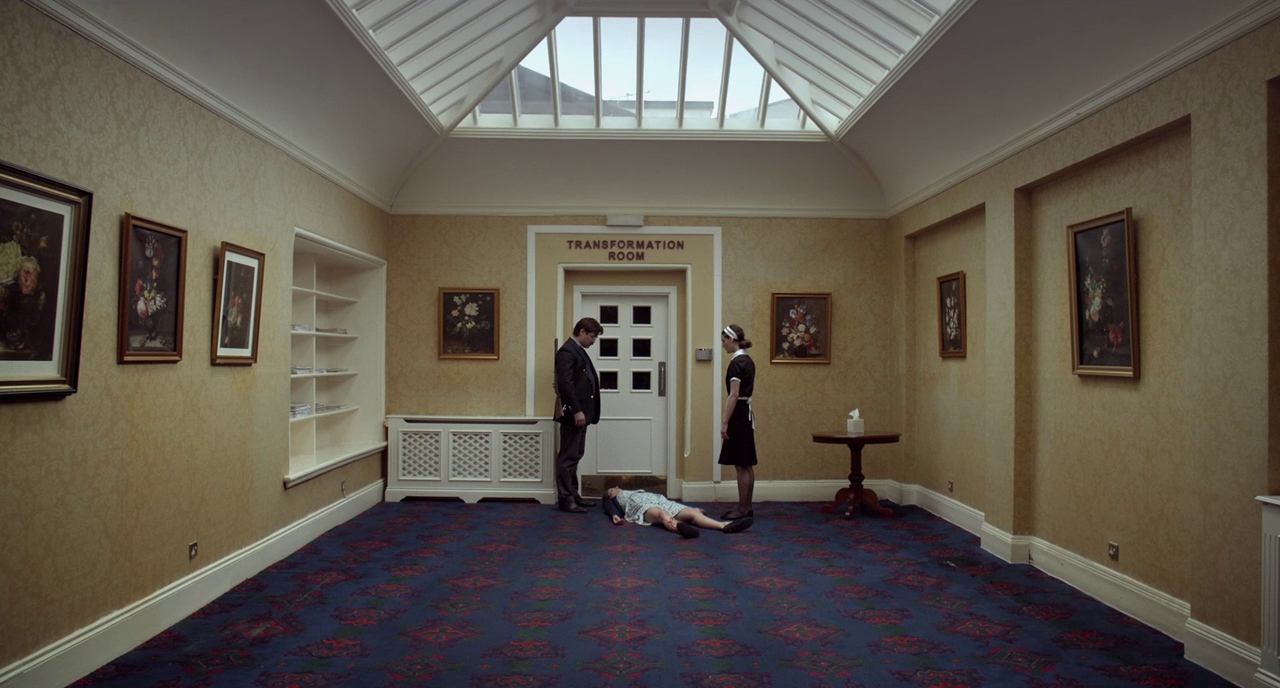
The Lobster (film still), 2015, film, 1 hr 58 min.
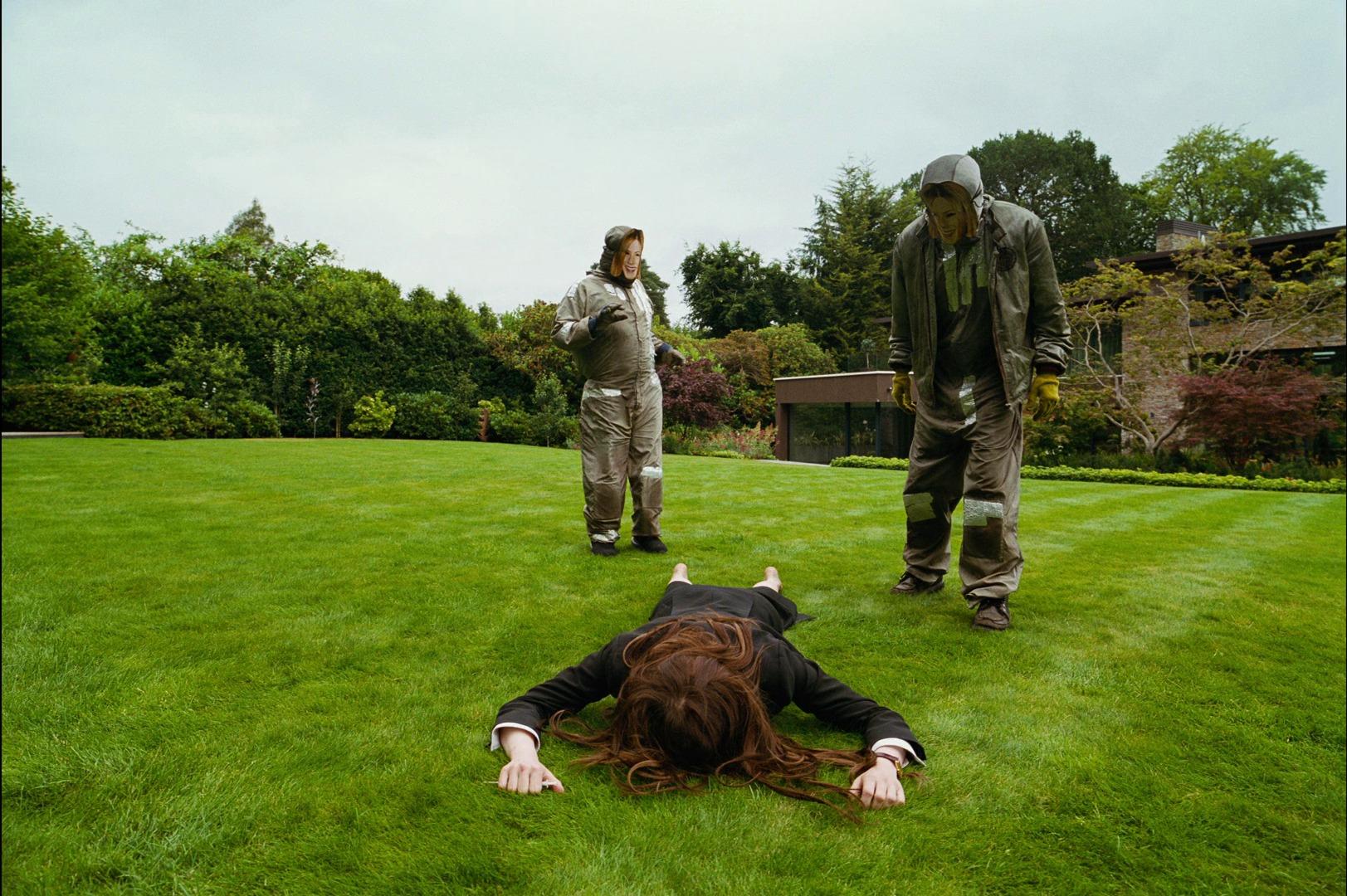
Lanthimos presents a reality that is interrupted and defiant of explanation. This remains true when Lanthimos considers not merely society but also the universe. Bugonia, 2025, his most recent film, explores concepts of original sin and the fall, also present in Greek myth—think Zeus’ desire to wipe out humanity and start again and Prometheus’ transgression. At the risk of spoiling the end, humanity is not saved; instead, there is a comical montage of dead bodies in various positions: at school, at a dance club, at the beach, in a dinosaur museum. When dealing with cosmic forces and human insignificance, the result is not that of high tragedy or Lovecraftian cosmic horror. Distance, discomfort and humour mingle in a post-tragic absurdism. As the song, “Where Have All the Flowers Gone?” plays over images of corpses, it is difficult not to laugh, either with the film or at its heavy-handedness. Bugonia‘s imagery of aliens dressed in strange, movement-impairing outfits accentuates the ridiculous extinction. Other films about human extinction serve as metaphors for climate change—and this feels true of Bugonia too as the aliens judge human beings as ecocidal and genocidal—but there seems only faint protest at humanity’s inability to grapple with the capitalist (dis)order to prevent ecological destruction. It is almost as if humanity were, to quote Teddy (Jesse Plemons) in Bugonia, “a dead colony atomised in a trillion directions . . ..” Ancient and feudal concepts of justification, duty and order are gone. While notions of fate and chance offer a contrast between the predestined and the random, both empty the universe of meaning. In Lanthimos’ work, macroscopic powers and systems intersect with random microscopic events, defying human agency. Yet some of Lanthimos’ films explore the challenge to be free, to defy rules and to find or exert one’s own order amid the random and the foretold (Dogtooth, The Lobster, Poor Things, Kinds of Kindness and even Bugonia).
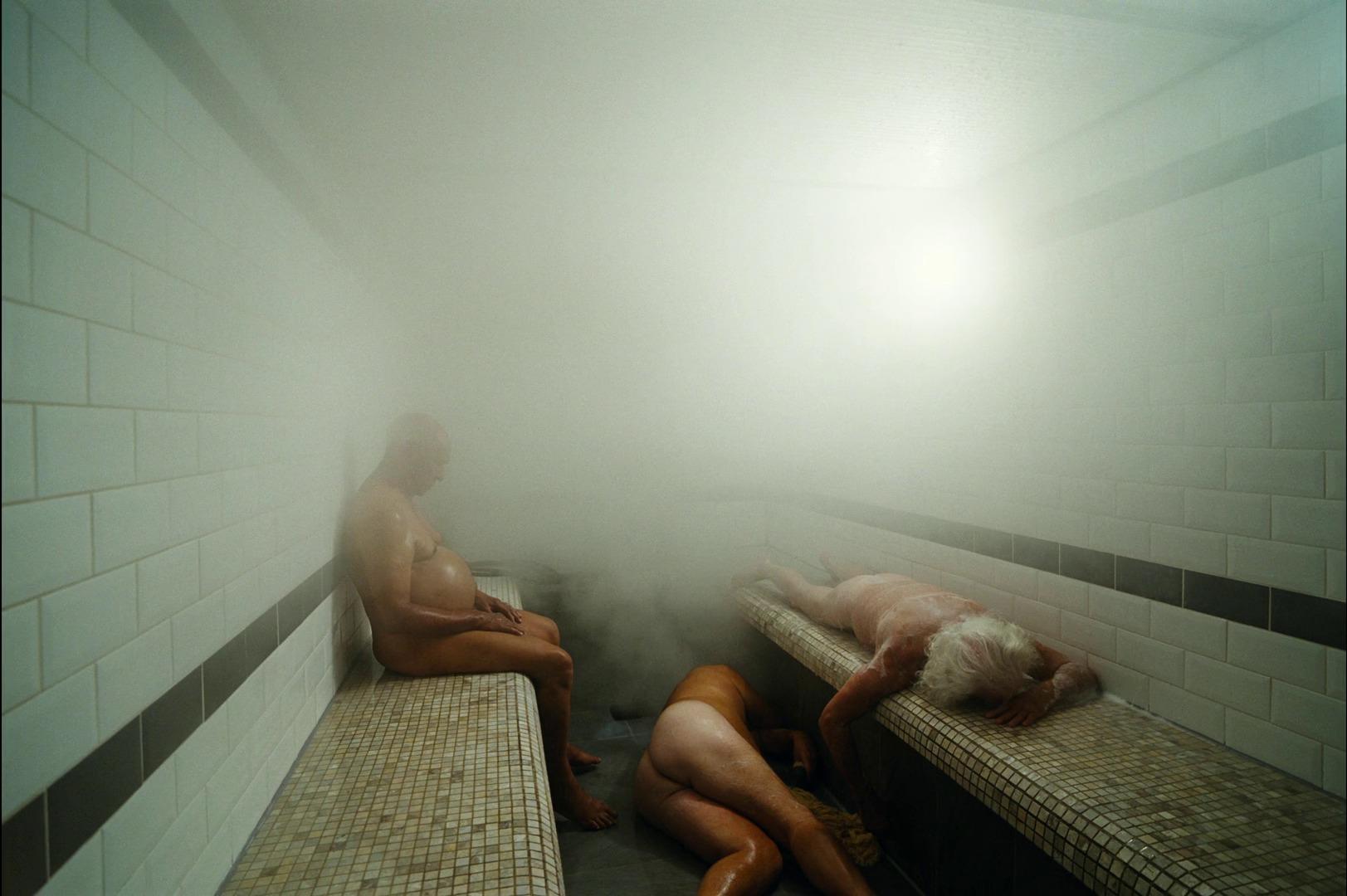
Bugonia (film still), 2025, film, 1 hr 58 min.
Although Lanthimos’ recent endeavours hover nearer to Stanley Kubrick and Michael Haneke than to Franz Kafka (1883–1924), Samuel Beckett (1906–1989), or Harold Pinter (1930-2008), his work exists just shy of the nihilism of the Chapman brothers but without the joyous bathos of Maurizio Cattelan or dada. To approach nihilism is paradoxical for art, as it deprives art(ice) of a point. Is Lanthimos’ disruptions evidence of the arbitrary “order of things,” a deus ex machina, or are his stylistic oddities an expression of disruptive freedom?
This question has implications for the strange, playful aestheticism found in Lanthimos’ recent films: the use of black-and-white slow-motion sequences in Poor Things, Kinds of Kindness and Bugonia, which recalls artistic photomontages. These sequences display a dadaist or surrealist juxtaposition, the significance of which is unclear given that filmic reality is already vitiated. In Poor Things, gothic oneiric imagery is operatically heightened as though commenting on the very genre of the gothic. Indeed, the film is particularly jarring in its jumbled aesthetic, perhaps evoking its Frankensteinian subject matter. The twisted Bildungsroman narrative concerns Bella Baxter (Emma Stone), the creation of the mad scientist Godwin Baxter (Willem Dafoe) who has taken the body of a suicided pregnant woman and replaced her brain with that of her unborn foetus. Lanthimos despite Dogtooth‘s Haneke-esque mastery and his cinematic trademark devices—awkward dialogue, quirky filmic devices and tendency to reuse actors—is still Bella Batxer finding or innovating a style.
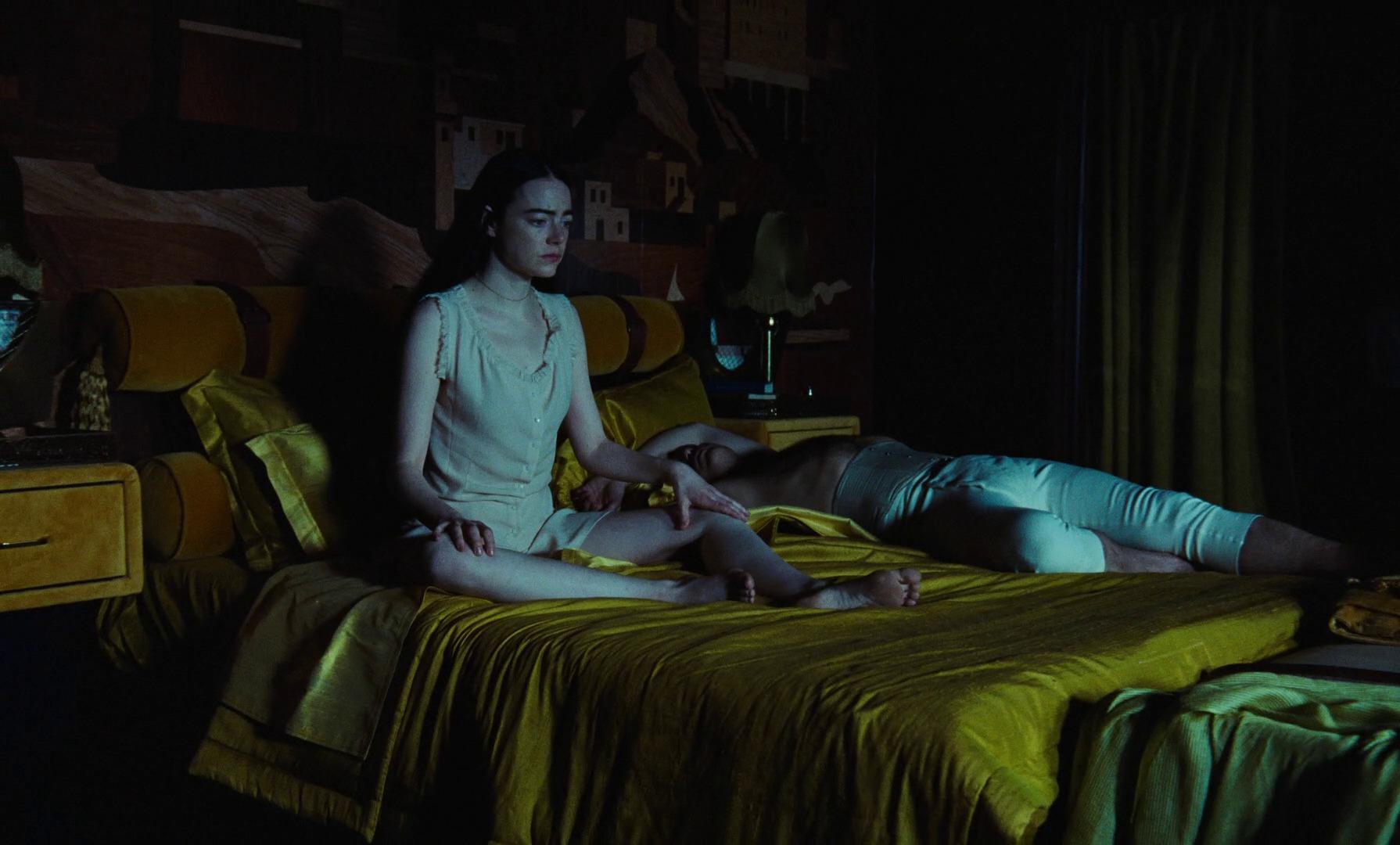
Poor Things (film still), 2023, film, 2 hr 21 min.
Apart from issues of fate and cosmic insignificance, his work explores cruelty, the psychosexual, reward and punishment, familial love, and curiously, education. I seldom feel, with some exceptions, that Lanthimos’ films work but there are always interesting stylistic choices and profound issues at play. Possibly this is because of the discombobulated aesthetic or perhaps the issues are too big for Lanthimos. Is this a weakness or a strength?
Given the current (post-tragic?) absurdity of Trump, it is a pity Lanthimos is taking a break from film, which as a medium offers the possibility of mediating absurdity through narrative. But Lanthimos’ photography reveals a more subtle quirkiness than is often present in his films, offering us respite from the more grotesque absurdities threatening the world.
Exhibition
Yorgos Lanthimos: Photographs
7 March-17 May 2026
Onassis Stegi, Athens
Dr Aleksandr Wansbrough is a writer, lecturer and artist, interested in film, art and philosophy.
Images courtesy of the artist.
The article was first published in Artist Profile Issue 75, 2026.

In Australia, political cartoons were altered by several events during the 1960s: the arrival of Les Tanner’s (1927‒2001) instinctual wit at The Bulletin, Bruce Petty’s...
Recognition of the importance of early bark paintings and their link to the world’s oldest continuing culture, is what makes them both highly sought and...

I had come to see my daughter sing in Deborah Kelly’s Creation Choir and was fortunate enough to make it inside the gallery for the...

Cuban-born, Brisbane-based artist Jorge Mariño Brito’s practice unfolds across two material registers that are best understood not as parallel tracks but as entwined explorations. Both...
The first work you encounter in Edge City is a gate, Settlement #8, 2025. Not one to pass through (not anymore), but a threshold nonetheless....
Designed to impress, the number and size of paintings—twenty-nine at nine square metres each and one even bigger—are a spectacle, lifting the exhibition from an...
Skilfully assimilating secondary sources throughout Paris in Ruins, Smee at the conclusion of Part One, “Salon of 1869,” writes that Auguste Renoir’s and Claude Monet’s...

Multidisciplinary artist Shireen Taweel looks skyward, into the night and beyond, with her exhibition the trig point. Drawing on fieldwork in 2025 at the Siding...

It was back in 2011 that Pip Wallis, senior curator at the Monash University Museum of Art (MUMA), remembers first seeing the work of Balinese...