
Wendy Stavrianos
Nicholas Thompson presents an exhibition that marks the fiftieth anniversary of Wendy Stavrianos' first solo exhibition in 1967.

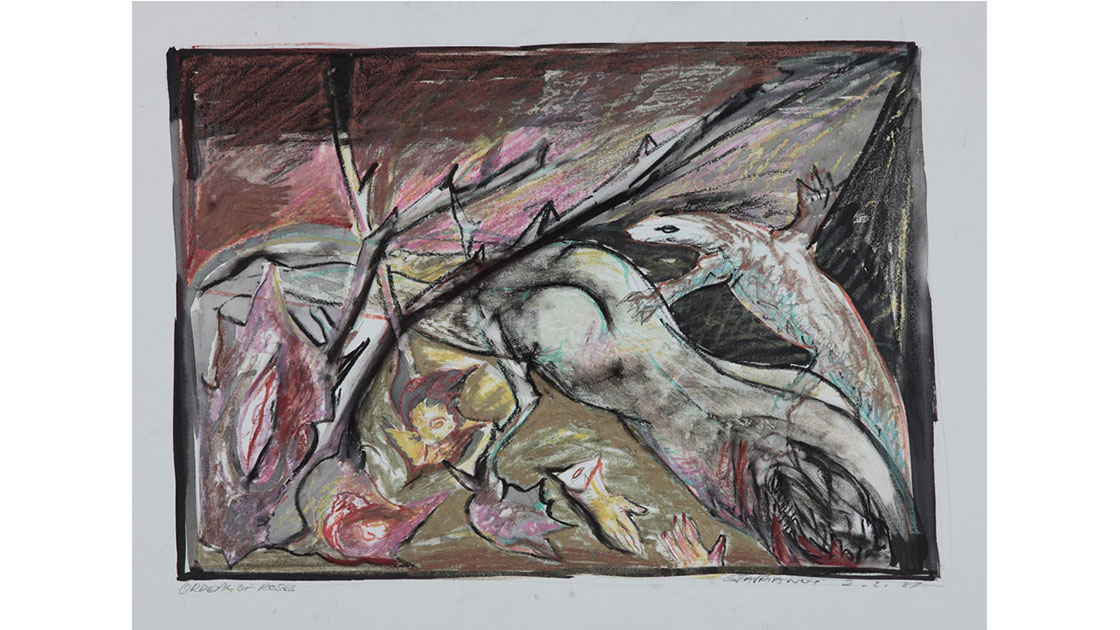
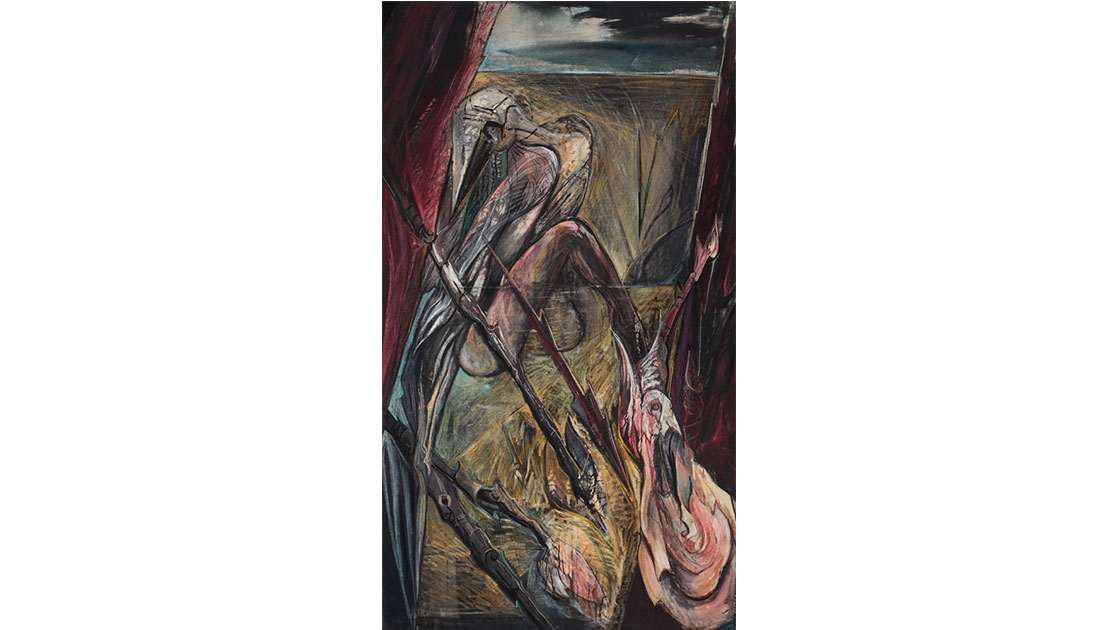


To mark this significant point in Stavrianos’ career, the exhibition ‘Rage, Memory & Desire: Revisiting the 1980s’ looks to a powerful and potent period of the artist’s career.
Charged and intense, the bringing together of this series is an insight to a time of change and personal challenges for the artist. Speaking of the period, Stavrianos reflected, “Looking back, the 1980s was for me an incredible creative time, although a period of great upheaval. There was an outpouring of work over those ten years between 1980 and 1990 that expressed authentic emotions, not of the fake kind. These were so overpowering at times that they seemed to break through a wall inside me, shattering all the past conditioning that had been built up since childhood. It was as if I had come to a crossroad, where life and art merged and could not be separated. I felt then, that my passion had at last found its form.”
During the mid to late 1980s the paintings Stavrianos was producing looked to the landscape, with the artist gathering inspiration from her travels to the Willlandra Lakes in Mungo National Park, to the coast of Tanya in New South Wales and the artist’s property in Victoria.
Alongside the embedded stories of places in her works, this series of works was greatly influenced by her European travels. In the exhibition essay Laura Murray Cree writes of the influences of Uccello’s Rout of San Romano (c.1438-40) at London’s National Gallery and Matthias Grunewald’s Isenheim Alterpiece (1512-16), alongside Jungian psychology and the feminist project of academic Camille Paglia to unite the Apolloinian male principle of the sky gods and the Chthonian body of mother earth.
Loaded with narrative from Australia and Europe, the visually intense paintings need to be experienced in person in order to be immersed in Stavrianos’ poetic abstraction.
EXHIBITION
Wendy Stavrianos | Rage, Memory & Desire: Revisiting the 1980s
Nicholas Thompson Gallery
16 September – 8 October 2017
Courtesy the artist and Nicholas Thompson Gallery.

Edwards was born on Kaurna Yarta in 1998 and raised on Nauo Country in the small seaside community of Tulka, on the Lower Eyre Peninsula....
Under the auspices of Geelong Gallery’s director, Humphrey Clegg, and co-curated by Marianne Mathieu, former scientific director of the Musée Marmottan Monet, and Claire Durand-Ruel...
Nike Savvas: Purple Haze presents intimate screen prints and immersive large-scale installation and video work by Savvas from 2005–2026, each evocative of different places and...
Although physically he is of modest stature, Zofrea has devoted much of his life to grand projects that have been conceived and executed on a...
Through a multidisciplinary collaboration between Rotterdam-based curators, architect Paul Cournet of CLOUD and artist-designer Sabine Marcelis of Studio Sabine Marcelis, the exhibition explores the interplay...
Artificial intelligence will be used by young artists who started using it as kids on their phones. They will see it as a natural extension...
This year’s Biennale arrives under more complex circumstances than most. It is shaped by the profound loss of its curator, Koyo Kouoh (1967–2025), whose exhibition...
No artist creates in isolation. Every painting carries traces of the conversations, places and histories that shaped it, preserving within its surface a particular moment...
The weekend markets at Fairfield Showground have been one of Western Sydney’s great institutions for more than fifty years. Fresh fruit and vegetables, children’s clothes,...