TRIBUTE I Béla Tarr: the sound of the dead
On 6 January, 2026, Béla Tarr (1955–2026) died. For cinephiles, the mourning had set in before the loss. Tarr heralded his 2011 film The Turin Horse, as his final directorial feature. This was not an attempt to drum-up publicity and, indeed, the pronouncement found unwelcome confirmation.
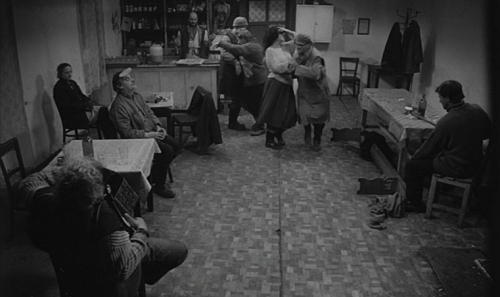
Tarr may not be a household name but he is an arthouse-hold name, known primarily for his mature, signature works as director—Damnation, 1987, Sátántangó, 1994, Werckmeister Harmonies, 2000, The Man from London, 2007, and The Turin Horse. These works are all black and white, with long takes and a focus on mud, wind, rain, decaying surrounds and misery. Tarr once expressed his filmic worldview as: “I think a whole pile of shit is coming from the cosmos.”
But in this maelstrom, it is not only humanity Tarr mourns. There’s a scene in Sátántangó where a girl, Estike, tortures a cat for a protracted length of time. In Werckmeister Harmonies, there is a decaying stuffed whale, part of a circus attraction, that is abandoned on the street, evoking the modern condition of being displaced. The Turin Horse is an imagined glimpse at the horse Nietzsche apocryphally embraced before his mental collapse. The horse signifies the suffering and burden of life. One can’t deny Tarr’s films are grim, even if one, perhaps cathartically, experiences his mature works as waking dreams.
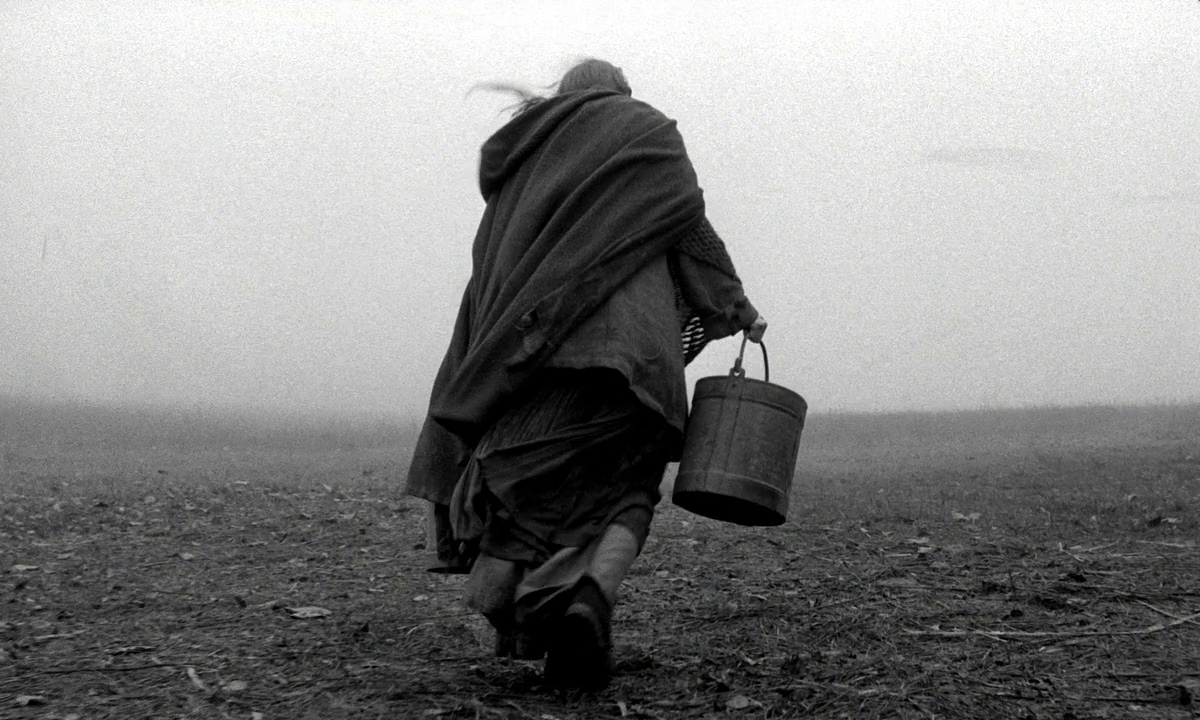
The Turin Horse (film still), 2011, digital image, 2 hr 26 min.
Tarr’s early films from the late seventies and early eighties were social realist, Tarr reflecting that “we will shoot on 16mm, in black and white and with non-professional actors, real people, real proletarians, without dialogue, just some improvisation.” His 1982 television adaptation of Macbeth signals his departure from social realism. While in colour and shot on video, Tarr’s mastery of the long take is pronounced: there are two shots and the second lasts 57 minutes. Tarr’s signature style is first exhibited in his portrait of desperation, Damnation. On the surface, Damnation may suggest continuities with social realism, following Karrer who hatches a desperate scheme to win over a married nightclub singer. However, the plan fails and he is reduced to barking at stray dogs amid rain and mud as hope to escape purgatory is revealed to be hell’s chief torment.
Instead of gritty realism there is grim mesmerism as time itself acquires a material presence, weighed down by history and the routine of day-to-day life. Yet, Tarr’s following feature, Sátántangó, is surprisingly tense and very funny despite its 439–minute runtime. The film opens with a long and muddy take of bulls mounting cows. Another moment of comedy comes when police must reword a vulgar description of a woman’s promiscuity. They settle on “a paragon of conjugal infidelity.” Yet, the possibility of beauty haunts the film. Villagers, after the collapse of the collective farm and the suicide of the disturbed child, Estike, come to place their faith in the criminal, Irimiás. Irimiás, acting like a religious prophet, promises a kind of salvation, played by the film’s composer Mihály Víg. Irimiás is a mysterious criminal who also informs for the police—it is his report the police must tidy-up. But Irimiás and other characters are haunted by a mysterious, ethereal and droning sound. Could it be bells? The church bell was destroyed during the war. The character of an obese, alcoholic doctor discovers the truth when he ventures out of his squalor. He finds the origin of the sound, a deranged man chanting and pounding the bell’s still-remaining clapper with a metal bar. In the doctor’s words, “I’ve mistaken the bells of the sky for the sound of the dead.”
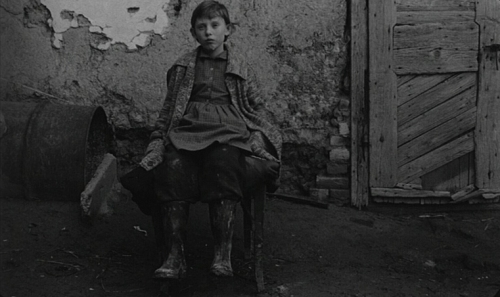
Sátántangó (film still), 1994, digital image, 7 hr 30 min.
Reminiscent of issues explored by Fyodor Dostoyevsky (1821–1881) and Andrei Tarkovsky (1932–1986), the film has no faith in salvation. As Tarr said, “Rain in [Tarkovsky’s] films purifies people. In mine it just makes mud.” The resultant mud isn’t purifying but it is captivating. Sátántangó‘s revelation suggests that beauty can be the product of ugliness and violence, even if it is a beauty without higher meaning.
I regret that I never met or interviewed Tarr. It is clear though that Tarr was a paradoxical filmmaker; a filmmaker whose works are singular, saying something that no other filmmaker quite expresses even though one can also detect stylistic similarities with other directors. He was an auteur who was eager to credit others. For instance, Tarr shared directing credit with his long-time collaborator, editor and wife, Ágnes Hranitzky, on Werckmeister Harmonies and subsequent films. His signature films were co-written by László Krasznahorkai, who would win the Nobel Prize in Literature in 2025. And Tarr’s late works depended on scores by Mihály Víg. His films are the product of creative collaboration and his distinctive vision.
Werckmeister Harmonies (film still), 2001, digital image, 2 hr 25 min.
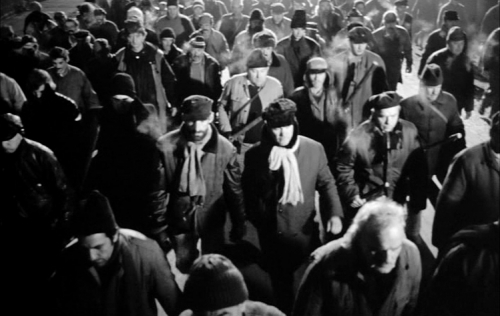
Tarr’s films were political but had a cosmic aspiration, expressing the lived reality of Soviet and post-Soviet bloc conditions while also exploring human finitude. Tarr detested repression though his career may have been the product of repression. (Due to his early filmic experiments, Tarr was barred from studying philosophy at university and thus had to abandon his aspiration to be a philosopher.) He was mindful of the ability of people to be led, thus intimating that chaos and authoritarianism are not mutually exclusive. He stated in an interview with The Guardian‘s Peter Bradshaw that his depiction of mass deception in Werckmeister Harmonies, where a circus performer hypnotically harnesses mob rage, was “not only about fascism” but rather “about all populism.” Having lived to see the end of “Goulash communism,” he sadly did not live to see the landslide electoral defeat of Orbán’s authoritarian government. There is an irony that the date of his death, January 6th, has a political valence.
Despite his departure from directing feature films, Tarr did not abandon cinema. In 2017, Tarr made a short documentary film, Muhamed in solidarity with refugees. He created a documentary cinema installation, Missing People, 2019, capturing wealth disparity in Vienna, focusing on those without a home. He ran an experimental, doctoral film school, film.factory (2013-2017), and also went on to produce the arthouse horror Lamb, 2021, serving as executive producer for his former student, Valdimar Jóhannsson. Many filmmakers have and will be influenced by Tarr.
In Susan Sontag’s provocative 1995 essay, “A Century of Cinema,” Sontag briefly asks, “And what will happen now to Béla Tarr?” Now that Tarr is dead, we may ask just that. We can know this: his films offer more than the sound of the dead. They offer the sound of life too, in all its struggle.
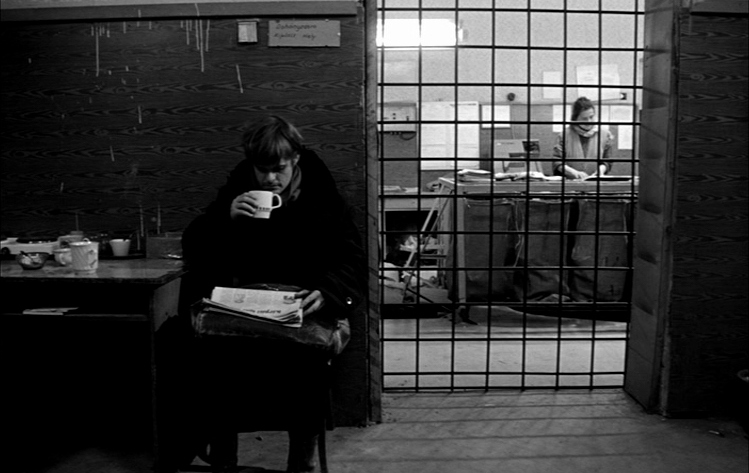
Werckmeister Harmonies (film still), 2001, digital image, 2 hr 25 min.
Films
Title: Bela Tar I A Curzon Collection (Limited Edition) Box St
Produced by: Curzon Film, United Kingdom
Contributors: Bela Tar, Erika Bok, Lars Rudolh, Mihaly Vig, Tilda Swinton
Released: August 2026
Language: Hungarian
Runtime: 800 min.
Dr Aleks Wansbrough is a Sydney based academic, artist and writer who teaches art and film theory.
Images courtesy of the artist.
The article was first published in Artist Profile Issue 76, 2026.
We call on the NSW Government to lift Lisa Havilah’s suspension and reinstate her as Chief Executive of Powerhouse, allowing her to lead the opening...
Two years ago, Macleod returned to his hometown of Christchurch, New Zealand, to be with his mother during the final phase of her life. At...
Edwards was born on Kaurna Yarta in 1998 and raised on Nauo Country in the small seaside community of Tulka, on the Lower Eyre Peninsula....

Under the auspices of Geelong Gallery’s director, Humphrey Clegg, and co-curated by Marianne Mathieu, former scientific director of the Musée Marmottan Monet, and Claire Durand-Ruel...
Nike Savvas: Purple Haze presents intimate screen prints and immersive large-scale installation and video work by Savvas from 2005–2026, each evocative of different places and...
Although physically he is of modest stature, Zofrea has devoted much of his life to grand projects that have been conceived and executed on a...
Through a multidisciplinary collaboration between Rotterdam-based curators, architect Paul Cournet of CLOUD and artist-designer Sabine Marcelis of Studio Sabine Marcelis, the exhibition explores the interplay...
Artificial intelligence will be used by young artists who started using it as kids on their phones. They will see it as a natural extension...

This year’s Biennale arrives under more complex circumstances than most. It is shaped by the profound loss of its curator, Koyo Kouoh (1967–2025), whose exhibition...