
New Histories
‘New Histories’ sees ten contemporary artists and collectives create new works that reimagine historic paintings from Bendigo Art Gallery’s 19th and early 20th century Australian and European collection. Informed by evolutions of technological, social, environmental and political significance, the contemporary artists challenge the nature of art as historic record and question the role of the artist and museum in the 21st century.





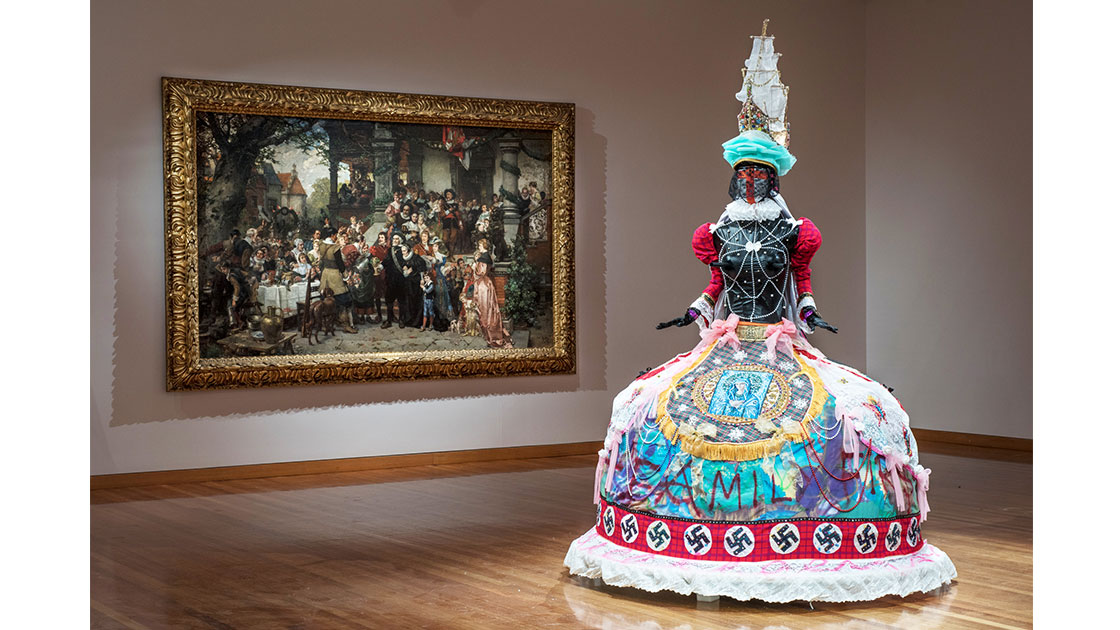
Encompassing performance, sound, film, painting and textiles, the presentation subverts what Curator Jessica Bridgfoot suggests is ‘the legacy of a Euro-Western superiority complex’. In her catalogue essay, Bridgfoot comments, ‘The voices of the First Nations peoples and the non-western-elite are omitted in a scramble to place Bendigo in line with its European and English Colonial counterparts as well as satiate the nostalgic needs of the new emigrants. Thus Bendigo Art Gallery’s collection offers a white male narrative of early Australia reflecting the interests and homelands of the new colonists, celebrating their conquests and omitting existing cultures in favour of a ‘Terra Nullius’ narrative.’
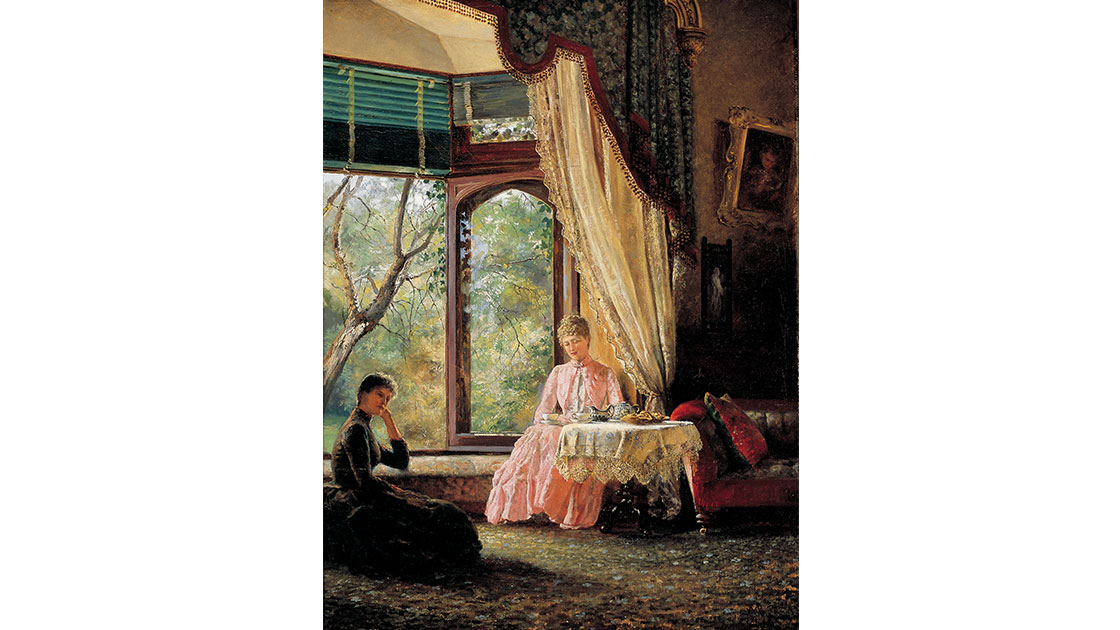
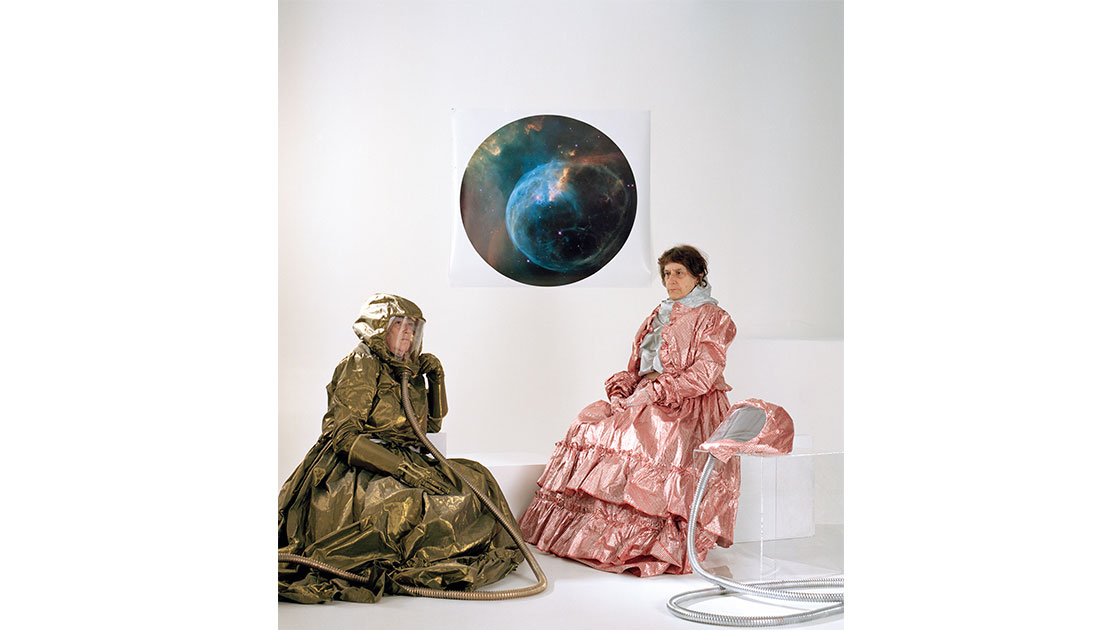
Among the works from the Collection, Emma Minnie Boyd’s painting Afternoon Tea (1888) – the first work by a female artist to enter the Gallery’s collection – depicts two women engaged in the Victorian art of tea inside the well-appointed Boyd family home in St Kilda East. Melbourne artist Andrew Goodman filters this domestic scene through a feminist utopian sci-fi lens with his photograph Untitled (afternoon Tea 2188) (2018). Projecting a fictional femme future with two women dressed in Victorian-esque space dresses, Goodman questions, ‘What future did Emma Minnie Boyd imagine for her two protagonists, sitting patiently in their drawing room? I like to imagine that she saw, with the dawning of modernism, a rapidly expanding horizon for such young women… perhaps they have found a room of their own: where they are unencumbered by the male gaze in a women’s domain and where they… can imagine different lives.’
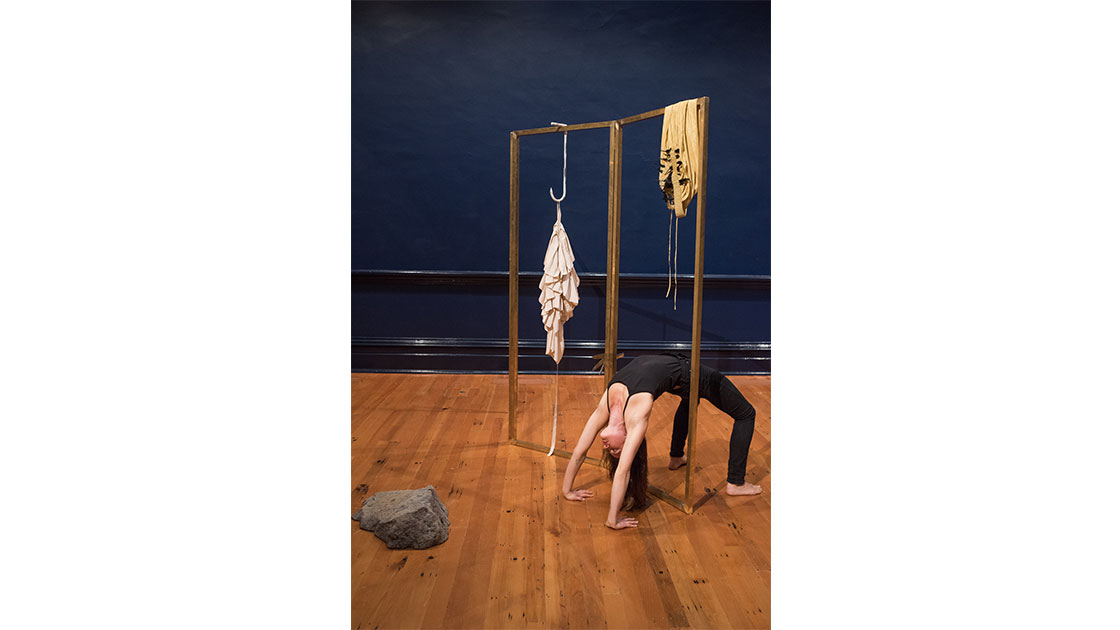
From a similar stance of gender enquiry, Melbourne artist Bridie Lunney reinterprets Rupert Bunny’s 1913 painting The Sun Bath, which portrays three women in various states of undress, their soft figures almost as decorative as the sensuous fabrics and exotic privacy screen. Lunney’s durational performances Always Radiant (2018) investigate the gender politics buttressing Bunny’s process of employing male models in staged photographs that would then be switched to female figures in his paintings. Featuring the contorted body of contemporary dancer Lily Paskas against a steel screen minimally adorned with Ann Demeulemeester garments, the work subverts the representation of ‘feminine beauty’ and generates, in the artist’s own words, ‘alternative gestures to the problematic repetition of passive, semi naked female bodies within art history.’
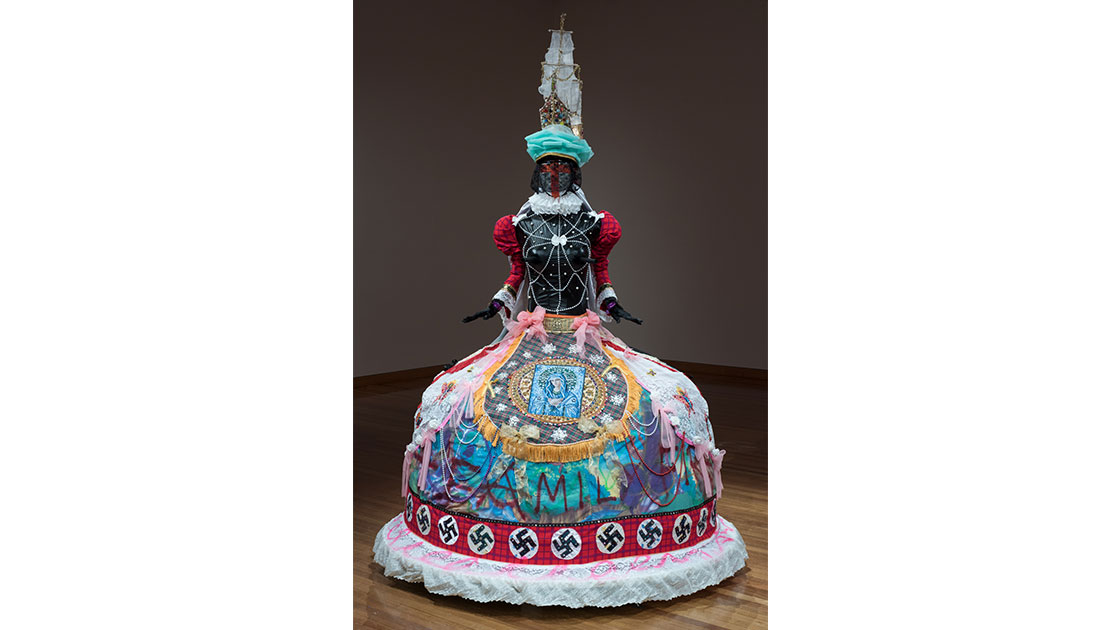
Perhaps one of the more critical works in the show is The Birth of a Nation (2018) by FAMILY FIRST! (Paul Yore and Devon Ackerman), which responds to German artist Carl Hoff’s 1883 painting The Golden Wedding. About the work, Paul Yore and Devon Ackerman describe, ‘the nauseating glut of disagreeable forms rendered in dirty tones… its mind-numbing subject rendered on a needlessly mammoth scale and with plagiaristic flair’. For the duo, most alarming is the painting’s ‘unthinking prefiguring of Nazism and the persistence of a globalised mythos of white, Anglophone cultural ascendancy’. The Birth of a Nation is an anachronistic textile figure clad in a constrictive corset and large crinoline reminiscent of the Victorian period, bordered with a row of swastikas. ‘Our spectral sculpture warns against mythologising history into a grand (heterosexual) male-dominated white narrative and queries the value systems underpinning the traditional institutions of the Church, State, and the family unit itself,’ remark the artists.
By shining a light into the shadows of untold histories, hidden figures and veiled narratives, ‘New Histories’ disrupts the status-quo and enables a diversity of voices to be heard.
EXHIBITION
New Histories
Bendigo Art Gallery, Victoria
13 April – 29 July 2018

Artificial intelligence will be used by young artists who started using it as kids on their phones. They will see it as a natural extension...
This year’s Biennale arrives under more complex circumstances than most. It is shaped by the profound loss of its curator, Koyo Kouoh (1967–2025), whose exhibition...
No artist creates in isolation. Every painting carries traces of the conversations, places and histories that shaped it, preserving within its surface a particular moment...
The weekend markets at Fairfield Showground have been one of Western Sydney’s great institutions for more than fifty years. Fresh fruit and vegetables, children’s clothes,...
In recent times, Yorgos Lanthimos has shifted toward photography, noting in a Guardian interview, 2026, that he needs respite, saying, “it might be a couple...
In Australia, political cartoons were altered by several events during the 1960s: the arrival of Les Tanner’s (1927‒2001) instinctual wit at The Bulletin, Bruce Petty’s...
Recognition of the importance of early bark paintings and their link to the world’s oldest continuing culture, is what makes them both highly sought and...
I had come to see my daughter sing in Deborah Kelly’s Creation Choir and was fortunate enough to make it inside the gallery for the...
Cuban-born, Brisbane-based artist Jorge Mariño Brito’s practice unfolds across two material registers that are best understood not as parallel tracks but as entwined explorations. Both...