PROFILE | Jim Lambie: The Language of the City
Jim Lambie returns to Australia for his third solo exhibition at Roslyn Oxley9 Gallery, Sydney, in February 2026. From Glasgow, where he lives and works, Lambie discusses his early plans for this exhibition, the perennial interests and systems that underlie his practice, and the roles of space and presence in contemporary art.
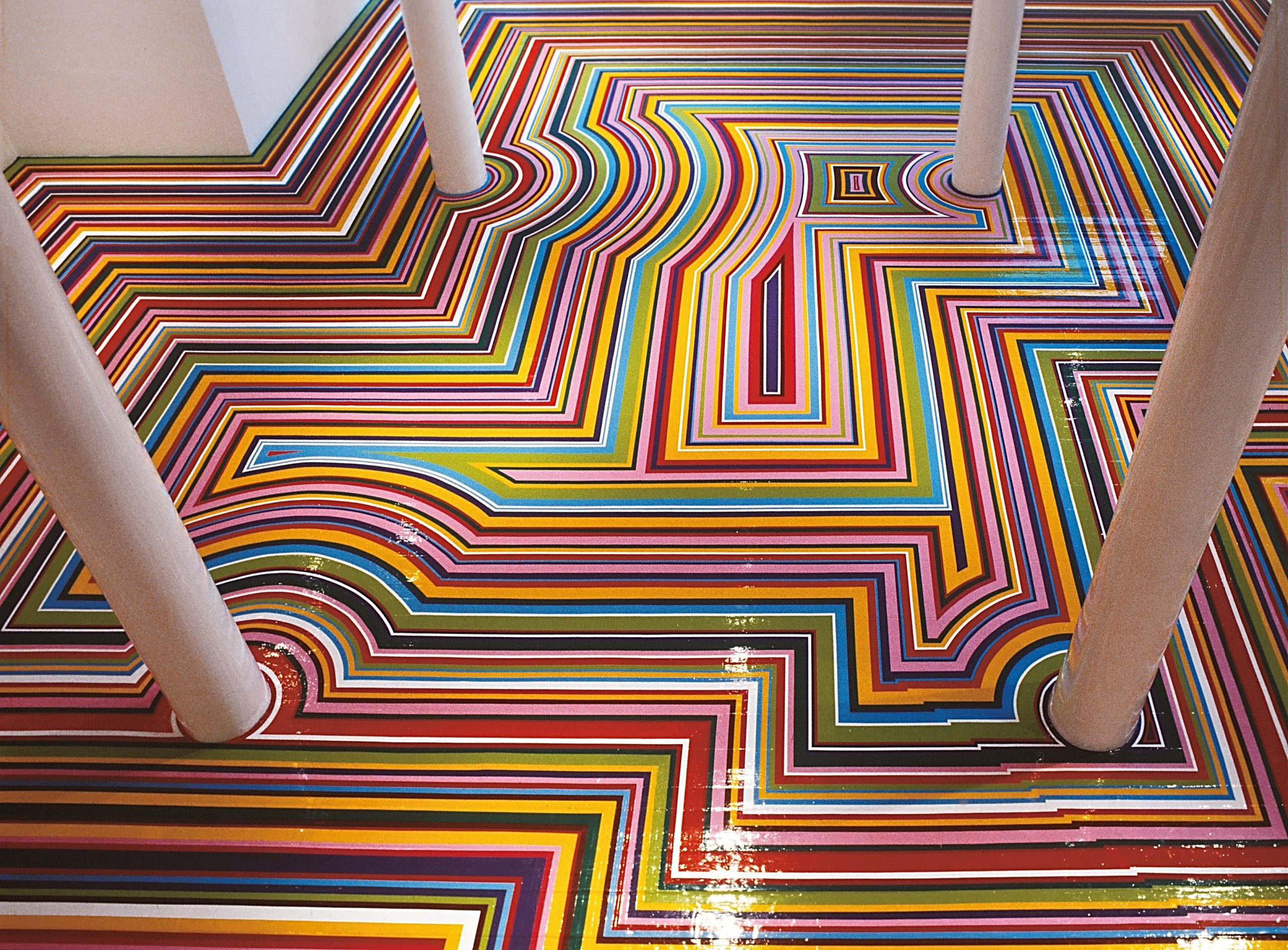
For most painters, tape has a prophylactic function. Stuck temporarily onto a canvas (or a doorframe, for that matter), tape protects what lies beneath or preserves the integrity of a newly painted edge or line. There are figurative muralists like the Tape Art duo Michael Townsend and Leah Smith; there have been moments in recent art history where tape has been greatly publicised, like Maurizio Cattelan’s Comedian, 2019—but these exceptions prove the rule. Tape is a painter’s tool—few have seen it as anything more.
For Jim Lambie, tape is a medium. After making works by resurfacing clothes with tape in the late nineties, Lambie created his initial Zobop installation on the floor of his first solo exhibition with Transmission Gallery, Glasgow, in 1999. In so doing, he created a singular system for engaging with exhibition spaces that he has continued to use, to great effect and acclaim, ever since. “Starting with a single strip of vinyl tape,” says Lambie, “I trace the architectural edge of the room, following each previous line until the work meets itself in the middle. People often see rhythm, colour, and the sense of industry involved. However, my initial concern was ‘how to fill a space and empty it at the same time.’ Once I imagined the whole surface of the floor as a site for that question, the sticky tape I had been using to knock together smaller sculptures suddenly became the vehicle.”
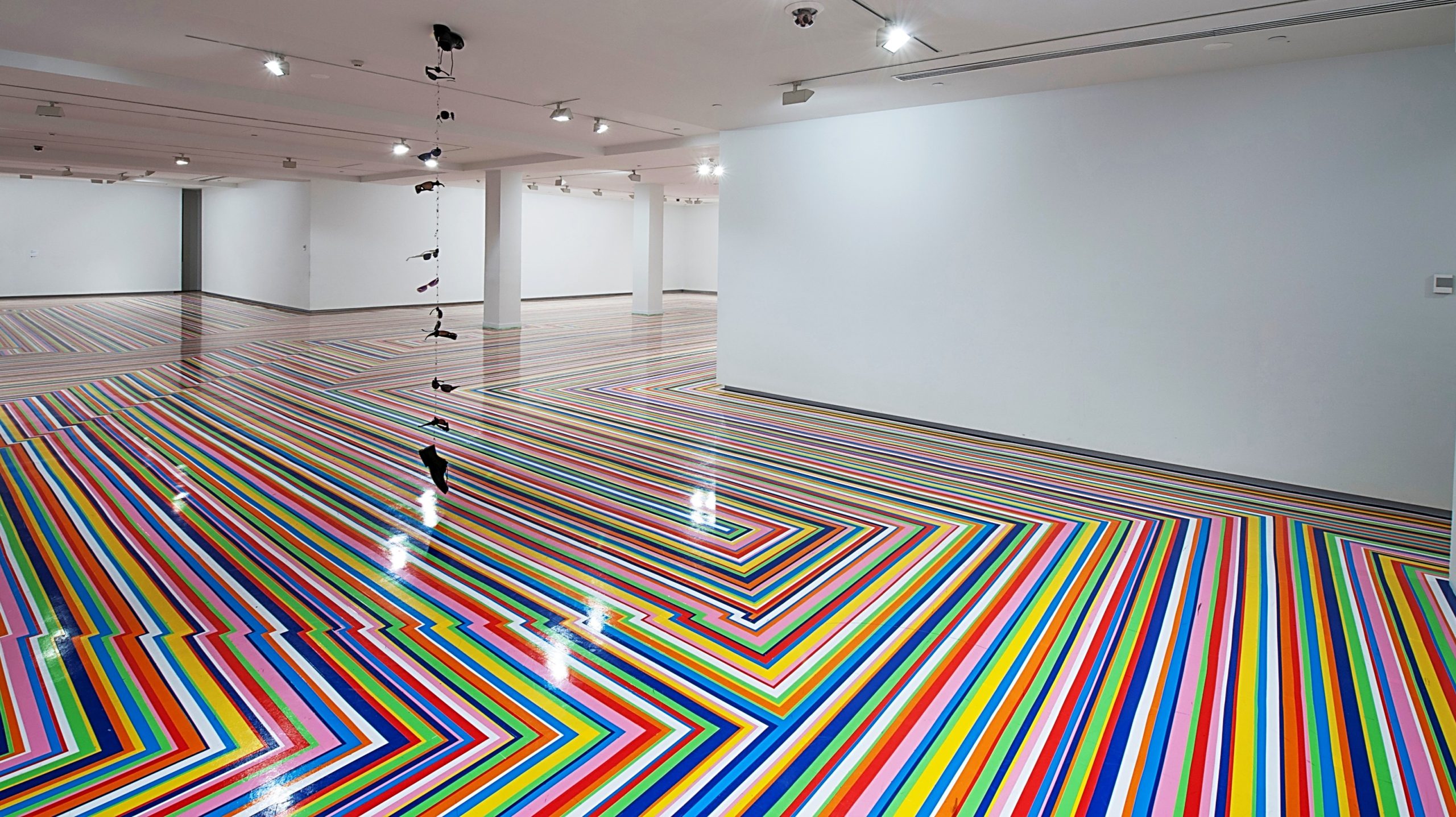
Installation view detail, Zobop, 2014, vinyl tape, dimensions variable, edition of 3 plus 1 artist’s proof. Exhibition, 19th Biennale of Sydney, Museum of Contemporary Art Australia, copy right the artist. Photographed by Sebastian Kriete.
Many artists consider the implications of the space in which their work is to appear, but few have intervened in these spaces as consistently as Lambie, and as much for its own sake. Each iteration of Zobop installed around the world is unique, driven by site-specificity and architectural idiosyncrasies—from the Palazzo Giustinian Lolin at the 50th Venice Biennale, 2003, to an upcoming solo presentation with Tate Britain in a deconsecrated church at Lake Como, Italy. The system recurs, as do the materials, but, above all, there is innovation at Lambie’s responsiveness to context and situation.
To empty a space by filling it—or filling it by emptying it—is a delightful paradox. The audience’s active participation in Lambie’s spaces adds to that delight: “It is always important that it functions as a floor, something people can walk on, with the scuff marks part of its life and interaction with the world. With the work fitted tightly to the architecture of the space and the rhythm of colour and lines, once folk walked across it and engaged with each other on top of it, it takes on another kind of energy within the room.”
I ask Lambie about the instructions that underpin each Zobop work, the extent to which the outcomes are prescribed or if chance is allowed to intercede. “There is a Sol LeWitt quote, ‘Let the system do the work.’ That’s pretty much the guide instruction for Zobop.” Just like LeWitt, Lambie brings into focus the role of the artist as director, as auteur. There is choreography within both their systems, the creation of set pieces that balance and benefit from the opposing effects of instruction and chance.
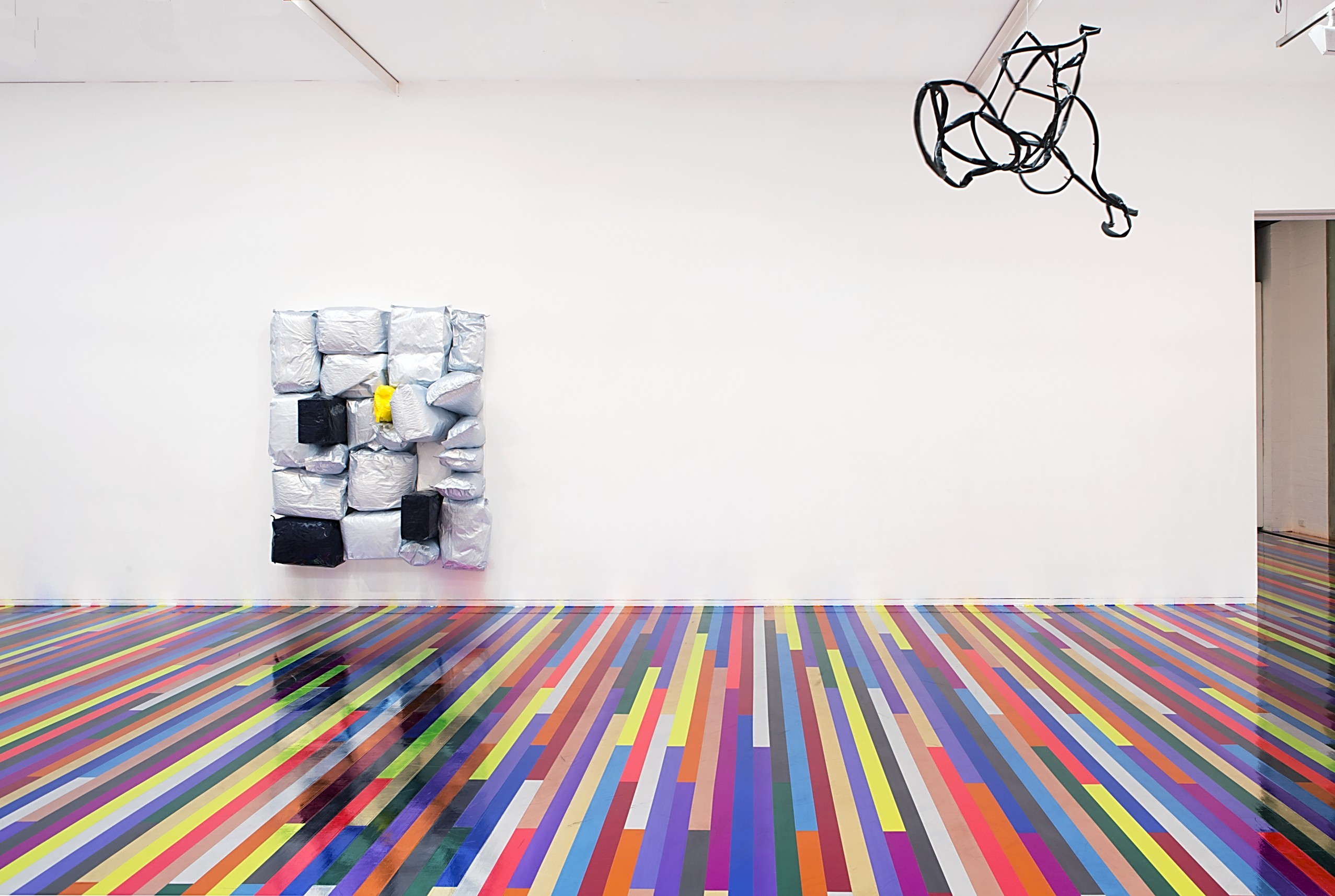
Installation view detail, Zero Concerto, 2015, Roslyn Oxley9 Gallery, Sydney, 2015. Photographed by Jessica Maurer.
One of Zobop’s gifts is its disarming and recontextualising function for a space—a literal foundation atop which the artist’s works within an exhibition are presented. Across Lambie’s career, his paintings and sculptures have invariably begun with found objects—including furniture, ladders, sunglasses, and vinyl records: “The work is continually being informed by everything from what I find in the city, at flea markets and in junk shops, urban observations and architectural features, to context, found text, and overheard conversations. The language of the city.”
It is a language in which Lambie is well-versed. Nearly three decades from his first solo exhibitions in Glasgow, Lambie continues to respond to sites around the globe, collecting and creating as he goes. While it may have begun from necessity, trawling for second-hand objects to use in sculptures while he was a battling art student, Lambie has continued to develop this practice of collection and creation to draw inspiration from the world around him: “I am always energised by material and the possibilities it opens up for new work. Even though the preparation and responsibilities grow around a show, I try to make at least one fresh piece in the week leading up to the show. Something which comes directly out of the local, of being there.”

Two Shirts, 1996, duct tape, aluminium foil, shirts, 34 x 62 x 8 cm (installed dimensions).
Having trained as a painter, Lambie’s reputation as a colourist precedes him. His use of colour over the years calls to mind Frank Stella’s famous comment, “Straight out of the can—it can’t get better than that.” In Australian terms, one thinks of the great colourist Michael Johnson and his ecstasy when applying colour straight from the tube. Lambie has used paint sprayed from a cannister or splashed from a tin across objects and installations—even Zobop’s colour is to a great extent prescribed by the availability of vinyl tape from commercial manufacturers. That purity of colour, along with the confinement to found objects that come to hand, is equivalent to a poet’s metre—a hemming in, so that one might have bounds from which to break free.
Lambie returns to Australia for his next exhibition at Roslyn Oxley9 Gallery, Sydney, in February 2026. It is a space he is familiar with, following well-received shows in 2015 and 2019, but it is also a space that continues to offer new opportunities for discovery: “When I did my first shows with the gallery, I never realised that it had these beautiful windows onto the greenery and trees tucked behind a couple of the gallery walls. Maybe I’ll open it up a little and let the outside in.” A variation on Zobop (Broadband) will “take the width of the vinyl tape from a single architectural reference within the space.” But he is still considering what that reference point may be. Once Zobop fills and empties the space, “there will be new resin paintings and also some sculptural moments.”
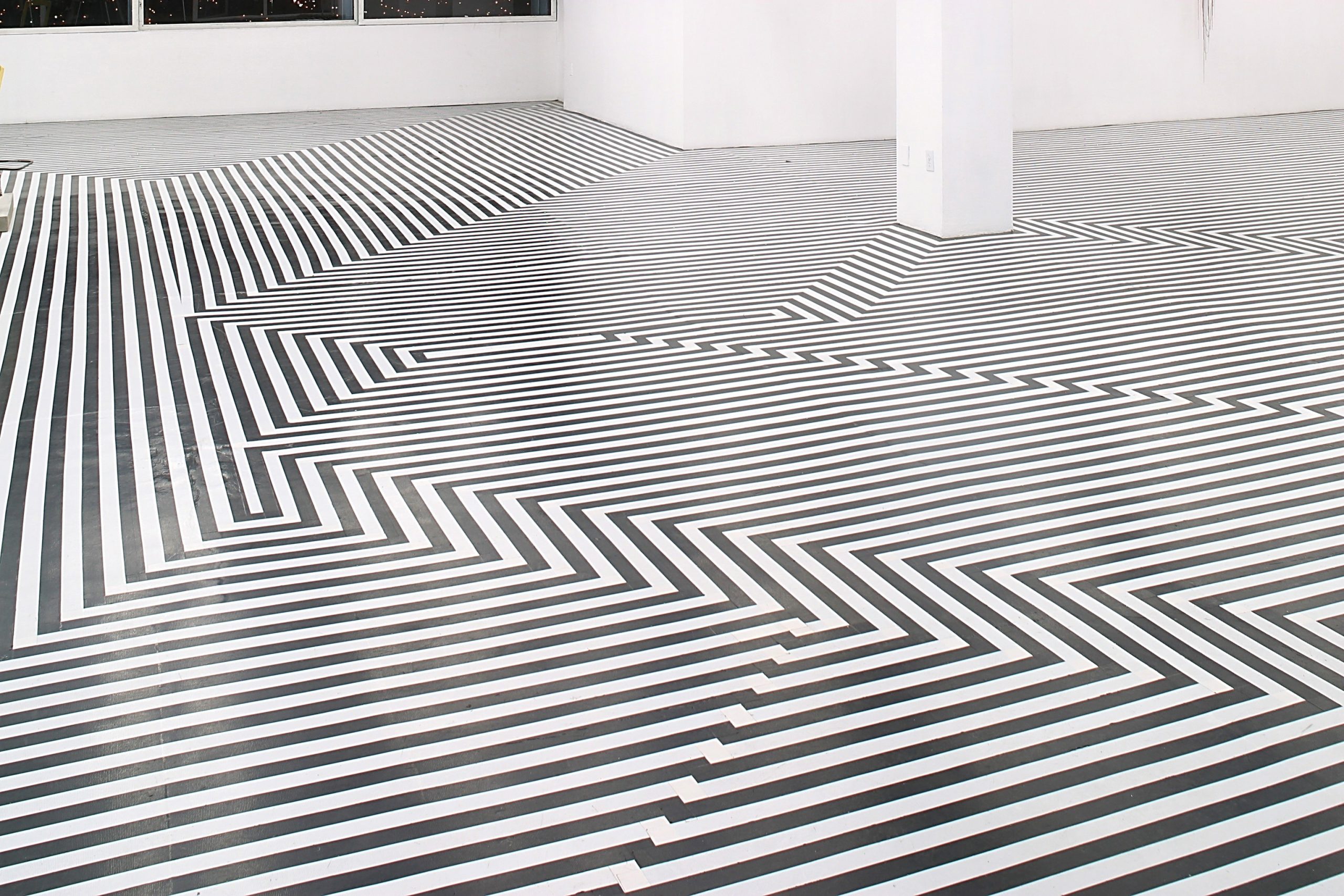
Installation view detail, Zobop Broadband (Black and White), 2003, black and white vinyl tape, dimensions variable, edition of 3 plus 1 artist’s proof. Exhibition, Grand Funk, OPA, Mexico, 2004.
The languages of cities and popular culture prime us to experience sensations that are universal, familiar, and celebratory of everyday life. Technologies, behaviours, and tastes change, but the simple pleasure and character of art made from objects has proved resilient. Lambie, for his part, remains convinced—not unlike Walter Benjamin, who contended with the effects of mechanical reproduction in the 1930s—that an artwork’s presence, and the audience’s presence with it, will endure: “It can feel like there’s a flattening out, driven by technology and scroll culture—however nothing can prepare you for standing in front of a work of art. Its presence. You can’t digitise its presence. If you want an immersive experience, stand in front of an 18 x 16 inch Vermeer for twenty minutes. It’ll blow your mind.”
EXHIBITIONS
Jim Lambie: Zobop (Colour-Chrome)
22 October 2025 – 12 October 2026
Vancouver Art Gallery, Vancouver
Jim Lambie
6 February – 7 March 2026
Roslyn Oxley9 Gallery, Sydney
Images courtesy of the artist and The Modern Institute / Toby Webster Ltd., Glasgow; Tokyo Opera City Art Gallery, Japan; Roslyn Oxley9 Gallery, Sydney; Museum of Contemporary Art Australia.
Jack Howard is a Sydney-based writer. He works for Parallax Legal and Annette Larking Fine Art.
This article was first published in Artist Profile Issue 73.
Deborah Halpern’s studio is engulfed with works in progress occasionally dispersed with other images and sculptures that illicit happiness. In the vast double window space,...
I recently left my home-studio on the Vaucluse clifftops in Sydney, with the whale and ocean views, and have set up a new studio in...
On a research trip to see the disused Mayday Hills Asylum, where Mike Parr will create his video projection on the exterior of the Birches...
The exhibition opens with paintings that place Done in conversation with some of the great names of art history. He has always been something of...
The art critic Harold Rosenberg (1906–78) asserted that “A painting that is an act is inseparable from the biography of the artist.” He continued, “The...

Museums and galleries often attempt to decolonise their collections and embrace diversity, equity and accessibility by ditching the elevated status of the artist. Yet artist...
Kaldor Public Art Project 38 is in the Naala Badu building (the term for “seeing waters” in the Gadigal language). Demand, as it happens, has...

Australia’s addiction to art prizes is difficult to comprehend. To the best of my knowledge, Australia has more art prizes per head of population than...

The measure of how much I enjoyed this book is that as I was reading it I was also compiling my list of Top Ten Books...