PROFILE I Stephen Lees: Art Historian in the Field
How does Stephen Lees reconcile his deep knowledge of art history with his desire to experience the Tasmanian landscape directly, transforming familiar coastal and alpine environments through a slow, layered approach to painting? Lucy Hawthorne visits Lees’s studio ahead of his solo exhibition Silent Conversations at Despard Gallery in Hobart.
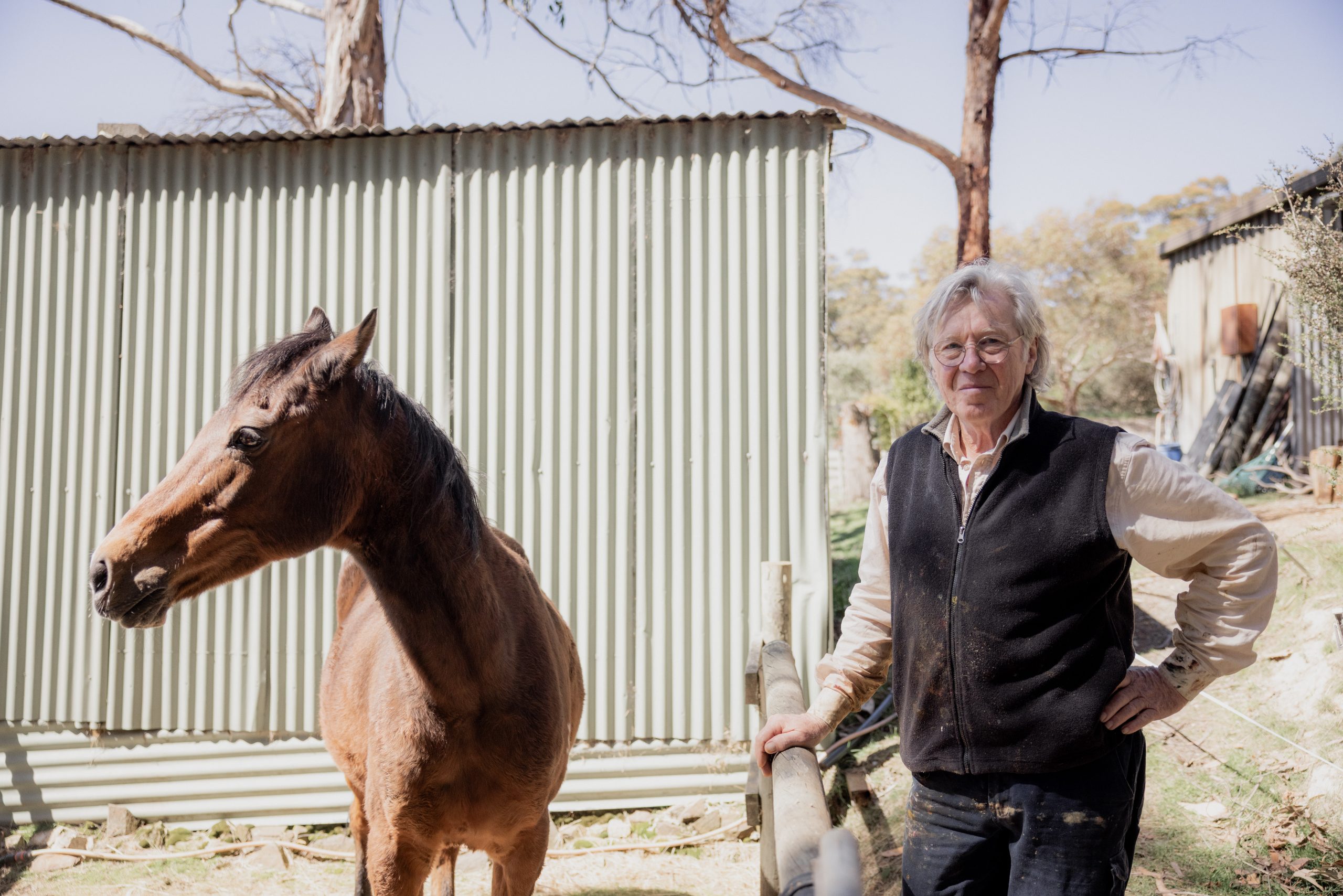
A horse greets me at the entrance to Stephen Lees’s home studio—a large shed in the semi-rural Leslie Vale in Tasmania’s south, overlooked by the dramatic Cathedral Rock. It’s an idyllic location for a landscape painter. However, the Sydney-born artist’s creative focus wasn’t always on nature. It was the inheritance of a small landscape easel in 1979 that initially drew Lees’ attention to the natural environment. With great reverence, Lees points to the French box easel once owned by his late uncle, describing it as “the crucial player in the whole thing.” “I immediately took it out to the Hawkesbury River,” he recalls, where he painted a section of recently burnt angophoras. In comparison to his experience making art in Sydney’s inner city, “it stripped away all the complication. It was so simple. I got great joy out of it.” Despite the revelation, the box would remain stored under his bed for nearly twenty years.
Growing up in Manly, on Sydney’s northern beaches, instilled in Lees a lasting appreciation for beaches, cliffs and the sea. As a lifelong painter, Stephen Lees recalls the challenge of attending the National Art School in the mid-1970s, a time when the dominance of painting in the Australian art scene was challenged by the rise of post-object art. While his fellow artists were experimenting with video art, installations and performance art, Lees felt “painting almost didn’t exist to institutions” at the time.
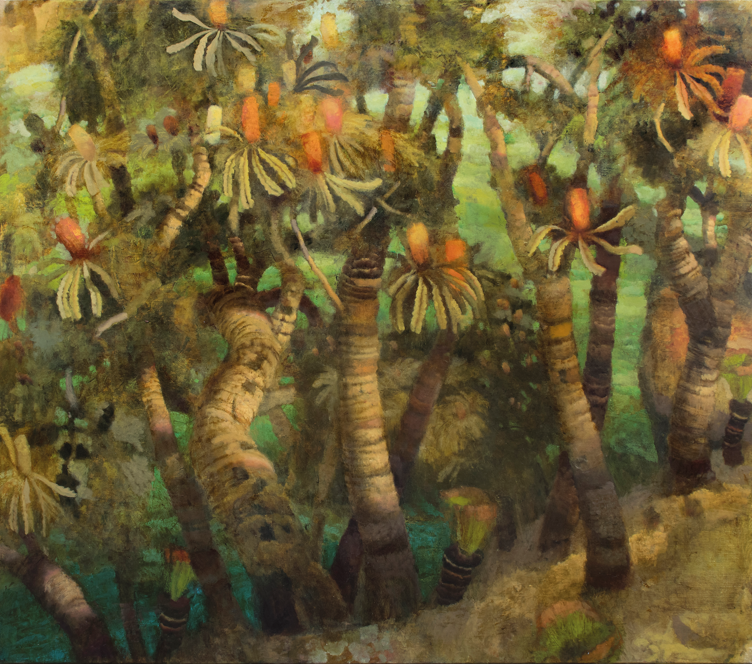
Myola Bank, 2026, oil paint, linen, 122 x 137 cm.
A friend’s slide collection initially lured Lees to Tasmania in the 1970s, establishing ties with the island state that eventually saw him enrol in the first studio art Master’s programme in 1982 at the then Tasmanian School of Art, where he also taught drawing and painting. Lees describes his work at the time as “more theoretical,” attempting to capture a sense of depth and movement through space. Initially inspired by his commute on Sydney’s railways, he soon grew frustrated with the project, pointing out, “of course, Tasmania has no [passenger] trains.”
Multiple sources describe Lees as a “painter’s painter” due to his focus on traditional painting techniques and deep love of art history. Recalling the period between art school and his 40s where he largely abandoned his art practice, Lees says, “because I chose not to engage in the commercial gallery world, I just did other things.” These “other things” included teaching, writing art reviews for the local newspaper, and working as designer and printmaker at the influential studio Redback Graphix. These experiences contributed to Lees’ rich art historical knowledge that informs his work today.
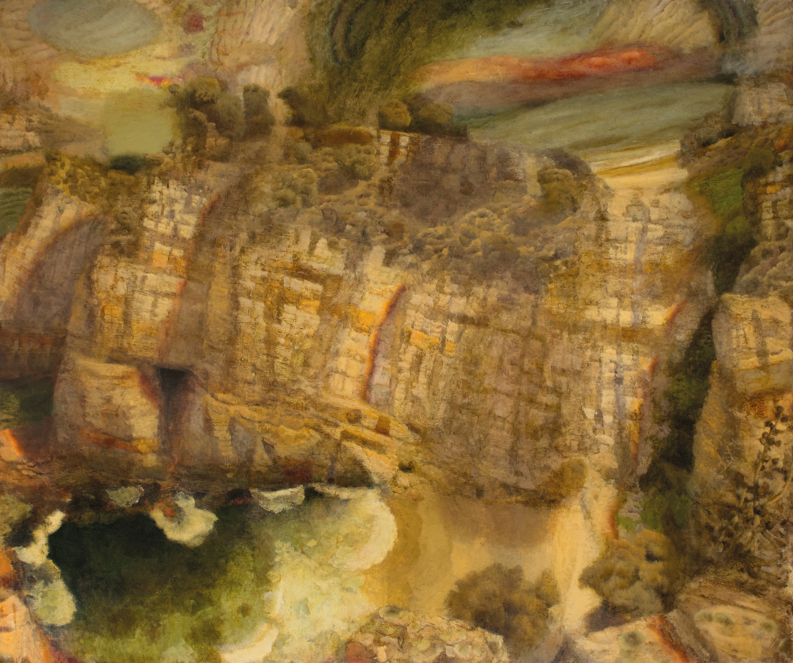
A Gnomon’s Tale – Goat Bluff, 2026, oil paint, linen, 152 x 183 cm.
When Lees and his beloved field easel permanently relocated to Tasmania in 1992 with the aim of painting landscapes, his first painting trip was to the harsh Central Plateau in the middle of winter. Far from being deterred by the conditions, he accepted a friend’s offer of a free basement room in Hobart and decided to make a living out of painting—a determination that ultimately established his artistic career.
Painting trips with other Tasmanian landscape artists would shape Lees work. Lees recalls the influence of rock climber and college art teacher Peter Jackson, who would lure him to cliff sites to paint, including Lees’s enduring favourite, Goat Bluff. “There’s a point where you can keep repeating the same subject and get somewhere,” he observes. In contrast to the dolerite that dominates Tasmania’s landscape, the sandstone cliffs of Goat Bluff are light in colour, reminiscent of the familiar Sydney sandstone of his childhood.
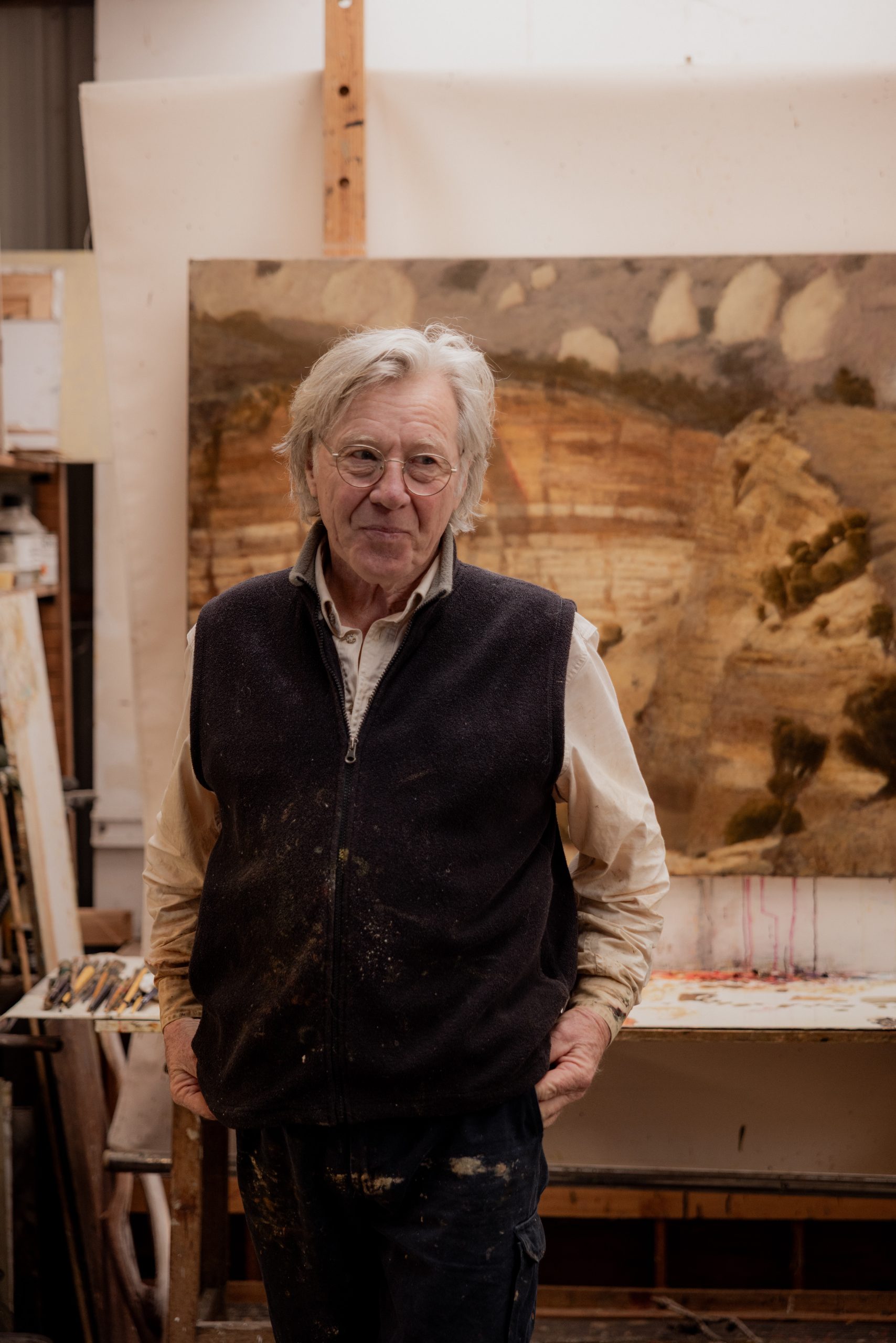
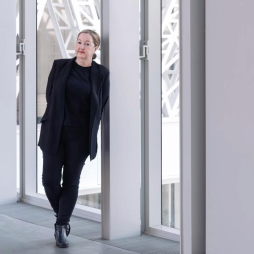
Portrait of Stephen Lees in his studio, 2026. Photographed by Rosie Hastie / Artist Profile.
Lees’s upcoming exhibition at Despard Gallery, Silent Conversations, features multiple depictions of the bluff. The distinct cave at sea level seems to be a constant across the various paintings, appearing as shadowy “void”—as Lees describes it—that adds mystery to his compositions. Like many of Lees’s studio paintings, A Gnomon’s Tale – Goat Bluff, 2026, started as a small plein air study. The alternating layers of transparent and opaque paint result in a soft, dreamy finish that changes with the ambient light, emphasising the weathered cliffs as they’re pounded by the southern waves and wind.
In addition to his favourite southern Tasmanian sites, Lees also enjoys the challenge of new locations, observing “a new space creates new problems.” The only alpine landscape in Lees’s upcoming exhibition at Despard, First Light – Cradle Valley, 2026, captures the magic of first light upon Tasmania’s high mountainscapes. Soft pink clouds are mirrored in alpine tarns, contrasting with the icy-looking pines in the foreground, their limbs spindly and gnarled. Curiously, Lees claims, “I’m not by nature romantic, I just enjoy using paint like that.” As he notes, there are “no virtuoso brush marks”, but rather the slow and careful construction of a picture, layer after layer. He comments, “I put them away, thinking they’re finished and then I see them again and realise they have a couple of days work still in them.”
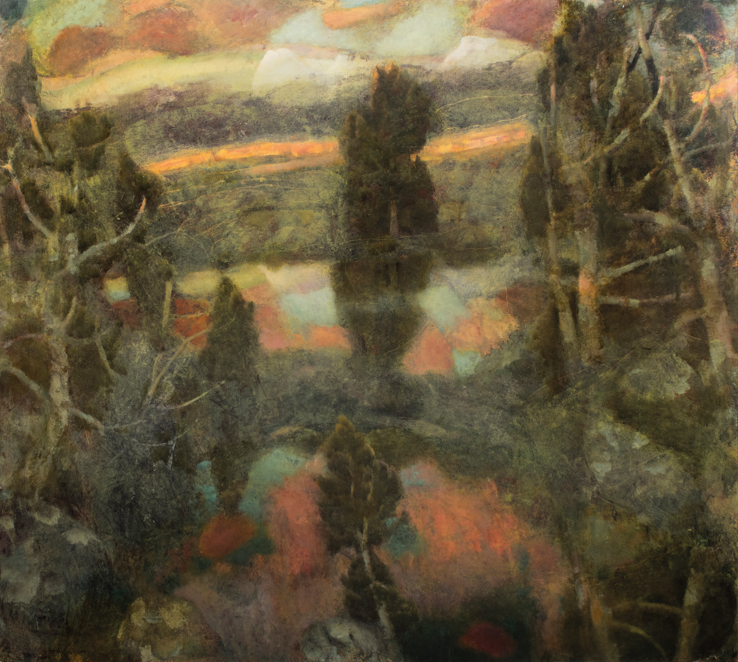
First Light – Cradle Valley, 2026, oil paint, linen, 137 x 152 cm.
Lees’s paintings have been recognised in multiple awards, with the artist winning the 2022 Bay of Fires Art Prize, as well. Seeking to counter the image of Tasmania sold to tourists of “lush green pastures,” Wishbone Ridge depicts trees contorted under fierce coastal winds. Steep cliffs plunge deep into a darkened sea. The perspective is warped, as if the rocky outcrop was captured from multiple viewpoints, more akin to mobile human vision than a camera lens. There’s a sense of drama, heightened by the touches of red in the sky and the almost flame-like leaves whipped by the weather.
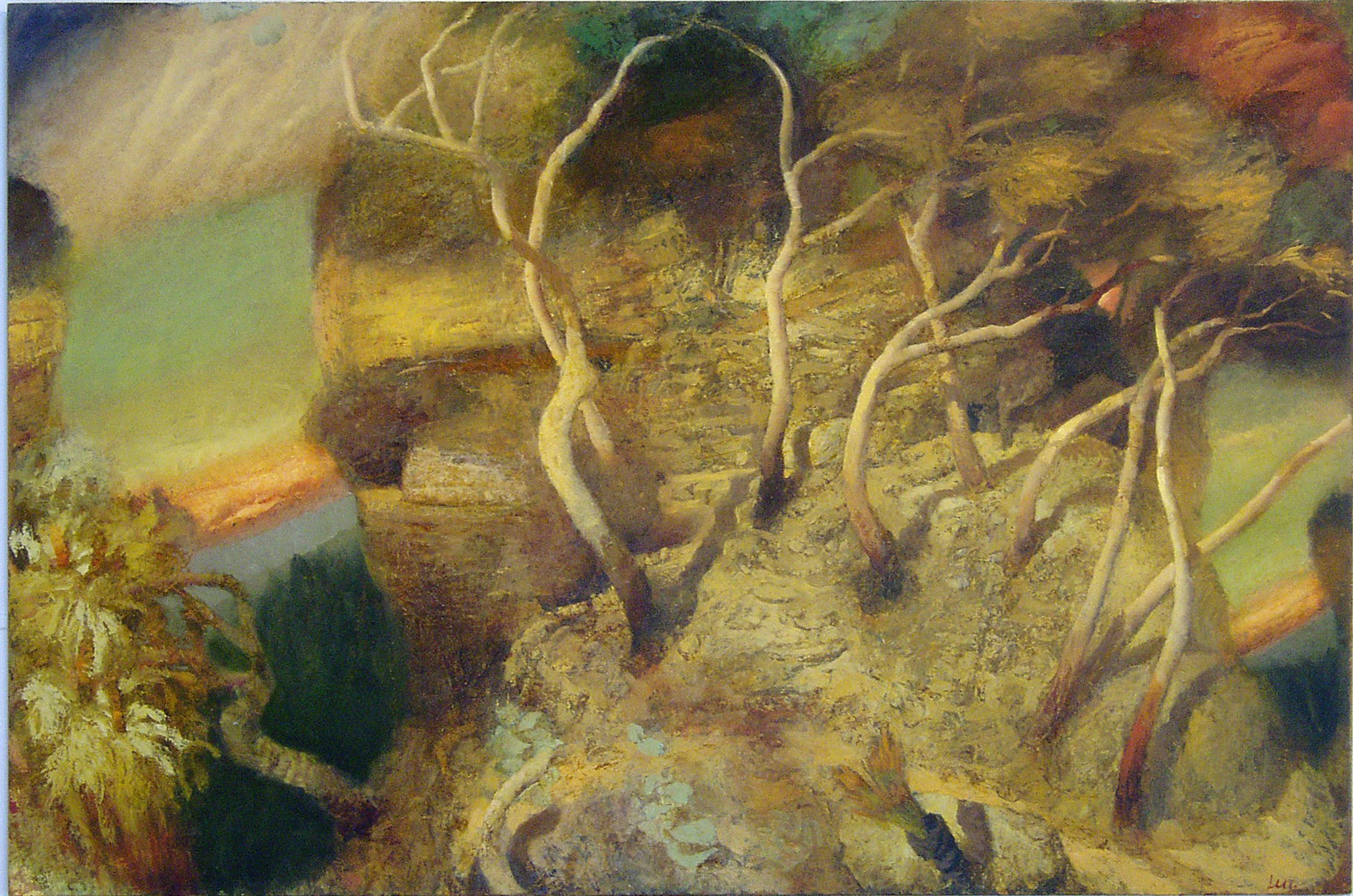
Wishbone Ridge, 2005, oil paint, board, 1220 x 180 cm.
Everybody’s Secret, 2026, depicts the entrance to Boronia Beach, a small cove near Lees’s home in Leslie Vale. He says, “I tend to select places that are out of the way” to avoid the public gaze while painting. “Feeling relaxed and calm” is crucial to his process, which for this work started with a small plein air study with relatively muted colours. The second iteration was painted in his studio, where the trees became more dynamic and patterned. Slightly larger, there are subtle shifts in perspective, almost as if the viewpoint is from the sea itself. By the third, scaled-up version, the scene becomes even more fantastical with rolling clouds that appear to glow, far from a literal representation of the environment.
Lees describes the struggle of the landscape painter, remarking, “at one level you want to engage with that place unmediated . . . but you bring the baggage of art history to [that scene].” At times in his career, he says, “I almost felt like I was an art historian that made pictures.”
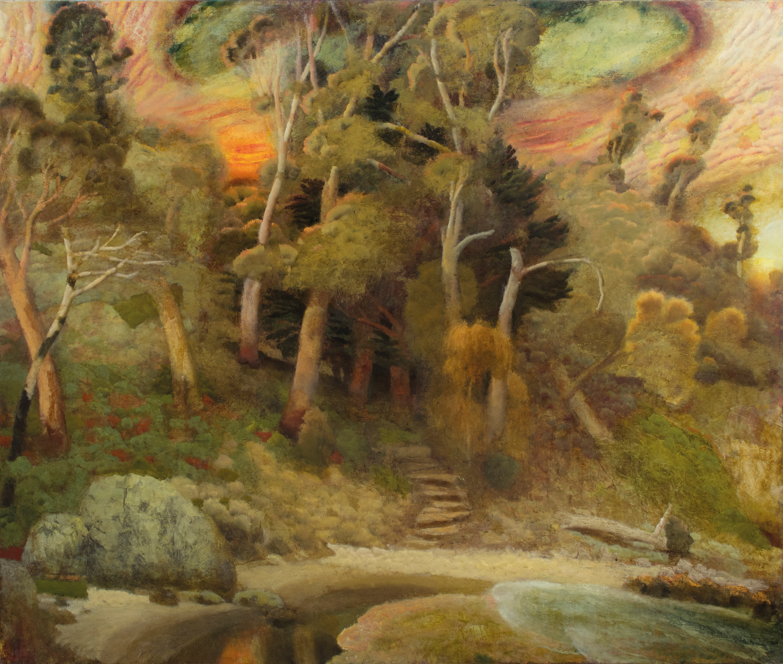
Everybody’s Secret, 2026, oil paint, linen 122 x 142 cm.
Exhibition
Silent Conversations
18 November – 12 December 2026
Despard Gallery, Hobart.
Dr Lucy Hawthorne is a Hobart-based arts writer, artist and librarian.
Images courtesy of the artist and Despard Gallery, Hobart
The article was first published in Artist Profile Issue 77, 2026.
Every decade has its art controversy and by the late 1990s the Museum of Contemporary Art (MCA) in Sydney was the big one, largely due...
Artist Profile is supporting Not AI’s to Take, a national campaign bringing together Australia’s leading arts and media organisations to protect Australian creativity. We believe...
Swain belongs to Kandos School of Cultural Adaptation (KSCA), the subject (and co-creator) of this touring exhibition curated by MAG&M’s Ben Rak and Katherine Roberts...
A Western tale is finished when a tired maxim has been wrung of life. So, let the grammar of what you do next convulse like...
The rise of China’s private museum sector emerged from a particular historical moment. Following the global financial crisis of 2008, sustained economic growth, rapid urbanisation...
This morning at 8.35 am, Elizabeth Ann Macgregor joined 702 ABC Radio’s Hamish Macdonald to discuss the ongoing controversy surrounding Lisa Havilah and the Powerhouse,...
Mona reveals itself slowly. Unlike classical museum architecture that conveys authority through monumental facades and grand, towering entranceways, visitors enter the Nonda Katsalidis-designed building through...
Tarr may not be a household name but he is an arthouse-hold name, known primarily for his mature, signature works as director—Damnation, 1987, Sátántangó, 1994,...
We call on the NSW Government to lift Lisa Havilah’s suspension and reinstate her as Chief Executive of Powerhouse, allowing her to lead the opening...