
Five Centuries of Melancholia
Five hundred years after the celebrated artist Albrecht Dürr produced his "Melencolia I" engraving, the historic work will be the centrepiece of an exhibition at The University of Queensland Art Museum.


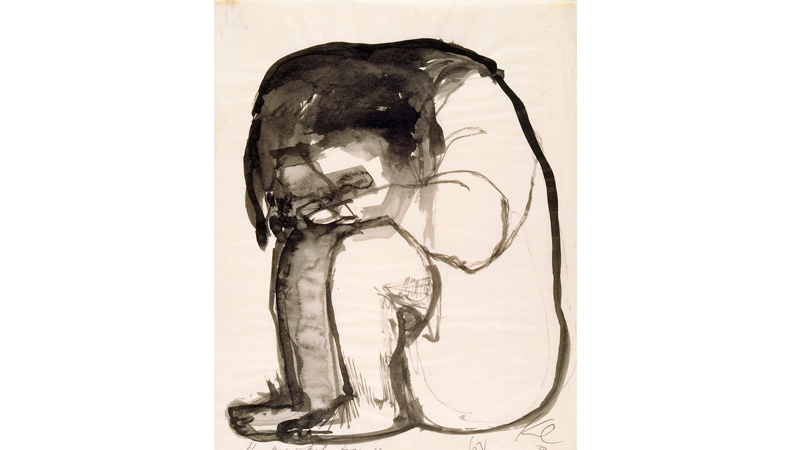
“Since the Renaissance, melancholy has been invoked as a condition, perspective, or mood, and inhabited figures, objects and landscapes,” said Dr Andrea Bubenik, an art history lecturer at UQ.
Dr Bubenik has curated the Five Centuries of Melancholia exhibition to be presented by the UQ Art Museum in partnership with the ARC Centre of Excellence for the History of Emotions (Europe 1100–1800).
She is a specialist in Northern Renaissance art and the art and science of Albrecht Dürer, and is an associate investigator with the Centre.
“I relish the opportunity to mark the 500th anniversary of one of the most enigmatic and written-about images in the history of art,” Dr Bubenik said.
“Understanding the ways historical images stake their claims in the present is an essential task for art historians and curators, museums and art galleries.
“This exhibition explores the iconic status and visual reception of Dürer’s engraving, as well as the idea of melancholia in and of itself.
“Artwork can easily and often fall into obscurity, yet Dürer’s engraving has had an impressive afterlife.
“As an art historian, I find it fascinating to trace the creative prominence and trajectory of melancholia through time and to discover the influence of Dürer’s engraving in artworks from the 16th century right up to the present day.”
Dr Bubenik said it was difficult to qualify a universal experience of melancholia.
“Its interpretation has shifted dramatically over time, and the modern tendency is to associate melancholy with depression,” she said.
“Melancholy hasn’t always been viewed as an affliction or stigmatised in the way depression sometimes is today.
“In fact, melancholy has a history of being interpreted positively by those who reflect and comment on the creative enterprise.
“This exhibition demonstrates that melancholy can be contemplative, self-reflective and a creative state, as well as a concept used to frame experience in a useful, and at times, very positive way.”
UQ Art Museum Director Dr Campbell Gray said the exhibition was a confluence of literary, visual, and psychological forms inspired by a scholar’s research on an evocative and intriguing subject.
“Dr Bubenik has brought her vision for this exhibition to life with great sensitivity, assembling a rich collection of work by international and Australian artists who have, over the past five centuries, responded to the melancholic state,” Dr Gray said.
“I’m deeply grateful for the partnership between the UQ Node, ARC Centre of Excellence for the History of Emotions (Europe 1100–1800) that has facilitated this project, resulting in an exhibition and associated publication, as well as lectures, symposia and other public programs.”
Five Centuries of Melancholia comprises 46 works by 33 artists drawn from national and state institutions, and regional, university and private collections. The exhibition runs from 30 August to 30 November 2014.
Click here for for more information
Source: UQ Media Release

The response to Artist Profile over time has shown that getting behind artists and their art matters to you as it does to us. To...
Remembering the incredible life of Charles Blackman OBE, who has passed away one week after his 90th birthday.
Congratulations to this year’s artists selected to take part in the 27th annual ‘Primavera: Young Australian Artists’ show at the Museum of Contemporary Art Australia...
Congratulations to Brook Andrew, who has been announced as the Artistic Director of the 22nd Biennale of Sydney, taking place in 2020.
Congratulations to Yvette Coppersmith, Yukultji Napangati and Kaylene Whiskey, who have been awarded the Archibald, Wynne and Sulman Prizes respectively.
‘JUST LET IT GO’ ASKS THIS ISSUE’S cover artist, Raquel Ormella, in the wonderful embroidery above. Like most of Ormella’s works it has a...
Emerging Melbourne photographer James Bugg takes home the $50,000 2018 Moran Contemporary Photographic Prize (MCPP).
Congratulations to Steve Lopes, who has won the 2018 Gallipoli Art Prize.
Applications for 2019 Bundanon Trust Artist-in-Residence program are now open.