Christopher Langton
Ahead of his current solo exhibition with Tolarno Galleries at Melbourne Art Fair, Christopher Langton wrote on his practice for Artist Profile 57. Here, the inter-media artist reflects on 3D printing, the eerie prescience of his recent bodies of work, virality, and painterly inflatables.

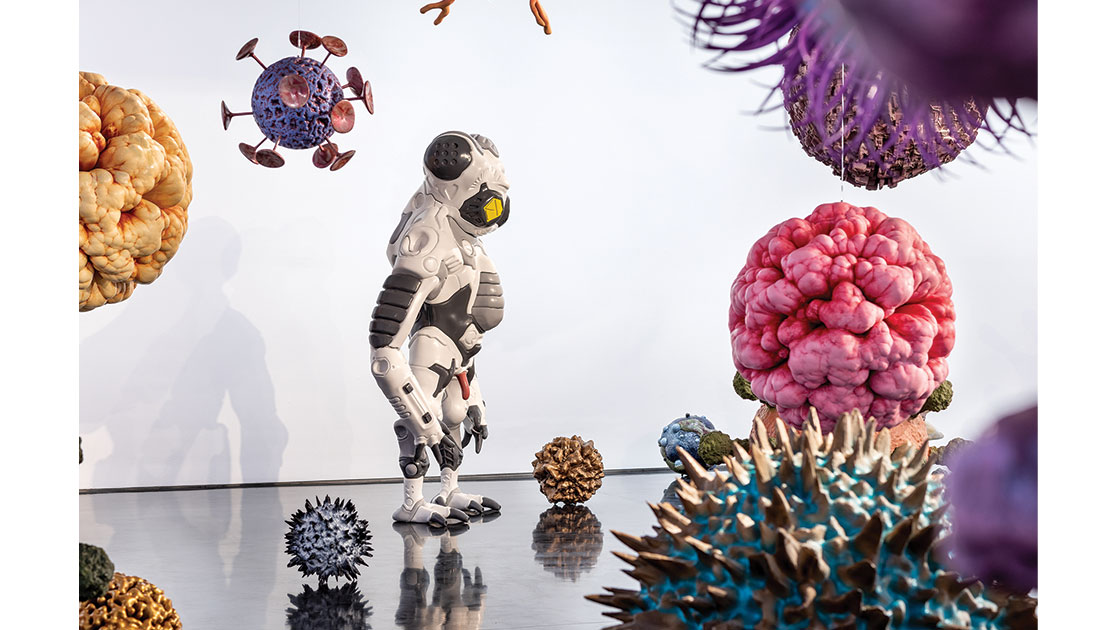
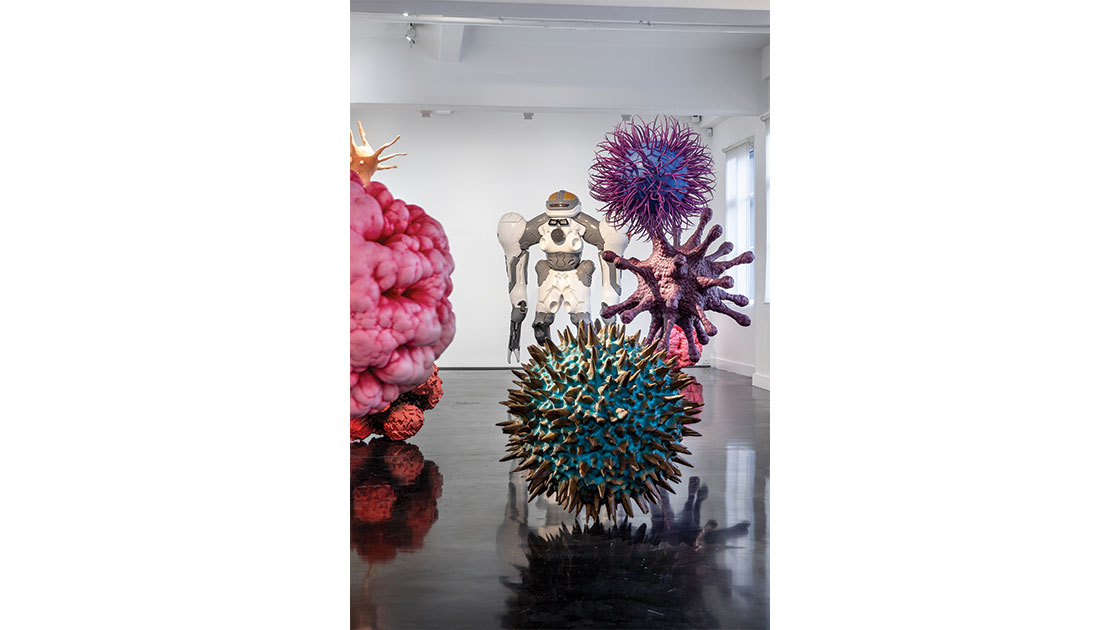
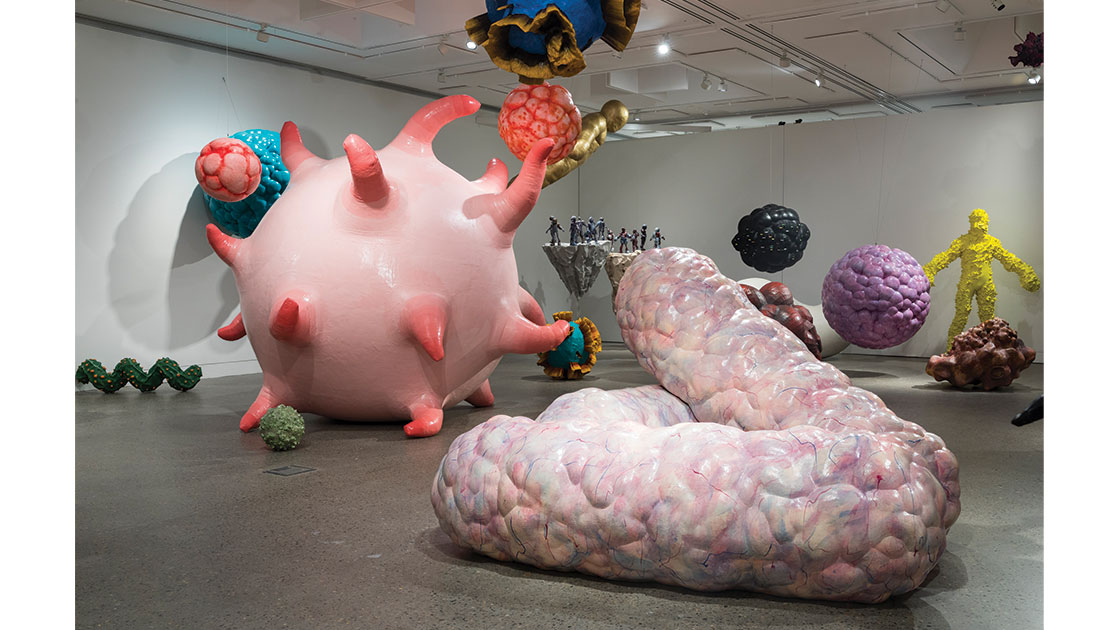
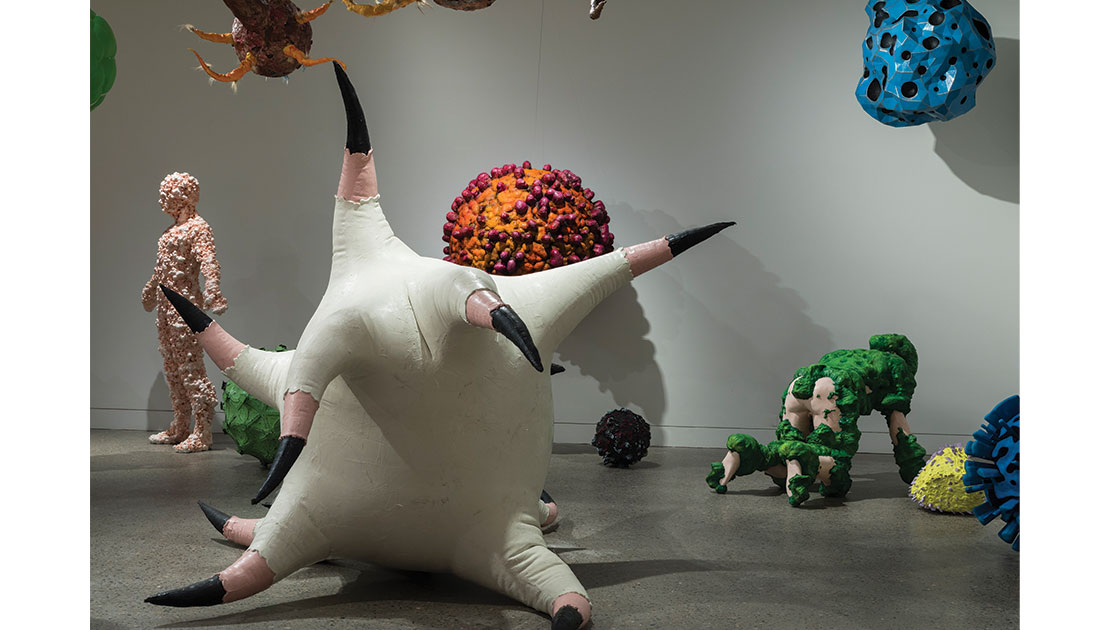
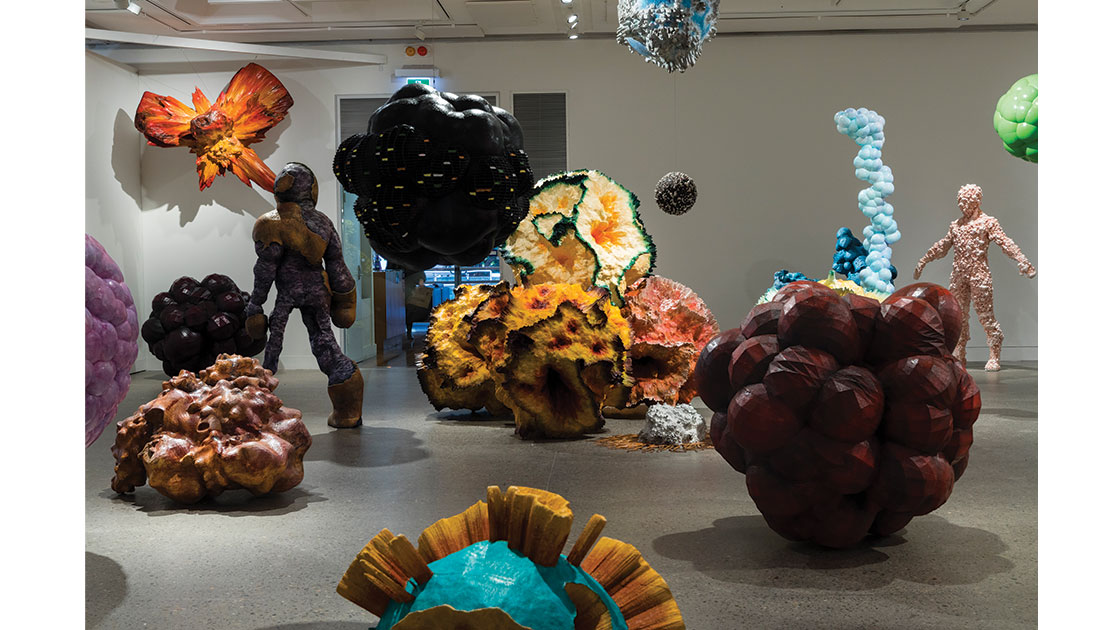
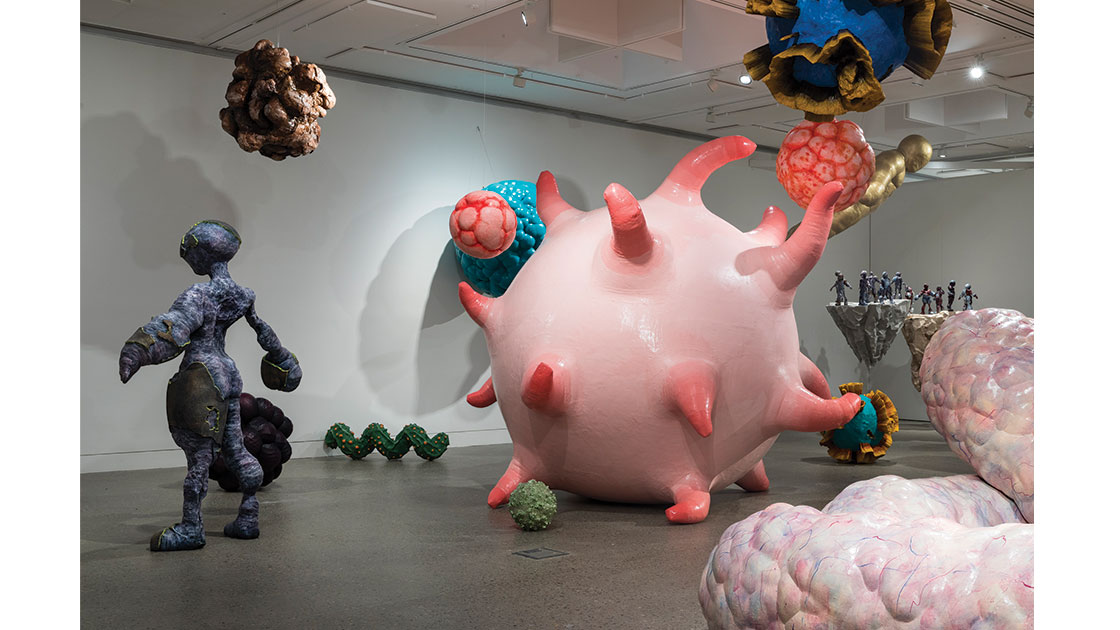
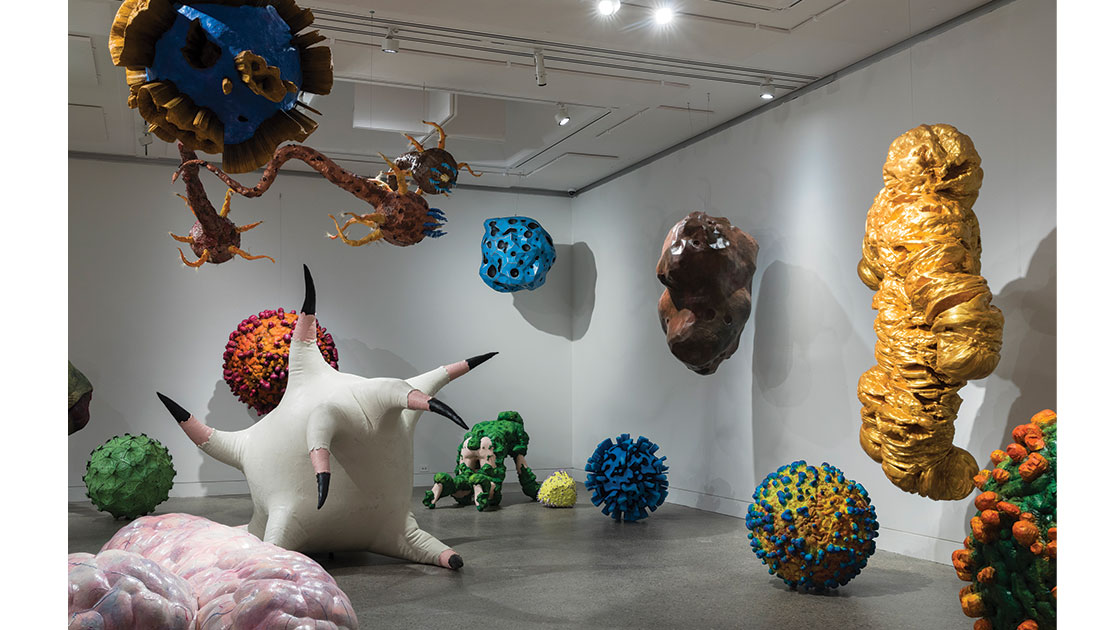
My recent exhibition, Colony, at Tolarno Galleries in August 2019, was a large-scale immersive installation that was conceived after a personal experience of a viral infection. However, throughout the pandemic it’s metastasised into something more universal. In the installation, two figures in white protective suits are surrounded by a legion of brightly coloured globular forms that fill the gallery space like an army of greatly expanded microorganisms, bacteria, viruses and fungi, along with scaled-down asteroids and space-junk forms. Some of these presences, which range in size from slightly larger than a soccer ball to well over human-scale, float in the air, while others perch or have landed on the ground. Their size, configuration, and bright colours make them seem kind of like cartoon sci-fi – which makes them strangely appealing – but there is also a sense of foreboding and dread in them coming together: a sense of something about to happen, and over which we have no control. Is this a peaceful coexistence?
The audience must adopt the role of an explorer to navigate the exhibition space, making their way carefully so that they don’t physically bump one of the forms and potentially risk “infection.” I like the fact that the installation places the audience on their guard, making it immediately apparent that they are the “outsider” in this colony and that the rules or protocols that govern it are not their own. I also like to think of the astronaut-like figures in the work as “aliens,” which highlights the fact that they, like us, are the newcomers to this world. This serves to position the work’s other forms as the original inhabitants, but inhabitants of where we’re just not sure. I recently read that less than half of our body’s cells are human; the rest are “microscopic colonists.” I think the very least we can do is acknowledge the majority cell count.
Colony was produced by printing segments of each form with a 3D printer that I designed and built. The printed sections were then manually joined together and hand painted over a two-year period. I like the tension this creates between the organic and the digital, and that the forms aren’t perfect.
The exhibition was well-received and I was fortunate that the entire installation was bought by an overseas collector. While Colony was on, I was also approached by Carrie Kibbler, a curator at Hazelhurst Regional Gallery and Arts Centre, who invited me to show the work there. Given the installation was no longer available, I offered to make a new work – Colonies, which was originally scheduled to open in August 2020, but was postponed until June 2021. It’s currently installed but was only open for one day before it was shut down due to COVID-19 restrictions in New South Wales. Hopefully it will re-open soon. The sense of menace has ramped up in this new work – the forms seem denser in Hazelhurst’s space, and the astronaut-like figures have been replaced by humanoid forms whose bodies are an unsettling amalgam of rock- and metal-like substances.
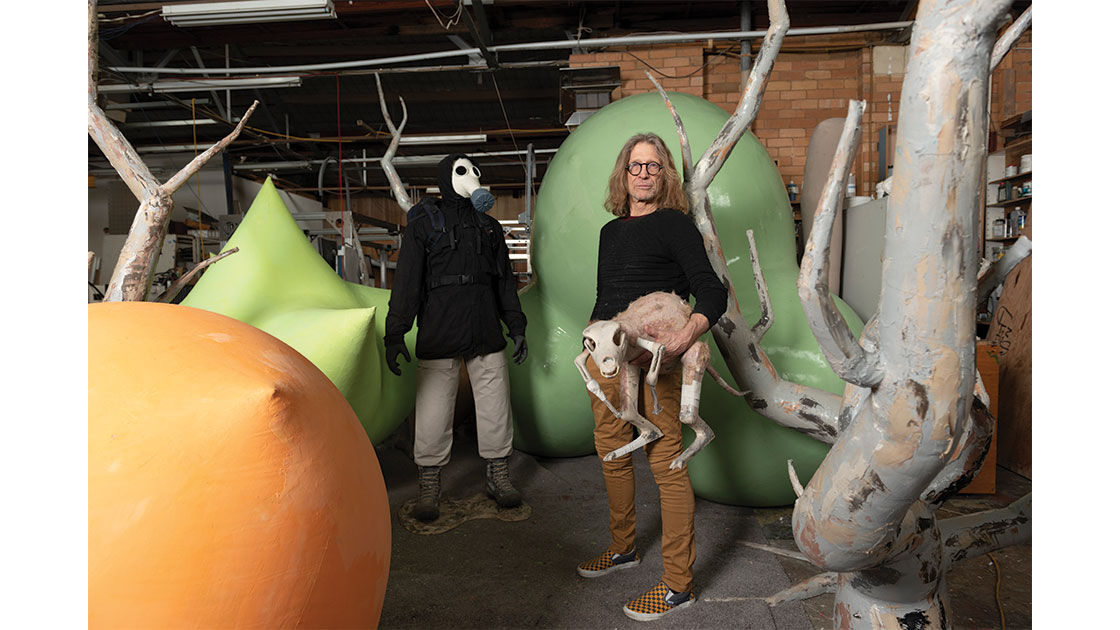
I have also recently been commissioned by National Exhibitions Touring Support Victoria to create a new work – Lost (working title), which coalesced last year as Melbourne slowly emerged from lockdown and we began to survey and traverse a very different world to the one that existed before. Our physical, social, political and economic landscapes have been inextricably altered; communities are polarised, and in many instances, the future seems uncertain. The question of the work could be “what now?”
One of the great things about this project is that it has enabled me to trial new mediums and techniques to build inflatables – a medium I am well-known for but haven’t worked with for some time. My experiments make me optimistic that I can make objects that, while retaining certain tropes of inflatables, can also incorporate features not normally associated with this type of object – forms that are painterly, and that have expressive surfaces or texture, hard edges or concave sections. The use of some or all of these features on an inflatable sculpture will hopefully create some confusion for the viewer as to whether the object is a blow-up or not. I am also experiencing more ease in attaching non-inflatable components seamlessly to the inflatable and have much greater control over the final form. In my experiments to date, the test pieces are much stronger and more durable than works I have previously made, and they can withstand more air pressure and do not have to be so voluminous to maintain rigidity. Importantly, as a result of trialling new methods, I have been able to introduce safer and more eco-friendly processes into my practice. All in all, it’s very exciting and I look forward to revealing this new work soon.
This essay was originally published in Artist Profile, Issue 57, 2021.
EXHIBITION
Bad Biology
17 – 20 February 2022
Tolarno Galleries, at Melbourne Art Fair, Melbourne

Carvings have been made for all time by Aurukun men. However, the more recent innovation to emerge from Aurukun are paintings. Vested in Country and...

A stone’s throw from the Illawarra escarpment at Campbelltown Arts Centre, the introduction to Draper’s ecosphere is a gathering of rainbow forms which, as an...

In 1991, Maurice and Katia Krafft died during the Mount Unzen eruption on Japan’s island of Kyushu. Herzog’s documentary does meditate on their deaths and...
Ruby Arrowsmith–Todd started attending the AGNSW film program in its early days as a self-educated, die-hard film fan, immersing herself in the cinematic sea of...
For most painters, tape has a prophylactic function. Stuck temporarily onto a canvas (or a doorframe, for that matter), tape protects what lies beneath or...
Deborah Halpern’s studio is engulfed with works in progress occasionally dispersed with other images and sculptures that illicit happiness. In the vast double window space,...
I recently left my home-studio on the Vaucluse clifftops in Sydney, with the whale and ocean views, and have set up a new studio in...
On a research trip to see the disused Mayday Hills Asylum, where Mike Parr will create his video projection on the exterior of the Birches...
The exhibition opens with paintings that place Done in conversation with some of the great names of art history. He has always been something of...